Hello, this is Ryuta Hamamoto from TIMEWELL.
On November 25, 2026, the US Federal Communications Commission (the FCC, the independent agency that licenses radio spectrum and satellite communications in the US) gave SpaceX permission to launch and operate up to 1 million "data centers in space"1. The satellites are called Starmind. In its announcement, the FCC said this is the first authorization of a space-based data center constellation in US history2.
The 1 million figure grabs the headlines, but what caught my eye was something else. The authorization covers spectrum and orbits, and nothing more. Whether the computers will perform, or whether the business will ever pay off, sits outside the review. And launching a computer into space is not, by itself, an "export" under US export controls. So how do computers in orbit connect to the web of rules the US has built around data centers on the ground? That is the question I start from here.
Who this is for: companies planning how to procure or run AI compute and data centers; manufacturers supplying satellite and space-grade parts and materials to space companies abroad; companies using cloud compute overseas; and export control and economic security teams.
In one sentence: ground-based data centers are running short of power and land, and a plan to line up computers in space, where the sunlight barely stops, has received a time-limited go-ahead from the US regulator to use spectrum and orbits.
Why now: the authorization comes with a condition that voids it unless the first satellite is operating by November 25, 20331. Six days earlier, on November 19, a US rule took effect that extends export controls to renting out data center computing power3. Whether computers in orbit fall inside that net is a new question.
Five terms are worth pinning down first.
| Term | In plain words |
|---|---|
| Orbital data center | A satellite carrying AI or other computers. It computes in orbit and sends the results to the ground |
| Sun-synchronous orbit (dawn-dusk) | An orbit that keeps riding above the line between day and night on Earth, so it is almost always in sunlight |
| Optical inter-satellite link | Laser links between satellites. They do not use radio spectrum |
| EAR and ITAR | US export control regulations. The EAR covers commercial and dual-use items; the ITAR covers weapons and military items |
| D:5 | A US country group under arms embargo. It includes China |
The short version
- What the FCC approved is how SpaceX may use backup spectrum and orbits. It declined to judge computer performance or business viability, calling them outside its authority1.
- 2033 is the deadline for the first satellite. The heavier deadline comes two years later: 100,000 satellites.
- In space, the same solar panel produces about 5.6 times as much electricity per year as the US ground average, and roughly 7x to 8x ground solar in Japan (our estimate, an order-of-magnitude guide). But heat can only leave by radiation, and cooling is one of the hardest problems in space.
- SpaceX is, for now, the only company that runs reusable rockets, mass satellite production and an in-orbit optical network in-house and already at scale. Even so, there are several competitors, and others got computing running in orbit first.
- Under US rules, a launch is not an "export." How the November 19 remote access rule applies to computers in orbit has no official answer yet.
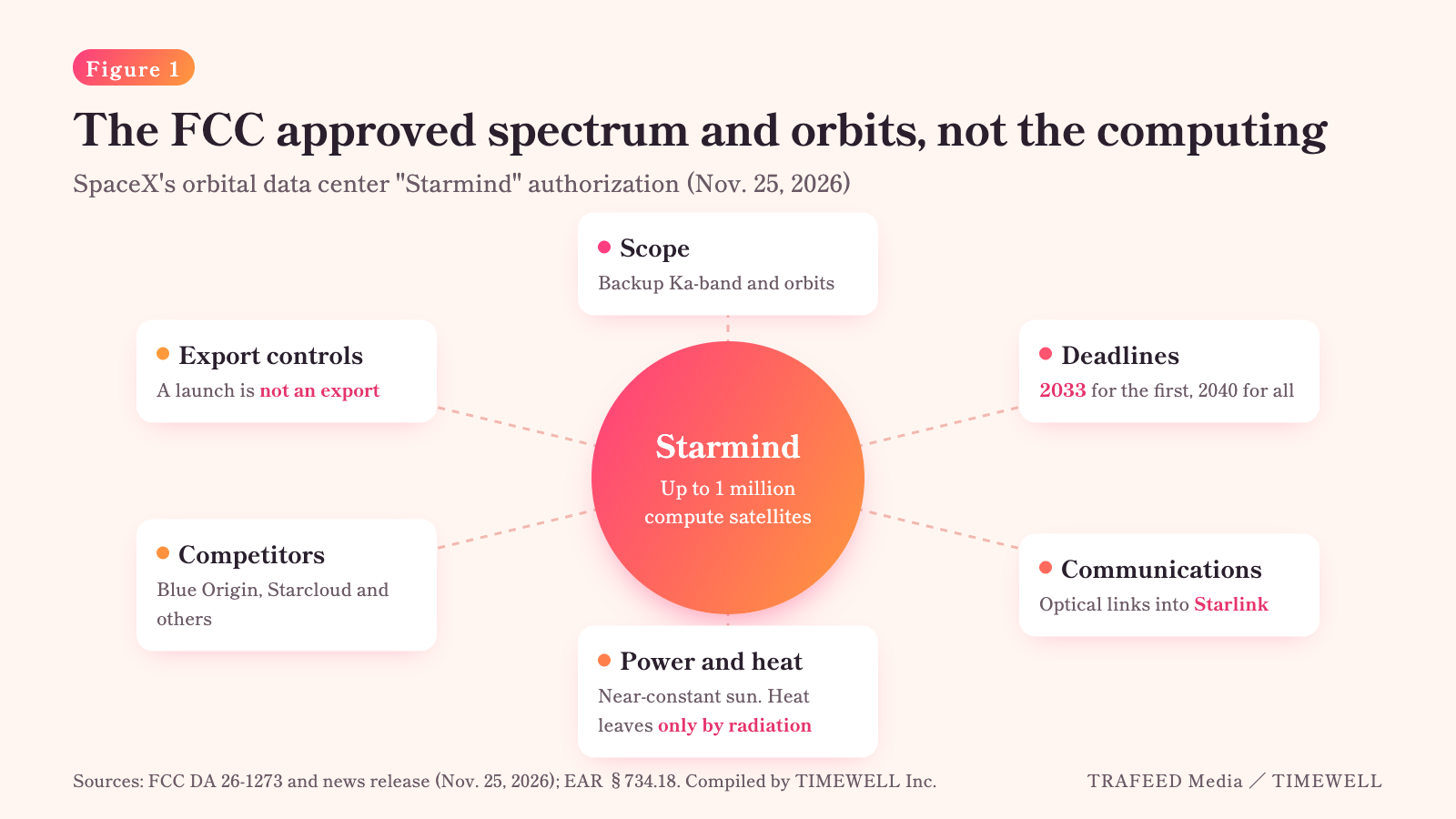 Figure 1. The Starmind authorization at a glance. Read it from Starmind in the center out to the six points around it; each point maps to a section of this article. Sources: FCC DA 26-1273; FCC news release (Nov. 25, 2026); EAR §734.18
What the FCC approved, and what it did not
The point of this section: the FCC's authorization is a radio license, not an approval of an orbital data center business. The deadlines look strict, but the first step is set a long way out.
The order is DA 26-1273, issued by the chief of the FCC's Space Bureau under delegated authority1. The commissioners did not vote on it. The licensee is Space Exploration Holdings, a SpaceX group company, and the order's conclusion grants the application in part and defers it in part, subject to conditions. SpaceX filed on January 30, 2026, and the FCC gave public notice on February 4 that it had accepted the application for filing4. The original plan used altitudes of 500 to 2,000 km. A letter in May narrowed that to 500 to 1,002 km, split into six shells (layers of satellites placed in the same altitude band)1.
Concretely, SpaceX may use Ka-band spectrum (18.8 to 19.3 GHz and 28.6 to 29.1 GHz) only for backup and emergency tracking, telemetry and command (TT&C: the links that measure a satellite's position and send it instructions from the ground)1. Even that is on a non-interference, unprotected basis. Starmind must not cause interference to other stations, and it gets no protection from interference itself. SpaceX told the FCC that day-to-day traffic will run over optical inter-satellite links into its Starlink network, and that radio is only for when the optical links fail5.
What I want to highlight is the line the FCC drew around itself. The order set aside comments about whether the project is feasible, how the heat will be handled, or whether it is less efficient than building on the ground, as having little to do with the authority Congress gave the FCC (regulating radio communications). In the order's own words: "In many cases, the comments seek to substitute the government's judgment regarding the viability of business endeavors for that of the applicant and private enterprise. We decline to do so."1 The American Astronomical Society (AAS) argued that the sheer volume of waste heat would brighten the infrared sky and interfere with observations. The FCC did not rule on that either, treating it as a non-radio effect. Petitions against the application from Amazon's satellite business (Kuiper), Viasat and the AAS were all denied.
Think of it as a building project. What the FCC issued is permission to use radios, plus an assigned lot to build on. It is not a review of what equipment goes inside the building, or of whether tenants will show up. The authorization tells you nothing about whether orbital data centers work technically or commercially.
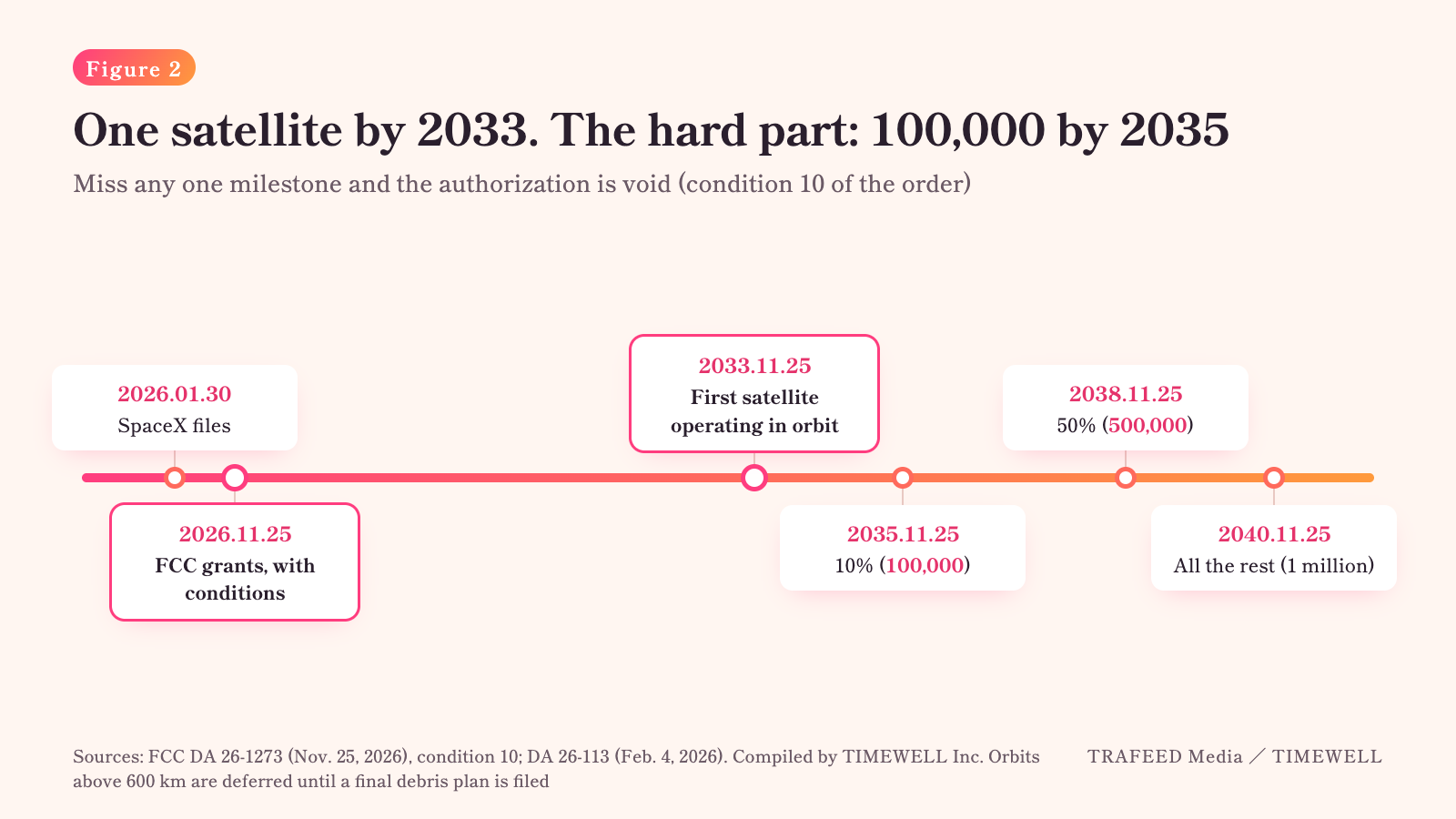 Figure 2. The authorization's deadlines. Read it left to right, and notice the roughly seven years between the two highlighted markers (the authorization date and the first-satellite deadline). Sources: FCC DA 26-1273 (condition 10); DA 26-113
The deadlines are in condition 10 of the order1. SpaceX must have the first satellite operating in its authorized orbit by November 25, 2033; deploy 10% of the authorized total (100,000 satellites) by November 25, 2035; 50% (500,000) by November 25, 2038; and the rest by November 25, 2040. Miss any one of them and the authorization becomes "null and void." SpaceX originally asked to be exempted from the milestone requirement altogether, but withdrew that request in an October letter and asked instead for the new milestone rules the FCC adopted in July. The surety bond requirement (money posted with the government as security for meeting the milestones) was waived. Shells above 600 km cannot be deployed until SpaceX files a final orbital debris (space junk) mitigation plan in a modification application.
Reading this as "SpaceX must build at scale by 2033" would be a mistake. What 2033 asks for is the first satellite. In its investor materials, SpaceX expects to begin deploying compute satellites "as early as 2028"6, so the first deadline leaves room to spare. The hard one is likely 100,000 satellites by 2035. SpaceX has told the FCC that each satellite will weigh under 4,000 kg5, so at the upper limit 100,000 satellites come to as much as 400,000 tonnes. The same investor materials put the total mass SpaceX had carried to orbit through the end of March 2026 at about 7,400 tonnes6. Meeting the 2035 deadline at maximum mass would mean hauling more than 50 times everything SpaceX has ever launched, in nine years.
Replace siloed classification work with AI.
METI's FY2024 data shows 52% of foreign exchange law violations stem from classification errors. Download the TRAFEED product catalog covering features and rollout.
Why put computing in space: swapping constraints, and the scale of solar power
The point of this section: an orbital data center is a bet that swaps the constraints of the ground for a different set of constraints in space. Land and power get much easier. Cooling gets harder.
It starts with power. The US AI Action Plan (July 2025) says "AI is the first digital service in modern life that challenges America to build vastly greater energy generation than we have today," and pushes to build out data centers, power plants and the grid7. SpaceX, in its investor materials, says AI's power demand is "already imposing unsustainable strains on terrestrial power grids" and calls AI computing in space "the only truly scalable solution to terrestrial energy constraints in the age of AI"6. When Elon Musk announced in February that xAI would be merged into SpaceX, he reportedly wrote, "My estimate is that within two to three years, the lowest cost way to generate AI compute will be in space"8.
If you rebuild Musk's argument from first principles (setting assumptions aside and reasoning up from physical facts), it runs in three steps. One: on the ground, securing power and land will cap AI's growth. Two: so put the computers somewhere with fewer constraints. Three: in space the sunlight barely stops and you need neither land nor a grid, so the main constraint becomes launch cost, and if reusable rockets bring that cost down, the numbers work. That is his logic. It is, of course, the operator's claim, not a demonstrated fact. SpaceX itself calls the assumptions behind the investment "speculative" in the same materials6.
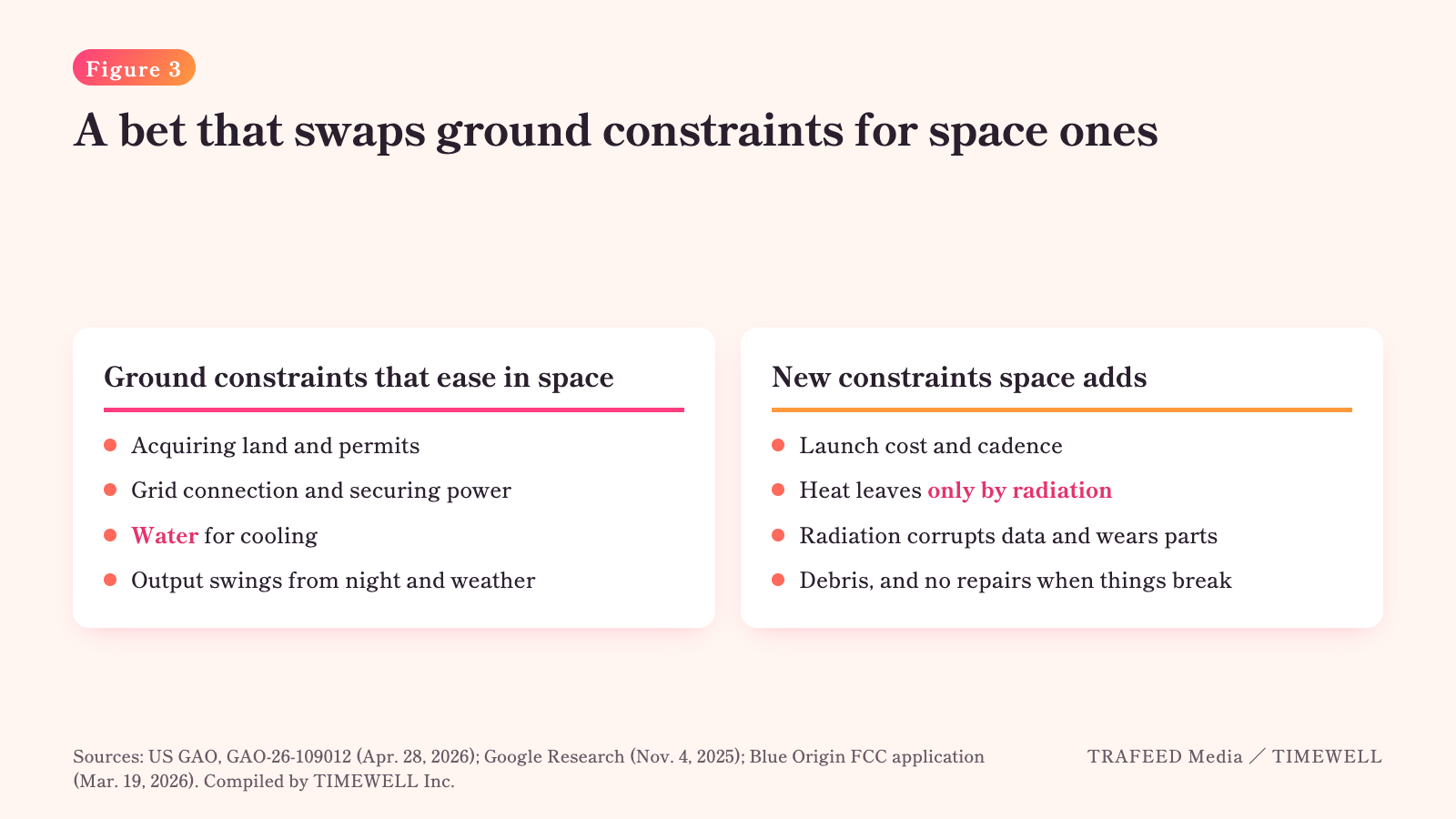 Figure 3. Ground versus space constraints. The four on the left ease in space; the four on the right are new in space. Sources: GAO-26-109012; Google Research; Blue Origin's FCC application
On land and power, space really does have the edge. In its FCC application, Blue Origin writes that a sun-synchronous orbit offers near-constant sunlight, lets computing run without drawing on terrestrial power grids or water, and avoids the cost of acquiring land or relocating residents9. The FCC, for its part, did not require an environmental review under NEPA, on the grounds that space activities take place outside US territory1.
Cooling is the opposite story. Ground data centers carry heat away with air or water. Space has no air. The only way to get rid of heat is to radiate it as infrared from panels called radiators. Radiated heat scales with the fourth power of temperature (P = εσT⁴, where σ is the Stefan-Boltzmann constant, 5.67×10⁻⁸ W/m²K⁴10). The cooler you want to keep the chips, the bigger the radiators have to be. The US Government Accountability Office (GAO) wrote in an April 2026 report that "Data centers generate excess heat, but space does not cool computing hardware efficiently."11 Google also acknowledges that "significant engineering challenges remain, such as thermal management"12. No water needed, but heat rejection becomes the biggest challenge. That is the accurate way to put it.
Space brings its own constraints on top of that: launch cost; radiation that corrupts data and wears out parts (GAO: "Space radiation can corrupt data unpredictably and degrade hardware."11); debris; and the fact that nobody can go up and fix things when they break. In a ground data center, a technician can swap a failed GPU the same day. In orbit, that is not an option. So I see an orbital data center as a bet that trades three ground constraints (land, the grid and water) for four space constraints (launch, heat rejection, radiation, and debris plus maintenance).
What grows is the yearly output, not the efficiency
You sometimes hear that solar panels are "several times more efficient" in space. That is not quite right. For the same panel, the share of light it turns into electricity (its conversion efficiency) barely changes. What changes is how much electricity the panel produces over a year. There are two reasons. With no atmosphere in the way, the light arriving is stronger. And in a dawn-dusk sun-synchronous orbit there is no night and no cloud, so the panel sees light nearly all day.
Let me check that with a Fermi estimate (multiplying the numbers on hand to get the order of magnitude). The intensity of sunlight at Earth's orbit, the solar constant, is 1,361 W/m²13. Ground solar panels are rated under 1,000 W/m² of light14. The capacity factor, the share of the year a plant effectively runs at its rated output, was 24.0% for US utility-scale solar in 202515. For Japan, materials for the power generation cost review by a METI advisory council (the Advisory Committee for Natural Resources and Energy) give a median of 18.3% for commercial-scale systems (50 kW and up) installed in 2022, and 15.8% for residential systems (under 10 kW)16. Night, rain and the angle of the sun are all already baked into the capacity factor.
| Item | Space (sun-synchronous orbit) | US utility-scale solar | Japan, commercial-scale | Japan, residential |
|---|---|---|---|---|
| Light reaching the panel | 1,361 W/m² | 1,000 W/m² (rating condition) | Same | Same |
| Capacity factor (for space, share of time in sunlight) | Assumed 99% | 24.0% | 18.3% | 15.8% |
| Annual output of a panel rated at 1 kW | About 11,800 kWh | About 2,100 kWh | About 1,600 kWh | About 1,380 kWh |
| How many times more space produces | n/a | About 5.6x | About 7.4x | About 8.5x |
As equations: space is 1.361 kW × 0.99 × 8,760 hours, or about 11,800 kWh. The US ground case is 1 kW × 0.24 × 8,760 hours, or about 2,100 kWh. Divide one by the other and you get about 5.6. The same formula puts space at about 7.4 times Japanese commercial-scale solar and about 8.5 times residential, which lands in the 7x to 8x range against solar in Japan. Treat all of this as orders of magnitude. Panels in space slowly degrade under radiation and lose efficiency when hot. The ground capacity factors come from real plant output, and their treatment of losses does not match the space-side estimate. The decimal places mean nothing.
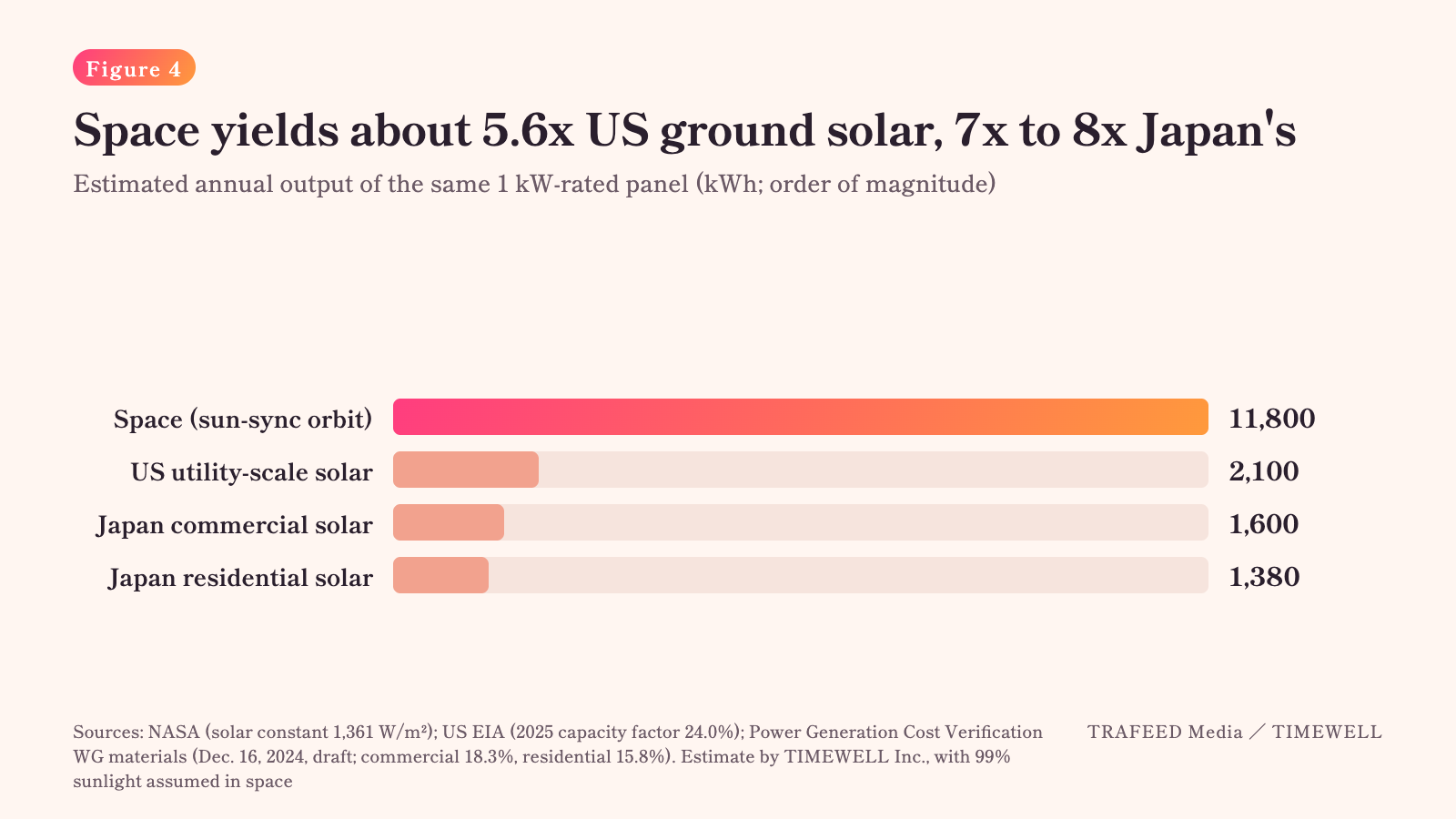 Figure 4. Annual output from the same panel, compared. See how many of the three ground bars would fit into the space bar at the top. Sources: NASA; US Energy Information Administration; Power Generation Cost Verification Working Group materials (Dec. 16, 2024, draft). Estimate by TIMEWELL Inc.
The companies' own numbers sit in the same range. SpaceX says "more than five times the energy per unit area of terrestrial solar"6. Starcloud's white paper sets a 24% median US capacity factor against more than 95% in space and arrives at "over 5 times"17. Google says "up to 8 times more productive than on earth"12. The multiple moves between about 5x and 8x depending on whether you compare with the US or with a less sunny place. That is all you need to remember.
Last, a rough power and heat budget for one Starmind satellite, using the upper limits SpaceX gave the FCC5: solar arrays under 1,500 m², radiators under 200 m², mass under 4,000 kg. Take the full 1,500 m² of solar array at 22 to 30% efficiency, and 1,500 m² × 1,361 W/m² × 0.22 to 0.30 gives about 450 to 610 kW. Let both faces of a 200 m² radiator radiate, with an emissivity of 0.92, and the heat it can reject is about 150 kW with the panel at 20°C, about 230 kW at 50°C and about 320 kW at 80°C (before subtracting the heat it absorbs from the Sun and Earth). Press reports put the onboard computing load at an average of 175 kW and a maximum of 250 kW18. These are my own guesses built on upper limits, but they point one way: the heat you can reject, more than the power you can generate, is likely to set the ceiling on scale first. In other words, the radiators, more than the solar arrays, will probably decide how big an orbital data center can get.
Not "SpaceX alone": the competitors, and the Starlink pairing
The point of this section: SpaceX is, for now, the only one running rockets, satellites and a communications network in-house and already at scale. But several other organizations are going after orbital data centers, and others are ahead on actually running computation in orbit.
In his statement on the authorization, FCC Chairman Brendan Carr said "SpaceX and the many competitors working on their own orbital data centers are meeting the moment," and noted that the FCC is reviewing other orbital data center applications too2. In a separate statement in March, he said that after SpaceX's 1 million, Starcloud had filed for 88,000 satellites and Blue Origin for 51,00019. The GAO report also says the FCC has received three applications from US companies since January 202611.
Blue Origin's "Project Sunrise," in an application dated March 19, 2026, plans up to 51,600 satellites in sun-synchronous orbits at 500 to 1,800 km9. For communications it relies on optical links, including its own satellite network "TeraWave" (filed separately), and for launch it assumes the capacity of its own heavy rocket, New Glenn. The application also notes that Blue Origin has designed, built, launched and reused two vehicles, New Shepard and New Glenn. Putting rockets, a network and orbital data centers under one roof is the same approach as SpaceX's; the difference is that Blue Origin's network is still at the application stage. Starcloud (based in Washington state) plans up to 88,000 satellites in an application dated February 4. It assumes fully reusable rockets such as Starship will be available for launch, and says itself that it will connect to optical networks run by Starlink, Amazon, Blue Origin and others, subject to commercial agreements20. The company announced that in November 2025 it launched "Starcloud-1," a satellite carrying an NVIDIA H10021.
Google, under "Project Suncatcher," launched prototype satellites carrying its own AI chips (TPUs) as a rideshare on a SpaceX launch, and announced in October 2026 that they were "operating as expected"22. In China, the "Three-Body Computing Constellation" started by Zhejiang Lab launched its first 12 computing satellites in May 2025. It says they deliver a combined 5 peta floating-point operations per second (5 PFLOPS) and make up the world's largest space computing constellation by current in-orbit capacity23. Xinhua reported in February that the satellites had been networked together and were running 10 AI models and applications in orbit24. In the US, Axiom Space also sent two orbital data center nodes to low Earth orbit in January 2026, running on Kepler Communications' optical relay network25.
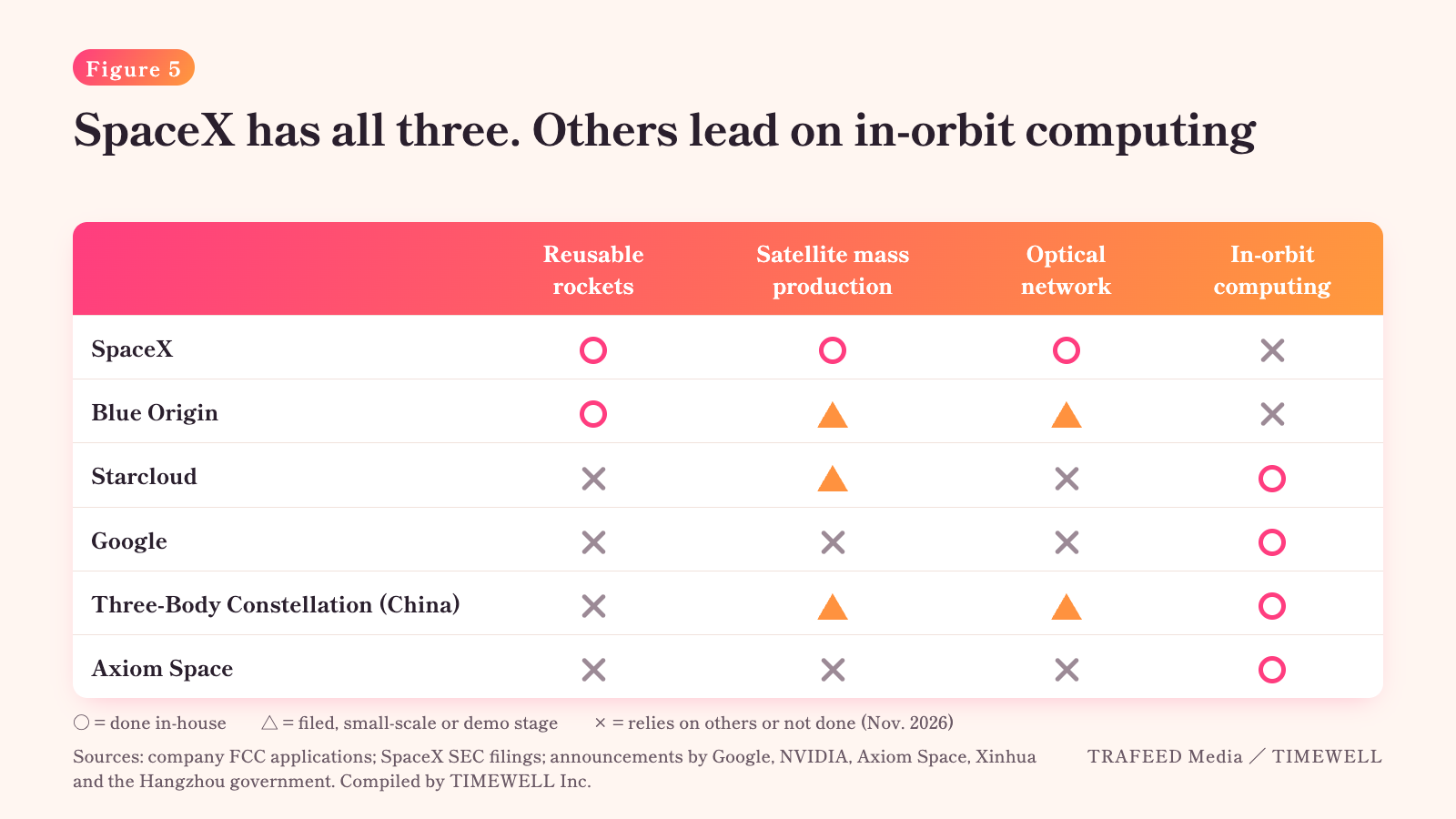 Figure 5. The main efforts compared. The first three columns show what each player has in-house; the last column shows whether it has run computation in orbit. Sources: company FCC applications; SpaceX SEC filings; company and institutional announcements (as of November 2026)
As Figure 5 shows, SpaceX has all three in-house (reusable rockets, mass satellite production and an in-orbit optical network) and already runs them at scale. According to its investor materials, SpaceX has carried more than 80% of the world's mass to orbit every year since 20236. I think it is fair to say SpaceX is, for now, the only company running all three in-house and at scale. That still does not get you to "SpaceX is the only company with the technology to pull this off." Blue Origin has filed with the same approach, and not a single SpaceX compute satellite has reached orbit yet. On running computation in orbit, Starcloud, Google, the Three-Body Computing Constellation and Axiom are ahead. SpaceX writes in the same materials that it alone can solve AI computing in space at scale in the near term6, but that is the company's own assessment.
I do think the Starlink pairing is a sound design on the communications side. Starmind connects to Starlink's first- and second-generation satellites over optical inter-satellite links and, in the application's words, sends data to the ground over a "high capacity (petabit) and high reliability laser mesh"4. Because radio is for emergencies only, it uses almost no new spectrum, and spectrum is something operators tend to fight over. Chairman Carr said in his March statement that new kinds of space businesses have been held back by a shortage of spectrum for command and control19. It is a bit like having your own highway already running right up to the site of a new factory. SpaceX says the availability of Starlink's optical links exceeds 99%5.
The capacity, though, has not been backed up in public. In its questions, the FCC asked for a technical analysis of whether Starlink's first and second generations can support optical links for 1 million satellites. SpaceX did not provide one, citing the FCC's position since 1999 that optical links fall outside its jurisdiction5. Starcloud also plans to connect to Starlink, so the Starlink network could end up carrying other companies' computing satellites as well. The pairing makes sense as a design, but whether it can carry 1 million satellites is something nobody outside SpaceX can check yet.
Large amounts of power in orbit: the energy upside, and a property weapons could use
This section makes two points. Being able to put large amounts of power in space is a major advantage for securing energy. But once high-power equipment is lined up in space in large numbers, there is a risk that, regardless of the operator's intent, it could in theory be repurposed as a power source for directed energy weapons.
The upside first. On the ground, even after a power plant is built, connecting it to the grid can take years. Solar arrays in space generate electricity almost without interruption, with no dependence on a terrestrial grid or on fuel. In his March statement, Chairman Carr said "Companies are racing to produce energy," describing a race to generate power in space, whether from solar or nuclear19. Executive Order 14369 of December 2025 makes nuclear reactors on the Moon and in orbit one of the pillars of US space policy26. SpaceX has set a goal of sending 100 GW of computing capacity to orbit every year6. Space is becoming a place to put not just computers but electricity itself.
Now the risk, stated plainly. When high-power equipment is placed in space in large numbers, there is a risk that, regardless of the operator's intent, it could in theory be repurposed as a power source for directed energy weapons (weapons that damage a target from a distance by hitting it with a laser or high-power radio waves). Running a high-power laser takes a large power supply and a way to dump the power you use as heat. An orbital data center satellite could also serve as a platform that has both: power generation in the hundreds of kilowatts by my estimate, and large radiators. This is not a claim that SpaceX, or any particular company or country, will do this. It is about a property that comes with putting large amounts of power in space at all.
Take machine tools. The same machine can make car parts or weapon parts. Export controls classify machine tools by precision because they draw the line by what a machine can do, not by what its user intends. I think high-power space infrastructure carries the dual-use problem that export controls have always dealt with up into orbit.
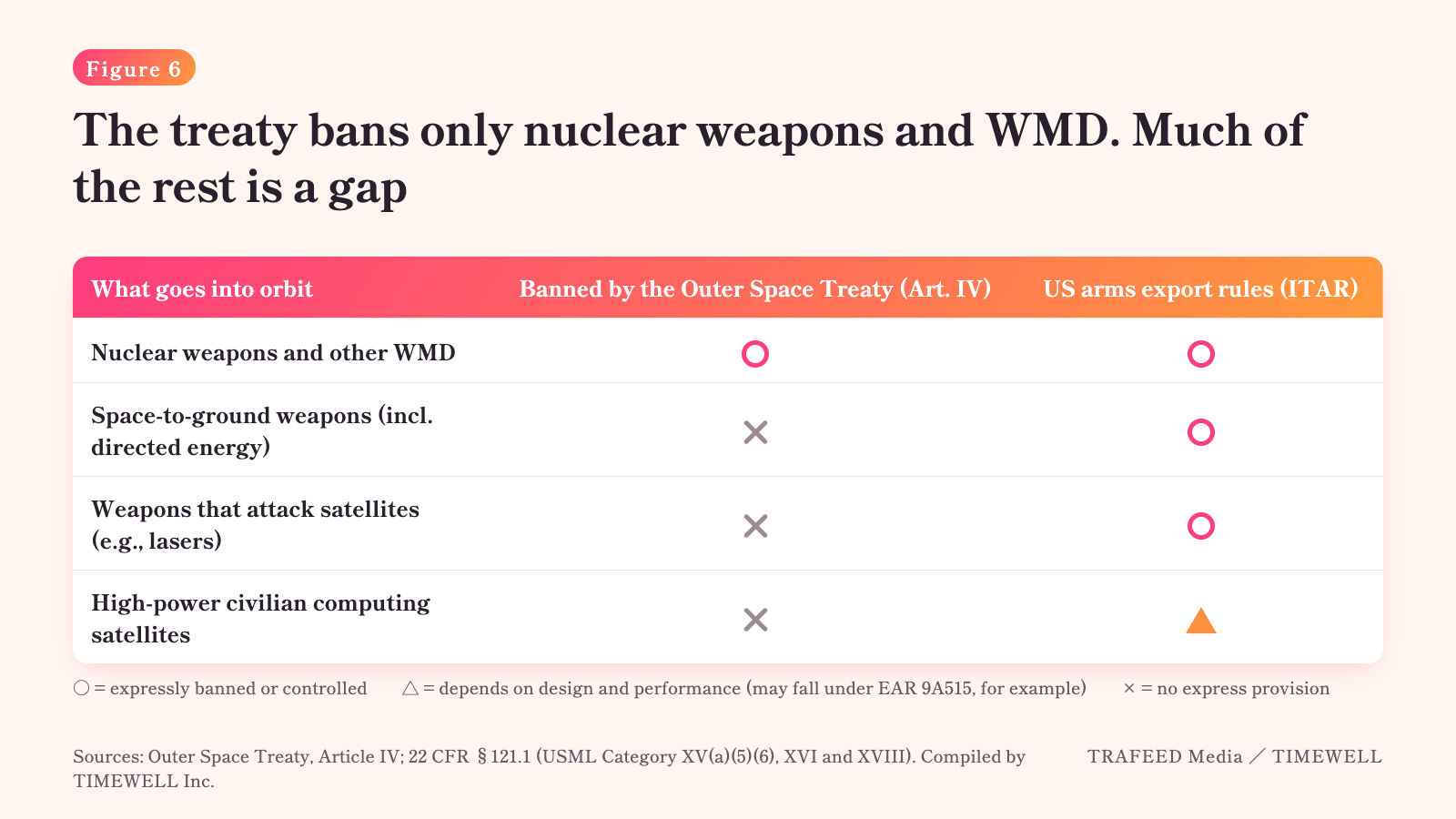 Figure 6. What goes into orbit, and how the treaty and US rules treat it. For each item in the left column, the two columns on the right show whether it is expressly prohibited or controlled. Sources: Outer Space Treaty, Article IV; 22 CFR §121.1
On the rules side, the gaps stand out. Article IV of the Outer Space Treaty prohibits states parties from placing nuclear weapons or "any other kinds of weapons of mass destruction" in orbit around the Earth27. The Moon and other celestial bodies are reserved for peaceful purposes, with military bases and weapons testing banned there too. Placing conventional weapons or directed energy weapons in Earth orbit, however, is not directly covered by the treaty's text. It is fair to call that a gap in the rules.
US export controls cover these items once they are weapons. Category XV of the ITAR's US Munitions List (USML) covers spacecraft with "space-to-ground weapons systems (e.g., kinetic or directed energy)" and spacecraft designed to attack satellites with lasers and the like28. Directed energy weapons themselves fall under Category XVIII. A high-power civilian computing satellite that carries no weapons, by contrast, would be classified under the EAR, for example as 9A515, depending on its design and performance. I could not find any provision that classifies something as a weapon just because it has a large power supply.
The concerns being raised in Congress and the press actually run the other way. In June 2026, Senators Cruz and Hickenlooper reportedly introduced the "New Horizon Act," which would have the Pentagon evaluate commercial orbital data centers and look at operating them so that they are protected from attack29. Orbital data centers are starting to be seen as targets to defend. In my research, I found no document from a public body that squarely analyzes whether the power on orbital data centers could be turned to weapons use. The GAO report does not explicitly address national security or export controls either11. The security side of putting large amounts of power in space is still mostly a gap, in treaties and domestic rules alike, and the debate has barely started.
Orbital data centers through an export control lens
The point of this section: orbital data centers offer export controls almost no point of entry, but there are clear situations where the controls do bite. The three questions in Figure 7 sort them out.
First, a launch is not an export. The EAR lists "Launching a spacecraft, launch vehicle, payload, or other item into space" among activities that are not exports, reexports or transfers30. The ITAR takes the same approach31. As long as a US company launches from the US and keeps owning the satellite, neither the satellite nor the GPUs on board have been "exported."
Transferring registration, control or ownership of the spacecraft changes that. Under the EAR, a transfer by a person in the US of registration, control or ownership of a spacecraft subject to the EAR to a person in, or a national of, a D:5 country is an export (§734.13(a)(3)). For spacecraft that provide space-based logistics, assembly or servicing, the destination country does not matter32. For a satellite subject to the ITAR, any transfer to a foreign person is an export. The satellite itself would be classified either under EAR 9A515, which covers commercial communications satellites among others, or, if it has certain functions, under USML Category XV. High-efficiency space-grade solar cells are also listed, under EAR 3A001.e.433. SpaceX has not disclosed how Starmind is classified, and I am not going to guess here.
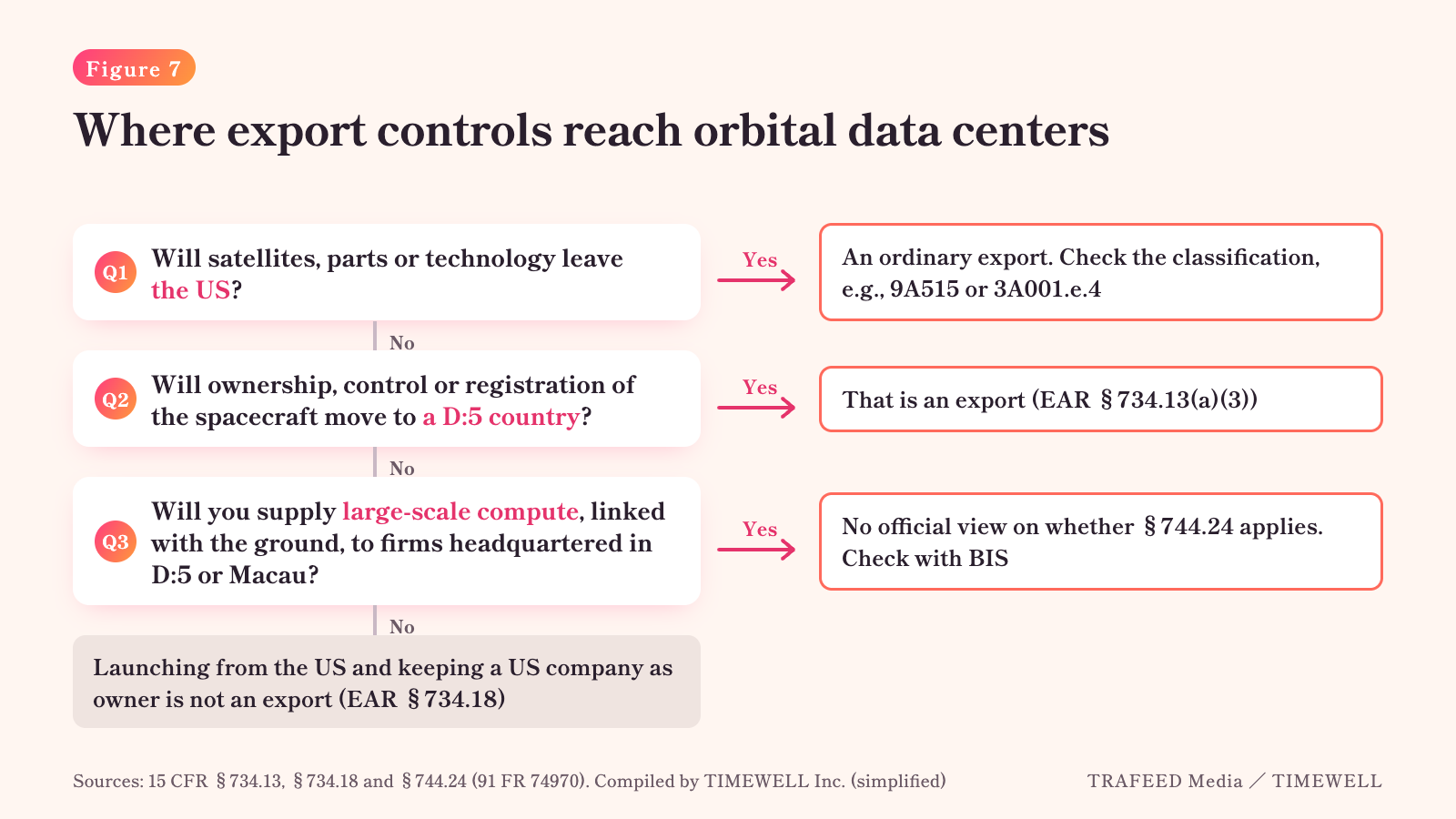 Figure 7. When export controls apply. Answer from the top; a "yes" at any point leads to the conclusion on the right. If all three are "no," as at the bottom, it is not an export. Sources: 15 CFR §734.13, §734.18 and §744.24
The newest question is the remote access rule that took effect on November 193. The new §744.24 requires a license to export, reexport or transfer advanced semiconductors when you know they will be used, at a data center anywhere in the world, to supply more than 12 million aggregate TPP (the yardstick US rules use for chip computing performance) to companies headquartered in a D:5 country such as China, or in Macau (including where the ultimate parent is headquartered there). Multiple data centers are added together if they are "digitally-linked," meaning used as one over a network. I covered how the rule works in more detail in Chip sellers tell neoclouds: no Chinese renters.
Twelve million TPP is about 760 NVIDIA H100s (our estimate). Divide the reported 175 kW per satellite by the H100's maximum power draw of 700 W34 and you get about 250 GPUs, so roughly three satellites would reach the threshold. That is an order-of-magnitude guide, and it swings a lot with the chips on board. The rule text says nothing about data centers in space, in orbit or on satellites. For GPUs launched straight from the US, the "export" that §744.24 assumes is unlikely to happen at all. If computers in orbit are used together with ground data centers over optical links, though, there may be room to count them together as "linked data centers." BIS (the Commerce Department's Bureau of Industry and Security) has not given an official view on this. Comments on the rule are due January 19, 2027, and I think there is a good chance this point comes up in them.
"Space is outside every country, so regulation can't reach it" is not accurate either. Article VI of the Outer Space Treaty makes states internationally responsible for private space activities too, and requires "authorization and continuing supervision." Article VIII provides that the state that registers an object launched into space retains "jurisdiction and control" over it27. A satellite registered in the US stays under US jurisdiction even in orbit. When you think about where your data sits, the starting point is which country the satellite is registered in.
Here is how this looks from Japan, as one example. For Japanese companies, two situations are closest to home. The first is a Japanese materials maker, say, supplying space-grade thermal materials or optical communication parts to a satellite maker abroad. On top of classifying the goods under Japan's Foreign Exchange and Foreign Trade Act (FEFTA), the supplier has to check the conditions the customer imposes. I summarized the conditions SpaceX places on its suppliers in SpaceX's NCNT supply chain and nationality demands. The second is renting computing capacity in orbit at some point. If the Japanese subsidiary of a company with a parent in China tried to rent large amounts of compute, the provider would likely check the renter's parent the same way a ground cloud would, and decide whether §744.24 applies. Japan's Ministry of Internal Affairs and Communications (MIC) wrote in a July 2026 document that "plans for space data centers on an enormous scale are appearing one after another, and moves to build proprietary high-capacity satellite optical communication networks are also getting into full swing" (my translation), and it listed R&D on satellite optical communications as a priority35. So with orbital data centers, export controls come into play in three situations: when goods or technology cross a border, when ownership and control change hands, and when you decide whom to rent computing power to.
Summary
The FCC's authorization marks the start of orbital data centers. It does not promise that they will succeed. It covers spectrum and orbits only, and past the first deadline of one satellite by 2033 stands a much heavier one: 100,000 satellites by 2035. Space greatly eases the land and power constraints, but heat can only leave by radiation, and heat rejection looks likely to set the ceiling on scale. There are several competitors. SpaceX leads by owning all three foundations in-house, while others are ahead on actual computing in orbit.
For export control teams, the thing to take away is how narrow the way in is (a launch is not an export), and where the real questions sit on the way out: transfers of ownership and the supply of compute. The security implications of putting large amounts of power in space also remain largely a gap in treaties and rules, while the technology moves ahead regardless. Personally, I am watching whether the treatment of computing resources in orbit makes it into the US regulatory debate before the comment deadline in January. If anything moves, I will update this article.
What I could not confirm
I could not confirm the following against primary sources: the risk factors in the main body of SpaceX's IPO registration statement (S-1); the original wording of some of Musk's remarks, such as those at Davos; an official figure for the computing power draw of one Starmind satellite (I only have press reports); and an analysis of the capacity of Starlink's optical links.
If you want to revisit how you classify satellites and space-grade parts, or how you check your counterparties' parent companies, as the rules change, you can bring it to a TRAFEED consultation.
Footnotes
-
US Federal Communications Commission (FCC), Space Bureau, "Memorandum Opinion and Order and Authorization," DA 26-1273 (adopted and released November 25, 2026; ICFS File No. SAT-LOA-20260108-00016; call sign S00798). Condition 10 (milestones), paragraph 17 (waste heat and infrared astronomy), paragraph 18 (issues outside the FCC's authority). https://docs.fcc.gov/public/attachments/DA-26-1273A1.pdf ↩ ↩2 ↩3 ↩4 ↩5 ↩6 ↩7 ↩8 ↩9
-
FCC news release, "FCC Authorizes 1 Million Satellites for Data Centers in Space" (November 25, 2026), including Chairman Carr's statement. https://docs.fcc.gov/public/attachments/DOC-427572A1.pdf ↩ ↩2
-
Federal Register, 91 FR 74970, "Addressing Remote Access to Advanced Semiconductors" (published and effective November 19, 2026; FR Doc. 2026-23529; comments due January 19, 2027). §744.24. https://www.federalregister.gov/documents/2026/11/19/2026-23529/addressing-remote-access-to-advanced-semiconductors ↩ ↩2
-
FCC Space Bureau public notice DA 26-113, "Space Bureau Accepts for Filing SpaceX's Application for Orbital Data Centers" (February 4, 2026), quoting the application (optical links; altitudes of 500 to 2,000 km). https://docs.fcc.gov/public/attachments/DA-26-113A1.txt ↩ ↩2
-
Letter from SpaceX to the FCC (September 16, 2026, signed by Madeleine Chang), answering questions from the FCC Space Bureau. Covers optical link availability, upper limits on satellite dimensions (solar arrays under 1,500 m², radiators under 200 m², mass under 4,000 kg) and the dawn-dusk sun-synchronous orbit. https://api-prod.fcc.gov/icfs-attachment/exp/api/v1/a81df57a93db4f10ac9c39bfa8373c08 ↩ ↩2 ↩3 ↩4 ↩5
-
SpaceX filing with the US Securities and Exchange Commission (SEC), Free Writing Prospectus (Rule 433; Registration No. 333-296070; June 4, 2026). https://www.sec.gov/Archives/edgar/data/1181412/000162828026040874/spacexukfwp.htm ↩ ↩2 ↩3 ↩4 ↩5 ↩6 ↩7 ↩8
-
The White House, "America's AI Action Plan" (July 2025). https://www.whitehouse.gov/wp-content/uploads/2025/07/Americas-AI-Action-Plan.pdf ↩
-
The Register, "Elon Musk merges xAI into SpaceX to spread universal consciousness via a sentient sun" (February 3, 2026), quoting SpaceX's announcement. https://www.theregister.com/2026/02/03/musk_spacex_xai_merge_hallucination_burning_man/ ↩
-
Blue Origin, FCC application for "Project Sunrise" (dated March 19, 2026). https://api-prod.fcc.gov/icfs-attachment/exp/api/v1/9c86a0e887b3f610e1cc75d9cebb3518 ↩ ↩2
-
National Institute of Standards and Technology (NIST), "Stefan-Boltzmann constant" (CODATA 2022). https://physics.nist.gov/cgi-bin/cuu/Value?sigma ↩
-
US Government Accountability Office (GAO), "Science & Tech Spotlight: Data Centers in Space," GAO-26-109012 (April 28, 2026). https://www.gao.gov/products/gao-26-109012 ↩ ↩2 ↩3 ↩4
-
Google Research, "Exploring a space-based, scalable AI infrastructure system design" (November 4, 2025). https://research.google/blog/exploring-a-space-based-scalable-ai-infrastructure-system-design/ ↩ ↩2
-
NASA, "Earth Fact Sheet" (solar constant 1361.0 W/m²). https://nssdc.gsfc.nasa.gov/planetary/factsheet/earthfact.html ↩
-
National Renewable Energy Laboratory (NREL), "Reference Air Mass 1.5 Spectra" (ASTM G173-03). https://rredc.nrel.gov/solar/spectra/am1.5/ ↩
-
US Energy Information Administration (EIA), "Electric Power Monthly," Table 6.07.B (solar capacity factor; 24.0% in 2025). https://www.eia.gov/electricity/monthly/epm_table_grapher.php?t=epmt_6_07_b ↩
-
Advisory Committee for Natural Resources and Energy (Japan), Power Generation Cost Verification Working Group (5th meeting), Document 2, "Summary of the power generation cost verification (draft)" (December 16, 2024; in Japanese), model plant specifications on slide 40. Commercial-scale solar is the median of FIT and FIP projects of 50 kW and up installed in 2022 (data collected June 2022 to May 2023); residential solar is the median of FIT projects under 10 kW installed in 2022. The document is a draft, and its cover notes that the specifications are still under review. https://www.enecho.meti.go.jp/committee/council/basic_policy_subcommittee/mitoshi/cost_wg/2024/data/05_05.pdf ↩
-
Lumen Orbit (now Starcloud), "Why we should train AI in space," white paper v1.03 (September 2024). https://starcloudinc.github.io/wp.pdf ↩
-
Via Satellite, "FCC Approves SpaceX's 1 Million Satellite Orbital Data Center Constellation" (November 25, 2026). https://www.satellitetoday.com/connectivity/2026/11/25/fcc-approves-spacexs-1-million-satellite-orbital-data-center-constellation/ ↩
-
Statement of FCC Chairman Carr, "Spectrum Abundance for Weird Space Stuff, Notice of Proposed Rulemaking" (FCC 26-13, March 2026). https://docs.fcc.gov/public/attachments/FCC-26-13A2.txt ↩ ↩2 ↩3
-
Starcloud, FCC application (dated February 4, 2026). https://api-prod.fcc.gov/icfs-attachment/exp/api/v1/5c6840321b3e365068b6a64ce54bcb49 ↩
-
Starcloud, "Starcloud-1." https://www.starcloud.com/starcloud-1 ↩
-
Google, announcement of the Project Suncatcher prototype satellites (October 1, 2026). https://blog.google/innovation-and-ai/models-and-research/google-research/project-suncatcher-prototype/ ↩
-
Hangzhou municipal government (English site, China Daily article), "Space-AI computing solutions paving way for faster smart tech development" (July 29, 2026). https://www.ehangzhou.gov.cn/2026-07/29/c_298438.htm ↩
-
Xinhua (news.cn), article on the inter-satellite network of the Three-Body Computing Constellation (February 13, 2026; in Chinese). https://www.news.cn/20260213/d985035629be4998bcb3086d1f4b6ecb/c.html ↩
-
Axiom Space, "Orbital Data Center." https://www.axiomspace.com/odc ↩
-
US Executive Order 14369, "Ensuring American Space Superiority" (signed December 18, 2025; 90 FR 60537). https://www.federalregister.gov/documents/2025/12/23/2025-23845 ↩
-
Treaty on Principles Governing the Activities of States in the Exploration and Use of Outer Space, including the Moon and Other Celestial Bodies (Outer Space Treaty), English text, Articles IV, VI and VIII, as posted by the US Federal Aviation Administration (FAA). https://www.faa.gov/about/office_org/headquarters_offices/ast/media/treaty_Princi_Gov_Acti_States_OST.pdf ↩ ↩2
-
22 CFR §121.1 (US Munitions List). Category XV(a)(5) and (6), Category XVI, Category XVIII. https://www.ecfr.gov/current/title-22/section-121.1 ↩
-
Air & Space Forces Magazine, "Senators Want Pentagon to Tap In to Commercial On-Orbit Data Centers" (June 12, 2026). https://www.airandspaceforces.com/senators-want-pentagon-to-tap-in-to-commercial-on-orbit-data-centers/ ↩
-
15 CFR §734.18(a)(1) (EAR; activities that are not exports, reexports or transfers). https://www.ecfr.gov/current/title-15/section-734.18 ↩
-
22 CFR §120.54(a)(1) (ITAR; activities that are not exports and related transfers). https://www.ecfr.gov/current/title-22/section-120.54 ↩
-
15 CFR §734.13(a)(3) (definition of export under the EAR); 22 CFR §120.50(a)(3) (definition of export under the ITAR). https://www.ecfr.gov/current/title-15/section-734.13 ↩
-
15 CFR part 774, Supplement No. 1 (Commerce Control List). ECCN 9A515 and 3A001.e.4. https://www.ecfr.gov/current/title-15/part-774 ↩
-
NVIDIA, "H100 Tensor Core GPU" specifications (maximum power draw of the H100 SXM is up to 700 W). https://www.nvidia.com/en-us/data-center/h100/ ↩
-
Ministry of Internal Affairs and Communications (Japan), "The state of space communications and R&D challenges" (Document AB10-2, July 13, 2026; in Japanese). https://www.soumu.go.jp/main_content/001082041.pdf ↩