Hello, this is Ryuta Hamamoto from TIMEWELL. Emerging-technology controls bury operators in statutes and acronyms. News alerts tell you something moved; they rarely tell you what to change on Monday morning.
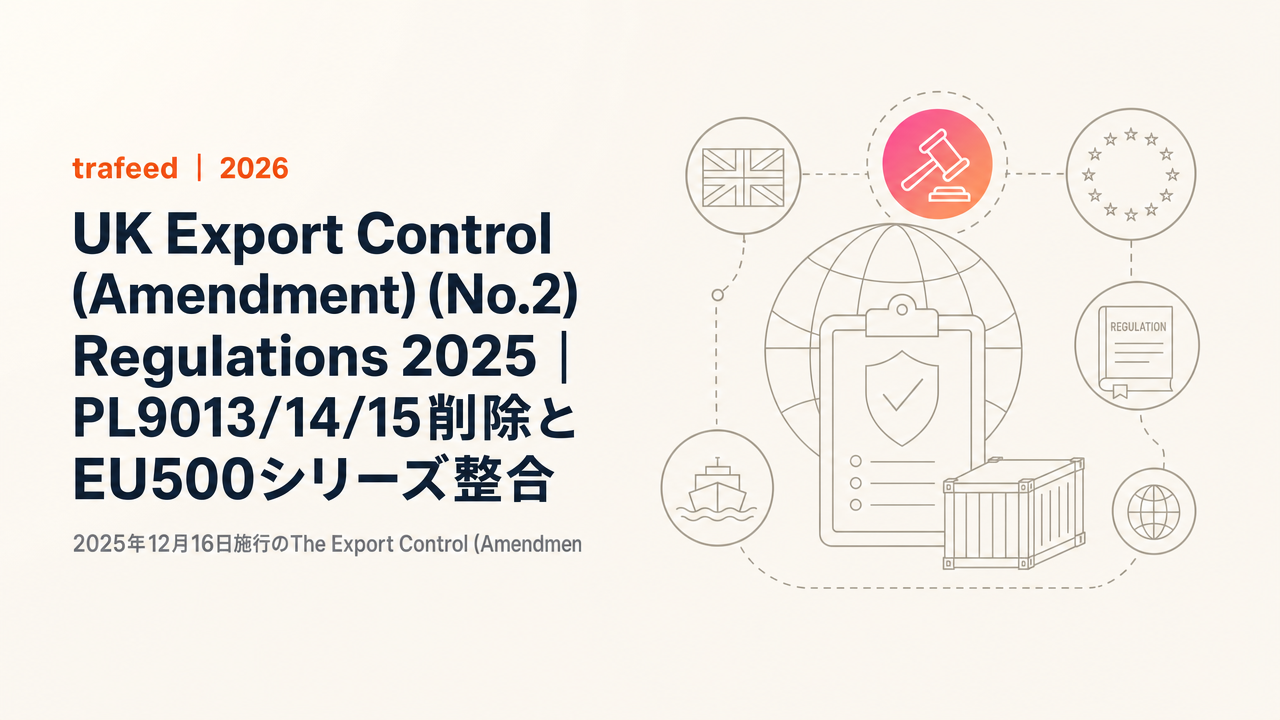
On 16 December 2025, the UK brought into force The Export Control (Amendment) (No.2) Regulations 2025 (SI 2025/1197). The centerpiece is removal of national entries PL9013, PL9014, and PL9015, folded into the EU-style “500 series.” The same package updated the military list (Schedule 2) for Wassenaar changes, fully lifted the Armenia/Azerbaijan arms embargo basis (Schedule 4), and refreshed eight Open General Export Licences (OGELs). English-language firm alerts poured out almost immediately. Japanese-language explanations stayed thin. So I am writing from terms through practice, for teams who actually ship and license.
What you will learn
- SI 2025/1197’s formal place and timeline
- What PL9013/14/15 actually were, and why they were deleted
- What the EU “500 series” is, and why the UK aligned
- Schedule 2, Armenia/Azerbaijan, and eight OGEL updates
- Relation to the proposed UK Modern Export Controls Bill
- Four typical Japanese-company impact patterns and five practical steps
Three terms first
SI 2025/1197 (Statutory Instrument 2025 No. 1197)
Under primary Acts, the government issues Statutory Instruments (SIs) when it needs to amend without waiting for a new statute. SI 2025/1197 amends the Export Control Act 2002 and The Export Control Order 2008 (ECO 2008). Item lists (Schedules 2 and 3) live under ECO 2008, so SIs update them often.
PL9013, PL9014, and PL9015
“PL” marks Schedule 3 national control entries. After Brexit, the UK added these emerging-tech categories:
| Entry | Main technologies |
|---|---|
| PL9013 | Quantum, cryogenics, advanced semiconductor manufacturing-related technology |
| PL9014 | Additive manufacturing (metal 3D printers), advanced materials, high-entropy alloy powders |
| PL9015 | Advanced computing, special high-temperature coatings, related advanced materials |
I still see online claims that “PL9013 equals old Iran sanctions language.” That is wrong. Iran measures live in separate sanctions instruments (for example, Iran (Sanctions) Regulations 2023).
OGEL (Open General Export Licence)
A government-issued general licence. If item, destination, and conditions fit, you may use it without an individual SIEL. Registration and record-keeping still apply, and ECJU can audit. This package replaced eight OGELs.
Why PL9013/14/15 were removed — three reasons
First, close the GB/NI gap. Under the Windsor Framework, Northern Ireland (NI) continues to apply EU dual-use rules such as Regulation 2021/821. Great Britain (GB) had run a parallel PL series. That made NI routing messy.
Second, the EU introduced the 500 series in September 2025. A delegated regulation put 500-series entries (third digit “5,” e.g., 3A5xx) into Annex I so emerging tech could be identified by number. Keeping the PL series would have meant triple management across GB, EU, and NI.
Third, alignment with UK Modern Export Controls thinking. Looking ahead to a modernized Act, aligning numbers with the EU while updating by SI is simply cheaper to operate.
The hybrid choice is clear: item numbers and technical specs align with the EU; licensing (OGEL and SIEL) stays UK-specific. SI 2025/1197 implements that choice.
Replace siloed classification work with AI.
METI's FY2024 data shows 52% of foreign exchange law violations stem from classification errors. Download the TRAFEED product catalog covering features and rollout.
What the EU “500 series” is
Identification rule: third digit is “5”
EU/UK dual-use numbers are five-character style (3A001, 4D004…). The 500 series uses a third digit of “5” (3A5xx, 4D5xx, 3E5xx). Existing numbers mostly come from WA, MTCR, NSG, and AG. The 500 series marks autonomous EU/UK emerging-tech controls.
Technology coverage
| Area | Examples |
|---|---|
| Quantum | Quantum computers, cryogenic electronics, parametric amplifiers, cryogenic cooling and wafer probers |
| Semiconductor manufacturing equipment | ALD, lithography, EUV pellicles, masks/reticles, SEM, etch tools |
| Advanced computing | Advanced ICs, FPLD-based electronic assemblies |
| Advanced materials | Special high-temperature coatings |
| Additive manufacturing | Metal 3D printers; high-entropy and refractory metal powder feedstocks |
| Life sciences | Certain research instruments |
Coverage largely overlaps old PL9013/14/15. Think number migration, not deregulation. Product masters and End-User Statements can be shared with the EU, but OGEL and SIEL remain UK-specific under the Assimilated Regulation framework.
Schedule 2 and Armenia / Azerbaijan
Schedule 2: Wassenaar reflection
SI 2025/1197 also updates the military list (Schedule 2). Participants typically domesticate December plenary changes the next year. This package touched ML1, ML2, ML7, ML10, ML13, ML19, and ML21 definitions/exceptions. Most changes are editorial, but munitions-related tech still requires line-by-line remapping.
Full lift of the Armenia / Azerbaijan arms embargo basis
| Date | Event |
|---|---|
| 1992 | OSCE arms-embargo recommendation |
| 1 Jul 2025 | Written statement foreshadowing reduction (NTE 2025/17) |
| 13 Oct 2025 | Parliament told of full lift (NTE 2025/28) |
| 16 Dec 2025 | SI 2025/1197 Schedule 4 removes the embargo basis |
Not total free trade: some items remain under transit control, and case-by-case licensing under the Strategic Export Licensing Criteria continues.
Eight OGEL updates (NTE 2025/33)
Eight OGELs were replaced to add 500-series references, delete PL9013/14/15 references, and revise Armenia/Azerbaijan exclusions. Existing registrants migrate automatically, but you still have to confirm your items remain in scope under the new 500-series numbers. Using an OGEL outside scope is unlicensed-export risk. I treat that as a checklist item, not a footnote.
UK Modern Export Controls Bill
Through 2024–2025 the government explored refreshing the Export Control Act 2002: higher penalties, clearer extraterritorial reach, stronger links to the Sanctions and Anti-Money Laundering Act 2018, and faster emerging-tech controls. As of May 2026 it remained at white-paper stage with no confirmed introduction. Near-term list maintenance will continue by SI. SI 2025/1197 is the model case for how that work gets done.
Four impact patterns for Japanese companies
| Case | Pattern | Key checks |
|---|---|---|
| A: UK subsidiary exports from the UK | London or other UK sites handle quantum, semiconductor tools, 3D printers | Remap PL to 500 series; recheck OGEL; confirm scope for China, Russia, Iran, and other sensitive destinations; watch derivative items pulled into 500 series |
| B: Japan parent exports to UK subsidiary | Japan to UK ordinary export | Japan side: FEFTA and Appended Table 1. UK import usually needs no dual-use import license. If reexport from the UK is planned, pre-map 500 series and OGEL |
| C: Japan company routes via UK warehouse/forwarder | Trading-house model | Goods in the UK are UK-controlled. Confirm the PL-to-500 switch at clearance, and that forwarders absorbed NTE 2025/29 and 2025/33 |
| D: Tech licenses with UK partners/universities | Joint R&D, licenses, secondees | Quantum and advanced computing transfers to UK persons can be controlled (including deemed-export style risks). Academic exceptions are content-dependent. Clear with ECJU and counsel before you sign |
Five practical steps
| # | Step | Content |
|---|---|---|
| 1 | Inventory old PL9013/14/15 | Review 2–3 years of licenses, product masters, End-User Statements, and shipments. No hits means lighter follow-on work. |
| 2 | Remap to 500 series | Parallel-read UK Strategic Export Control List 2025 and EU Dual-Use Annex I. Where mapping is not 1:1, decide by technical parameters. |
| 3 | Recheck OGEL scope | Review new schedules for registered OGELs (including Dual-Use to EU/Channel Islands). If out of scope, obtain SIEL or other individual authorization. |
| 4 | Update SOPs, checklists, training | Replace every internal PL9013/14/15 reference; brief sales, procurement, logistics, and legal on 500 series. |
| 5 | Refresh counterparty End-User Statement templates | Align subsidiary and customer forms to new numbers at the next contract cycle. |
FAQ
Q1. Our old materials say PL9013 is Iran-related. What now?
Correct immediately. Leaving wrong training materials recycles error.
Q2. Do NI and GB differ?
Yes. NI applies EU Dual-Use Regulation 2021/821 under the Windsor Framework; GB applies the UK Assimilated Regulation. 500-series alignment shrinks the gap, but OGEL/SIEL vs EU GEAs remain different systems.
Q3. Are EU and UK 500 series identical?
Item numbers and technical specs yes; licensing systems no. Share product masters carefully; keep national licensing workflows.
Q4. Penalties?
Up to 10 years’ imprisonment and unlimited fines. Practice escalates: warning → compound penalty → license revocation → criminal prosecution.
Q5. Is Armenia/Azerbaijan fully free?
No. Embargo basis lifted; Strategic Export Licensing Criteria case-by-case review continues; some transit controls remain.
Latest developments as of July 2026
UK 500-series alignment sits inside a broader reframing of quantum, semiconductors, and critical minerals as economic-security issues. The Japan–India summit on 2 July 2026 (16th annual) produced a joint declaration across semiconductors, rare earths, clean energy, ICT (subsea cables), and pharmaceuticals, with investment on the order of about ¥2 trillion (Prime Minister’s Office of Japan, 1 July 2026). It does not directly amend UK lists, but overlapping technologies mean Japanese firms should read UK/EU list updates and supply-chain realignment on one map. See Japan–India Summit and economic security.
Key takeaways
If I had to leave one operating rule with a Japanese export-control team, it would be this: start with Step 1. Did you ever use PL9013/14/15? If not, impact is limited. If yes, walk Steps 2 through 5 in order.
- SI 2025/1197 was the UK’s largest 2025 item-structure reform
- PL9013/14/15 were national emerging-tech controls, not Iran sanctions leftovers
- Removal was about GB/NI gap closure and EU 500-series alignment
- Equivalent or stronger substance returns as 500 series under the Assimilated Dual-Use Regulation
- Schedule 2 reflects Wassenaar; Schedule 4 lifts the Armenia/Azerbaijan embargo basis; eight OGELs update together
- Segment four impact patterns, then run the five steps
- Deeper reform may still come via a Modern Export Controls Bill; near-term change remains SI-driven
Related articles
- China dual-use catalog 2026 | 1,122 export items and ~70–85 new entries
- U.S. EAR, China dual-use, and EU dual-use rules — simultaneous impact
- AI Diffusion Rule withdrawal and alternatives — 2026 U.S. AI export controls
TRAFEED: multi-jurisdiction list drift in one workflow
When list numbers jump every few months, spreadsheet remapping does not scale. TIMEWELL’s AI export-control agent TRAFEED (service catalog PDF) is built for that kind of drift.
- Machine-readable Japan, U.S., EU, and UK lists with rapid amendment reflection
- Automatic remapping for PL9013/14/15 to 500-series style shifts
- Classification, OGEL applicability, and end-user checks in one workflow
- Multilingual (JA/EN/ZH) for overseas subsidiary users
If UK amendments are hard to keep up with, classification is still person-dependent by site, or you lack bandwidth to track U.S., China, EU, and UK deltas monthly, contact us. For AI rollout plus operating discipline, WARP consulting can run alongside.
References
- SI 2025/1197: https://www.legislation.gov.uk/uksi/2025/1197/made
- SI 2025/532 (first 2025 amendment): https://www.legislation.gov.uk/uksi/2025/532/regulation/5/made
- NTE 2025/29: https://www.gov.uk/government/publications/notice-to-exporters-202529-the-export-control-amendment-no2-regulations-2025/nte-202529-the-export-control-amendment-no2-regulations-2025
- NTE 2025/30: https://www.gov.uk/government/publications/notice-to-exporters-202530-updates-to-export-control-regulations/nte-202530-updates-to-export-control-regulations
- NTE 2025/13: https://www.gov.uk/government/publications/notice-to-exporters-202513-the-export-control-amendment-regulations-2025/nte-202513-the-export-control-amendment-regulations-2025
- NTE 2025/17 Armenia/Azerbaijan update: https://www.gov.uk/government/publications/notice-to-exporters-202517-update-to-the-uk-arms-embargo-on-armenia-and-azerbaijan/nte-202517-update-to-the-uk-arms-embargo-on-armenia-and-azerbaijan
- NTE 2025/28 removal: https://www.gov.uk/government/publications/notice-to-exporters-202528-removal-of-the-uk-arms-embargo-on-armenia-and-azerbaijan/nte-202528-removal-of-the-uk-arms-embargo-on-armenia-and-azerbaijan
- UK Strategic Export Control List 2025: https://assets.publishing.service.gov.uk/media/69415ba1f065108822537524/uk_export_control_list_2025.pdf
- ECJU: https://www.gov.uk/government/organisations/export-control-joint-unit
- Written Ministerial Statement HCWS760 (1 Jul 2025): https://questions-statements.parliament.uk/written-statements/detail/2025-07-01/hcws760
- Hansard (13 Oct 2025): https://hansard.parliament.uk/commons/2025-10-13/debates/25101368000027/
- Wassenaar Control Lists: https://www.wassenaar.org/control-lists/
- Strong & Herd; Akin Gump; Baker McKenzie Sanctions News; Cooley (2025 dual-use list updates)
Based on public information as of May 2026. Individual determinations require ECJU, UK counsel, and your export-control lead. Future interpretation may change.