From TIMEWELL
This is Hamamoto from TIMEWELL.
Looking for AI training and consulting?
Learn about WARP training programs and consulting services in our materials.
Software Development Is Undergoing a Dramatic Transformation
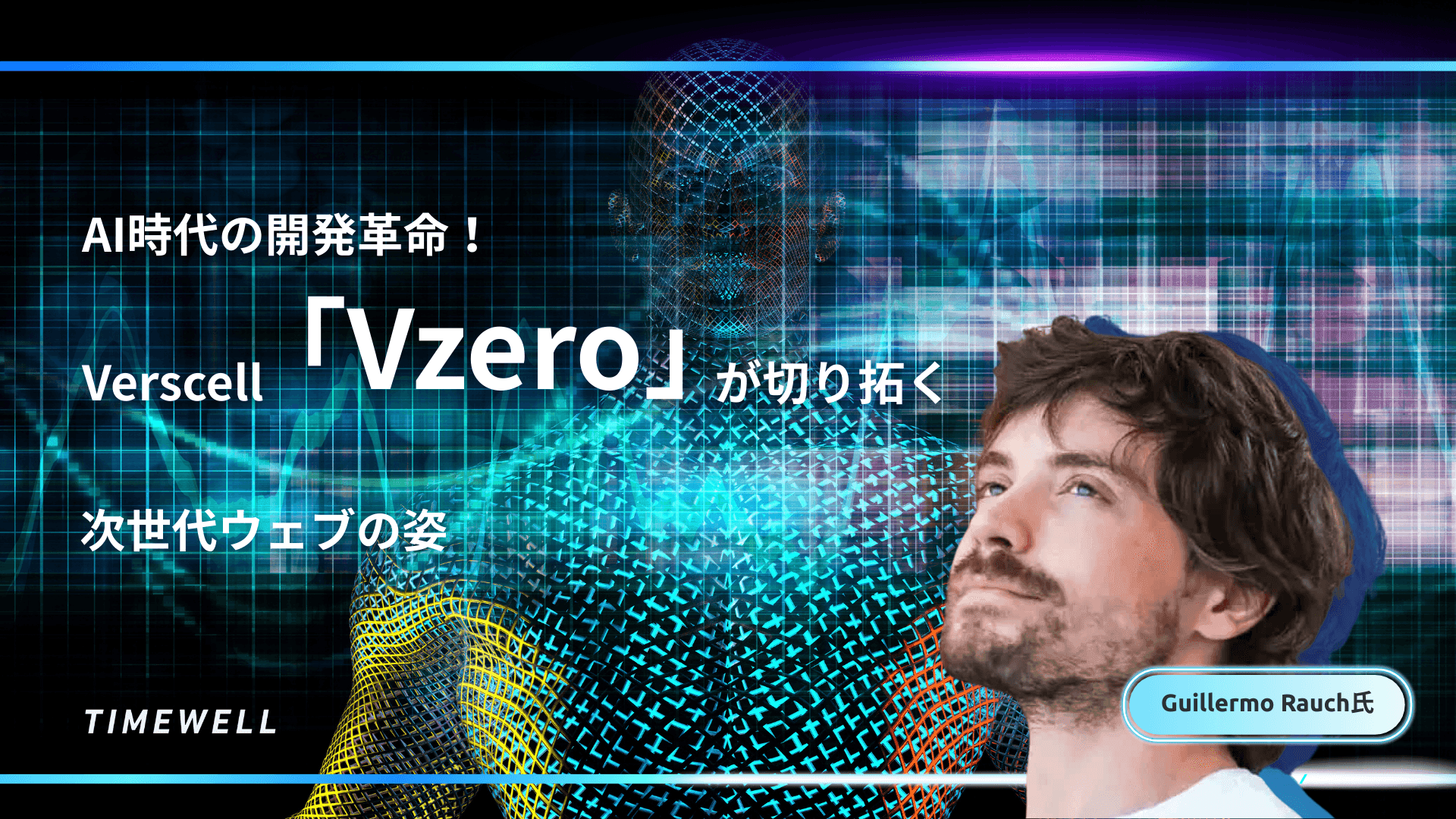
The rapid advancement of AI technology is triggering a dramatic transformation at the frontlines of software development. Traditionally, developers honed their skills by writing vast amounts of code and iterating through countless revisions. Today, AI is becoming deeply embedded in that process. Vercel CEO Guillermo Rauch's "v0" — a tool that generates frontend applications from text input alone — is upending how development works and how the market is structured at a fundamental level.
This technology marks a new phase that goes beyond legacy web frameworks, evolving from single-codebase development to a simple, natural-language-driven approach. It delivers benefits not only to developers but to a wide range of users including designers and marketers. v0 also generates working frontend demos that can stand in for investor pitch decks — bringing fresh energy to startup culture.
This article draws on an interview with Guillermo Rauch to give a comprehensive look at the current state of AI-driven next-generation development, the arrival of the agent era, and how automated infrastructure is shaping the future web.
- AI and Next-Generation Frontend Development: The Codeless World That v0 Is Opening
- The Agent Era and Vercel's Bold Strategy
- The Future Infrastructure That Automation and AI Are Building
- Summary
AI and Next-Generation Frontend Development: The Codeless World That v0 Is Opening
The software development market is undergoing a major shift in how it works. In frontend development especially, even as modern technologies and frameworks like React and Tailwind have proliferated, AI is now driving a new revolution. According to Rauch, the emergence of AI-powered automatic code generation marks a decisive turning point for traditional single-codebase and template-driven development approaches. Large language models (LLMs) can now generate working code from natural language alone. This means that not only professional developers with deep technical expertise, but also designers, marketers, and others adjacent to development can now bring their own ideas to life.
Vercel's v0 goes beyond merely generating code — it automatically incorporates refined design, performance optimization, and security considerations that were difficult to address with traditional frameworks. Users simply type a text prompt describing what they want to build, and a working web application is generated instantly. The time from concept to launch is dramatically compressed.
v0 is also rigorous about code quality management throughout the generation process. Its custom model performs error checking and real-time feedback, producing safe, accurate code with a built-in mechanism for continuous improvement based on usage patterns post-launch. The entire system has user feedback and automated evaluation metrics embedded in it, enabling real-time visibility into how published applications are actually being used and where improvements are needed. This ensures quality is maintained even as technology evolves daily, preventing errors and vulnerabilities before they occur.
This transformation also involves a generational shift in the development market. The knowledge and technical skills that experienced senior developers accumulated over years have traditionally been considered the most valuable asset. Today's environment, however, makes it possible to produce high-quality output quickly from the start by leveraging the benefits of the latest technology. Younger developers and those new to software creation can draw on the accumulated lessons and successes of previous generations through AI, efficiently producing high-quality output. In this sense, v0 is not just a tool — it is emblematic of the next-generation development cycle itself.
The arrival of v0 holds the potential to refresh traditional assumptions not just about developer efficiency and productivity, but across every dimension of web application design, performance, and security. The spread of this technology dramatically simplifies early-stage idea validation, transforming the previously costly and time-intensive process of prototyping into something quicker and more accessible. In practice, the ability to present a working web application during a pitch — rather than a slide deck — is already producing clear results in some startup use cases.
The quality management process embedded in generation is also far more flexible and automated than traditional frameworks. When a user enters a natural language prompt, the system understands its meaning and automatically selects the appropriate UI components and styling elements. If errors or issues arise that diverge from the user's intent, real-time error checking and feedback mechanisms apply corrections, ultimately ensuring reliable operation. This is precisely the boundless potential of AI and the decisive strength of next-generation frontend development.
v0 has also begun taking on the role of an "agent" across the entire development process, not just a code generation tool. Responding to user requirements, it automatically generates optimal website design and functional prototypes, then proposes adjustments and improvements — dramatically reducing the manual work that previously dominated development. This evolution brings not only productivity gains across the development market but an environment where creative thinking is freer, ultimately raising the quality of the user experience itself.
The Agent Era and Vercel's Bold Strategy
AI-powered automatic code generation is not merely a technical innovation — it is fundamentally restructuring the entire software development ecosystem. Guillermo Rauch says that an environment where not only developers but agents including designers and marketers can be put to work will become extremely important to how applications are built in the future. In short, a major shift is underway from a world where only developers wrote code by hand to one where creators of every background express their ideas in natural language and leverage automatically generated code.
Vercel has ridden the agent era wave precisely, deploying v0 as the vehicle for a strategy that redesigns the development process from the ground up. Their strategy places the end-user experience first, then builds the tools and infrastructure needed to deliver the simplest, most intuitive interface possible. AI provides extensive support not only when developers are bringing their ideas to life, but across the entire process through to market deployment and user adoption.
For example, if a user asks for "the ideal landing page for an e-commerce site," v0 automatically generates the optimal design and code from the standpoint of market trends, security, and performance. This makes it possible to walk into business negotiations with a working web application in hand instead of a PowerPoint deck.
Vercel is also extending the agent role beyond traditional development tooling into marketing and support. In chatbots and customer support, for instance, systems have been introduced that combine existing knowledge with cutting-edge AI technology to deliver fast, accurate answers to users' specific problems. One reported success story: a v0-generated frontend was adopted as-is for a pitch. The role agents play is expected to expand further going forward.
This new strategy does carry challenges that differ from traditional development environments. AI-generated code tends to be concise and clean, but the underlying logic can be harder to understand than conventional source code. This may require more advanced knowledge and tooling for maintenance and future extension. Vercel is attentive to these points, however — leveraging feedback loops and automated evaluation systems to put in place a framework that handles not only user experience but long-term operation.
A key characteristic of the agent era worth noting is the flexibility to respond to users' evolving needs. Users are not looking for a single fixed solution; they find great appeal in the idea that an AI agent will make optimal suggestions in response to their ever-changing requirements. In one case, a chatbot in a company's support division smoothly facilitated knowledge sharing across departments, dramatically improving the existing support structure. This kind of development is expected to influence not just future service delivery methods but corporate management strategy as a whole.
The Future Infrastructure That Automation and AI Are Building
Alongside software development, AI's advance is bringing major change to cloud infrastructure and web delivery technology. Traditional high-speed website performance and reliable service delivery depended on caching and content streaming technologies. Vercel has spent years building the technical foundation for the transition from static sites to dynamic sites and ultimately to a "generative web." Rauch says the know-how the company has built in cloud infrastructure automation is now being deployed in conjunction with AI-powered automatic code generation, opening a new frontier.
Traditional cloud infrastructure focused on optimization for delivering user-specific content on demand. Amazon.com, for instance, has used streaming technology to deliver different product recommendations and content to each user at high speed. Vercel has advanced this concept further, building a system called "Fluid Compute" for real-time delivery of AI-generated content. Rather than relying on traditional static caches, this system generates and delivers the optimal information for each user's request on demand — a new form that fuses AI code generation with cloud infrastructure automation.
Modern automated infrastructure also incorporates layered protections: automatic error correction, performance optimization, and security monitoring. Vercel has built a system to automatically detect and suggest fixes for errors and vulnerabilities latent in LLM-generated code. When the system detects a problem, an agent immediately identifies the cause, and a process to automatically generate and apply safe code kicks in. This dramatically improves the efficiency of operations and maintenance that were previously handled manually.
The combination of cloud auto-scaling and AI code generation also dramatically increases the autonomy of infrastructure operations. When the number of users spikes suddenly or traffic fluctuates unexpectedly, an AI agent immediately adjusts the number of servers and resource allocation to maintain stable service — something that simply could not be achieved through manual operation. In this way, AI-era infrastructure feels genuinely close to operating in a nearly "self-driving" mode.
Another notable characteristic of the generative web application era is the declining relevance of traditional installable software. There was a time when using software required downloading and installing an application. Today, an environment where software can be used immediately via the web is rapidly taking shape. v0 sits at the leading edge of this trend, delivering an experience where users can access high-quality web applications simply by opening a browser — making software use more seamless and intuitive than ever.
Advances in AI and automation are also having a major impact on the tools developers actually use and how they integrate. Seamless editor integration, automatic pull request generation from code, real-time error flagging and fix suggestions — these will become essential elements of future infrastructure operations and development processes. Companies can thus be confident that their own systems will always be in an optimized state, with rapid support available when human intervention is needed.
This future infrastructure, born from the fusion of automation and AI, is genuinely close to reaching a near-"self-driving" state in the near future. Systems that detect problems, performance degradation, and security concerns on their own — and automatically execute the most effective fixes — will become the standard across cloud services. As a result, we will be able to use services in an environment that balances stability and speed better than ever, while companies too move much closer to a future of reduced operational costs and optimized resources.
This article has drawn on an interview with Vercel CEO Guillermo Rauch to explain in detail the innovation that AI technology and automation are bringing to next-generation software development. Instant frontend generation from natural language input without writing code, the proliferation of tools that function as agents, and the advance toward near-fully automated infrastructure all hold the potential to fundamentally transform the web environment of the future.
An era has arrived in which developers and designers — and diverse creators of every kind — can easily bring their own ideas to life, and the realization of a new "generative web" that transcends the limits of traditional frameworks is becoming credible. Vercel's v0 sits at the forefront of this shift, delivering high-quality, rapid output for both users and enterprises. As agent technology and automation continue to evolve, major transformation in how software and web services are built is inevitable. To avoid being left behind by this new development revolution, staying alert to emerging trends and proactively embracing the latest technologies will be essential.
Reference: https://www.youtube.com/watch?v=YoxeOS60qBc
TIMEWELL AI Consulting
TIMEWELL is a professional team supporting business transformation in the age of AI agents.
Our Services
- AI Agent Implementation: Business automation using GPT-4o, Claude Opus 4, and Gemini 1.5
- GEO Strategy Consulting: Content marketing strategy for the AI search era
- DX and New Business Development: Business model transformation through AI
In 2026, AI is evolving from something you "use" to something you "work with." Let's think through your AI strategy together.