(22 November 2026) For the eKYC amendments taking effect on April 1, 2027, we replaced the source, which was a different FSA draft amendment on another subject, with e-Gov's revision history of the enforcement ordinance and the text as of the effective date. We also added the submission to the Diet of a bill on beneficial ownership information.
This is Hamamoto from TIMEWELL.
Before you sign with a new business partner, you look into it: "Is this company really all right?" When you open a bank account, you are asked to verify your identity. Both are everyday scenes, yet verifying a corporate counterparty has a name, KYB (Know Your Business), and verifying an individual has its own name, KYC (Know Your Customer). Each has a legal basis and a set way of being done.
This article is an introduction to KYB and anti-social-forces checks. Starting from "what is a UBO?" and moving through the different situations that require verification and on to the major regulatory change to eKYC (online identity verification) scheduled for 2027, it explains things plainly, drawing on primary sources from the National Police Agency, the Ministry of Justice, and the Financial Services Agency.
What KYB is, and why you check the people inside the company
The legal footing for KYB is the Act on Prevention of Transfer of Criminal Proceeds (APTCP).1 To prevent money laundering and terrorist financing, it obliges "specified business operators" such as financial institutions, real-estate agents, and certain professionals to verify their counterparties (verification at the time of transaction).
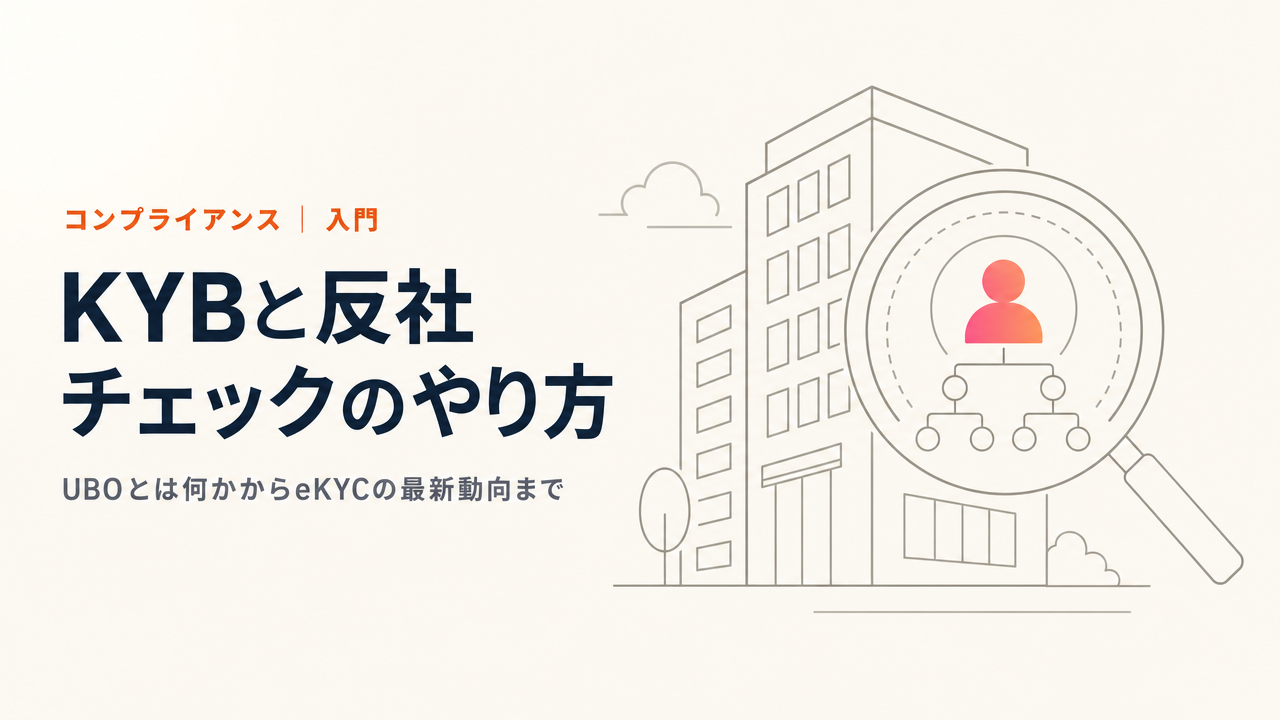
The crucial point here is that verifying a corporate counterparty does not end with looking at the company name and its registration. Someone who wants to move dirty money will interpose a shell company so as not to put their own name forward. Verification therefore has to trace back to the flesh-and-blood individual who substantively controls the company. That individual is called the UBO, the Ultimate Beneficial Owner.
What a UBO is: identified in the order "over 50% → over 25% → influence → representative"
The rules for identifying a UBO are set out in the enforcement regulations of the APTCP. For an entity governed by capital-based majority rule, such as a stock company, you identify them in the following order.2
| Rank | Criterion |
|---|---|
| 1 | An individual holding, directly or indirectly, more than 50% of the voting rights |
| 2 | If there is no one at rank 1, an individual holding, directly or indirectly, more than 25% of the voting rights |
| 3 | If there is no one at ranks 1 or 2, an individual with dominant influence over the business activities |
| 4 | If there is still no one, the representative |
In practice people often say "the UBO threshold is 25%," but strictly speaking, more than 50% is the first rank and more than 25% comes next. The other key point is that "indirect" holdings are counted. If the shareholder of Company A is Company B, and Company B is in turn held by individual X, you trace back to X to make the determination. When holding companies or funds are stacked several layers deep, this tracing quickly becomes difficult.
Note that for entities where voting rights are not proportional to the number of shares, such as a limited liability company (godo kaisha) or a general incorporated association, the determination is made by the share of the right to receive profit distributions or asset distributions (over 50% → over 25%) rather than by voting rights.2
Replace siloed classification work with AI.
METI's FY2024 data shows 52% of foreign exchange law violations stem from classification errors. Download the TRAFEED product catalog covering features and rollout.
The three situations where UBO verification comes up: easily confused, so let's sort them out
The term "beneficial owner" actually appears in three separate systems. Confuse them and you will get lost in practice, so here they are in a table.
| Situation | System | Mandatory or voluntary |
|---|---|---|
| When transacting with a specified business operator | Verification at the time of transaction under the APTCP | Mandatory (an obligation on the specified business operator) |
| When incorporating a stock company, etc. | UBO declaration at the notary's articles-of-incorporation notarization (began November 2018) | Mandatory at incorporation3 |
| When you want to prove UBO information after incorporation | The beneficial ownership list system at the commercial registry (began January 2022) | Voluntary; no fee4 |
The third, the list system, is surprisingly little known. If a stock company applies, the registrar verifies and stores its UBO information and issues certified copies free of charge. It is useful when a UBO proof is requested for a transaction with an overseas bank or a subsidy application. Incidentally, as of July 2026 there is no system that mandatorily records UBO information as a registered item. Since then, on October 23, 2026, the Cabinet submitted to the Diet a bill on ascertaining information on the beneficial owners of legal entities (our translation of the title: "Bill on Ascertaining Information Concerning Beneficial Owners of Legal Persons, etc."), which the House of Representatives Committee on Cabinet passed on November 20 (House of Councillors bill information as of November 21, 2026)5. When it will be enacted and take effect depends on the rest of the Diet's deliberations.
How to run an anti-social-forces check: the basis and the four basic steps
The anti-social-forces check is done together with KYB. Its basis is the government guideline "Guideline for Enterprises to Prevent Damage from Anti-Social Forces," agreed by the working-level committee of the Ministerial Meeting on Measures Against Crime on June 19, 2007,6 together with the organized crime exclusion ordinances enacted in every prefecture. It has become effectively mandatory practice in IPO reviews and banking relationships as well.
The basic flow has four steps.
- Search databases. Search newspaper-article databases and specialized anti-social-forces databases for the company name and the names of its representative and directors. Past incident coverage and administrative-sanction history are the basic screening targets.
- Confirm the substance of the company. Check the registration information, address, line of business, and the UBO. This is where you catch a company that has changed its name or one with a different figure standing behind it.
- Insert an organized-crime-exclusion clause into the contract. This is a clause allowing termination without prior demand if the counterparty turns out to be an anti-social force. It is also the practice required by the exclusion ordinances.
- Re-check periodically. Even if there was no issue at contract time, shareholders or directors can change afterward. Only when it includes ongoing verification after the relationship begins does it truly deserve to be called an anti-social-forces check.
Regulatory momentum and eKYC: a major change is coming in April 2027
Finally, let's take stock of where this field is right now. There are three developments.
The first is the shift to ongoing customer management. The Financial Services Agency's Guidelines for Anti-Money Laundering and Combating the Financing of Terrorism (most recently revised on March 31, 2026) call not for a one-time check at the start of a transaction but for ongoing customer management that keeps customer information updated on a regular basis; the deadline for financial institutions to put the framework in place was the end of March 2024.7 Verification is changing from a "point" task into a "line" task.
The second is the evolution of eKYC methods. Under an amendment to the enforcement regulations promulgated on June 24, 2025, a new verification method using the My Number Card's public key infrastructure loaded onto a smartphone was established, while at the same time verification methods carrying a high risk of impersonation were abolished.8
The third is the biggest change. Under amendments to the enforcement regulations taking effect on April 1, 2027 (e-Gov's revision history lists three, including an order promulgated on June 24, 2025), non-face-to-face verification by sending images of identity documents and by mailing copies is set to be abolished in principle, with the method consolidated in principle around the My Number Card's Japanese Public Key Infrastructure (JPKI). Even in person, reading the IC chip of a driver's license or the like is set to become mandatory in principle.9 Behind this is the reality that account openings using forged documents have been exploited for special fraud. The scene of "uploading a photo of your driver's license to verify your identity" looks set to become a thing of the past in about a year. (These April 2027 changes are scheduled, not yet in force.)
The real battleground moves to "ongoing counterparty investigation"
Take a step back and a common trend comes into view: verification, done rigorously and continuously. While identity verification of individuals is heading toward a technical solution via the My Number Card, verification on the corporate side, that is, KYB, is if anything getting harder. You have to trace the capital chain back through several layers to identify the UBO, cross-check against anti-social-forces and sanctions lists, and keep following changes in shareholders and directors. This work has to be run for every counterparty, continuously.
Summary
- KYB is the corporate version of counterparty verification. What distinguishes it is tracing back not just the company's registration but the "individual behind it," the ultimate beneficial owner (UBO).
- A UBO is identified in the order: over 50% of voting rights → over 25% → dominant influence → the representative. Indirect holdings are included.
- The situations where a UBO appears are three (verification at the time of transaction = mandatory; articles-of-incorporation notarization declaration = mandatory at incorporation; registry list system = voluntary), each a separate system.
- The anti-social-forces check rests on the government guideline and the exclusion ordinances. Its four steps are database search, substance confirmation, an exclusion clause, and ongoing re-checking.
- In April 2027, eKYC is set to move to the abolition in principle of image-upload verification and consolidation around the My Number Card (scheduled to take effect). Verification is entering an era of the "line" rather than the "point."
If you want checks on counterparties' capital ties and beneficial owners to run as a routine process, you can contact us about TRAFEED.
References
Related articles
- What Is Inward FDI Screening in Japan? FEFTA Prior Notification and the 1% Rule Explained
- What Is the UFLPA (Uyghur Forced Labor Prevention Act)?
- TRAFEED | Export Control AI Agent
Footnotes
-
Act on Prevention of Transfer of Criminal Proceeds (Act No. 22 of 2007) — e-Gov Law Search ↩
-
Enforcement Regulations of the Act on Prevention of Transfer of Criminal Proceeds, Article 11 — e-Gov Law Search ↩ ↩2
-
Japan National Notaries Association, "The System for Declaring the Person Who Is to Be the Beneficial Owner in Articles-of-Incorporation Notarization" ↩
-
Ministry of Justice, "Establishment of the Beneficial Ownership List System" (operation began January 31, 2022) ↩
-
House of Councillors, bill information: Cabinet bill No. 19, 222nd Diet session, "Bill on Ascertaining Information Concerning Beneficial Owners of Legal Persons, etc." (submitted October 23, 2026; passed by the House of Representatives Committee on Cabinet on November 20, 2026) ↩
-
Ministry of Justice, "Guideline for Enterprises to Prevent Damage from Anti-Social Forces" (agreed by the working-level committee of the Ministerial Meeting on Measures Against Crime, June 19, 2007) ↩
-
Financial Services Agency, "Guidelines for Anti-Money Laundering and Combating the Financing of Terrorism" (revised March 31, 2026) ↩
-
National Police Agency JAFIC, "Materials on the Amendments to the Enforcement Regulations of the Act on Prevention of Transfer of Criminal Proceeds" (promulgated June 24, 2025) ↩
-
e-Gov, revision history of the Ordinance for Enforcement of the Act on Prevention of Transfer of Criminal Proceeds (the amendments taking effect April 1, 2027 are Order No. 3 promulgated June 24, 2025, Order No. 1 promulgated March 6, 2026, and Order No. 5 promulgated June 26, 2026). In the text as of April 1, 2027, item (e) of Article 6(1)(i) is replaced: the method of having the customer send image data of a photo ID gives way to methods such as having the customer read the information on the ID's IC chip (checked November 22, 2026) ↩