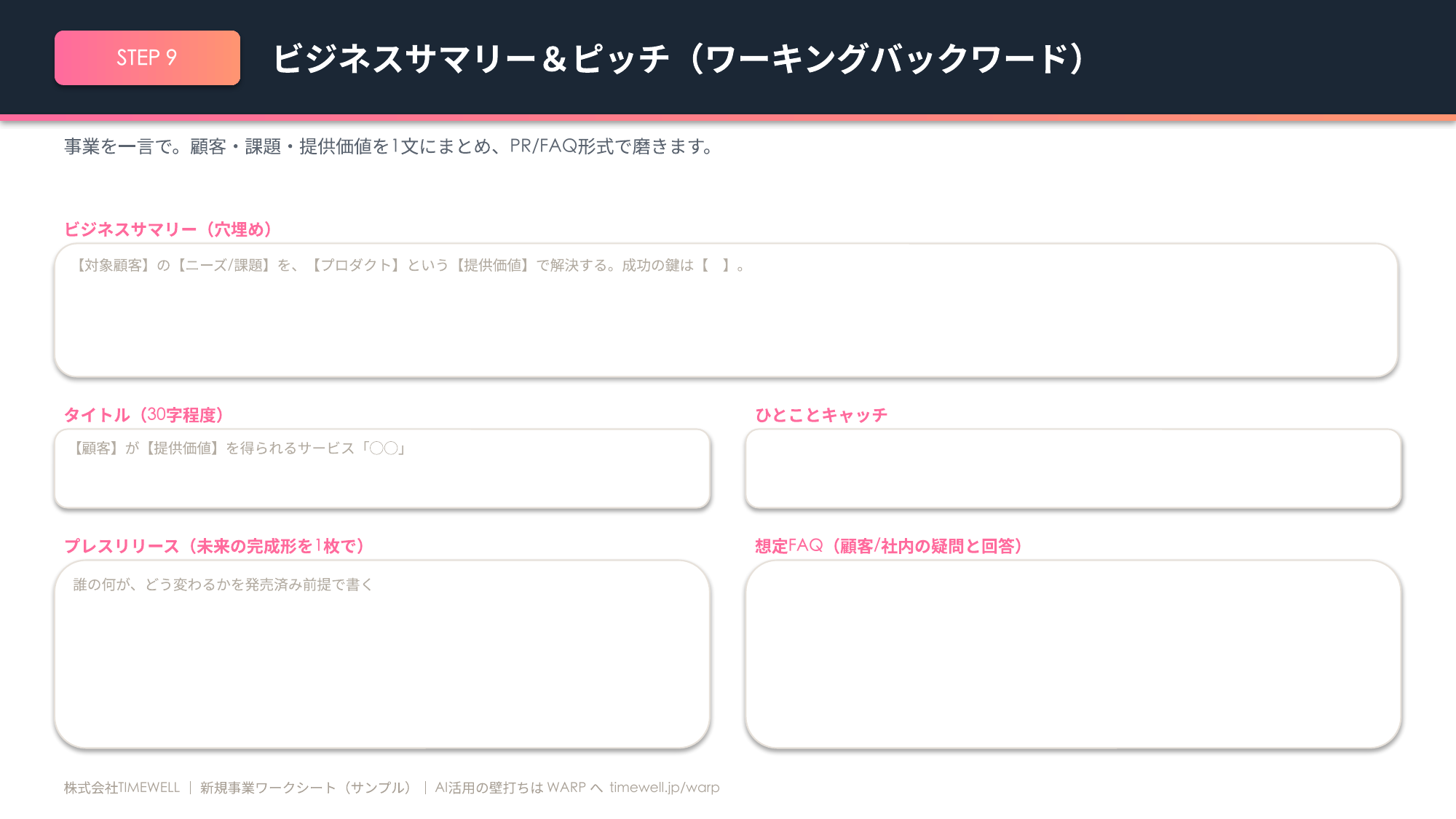
Business Summary & Pitch Worksheet (editable PPT)
A summary-and-pitch template that distills customer, problem, and value into one sentence and refines it in PR/FAQ form.
Download the PPT (free)PowerPoint (.pptx) ・ no email required
Hello, this is Ryuta Hamamoto from TIMEWELL.
You have a good business idea, but the moment you try to explain it, the other person's eyes start to wander. Have you had that experience? Most of the time the cause is not that the idea is bad, but that it hasn't yet been shaped into something you can say in one line. What looks three-dimensional in your head comes out of your mouth as fog: "It's a service that uses AI to make work more efficient, and, um, it can do all sorts of things." This is not a matter of talent. It's a matter of the order in which you build things.
This article is the final installment in a nine-step series for people who want to start a new business. It's the one about how to craft the business summary that conveys your idea in a single line, and the pitch you deliver to investors, teammates, and customers. The tools we'll use are Working Backwards, the reverse-engineering mindset Amazon has practiced for years, and the PR/FAQ document at its core1. It sounds difficult, but all you're really doing is "writing out the finished future in words, before you build." Anyone can do it once they start moving their hands. I've included templates, a worked example from a fictional business, and AI prompts you can paste in to spar with an AI along the way.
By the way, not being able to describe your own business well in your own words is closely connected to your AI literacy. Before you read on, it's worth spending about three minutes on the AI Literacy Check to confirm you're set up to have AI help organize your thinking. The prompts in this article will land better if you do.
Write the explanation "before" you build, not "after"
Most people build a product or service to some degree, and only then prepare the materials to explain it. That's backwards. Working Backwards starts by writing "what press release would we issue if this were finished and out in the world," and then decides the contents by reverse-engineering from there. It was proposed by Colin Bryar and Bill Carr, former executives who each spent more than a decade in senior roles at Amazon, and they codified the method in their book Working Backwards1.
Why go to the trouble of reverse-engineering from the future? The reason is simple: if you start from features, you can end up with something that excites the builder but isn't necessarily what the customer wants. When "I want to use this technology" or "I want to load in this feature" becomes the starting point, before you know it you've assembled a grab bag of features nobody asked for. Reverse-engineer from the finished press release, on the other hand, and the question "will this actually delight the customer?" sits in the center the whole time. You can validate whether the idea truly resonates using nothing but words, before you write a single line of code or design. That's the tastiest part of this method.
If you've followed this series in order, the ingredients are already in your hands. You narrowed down who you're selling to with customer segmentation, dug into the pain with the empathy map, put the benefit into words with the value proposition canvas, decided your differentiation with the positioning map, and laid the numerical foundation with market sizing. The final installment is the work of bundling all of it into "a single page that gets through to people." Whenever you want to check the big picture, come back to the hub, the complete guide to the new business framework.
Before we get to work, I've prepared a fill-in-the-blanks template. It's a set of slides matching each step in this article. So you can move your hands as you read, it helps to download it first.
Download the free sample PowerPoint template
Create the one-line summary and the title (steps 1 to 3)
The first thing to do is narrow your customer down to a single person. Make the target concrete enough that you can say "who, in what situation, with what problem" in one sentence. If this is vague, everything you write from here on will be blurry. "Small business owners" is too broad. Only when you narrow it to something like "the owner of an independent shop in a local shopping district who wants to handle online orders but can't run their own delivery network" do the words finally form a clear image.
Once the customer is decided, create the business summary that captures the business in one line. What helps here is the positioning template Geoffrey Moore presented in his book Crossing the Chasm2. Just fill in the following blanks and you'll have the skeleton of a sentence that gets through.
For [target customer] who [problem to solve], [service name] is a [product category] that [key benefit]. Unlike [existing alternative], we deliver [point of differentiation].
In this article, I'll carry one fictional new business through to the end as an example. The subject is "Machi no Hakobi-bin," a same-day, within-neighborhood delivery service that independent shops in a shopping district can share. Plugged into Moore's template, it looks like this.
For the owner of an independent shop in a shopping district who wants to handle online orders but can't run their own delivery network, faced with the problem that delivery costs are high, same-day delivery is out of reach, and local customers are being lost to major e-commerce, Machi no Hakobi-bin is a last-mile delivery service in which multiple shops share a delivery rider, cutting the cost per delivery to roughly half that of arranging it individually while making same-day, within-neighborhood delivery possible. Unlike keeping your own motorbikes and dedicated drivers, it lets you share a nearby delivery slot only when an order comes in, so you can start with zero fixed cost.
Try reading it aloud. If you can say it in under 30 seconds with no jargon mixed in, it passes. If it's long and you need to catch your breath, you haven't narrowed it enough.
Once the summary is solid, turn it into a one-line headline, that is, the title of your press release. The template is "[Company name] launches [service name], letting [target customer] gain [benefit]." What matters here is making the subject the result the customer gains, not the feature. For Machi no Hakobi-bin, it becomes this.
Machi no Hakobi-bin launches a shared delivery service letting independent shops start same-day, within-neighborhood delivery with zero fixed cost
When you can't quite nail it in one line, sparring with an AI is the fast route. Try the prompt below, pasting in your own idea.
You are a venture capitalist specializing in seed-to-early-stage new businesses, having screened over 200 pitches a year. With that eye, polish my idea below into a single-sentence positioning statement.

Steps:
(1) First, extract these five elements from my idea: target customer / problem to solve / product category / key benefit / existing alternative and point of differentiation. Mark any element where information is missing as "(insufficient info)."
(2) Following Geoffrey Moore's positioning template, "For [target customer] who [problem], [service name] is a [product category] that [key benefit]. Unlike [existing alternative], we deliver [differentiation]," write three sentences that each take a different angle.
(3) Score each variation from 1 to 5 on three axes: (a) does it avoid jargon, (b) is the benefit "the result the customer gains" rather than a "feature," (c) is it short enough to read aloud in 30 seconds.
(4) State the best variation, the reason, and how it differs from the runner-up.

Output format:
- "Five extracted elements": a bulleted list
- "Comparison table of the three variations": columns | # | Sentence | (a) Jargon-free | (b) Benefit quality | (c) 30-sec read | Total |
- "Recommendation and reason": the recommended number, why you chose it, and how it differs from the runner-up, in 3-4 sentences
- "Three weak assumptions most in need of validation": three unverified hypotheses this sentence relies on

Constraints:
- Banned: abstract words like "high-quality," "convenient," "efficient." Spell out who, which task, and how much it changes.
- If you use numbers that are not confirmed, mark them "(assumption)" and state the underlying premise. Do not fabricate facts.
- Always express the benefit as a result the customer gains (time, money, or opportunity).

[My idea] (paste here)
Looking for AI training and consulting?
Learn about WARP training programs and consulting services in our materials.
Write the fictional press release (step 4)
Once you have the summary and title, it's finally time to write the fictional press release. Keep it to one A4 page. Push any deep dives that threaten to run long into the FAQ you'll write next. The key is to write it "as if it's already out in the world," even though you haven't built anything yet. Tentatively pencil in an actual assumed launch date and it instantly gains a sense of reality.
The standard structure follows this order: headline, subheadline, assumed launch date, opening paragraph (who and what it solves, in three or four sentences), the customer's problem (two or three pains in order of importance), the solution, a quote from your leader, how it works, a fictional customer quote, and a one-sentence "how to get started" with a URL. Banish all jargon and any phrasing that only makes sense inside your own company. The iron rule is to write using only words a customer could read and understand as is.
Here's an excerpt from Machi no Hakobi-bin. Get a feel for the writing texture.
The opening reads like this. Machi no Hakobi-bin, Inc. today launched a locally rooted, same-day delivery service for independent shops in shopping districts. By having several nearby shops share a single delivery rider, even independent shops can now capture and deliver the "I want it today" orders from local customers that were previously flowing to major e-commerce.
In the problem paragraph, line up the walls shop owners face in order of importance. Many owners were caught in a triple bind: they wanted to take online orders, but the cost per delivery was so high it wiped out the profit; they didn't have enough order volume to justify hiring a dedicated driver; and in the end they could only serve customers who could come to the shop to pick things up.
In the solution paragraph, write how you answer that pain. We adopted a shared model in which a single rider makes the rounds, batching orders from the same neighborhood. Because you're charged only for what you use, fixed costs are zero, and the cost per delivery is roughly half that of arranging it individually.
Keep the founder's quote unadorned, too, just one line. "The number one reason local shops disappear is losing to the big players on convenience. If we make delivery affordable enough for an independent shop, the shopping district can still put up a fight." As for how it works, the owner simply registers the order and delivery address in a dedicated app. It's automatically assigned to an available rider nearby, and reaches the customer in as little as two hours. For the customer quote, stand up a specific person, even a fictional one. "Even a small deli like ours can make it in time for tonight's dinner. Our regulars have come back." Keep "how to get started" to one sentence. No setup fee and no monthly fixed fee, you can use it from a single delivery.
Once you've written this far, the person who wrote it should understand it best of all. If reading the headline doesn't excite you, that means it won't excite the customer either. When that happens, it's a sign to go back to the plan itself and rethink. When you want to draft the whole thing in one go, the prompt below helps.
You are a product manager and technical writer well-versed in Amazon's Working Backwards method and PR/FAQ. From the premises below, write a "fictional press release" to write before you start building, about one A4 page (roughly 400-550 words).

Steps:
(1) Read the premises and choose only vocabulary the target customer can read and understand as is. Replace jargon and internal shorthand with everyday words.
(2) Tentatively pencil in one realistic assumed launch date (mark it "(assumption)").
(3) Fill in the following structure, in this exact order.

Output format (use these headings in this order):
1. Headline (one line whose subject is the result the customer gains)
2. Subheadline (one sentence supporting the headline)
3. Assumed launch date (assumption)
4. Opening (who and what it solves, in 3-4 sentences)
5. Customer's problem (2-3 items in order of importance, 1-2 sentences each)
6. Solution (how you answer it, 3-4 sentences)
7. Founder's quote (an unadorned line, 1-2 sentences)
8. How it works (from sign-up to value delivered, in 3 steps or fewer)
9. Fictional customer quote (1-2 sentences with a specific persona)
10. How to get started (one sentence, mentioning whether there's a fee)

Constraints:
- Banned: abstract words like "convenient," "high-quality," "easy." Get concrete with numbers, proper nouns, and specific situations.
- Do not assert unconfirmed numbers (price, reduction rate, time) as fact; mark them "(assumption)" and add a one-line premise for how they were derived. Do not fabricate.
- Center the writing on the result the customer gains, not a list of features.
- After writing, critique yourself harshly on "will this headline truly excite the customer?" and name three spots you felt were weak, with fixes.

[Premises] Target customer: / Problem: / Solution: / Differentiation: (paste here)
Kill your weak points early with two kinds of FAQ (steps 5 and 6)
Once the press release fits on one page, questions you couldn't cover will inevitably surface. What absorbs those is the FAQ. There are two kinds of FAQ, and the trick is to think about them separately.
One is the customer-facing FAQ. How much does it cost? How is it different from existing options? What do I need to get started? How much effort is it to switch? It answers the questions a prospect asks first. For Machi no Hakobi-bin, that would be: the price has no setup or monthly fee, just per-delivery usage charges; the difference from the big delivery agencies is that it specializes in same-day, within-neighborhood service and keeps the unit cost down through sharing; all you need is a smartphone and your product, with no dedicated vehicles or drivers to hire. To fully surface the questions by putting yourself in the customer's shoes, having an AI play the customer reduces the gaps.
Become the actual target customer of the service below. Think as that person, including their job title, budget, daily work, and past failures.

Steps:
(1) From the given attributes, first put into words your (the customer's) position, sense of budget, and decision-making habits.
(2) Read the introduction and list 15 things you would actually wonder or worry about, in colloquial language, when considering whether to use it. Always include price, difference from existing options, effort to switch, what's needed to adopt it, what happens if it doesn't work out, and the difficulty of convincing your own organization.
(3) Sort the 15 into three groups: "must know before adopting / worries once I start using it / asked in approval or by my boss."
(4) For each question, write a draft "customer-facing FAQ" answer, in 2-3 sentences, that I as the provider should prepare.

Output format:
- "My persona (as the customer)": 3-4 sentences
- "Anticipated Q&A table": columns | # | Group | Customer's question (colloquial) | Draft answer (2-3 sentences) | (15 rows)
- "Three questions where the answer feels weak or evasive": three questions that would put us at a disadvantage if answered honestly, each with a one-line note on why

Constraints:
- Don't leave questions vague like "does it really work?"; get concrete about amounts, effort, time, and failure scenarios.
- If a draft answer uses unconfirmed numbers, mark them "(assumption)" and add the premise. Do not fabricate.
- Don't gloss things over; prioritize the points a customer genuinely balks at.

[Service introduction] (paste here) / [Target customer attributes] (paste here)
The other is the internal FAQ. This is where you ask yourself whether it holds up as a business, and the harder a question is to answer, the more valuable it is. How large is the market? What are the unit price, cost, and gross margin, and what's the condition for turning a profit? What are the dependencies, the people, technology, or partnerships you need? What's the biggest risk and the scenario where it doesn't work? Why can our company win? Why now? For Machi no Hakobi-bin, you'd estimate market size by multiplying the number of shops in shopping districts by the share not handling e-commerce and the average delivery unit price, and talk about profitability in terms of a break-even: how many shops in one area register and how many deliveries per day it takes to fill a rider's capacity. The biggest risk is a mismatch between demand and rider supply. You'd cite specifics like riders not gathering in sparsely populated areas, or too few slots at peak hours, and write the countermeasure too, that this is exactly why you focus on a single shopping district at first to build density.
What matters here is not asserting the market size numbers without grounds. Provisional is fine, but present the calculation formula together with its premises. This foundation-building is where the work you did in the earlier step, estimating market size with TAM, SAM, and SOM, pays off directly. It's tempting to look away from the inconvenient questions, but investors and teammates will jab at exactly those spots. Crush them yourself in advance and you won't panic in the real conversation. To get ahead of the tough questions, having an AI play an investment committee works well.
You are a tough investment committee (three reviewers) reviewing my business plan. You probe, starting from the hardest points, whether there's enough grounds to justify an investment.

Steps:
(1) Read the press release (or service overview) below and surface the vital points of whether it holds up as a business.
(2) Create 10 "internal FAQ" questions needed to make a decision, in order from hardest to answer. You must include these perspectives: (1) market size (TAM/SAM) (2) unit price, cost, gross margin, and profitability conditions (3) dependencies such as needed people, technology, and partnerships (4) the biggest risk and the scenario where it fails (5) why our company can win / why now (6) what we won't do (out of scope) (7) the metrics for measuring success.
(3) For each question, add a hint on the points I should address and the type of formula or data I should use to answer.

Output format:
- "Internal FAQ table": columns | # | Question | Perspectives covered (1-7) | Hint on points to address | Likely follow-up jab | (10 rows, hardest to answer first)
- "Three weakest hypotheses most in need of validation": which of market, unit economics, or execution is most likely to break, three items with reasons

Constraints:
- Don't let it slide with abstract words like "the market is big" or "there's demand"; make questions that probe with numbers (e.g., break-even at a unit price of X and Y deliveries, where you ask for the X).
- When probing market size or unit economics, prompt for the explicit formula (e.g., number of shops x share not handling e-commerce x average unit price). Have provisional numbers marked "(assumption)." Do not fabricate.
- Place the more inconvenient questions higher, on purpose.

[Press release/overview] (paste here)
Keeping the customer-facing and internal FAQs separate is convenient when you later show them to people. Show customers only the customer-facing set, and show both to investors and to internal decision-makers. From the same material, you can serve it up differently depending on the audience.
Validate through silent reading and distill it into a pitch (steps 7 to 9)
Once the PR/FAQ is written, you read it and validate it. Amazon's method is called silent reading, and it devotes the first 10 to 20 minutes of a meeting to everyone reading silently. Rather than explaining with bullet-point slides, you make the decision on the prose itself. It's a famous story that Amazon's founder banned the use of slides in meetings1. Prose doesn't let you fudge. A hole you could ride past on momentum in slide bullets becomes plainly visible as a logical leap when written in full sentences.
What you actually do is have a third party read it silently and ask them frankly, "Do you want this?" and "Where was it unclear?" Ideally someone close to your assumed customer. If reading it doesn't move them, rebuild the plan. What you're deciding here is one of three options: go, rebuild, or stop. When the market, unit price, or cost numbers don't hold up, or the customer quote just can't help sounding fabricated, not starting yet is the right call. A PR/FAQ isn't something you complete in one shot. Assume you'll rewrite it many times, and keep reworking it until the prose excites you to read. Think of rewriting not as failure but as the privilege of making your mistakes cheaply, before you start.
Once you get a go, it's the final finishing touch. Compress the business summary and the opening paragraph of the press release into a spoken-word elevator pitch. An elevator pitch is a short explanation, lasting the 30 seconds to 2 minutes you'd share an elevator ride, that makes the other person understand and want to hear more. The basic elements are: who it's for, what it is, why it's needed, and how you deliver it. Whether you can grab the listener's attention in the first sentence or two is what decides the outcome. A common misunderstanding here is thinking the purpose of the pitch is to close a sale on the spot. The purpose is to lead into the next conversation. Push the sale too hard and the listener pulls back instead.
For the same business, the phrasing that lands changes with the audience. Investors want the market and the winning angle, a recruiting candidate wants a problem worth solving, and a prospect wants a benefit that's personal to them. Prepare multiple tones from one summary, and you won't be caught off guard in any situation. Crafting these variations is another thing AI is good at.
You are a business development consultant and speechwriter who sharpens executives' pitches. Convert the business summary and press release opening below into a spoken-word elevator pitch.

Steps:
(1) Extract the four elements from the material: who it's for / what it is / why it's needed / how you deliver it. If one is missing, flag it as "(element missing)."
(2) Craft a hook in the opening sentence that grabs the listener's attention (use a number, a surprising fact, or the listener's pain).
(3) Make two versions: (A) a 30-second version (about 60-75 words) and (B) a 15-second version (about 30 words). Both close with "a question that makes them want to keep talking."
(4) Serve up the same content in three tones: for investors, for recruiting candidates, and for prospects (investors = market and winning angle, recruiting candidates = a problem worth solving, prospects = a benefit personal to them).

Output format:
- "Four extracted elements": a bulleted list
- "Pitch table": columns | Audience | 30-second version | 15-second version | (three rows: investors, recruiting candidates, prospects)
- "Read-aloud check": a one-line note on whether each 30-second version truly fits 30 seconds (word count) and whether the opening hook works
- "The single weakest pitch and how to fix it"

Constraints:
- Banned: abstract words like "innovative," "cutting-edge," "convenient," and overuse of buzzwords. Use concrete phrasing the listener feels is personal to them.
- Avoid a salesy tone; keep the purpose strictly to "leading into the next conversation."
- Mark unconfirmed numbers "(assumption)." Do not fabricate facts.

[Material] (paste here)
Make AI a partner in building your business
I've introduced five prompts so far. Line them up and AI's role becomes clear. Polish the summary, draft the press release, become the customer to surface questions, become the investment committee to jab at weak points, and convert it into a pitch. What they have in common is that you're not dumping the answer on the AI. You use it strictly as a sparring partner and make the judgments yourself. Get this wrong and you'll mass-produce business plans that look the part but have no substance.
What I always keep in mind when I use AI to build a business is to have it draft fast and critique hard. When you think alone, you inevitably go easy on your own ideas. Have AI play an investment committee or a scathing customer, and weak points you didn't want to see come out. Every time you crush one, the business plan gets a little more robust. Get used to this way of using it and the speed of building a business changes in a way you can feel.
At the same time, let's look at the common failures. Starting from the product or feature. Filling the press release with jargon. Listing features instead of benefits. Dodging inconvenient questions in the FAQ. Asserting market size without grounds. Trying to complete it in one shot. Every one of them happens the moment you stray from the principle of working backwards. Be especially careful when you feel the urge to speak in feature words like "AI-powered." What the customer wants to know isn't the technology inside, but the result, how many of their own minutes it frees up.
Extending this kind of sparring with AI into business strategy itself is what TIMEWELL's WARP accompanies you on. We help you not just wield AI as a tool but design how to build it into your management and business decisions. If you'd like to actually run a PR/FAQ on your own idea, don't hesitate to reach out through a WARP consultation.
Summary
Not being able to say your business in one line isn't a matter of talent, it's a matter of order. Rather than explaining after you build, write out the finished future in words before you build. Grasp this one idea from Working Backwards, and from there you just move your hands to get closer to a business plan that gets through.
Finally, let me name just one thing you can do starting tomorrow. Take the idea you're thinking about now and fill in just one A4 page. A fictional press release. It's fine if you can't write it well. The very fact that you couldn't write it is the clearest diagnosis of all that your customer image and benefit aren't yet defined. Once you can write it, have someone read it silently. Whether that person's face moves is the most honest feedback you can get before writing a single line of code.
With that, you've completed all nine steps of the new business framework. Whenever you want to look back at the whole thing or return to a step along the way, head to the complete guide to the new business framework. I hope your one line draws out someone's "tell me more."
Footnotes
-
Colin Bryar and Bill Carr, Working Backwards: Insights, Stories, and Secrets from Inside Amazon (2021), and the authors' official site workingbackwards.com. The primary explanation of Working Backwards, PR/FAQ, and silent reading. ↩ ↩2 ↩3
-
Geoffrey A. Moore, Crossing the Chasm. The source of the positioning statement (the template for expressing a value proposition in one sentence). ↩