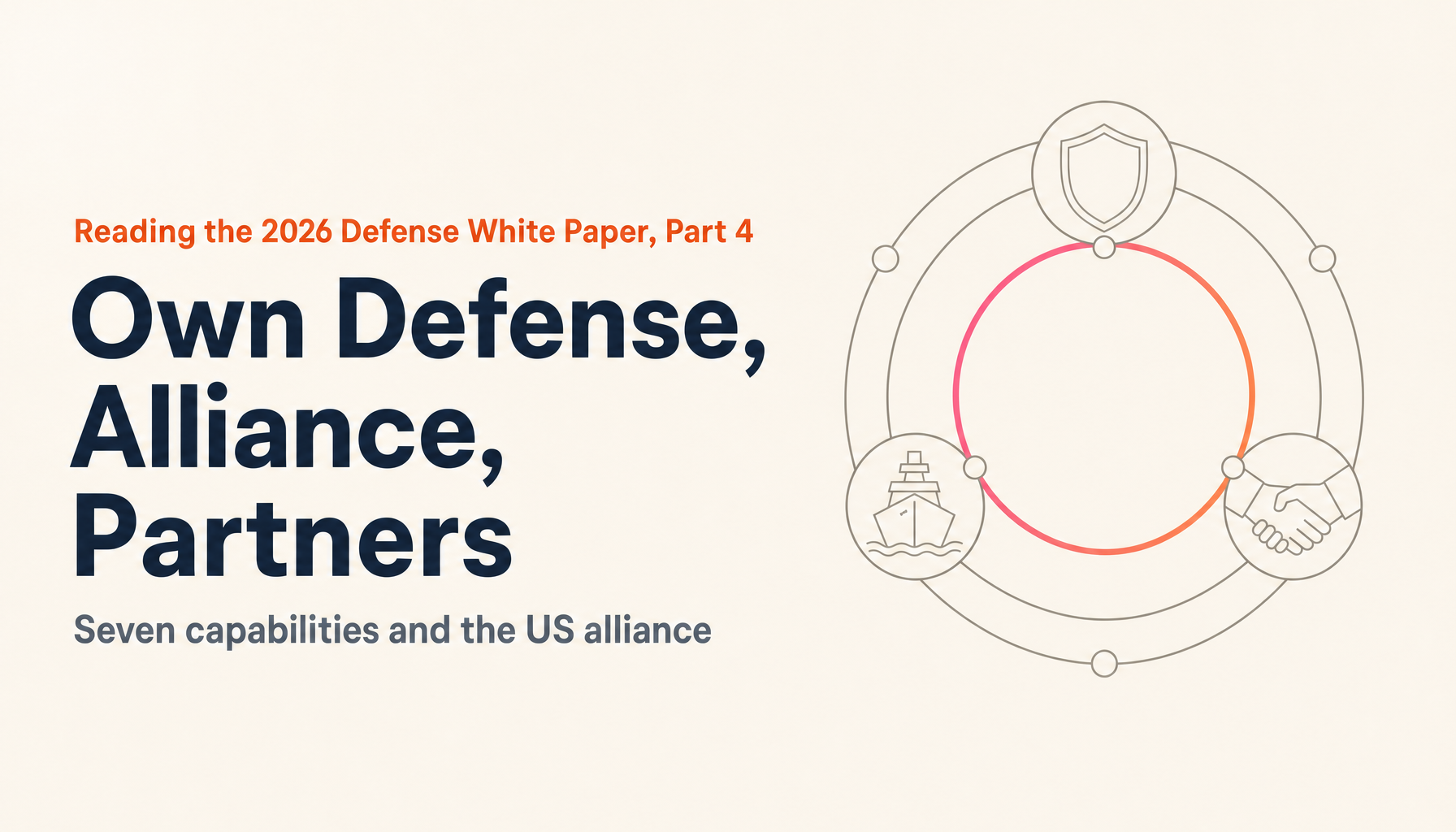
Hello, this is Ryuta Hamamoto from TIMEWELL Inc. This is the fourth part of our five-part series reading the Reiwa 8 (2026) edition of Japan's Defense White Paper.
Here is the answer up front. Part III of the White Paper covers three approaches to achieving Japan's defense objectives. The first is Japan's own defense posture, the second is the Japan-US alliance, and the third is cooperation with like-minded countries.1 In this part, I read the seven capabilities that form the core of Japan's own defense build-up and the mechanics of the Japan-US alliance in the most detail. For the whole series, Part 1 covers the special feature and Japan's policy, Parts 2 and 3 cover the situation in each country and region and the new ways of warfare, and Part 5 covers the industrial and personnel base.
Part III runs to about 190 pages, so I cannot fit everything into one article. I spend the most time on the seven capabilities in Chapter 1 and the alliance in Chapter 2, and I keep to the essentials for Chapter 3 on like-minded countries and Chapter 4 on coexistence with communities and the environment. Where something does not fit, I point you to the original text as a section to keep reading.
This article explains what the White Paper says, in the White Paper's own terms. Where I write "the White Paper says," that is the government's position, not my evaluation. When I give my own view, I label it "my view." On points where opinions differ, such as counterstrike capability or the realignment of US forces, I convey the White Paper's text and the government's position and do not take sides. I mention equipment names only to the extent the White Paper states them, and I do not compare performance.
Key terms first
This section has many acronyms, so here are the main terms up front. The everyday comparisons are mine.
| Term | Meaning | Everyday comparison |
|---|---|---|
| Three approaches | The three routes to the defense objectives. Japan's own defense posture, the Japan-US alliance, and cooperation with like-minded countries | Three roads to one goal |
| Joint operations | Operations in which the ground, maritime and air SDF act together under the unified command of the Joint Operations Commander | A project where one lead coordinates three departments |
| Stand-off defense capability | The ability to deal with invading ships, landing forces and similar targets from outside their threat range | A long arm that acts from outside the other side's reach |
| Counterstrike capability | The ability to carry out an effective counterattack in the other side's territory, as the minimum necessary self-defense measure under the three requirements, when an armed attack has occurred | No comparison here. Read the White Paper's definition |
| Unmanned assets | Equipment such as unmanned aerial, surface and underwater vehicles | Robots that work in dangerous places in place of people |
| Cross-domain operations | Operations that fuse space, cyber and electromagnetic domains with land, sea and air to amplify overall capability | An orchestra of players with different instruments |
| Civil protection | Evacuation and relief efforts that protect residents' lives and property from armed attack and similar events | A town's evacuation plan and shelters |
| Articles 5 and 6 of the Japan-US Security Treaty | Article 5 provides for joint response to an armed attack on Japan. Article 6 provides for US forces' use of facilities and areas in Japan | A promise to help each other, and the base that makes it possible |
| Extended deterrence | Providing one country's deterrence to its allies and others | A neighborhood security pact |
| Alliance Coordination Mechanism (ACM) | A mechanism for policy and operational coordination between Japan and the US from peacetime to contingencies, so that responses are consistent | A liaison meeting and working desk between two companies |
| Capacity building assistance | Training and technical support that raise the partner country's own capability | A visiting technical training course |
The map of Part III and preparing for an invasion of Japan
Three objectives and three approaches
Part III begins with the three defense objectives in the National Defense Strategy. The first is to create a security environment in which unilateral change of the status quo by force is not tolerated. The second is to deter and respond to such change or attempts, in cooperation with allies and like-minded countries. The third is that, if Japan is invaded, Japan takes primary responsibility for dealing with it. To achieve these, the White Paper says Japan pursues three approaches, its own defense posture, the Japan-US alliance and cooperation with like-minded countries, integrating all efforts.2
Chapter 1 covers Japan's own defense posture, Chapter 2 the Japan-US alliance, Chapter 3 cooperation with like-minded countries, and Chapter 4 coexistence with local communities and the environment.2
Responding to an invasion through joint operations
The White Paper notes that Japan has many islands and a vast exclusive economic zone (EEZ). If deterrence fails and an invasion occurs, Japan takes primary responsibility for responding, with support from its ally. In doing so, the Ministry of Defense and the SDF fuse operational capabilities in the land, sea and air domains and in the space, cyber and electromagnetic domains under the unified command of the Joint Operations Command, and conduct joint operations that link the ground, maritime and air SDF.3
The White Paper also sorts out operations by domain. Aerial attacks are detected by warning and control radars and airborne warning and control system (AWACS) aircraft and intercepted at a distance by fighters and surface-to-air missiles. Ships and landing forces are dealt with as early and as far out as possible using stand-off missiles and unmanned assets. Securing sea lanes is also treated as an operation.4
Against ballistic missiles, the basic approach is multilayer defense, combining upper-tier interception by SM-3 missiles on Aegis ships with lower-tier interception by Patriot PAC-3, with command and control handled by the Japan Aerospace Defense Ground Environment (JADGE). Japan receives shared early warning (SEW) information from US forces right after a launch, and since December 2023 Japan, the US and South Korea have been able to share missile warning data in real time on a continuous basis.4
The space, cyber and electromagnetic domains come up again below. As for large-scale terrorism and attacks on critical infrastructure, the police respond first, the SDF support them as needed, public security operations apply if police capability is insufficient, and defense operations apply if the event is recognized as an armed attack.5
Everyday surveillance and international missions
The White Paper devotes many pages to everyday activities, not only to responding to an invasion. Japan consists of more than 14,000 islands, its territorial sea and EEZ together rank sixth in the world by area, and the SDF conduct intelligence gathering and surveillance around the clock.6 In fiscal 2025 the Air SDF scrambled 595 times, 366 against Chinese aircraft, 214 against Russian aircraft and 15 against others. The White Paper records that in December 2025 a Chinese military aircraft directed radar at an SDF aircraft, calls it a dangerous act, and says the Minister of Defense explained the incident to other countries and shared strong concern. I covered the neighbors themselves in Part 2.6
Responding to information warfare that works on people's perception, such as the spread of false information, is also covered. The White Paper says the Defense Intelligence Headquarters plays the central role, that Japan will build the intelligence capability to respond reliably to information warfare, including the cognitive domain, by 2027, and that Japan itself does not engage in spreading false information or manipulating public opinion in ways that would damage its credibility.7
International missions include responding to ship-to-ship transfers at sea by North Korean-flagged vessels, which violate UN Security Council resolutions. The Maritime SDF confirmed 24 suspected transfers between 2018 and the end of March 2026 and shared the information with the countries concerned.7 In counter-piracy off Somalia and in the Gulf of Aden, the number of ships escorted reached 4,076 as of March 31, 2026, and information gathering for the safety of Japan-related ships in the Middle East continues. The White Paper cites Japan's dependence on the Middle East for about 90 percent of its crude oil imports.8
The main points so far are these.
- For an invasion, Japan responds with joint operations that fuse land, sea, air, space, cyber and electromagnetic capabilities under the unified command of the Joint Operations Command.
- The SDF carry out surveillance around the clock, and scrambles in fiscal 2025 numbered 595.
Replace siloed classification work with AI.
METI's FY2024 data shows 52% of foreign exchange law violations stem from classification errors. Download the TRAFEED product catalog covering features and rollout.
The seven capabilities (1) Reaching, defending, and unmanned work
This is the core of Chapter 1. The White Paper says that ways of fighting are changing, with large-scale missile attacks by precision-strike weapons, hybrid warfare including information warfare, the space, cyber and electromagnetic domains, and asymmetric attacks using unmanned assets being combined. It therefore says Japan will fundamentally strengthen its ability to defend itself by focusing on the other side's capabilities, and it prioritizes seven fields.9
Here is an overview table first. The budget figures are the 2026 budget measures that the White Paper shows for each field.10
| Capability | In one line | 2026 budget measures (approx.) |
|---|---|---|
| Stand-off defense | Deal with threats from outside their range | 973.3 billion yen |
| Integrated air and missile defense | See and defend against what comes from the air as one system | 509.1 billion yen |
| Unmanned asset defense | Combine inexpensive, numerous unmanned systems with crewed equipment | 277.3 billion yen |
| Cross-domain operations | Fuse space, cyber and electromagnetic with land, sea and air | Space 174.0 billion, cyber 233.1 billion, land, sea and air 992.9 billion yen |
| Command and control, intelligence | Connect information and decide quickly and correctly | 516.6 billion yen |
| Mobile deployment and civil protection | Move the forces and the residents who need to move | 192.4 billion yen |
| Sustainability and resilience | Keep going with ammunition, fuel, maintenance and facilities | A field total could not be confirmed |
Stand-off defense capability and counterstrike capability
Stand-off defense capability is the ability to deal with invading ships, landing forces and similar targets from outside their threat range. The White Paper says that stand-off missiles with long range and high survivability against interception can effectively stop attacks on Japan while keeping SDF personnel safe.9
The White Paper explains the government's thinking in a Q&A form. First, advances in military technology are making it harder to detect the other side's first strike in advance, so while maintaining an exclusively defense-oriented policy, reducing the possibility of an armed attack itself is important. Second, stand-off missiles are meant for ships and landing forces but can also be used for counterstrike. Third, counterstrike capability is defined as the ability to carry out an effective counterattack in the other side's territory, as the minimum necessary self-defense measure under the three requirements for the use of force, when an armed attack has occurred and ballistic missiles or similar means have been used. Fourth, asked whether this raises regional tension, the government replies that it acts within the Constitution and international law, upholds the exclusively defense-oriented policy, would not use these missiles for a preemptive strike, and has built up the quantity needed to stop and eliminate an invasion.9 I do not evaluate whether people agree or disagree with this.
On concrete steps, the ground-launched Type 12 surface-to-ship missile (improved) completed development in fiscal 2025 and was fielded as the Type 25 surface-to-ship missile, and the hypersonic missile has entered early mass production from 2026. Among foreign systems, acquisition of the US-made Tomahawk began in fiscal 2025.10
Operating missiles requires target information. The White Paper says that from the end of fiscal 2025 Japan began launching small satellites in stages to build a satellite constellation (many small satellites operated together as one system) for detecting and tracking targets, aiming for full operation from fiscal 2027.11 My view is that the point to note when reading the White Paper is that stand-off defense is discussed as a set with information gathering and command and control, not only as a matter of how many missiles there are.
Integrated air and missile defense capability
For an island nation, the White Paper says, responding to threats from the air is extremely important. Ballistic missiles with multiple or maneuvering warheads, faster and longer-range cruise missiles, stealth aircraft and hypersonic glide vehicles (HGVs) have made the threat more diverse, complex and advanced.12
The approach is to strengthen detection, tracking and interception sharply and then to operate sensors such as radars and the shooters (interceptor missiles and their launch platforms) as one network, optimally. Air defense equipment that each service operated separately will be operated together with ballistic missile defense equipment. Concrete measures include strengthening interceptors such as the PAC-3 MSE, acquiring the SM-3 Block IIA, which Japan and the US developed jointly, building Aegis system equipped vessels, and the joint Japan-US development of the Glide Phase Interceptor (GPI) for hypersonic weapons in their glide phase.12
Unmanned asset defense capability
The White Paper says unmanned assets can operate for long periods in harsh environments without human losses and can impose costs on the other side. It introduces the tasks they are expected to take on as the "4Ds," meaning dull, dirty, dangerous, and deep or distant.13
The Ministry of Defense aims to build the Synchronized, Hybrid, Integrated and Enhanced Littoral Defense (SHIELD) system, a multilayer coastal defense using unmanned assets, within fiscal 2027. It combines inexpensive, numerous unmanned aerial vehicles (UAVs), unmanned surface vehicles (USVs) and unmanned underwater vehicles (UUVs) in layers according to mission, terrain and the nature of the threat, linked with crewed assets. The White Paper calls this an asymmetric, multilayer defense posture. It also says that some activities, such as real-time tracking of submarines by patrol aircraft, can for now be done only by crewed assets, so both will be used together.13
Unmanned assets are not only for attack. The White Paper records that in June 2025 the Maritime SDF carried out its first trial of live mine disposal using an unmanned system at Iwo Jima. The explanation is that this can lower the burden on personnel working in dangerous environments.13 For how an unmanned boat gets procured, see How Japan's Coast Guard Got an Autonomous Boat.
The main points so far are these.
- Stand-off missiles can also be used for counterstrike, but the White Paper says their original purpose is to stop invading ships and landing forces at a distance.
- Integrated air and missile defense operates sensors and shooters as one network, and unmanned assets are used together with crewed equipment.
The seven capabilities (2) Fusing, connecting, moving, sustaining
Cross-domain operations capability
Cross-domain operations fuse the operational capabilities of space, cyber and electromagnetic domains with those of the traditional land, sea and air domains to amplify overall capability through synergy. The White Paper stresses that weakness in one domain can be covered by another and says Japan will expand its capability in space, cyber and the electromagnetic spectrum.14
In space, Japan issued its Defense Guidelines for Space Domain in July 2025 and is strengthening capability along four approaches, which are fast and accurate situational awareness, securing satellite communications, mission assurance, and hindering the other side's command, control and communications. The Air SDF is scheduled to be reorganized as the Air and Space SDF within fiscal 2026, reflecting that space is becoming a domain for operations and not merely something to observe.14
In cyber, the White Paper explains that under the Active Cyber Defense legislation passed in May 2025, the SDF received legal authority for "access and neutralization measures" to prevent damage from serious cyberattacks. The Ministry of Defense and the SDF plan to establish, by fiscal 2027, a posture that can protect command and control and high-priority equipment systems even while under cyberattack, and to build the capacity to support cyber defense in the defense industry. For information systems, the approach shifts from one-time "risk elimination" to continuous "risk management," and "zero trust," which does not assume the inside of an organization is safe, is being introduced.15 For where cyberattacks meet export controls, see Cyberattacks Are an Export Control Problem Too.
In the electromagnetic domain, the pillars are jamming capability, electronic protection, electronic warfare support and electromagnetic spectrum management that coordinates frequencies. In the land, sea and air domains, acquisitions and upgrades such as destroyers, submarines and F-35 fighters are listed, and they include the reorganization of the Ground SDF's 15th Brigade into the 15th Division.16
Command and control and intelligence-related functions
Information and communications underpin both daily life and SDF activities, from peacetime to contingencies. The White Paper says that new ways of fighting are appearing, in which huge volumes of data sent with large capacity and low latency are analyzed by AI in a short time and used in operations, and that in July 2025 the Ministry of Defense formulated its Next-Generation Information and Communications Strategy. The aim is to secure "decision superiority," meaning the ability to decide faster and more accurately than the other side.17
Concretely, it pursues a mesh network of multiple communication lines that stays connected even if one fails. For the data platform, it plans to move from a build centered on its own servers to a hybrid cloud that also uses commercial cloud services. The hardware for the Ministry of Defense cloud is to be physically dispersed so that it remains usable during armed attack or disasters.17
On intelligence gathering and analysis, the number of defense attachés posted to Japanese embassies and other missions is expected to reach 86 with the fiscal 2026 increase.17 The White Paper also discloses that a series of cases involving the protection of specially designated secrets occurred, and lists recurrence-prevention measures such as a fundamental overhaul of security education and a system to manage the status of suitability evaluations in one place.18 The 2026 budget measures are about 516.6 billion yen.17
Mobile deployment capability and civil protection
The White Paper says that because Japan has many islands, an invasion would require quickly deploying the necessary forces, not only those stationed in the area in peacetime. Beyond strengthening SDF transport capacity, Japan is securing private finance initiative (PFI) vessels to reach an eight-vessel system, and in March 2025 it newly formed the SDF Maritime Transport Group as a joint unit of the three services. In the southwest region it has built garrisons on Yonaguni, Miyako, Ishigaki and Amami-Oshima and deployed units there.19
The other pillar is civil protection. The White Paper introduces the national basic guideline that sorts armed attack scenarios into four types, which are landing invasion, attacks by guerrillas or special forces, ballistic missile attack, and air attack. For remote islands where evacuation is difficult, Japan is building sturdy "specific temporary evacuation facilities," and in March 2026 it formulated a basic policy on securing shelters. The Ministry of Defense and the SDF run civil protection drills and support evacuation of residents.19
Sustainability and resilience
The last field is, so to speak, staying power. The White Paper says the Ministry of Defense and the SDF treat securing ammunition and fuel, raising the number of operational equipment units and hardening facilities as top priorities, and states frankly that the current sustainable response capability is not necessarily sufficient.20
Ammunition has become harder to secure because of rising prices and manufacturers withdrawing, and the National Defense Strategy aims to eliminate ammunition shortages by fiscal 2027. For equipment availability, the goal is to eliminate non-operational status caused by parts shortages and reach maximum availability by fiscal 2027. For facilities, more than 20,000 buildings across 283 districts have been surveyed, and rebuilding is prioritized under a plan.20 For the capital investment and parts issues behind boosting drone and ammunition output, see Japan Aims to Surge-Produce Drones and Ammunition in a Crisis. This also connects directly to the defense industrial base I take up in Part 5.
The main points so far are these.
- Cross-domain operations fuse space, cyber and the electromagnetic spectrum with land, sea and air, and command and control and intelligence aims at "decision superiority."
- Mobile deployment and civil protection move forces and residents, and sustainability and resilience keep operations going with ammunition, fuel, maintenance and facilities.
The whole-of-nation posture and daily training
The White Paper says that the SDF must be strong but Japan cannot be defended unless the whole country cooperates. In addition to fundamental reinforcement of defense capability, it says Japan will integrate national power, including diplomacy, intelligence, economic strength and technology, and build a whole-of-government defense posture, naming four fields. They are research and development, public infrastructure, cybersecurity, and international cooperation to strengthen the deterrence of Japan and like-minded countries.21
In research and development, civilian research by relevant ministries that also helps defense is organized as "important technology challenges," and "matching projects" have been certified since fiscal 2024. In public infrastructure, airports and ports covered by a framework between the relevant ministries and the infrastructure managers, so that the SDF and Japan Coast Guard can use them smoothly in peacetime, are called "specific use airports and ports," and roads were added from fiscal 2025. Adding up the additions shown in the White Paper's figure gives, by my calculation, a cumulative 24 airports and 33 ports. In international cooperation, under the Official Security Assistance (OSA) program that the Ministry of Foreign Affairs created in 2023, support for equipment provision and infrastructure was decided in fiscal 2025 for Papua New Guinea, Sri Lanka, Malaysia, Tonga, the Philippines, Indonesia, Thailand and Fiji.21
Disaster response is also part of the whole-of-nation posture. In fiscal 2025 there were 339 disaster relief dispatches in total, of which 284 were emergency patient airlifts from remote islands and similar areas. For wildfires, the Ground SDF carried out aerial firefighting with helicopters in 24 cases across 16 prefectures. A total of 692 retired SDF personnel serve in disaster prevention and crisis management posts in 494 municipalities and other bodies (as of the end of March 2026).22 Activities are decided on the basis of three requirements, urgency, public nature and non-substitutability.
Training and exercises are also a pillar of Chapter 1. In October 2025 the first SDF joint exercise (field training) since the Joint Operations Command was established took place, with US and Australian forces joining part of it. The White Paper also lists a joint disaster response exercise assuming an earthquake directly under Tokyo, and training for protecting Japanese nationals overseas with the cooperation of Djibouti and Jordan. It also publishes the findings and recurrence-prevention measures for accidents during training, and records that personnel lost their lives.23
The Japan-US alliance and how it works
Why the Japan-US alliance
Chapter 2 covers the Japan-US alliance. The White Paper explains that to secure peace and security, a seamless defense posture able to respond to every kind of situation is needed, from the use of nuclear weapons to shows of force and intimidation, but even the United States finds it difficult to ensure its security alone, and for Japan to maintain such a posture on its own is not easy given its population, land and economy. Japan has therefore made its security arrangements with the United States, with which it shares basic values such as democracy, respect for human rights, the rule of law and a capitalist economy, the pivot of its security.24
The legal basis is Articles 5 and 6 of the Japan-US Security Treaty. Article 5 provides that the two countries respond jointly to an armed attack on Japan, and Article 6 provides that Japan makes facilities and areas available to US forces. The White Paper presents the view that, because of the US obligation to defend Japan, anyone planning an armed attack on Japan would have to be ready for direct confrontation with US military power as well, and aggression is thus deterred.
Policy consultation takes place in the Security Consultative Committee (Japan-US "2+2"), attended by the foreign and defense ministers of Japan and the US Secretaries of State and Defense. The White Paper records that Prime Minister Takaichi and President Trump held a summit in October 2025, and that at the March 2026 summit during her visit to the United States they agreed to advance broad security cooperation, including joint development and joint production of missiles. At the October 2025 meeting of the defense ministers, three points were confirmed, improving the command and control framework, expanding the joint presence in the southwest region, and defense equipment and technology cooperation.25
Joint deterrence and response
The White Paper says Japan's defense strategy and the US defense strategy are in line in putting top priority on not allowing unilateral change of the status quo by force. On that basis, the two sides deepen discussion of their respective roles, missions and capabilities to further strengthen joint, integrated deterrence. Concretely, it lists cooperation in cross-domain operations, building a cooperative posture to exercise Japan's counterstrike capability more effectively together with the US, including intelligence gathering, and stronger coordination in air defense, anti-submarine warfare, mine warfare and amphibious operations.26
One point deserves attention here. In a note, the White Paper states that all SDF activities are conducted on the independent judgment of sovereign Japan in accordance with the Constitution and domestic laws, and that nothing changes about the SDF and US forces acting under their own separate chains of command.26 Working together and having a single command are different things, as the White Paper presents it.
Another term is "extended deterrence." The White Paper explains it as providing the deterrence one country holds to its allies and others, and says Japan receives extended deterrence, including nuclear deterrence, from the United States. The two countries set up the Extended Deterrence Dialogue in 2010 and in December 2024 produced "guidelines on extended deterrence between the two governments." Consultations were also held in June 2025 and February 2026.26
The Alliance Coordination Mechanism and stronger command and control
In 2015 the two governments set up the Alliance Coordination Mechanism (ACM) on the basis of the Guidelines. It exists so that Japan and the US can respond jointly and consistently, without gaps, to situations affecting Japan's peace and security. The White Paper names three features. It can be used from peacetime, it can also be used for large-scale disasters in Japan and for cooperation in the Indo-Pacific and globally, and it allows whole-of-government coordination that secures the involvement of the agencies of both countries. It records use of the ACM in cases such as the Kumamoto and Noto Peninsula earthquakes and North Korean ballistic missile launches.27
At the end of March 2025, in step with the creation of the Joint Operations Command, US Forces Japan began upgrading to a joint force headquarters, and a section dedicated to liaison was established. The White Paper explains that the upgrade will proceed in stages after review within the United States, with details discussed in a Japan-US working group. The Bilateral Planning Mechanism (BPM), which drafts joint plans in peacetime for contingencies, was also set up in 2015.27
US forces in Japan and their realignment
The White Paper says that for the alliance to work fully as deterrence, the presence of US forces in Japan must be secured and a posture for responding quickly to contingencies must be in place from peacetime. The status of US forces in Japan is governed by the Japan-US Status of Forces Agreement. As of the end of fiscal 2025, 25,494 workers are employed at US facilities and areas across Japan, and the Japanese government employs them. The Ministry of Defense budget related to stationing US forces is about 466.0 billion yen for fiscal 2026, of which the Alliance Resilience Budget (host nation support) is about 219.1 billion yen.28
On realignment of US forces in Japan, the White Paper explains the history starting with the 2006 Roadmap and the readjustment at the January 2023 Japan-US "2+2." It describes keeping the 12th Marine Regiment in Okinawa and reorganizing it as a Marine Littoral Regiment (MLR), with the post-realignment strength of US Marines in Okinawa remaining about 10,000. In December 2024, as the first stage of relocating US Marines from Okinawa to Guam, an advance party of about 100 began moving, and the two sides have confirmed that more than 4,000 will relocate in the future.29
On Okinawa, the White Paper records that as of January 1, 2026, about 70 percent of the area of US exclusive-use facilities and areas in Japan is concentrated in Okinawa, and states the government's position that maximum effort is needed to reduce the burden on Okinawa. On relocating and returning Futenma Air Station, it presents the government's view that relocation to Henoko in Nago City is the only solution that avoids its continued use, and it describes progress of the reclamation work and the plan to return land south of Kadena Air Base (the Okinawa Consolidation Plan).30 Local governments, residents and experts hold a range of views on this issue. This article limits itself to the White Paper's text and the government's position, and it does not evaluate or take sides. If you are interested, please read the relevant part of the White Paper directly (Part III, Chapter 2, Section 4).
Japan-US training is where cross-domain operations and island defense are practiced. In fiscal 2025, Australian forces took part in the command post exercise Keen Edge 26, and the field exercise with US Marines, Resolute Dragon 25, is described as the largest in Japan. The trilateral Freedom Edge 25 with the US and South Korea was also held.31
The main points so far are these.
- The Japan-US alliance rests on Articles 5 and 6 of the Treaty. The SDF and US forces act under separate chains of command, and the Alliance Coordination Mechanism coordinates policy and operations.
- The realignment of US forces and the effort to reduce Okinawa's burden are presented in the White Paper as the government's position. This article does not evaluate them.
Cooperation with like-minded countries, sorted by tools and frameworks
Chapter 3 covers cooperation with like-minded countries. The White Paper says the first objective in the National Defense Strategy is to create an environment that does not tolerate unilateral change of the status quo by force, and that to do so it is extremely important to strengthen ties not only with allies but with as many countries as possible. The concept at the center is a "Free and Open Indo-Pacific (FOIP)," and the White Paper also touches on the "evolved FOIP" that Prime Minister Takaichi announced in Hanoi in May 2026.32
A list of country names does not give the full picture, so I read it through the "tools" and "frameworks" that the White Paper organizes. Defense cooperation and exchanges take the following four forms.32
| Tool | What it involves |
|---|---|
| Cooperation and exchanges among people | Defense ministers' meetings, chiefs of staff meetings, working-level talks, accepting students and so on |
| Cooperation and exchanges among units | Joint training and exercises, port and airfield visits by ships and aircraft, goodwill exercises and so on |
| Capacity building assistance | Raising the partner country's capability through human resource development and technical support |
| Defense equipment and technology cooperation | Transfers of defense equipment, joint research and development, participation in international exhibitions and so on |
Agreements that institutionalize cooperation are layered on top. According to the White Paper, the situation as of April 2026 is as follows.32
| Agreement | What it does | Status (as of April 2026) |
|---|---|---|
| Reciprocal Access Agreement (RAA) | Sets procedures and status for one country's units visiting another to conduct cooperative activities | Australia, the United Kingdom, the Philippines |
| Acquisition and Cross-Servicing Agreement (ACSA) | Sets the terms for mutual provision of goods and services needed for joint training, UN peacekeeping and so on | Concluded with the US, Australia, the UK, Canada, France, India, Germany and Italy. Signed with the Netherlands, New Zealand and the Philippines |
| Defense equipment and technology transfer agreement | Sets procedures for transfers and obligates proper use and management | Concluded with 17 countries, including the US, the UK, Australia and India. Signed with Canada |
As a bilateral example, the White Paper calls Australia a "special strategic partner in the Indo-Pacific" and says the National Defense Strategy seeks a relationship second in closeness only to Japan-US defense cooperation.33
Among multilateral frameworks, the ASEAN Defence Ministers' Meeting-Plus (ADMM-Plus) is the leading one, and Japan co-chairs the Experts' Working Group on Maritime Security with the Philippines for 2024 to 2027. Since 2021 Japan has hosted the Japan-Pacific Islands Defense Dialogue (JPIDD) for the Pacific island countries.34 At the Shangri-La Dialogue in May 2025, then Defense Minister Nakatani proposed the spirit of "OCEAN," in which countries strengthen cooperation and coordination among their own voluntary efforts.35
Capacity building assistance means raising the partner country's own capability through training and technical support. According to the White Paper, Japan has provided it to 19 countries, one organization and one region, mainly in the Indo-Pacific, in fields such as humanitarian assistance and disaster relief, peacekeeping, medical care, air rescue and ship maintenance. In fiscal 2025 it carried out 29 projects for 13 countries, one organization and one region. Technical guidance on unexploded ordnance disposal in the Solomon Islands is introduced as an example.36 The Maritime SDF's Indo-Pacific Deployment (IPD25) visited 22 countries and held 27 joint exercises and 3 goodwill exercises.36
On relations with countries whose military activities are active, the White Paper says Japan urges China, through defense exchanges, to observe international norms of behavior and conveys its concerns frankly to build mutual understanding and confidence, and that with Russia it condemns the invasion of Ukraine in the strongest terms while keeping the contact needed to avoid unforeseen events.35
In international peace cooperation, Japan dispatches four Ground SDF members to the Multinational Force and Observers (MFO), which monitors the ceasefire between Egypt and Israel, and headquarters staff to the UN Mission in South Sudan (UNMISS).37 In arms control, disarmament and non-proliferation, Japan also sends Ministry of Defense staff to meetings of international export control regimes, which will feel close to daily practice for readers in export controls.38
For the framework on equipment transfers, see What Are the Three Principles on Defense Equipment Transfer? For country-by-country defense cooperation (Chapter 3, Section 1, item 2, printed pages 404 to 429) and bilateral and multilateral training with like-minded countries (Section 2), please continue with the original text.
Coexistence with local communities and the environment
Chapter 4 starts from the point that the activities of the Ministry of Defense and the SDF are possible only with the understanding and cooperation of each citizen and of local governments.39
On civilian support, the Ground SDF disposed of 1,655 pieces, about 37.4 tons, of unexploded ordnance in fiscal 2025, of which Okinawa Prefecture accounted for about 28 percent. General medical care at some SDF hospitals and emergency airlifts from remote islands also support local healthcare.39
On measures around bases, noise countermeasures and other surrounding-area projects are carried out. According to the White Paper, as of January 1, 2026, SDF facilities occupy about 1,100 square kilometers, about 0.3 percent of Japan's land area, and US exclusive-use facilities and areas about 263 square kilometers, about 0.07 percent.39 The White Paper also describes the operation of the law on surveying land near important facilities and the law banning drone flights over defense facilities.40
On the environment, in July 2025 the ministry formulated a plan to reduce greenhouse gas emissions from its operations and set targets of 50 percent by fiscal 2030, 65 percent by fiscal 2035 and 79 percent by fiscal 2040, against a fiscal 2013 baseline. It also touches on the Defense and Wind Power Coordination Act (in force since March 2025), which addresses wind turbines that interfere with radar operations, and on replacing fire-fighting foam containing PFAS.41
On communication, it conducts public relations through its official website, social media and other channels. It has decided not to hold the traditional reviews of troops, fleet reviews and air reviews unless the security environment changes substantially. On public records management, it says it takes seriously that past logbook issues led to public distrust and works to prevent recurrence.42
This is one of five parts reading Japan's 2026 Defense White Paper. The other parts are listed below.
- Part 1: the feature, the three documents and the budget
- Part 2: the security environment around Japan (first half)
- Part 3: the world's security picture and new ways of war
- Part 5: the defense industrial base and the people behind it
Part 4 in summary, and what comes next
Here is what we learned in Part 4. Part III of the White Paper lays out how Japan intends to achieve its defense objectives through three approaches, its own defense posture, the Japan-US alliance, and cooperation with like-minded countries. For Japan's own defense, seven capabilities, from stand-off defense to sustainability and resilience, are prioritized. The Japan-US alliance works through the Alliance Coordination Mechanism while the SDF and US forces keep separate chains of command, and cooperation with like-minded countries advances through a combination of four tools, which are people, units, capacity building and equipment and technology, together with agreements.
In Part 5, I read the foundations that support these capabilities, which are the defense production and technology base and the personnel base. The Defense Production Base Strengthening Act, the Defense Equipment Transfer Principles, and SDF pay and hiring are close to the daily work of export controls, economic security and manufacturing.
If your work touches defense, economic security or export controls, you are welcome to see the TRAFEED information or get in touch through the contact page.
A closing note from me. What stayed with me after reading about 190 pages is that the White Paper repeats words such as ensuring transparency, fulfilling accountability and gaining local understanding with the same weight as becoming stronger. Talk about defense capability and talk about the relationship with the society that supports it sit side by side in the same chapter structure. If you read Part III with that in mind, I think it looks different.
References
Footnotes
-
Ministry of Defense, Defense of Japan 2026 (Reiwa 8 edition White Paper), Part III digest (printed pages 281 to 285). The original gives https://www.mod.go.jp/j/press/wp/wp2026/pdf/ as the PDF location. PDF page positions are 10 higher than printed page numbers. ↩
-
Same, Part III, Chapter 1, Section 1, item 1 "Responding to invasion of Japan and large-scale terrorism" (printed pages 286 to 287). ↩
-
Same, Part III, Chapter 1, Section 1, items 2 to 3 (printed pages 288 to 289). ↩ ↩2
-
Same, Part III, Chapter 1, Section 1, item 7 (printed pages 290 to 291). ↩
-
Same, Part III, Chapter 1, Section 1, item 2, subitems 1 to 2 (printed pages 291 to 295). ↩ ↩2
-
Same, Part III, Chapter 1, Section 1, item 2, subitems 5 to 6 (printed pages 296 to 297). ↩ ↩2
-
Same, Part III, Chapter 1, Section 1, item 2, subitem 7 (printed pages 297 to 300). ↩
-
Same, Part III, Chapter 1, Section 2 opening and item 1 "Strengthening stand-off defense capability," basic approach and commentary (printed pages 302 to 304). ↩ ↩2 ↩3
-
Same, Part III, Chapter 1, Section 2, item 1 subitems 2 to 3, and the "2026 budget highlights" of each item (printed pages 305, 308, 310, 317, 322, 324, 331, 336). ↩ ↩2
-
Same, Part III, Chapter 1, Section 2, item 1, subitem 2 "Functions needed for target information collection and command and control" (printed page 305). ↩
-
Same, Part III, Chapter 1, Section 2, item 2 "Strengthening integrated air and missile defense capability" (printed pages 307 to 309). ↩ ↩2
-
Same, Part III, Chapter 1, Section 2, item 3 "Strengthening unmanned asset defense capability" and commentary (printed pages 310 to 312). ↩ ↩2 ↩3
-
Same, Part III, Chapter 1, Section 2, item 4, subitem 1 "Space domain" (printed pages 312 to 317). ↩ ↩2
-
Same, Part III, Chapter 1, Section 2, item 4, subitem 2 "Cyber domain" and commentary (printed pages 317 to 322). ↩
-
Same, Part III, Chapter 1, Section 2, item 4, subitems 3 to 4 "Electromagnetic domain" and "Land, sea and air domains" (printed pages 322 to 324). ↩
-
Same, Part III, Chapter 1, Section 2, item 5 "Strengthening command and control and intelligence-related functions" and commentary (printed pages 324 to 331). ↩ ↩2 ↩3 ↩4
-
Same, Part III, Chapter 1, Section 2, item 5, subitem 3 (1) c "Efforts on information security" (printed pages 329 to 330). ↩
-
Same, Part III, Chapter 1, Section 2, item 6 "Strengthening mobile deployment capability and civil protection" (printed pages 331 to 336). ↩ ↩2
-
Same, Part III, Chapter 1, Section 2, item 7 "Strengthening sustainability and resilience" (printed pages 336 to 340). ↩ ↩2
-
Same, Part III, Chapter 1, Section 3, items 1 to 4 (printed pages 341 to 345). The additions to specific use airports and ports are in Figure III-1-3-2 (printed page 343). ↩ ↩2
-
Same, Part III, Chapter 1, Section 3, items 5 to 7 (printed pages 345 to 353). ↩
-
Same, Part III, Chapter 1, Section 4 (printed pages 354 to 358). ↩
-
Same, Part III, Chapter 2, Section 1, items 1 to 2 "Significance of the Japan-US security arrangements" and "Guidelines" (printed pages 359 to 360). ↩
-
Same, Part III, Chapter 2, Section 1, item 3 "Japan-US policy consultations" (printed pages 360 to 362). ↩
-
Same, Part III, Chapter 2, Section 2 (printed pages 363 to 366). ↩ ↩2 ↩3
-
Same, Part III, Chapter 2, Section 3 (printed pages 367 to 369). ↩ ↩2
-
Same, Part III, Chapter 2, Section 4, item 1 "Stationing of US forces in Japan" (printed pages 370 to 372). ↩
-
Same, Part III, Chapter 2, Section 4, item 2 "Efforts toward realignment of US forces in Japan" (printed pages 373 to 386). ↩
-
Same, Part III, Chapter 2, Section 4, items 2 and 3 (printed pages 376 to 387). The description of Okinawa is limited to presenting the government's position as the White Paper gives it. ↩
-
Same, Part III, Chapter 2, Section 5 (printed pages 392 to 396). ↩
-
Same, Part III, Chapter 3, Section 1, item 1 (printed pages 397 to 401). The status of agreements is on printed page 397. ↩ ↩2 ↩3
-
Same, Part III, Chapter 3, Section 1, item 2 "Promoting defense cooperation and exchanges with each country," subitem 1 "Australia" (printed page 404). ↩
-
Same, Part III, Chapter 3, Section 1, item 3 "Promoting multilateral security cooperation" (printed pages 430 to 433). ↩
-
Same, Part III, Chapter 3, Section 1, item 2 "Efforts contributing to realizing FOIP" (printed page 403). ↩ ↩2
-
Same, Part III, Chapter 3, Section 1, item 4 "Active and strategic efforts in capacity building assistance," and Section 2, item 4 "IPD25" (printed pages 435 to 438). ↩ ↩2
-
Same, Part III, Chapter 3, Section 3 (printed pages 446 to 448). ↩
-
Same, Part III, Chapter 3, Section 4 (printed pages 451 to 455). ↩
-
Same, Part III, Chapter 4, Section 1 (printed pages 458 to 463). ↩ ↩2 ↩3
-
Same, Part III, Chapter 4, Section 1, item 5 (printed pages 464 to 465). ↩
-
Same, Part III, Chapter 4, Section 2 (printed pages 466 to 468). ↩
-
Same, Part III, Chapter 4, Section 3 (printed pages 469 to 473). ↩