(November 21, 2026) We corrected two points. The entities MOFCOM added to its export-control list on February 24, 2026 are six IHI group companies, not IHI Corporation itself. And the fine cap of RMB 50 million or 5% of prior-year revenue that we attributed to the amended Cybersecurity Law is set by the Personal Information Protection Law.
This is Hamamoto from TIMEWELL. Today I want a candid look at doing business with China.
No one needs a lecture on how large the Chinese market is for Japanese companies. What has changed is the operating system around that market. U.S. and Chinese export controls are thicker; data rules and capital controls constrain daily operations. Selling into China or running a business there now requires more layers of confirmation than a few years ago.
I get more questions like "Is it still safe to keep our China book?" The answer depends on the facts. One thing is certain: continuing yesterday's process without understanding today's rules is the highest-risk option.
This article organizes facts from statutes, announcements, and official materials. Placement on a control list is a regulatory classification, not a judgment of wrongdoing by the listed company. We do not attach pejorative attributes to Japanese, U.S., or Chinese companies.
How U.S. Controls Reach Japanese Exporters
Any serious China-risk discussion starts with the U.S. Export Administration Regulations (EAR). EAR restricts exports and reexports of specified items and technology for U.S. national-security and foreign-policy reasons.
EAR is not limited to U.S. companies. Products with U.S.-origin content above de minimis thresholds, or foreign direct products of controlled U.S. technology, can be in scope when a Japanese company ships from Japan to China. "We're Japanese, so EAR doesn't apply" is not a safe assumption.
The Entity List is a core tool. Shipping EAR items to listed parties often requires a BIS license that is frequently denied. Add the Military End-User List, SDN programs, and related lists, and the screening universe is large.
On September 29, 2025, BIS adopted the Affiliates Rule, extending Entity List / MEU (and related) restrictions to entities owned 50% or more by listed parties1. That rule was subsequently stayed from November 10, 2025; the original end date was November 9, 2026, but on November 9, 2026 BIS extended the stay through January 10, 2027 (91 FR 70789)2. Even during the stay, mapping ownership is prudent because the stay is temporary and the rule can return after it ends.
Practically, it is no longer enough to check only the named counterparty. Parent and affiliate ownership can matter. Penalties under U.S. law can reach criminal fines up to $1 million and 20 years imprisonment per violation, plus administrative measures such as Denied Person status.
Japan’s METI Framework Has Also Updated
In parallel, Japan has updated its own controls.
In July 2023, METI added 23 items including advanced semiconductor manufacturing equipment to export controls. The legal design is destination-neutral list control, but semiconductor supply chains felt real operational impact. Device makers such as Tokyo Electron and SCREEN Holdings adjusted sales and licensing practices accordingly — a business response to regulation, not a commentary on corporate character.
In 2025, catch-all reforms expanded what must be checked for end use and end users even when items are not list-controlled.
Japanese companies must satisfy both U.S. EAR and Japanese FEFTA. One regime is no longer enough.
The hard part is simultaneous policy movement. The U.S. tightens controls based on security concerns; China applies its Export Control Law and dual-use rules. This is a board-level issue, not only a compliance desk problem.
One semiconductor executive put it simply: prioritize U.S. compliance and China revenue shrinks; keep the China book and EAR diligence multiplies. That dilemma is common.
Replace siloed classification work with AI.
METI's FY2024 data shows 52% of foreign exchange law violations stem from classification errors. Download the TRAFEED product catalog covering features and rollout.
China’s Export-Control Measures: 2026 Developments
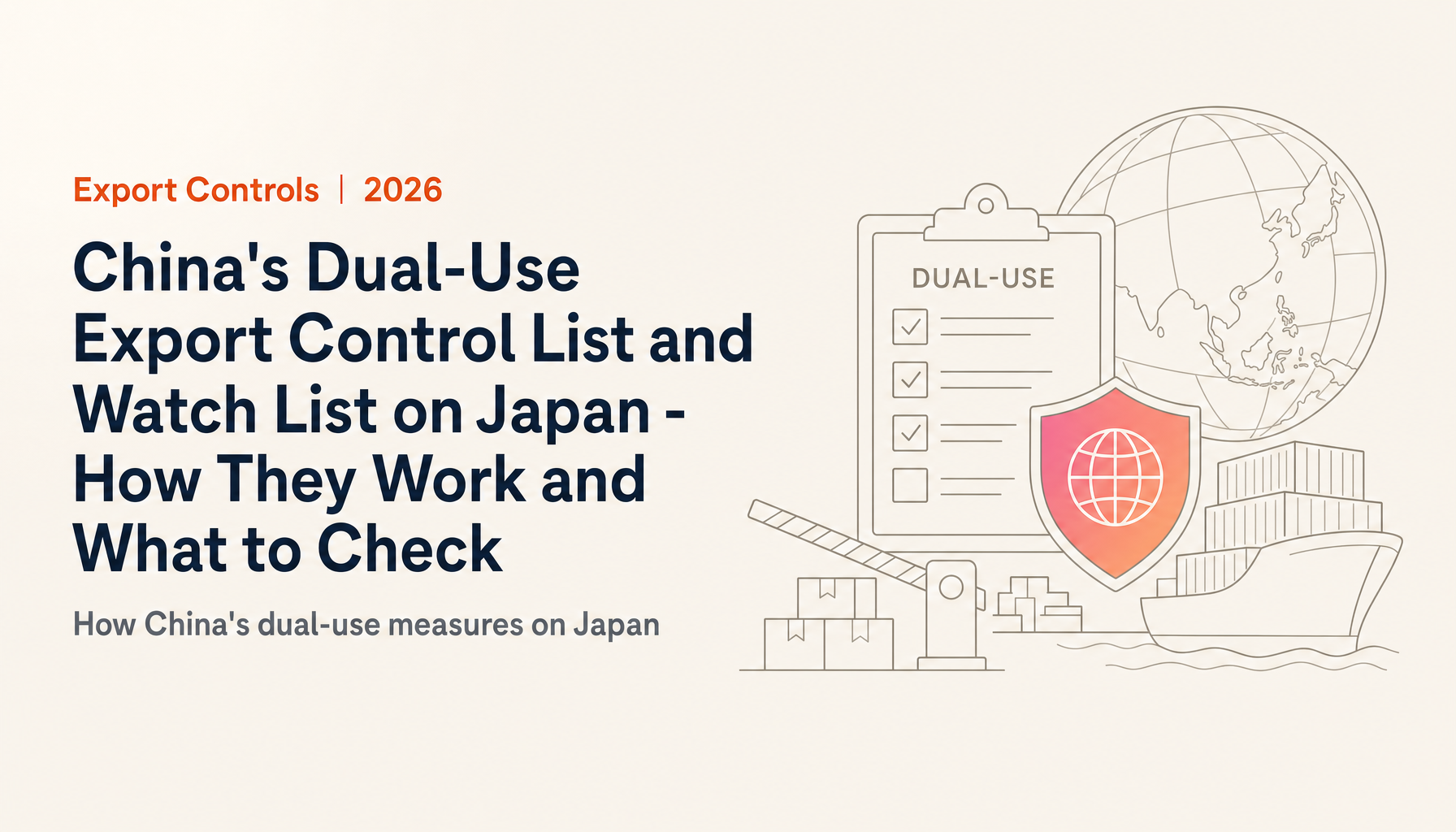
On January 6, 2026, MOFCOM issued Announcement No. 1 of 2026 strengthening dual-use export controls toward Japan3. The framework prohibits dual-use exports for Japanese military end users, military end uses, and other end users/uses that could contribute to enhancing Japan’s military capabilities. It took effect on promulgation with no wind-down period.
On February 24, 2026, MOFCOM issued two announcements (Nos. 11 and 12 of 2026) adding 20 Japanese entities each to its export-control list and its watch list. The export-control list includes affiliates of Mitsubishi Heavy Industries, IHI, and Kawasaki Heavy Industries with defense-related business, as well as the National Defense Academy of Japan and the Japan Aerospace Exploration Agency (JAXA); IHI Corporation itself is not listed. The watch list in the annex names companies such as SUBARU, TDK, Hino Motors, ENEOS, Mitsubishi Materials, and Nitto Denko4.
Critical framing: list placement is a Chinese regulatory classification. It is not a finding that listed companies acted improperly. Many are ordinary civilian manufacturers or firms with defense-related businesses captured by a broad dual-use frame. Do not assume "we only make civilian products, so we are unaffected" — map your own position and that of your counterparties.
Rare earths, gallium, and other materials where China holds a large supply share can fall within dual-use policy discussion. Supply-chain visibility sits next to export-control screening as a core task.
China explains measures under domestic law and national-security interests. For companies, the practical move is to capture announcement numbers, scope, and hit patterns on your book — then adjust sourcing and contract terms — rather than to litigate geopolitical narratives in the compliance memo.
Do Not Overlook China’s Own Lists
Alongside U.S. lists, China runs proprietary tools such as the Unreliable Entity List and export-control restricted lists. Awareness is lower than for U.S. lists, but operational impact is real: trade and investment restrictions, tighter dual-use licensing, or supply cuts can follow listing.
A 50% concept similar to the U.S. Affiliates Rule also appeared in a Chinese announcement. MOFCOM Announcement No. 61 of 2025 (October 9, 2025), on rare-earth items produced outside China, said applications for exports to importers and end users on the export-control list or watch list, including subsidiaries and branches in which they hold 50% or more, would in principle not be approved. Announcement No. 70 of 2025 (November 7, 2025) suspended it until November 10, 2026; we have not confirmed from MOFCOM announcements how it has been handled since. Parallel evolution of U.S. and Chinese techniques raises compliance cost.
Cross-list search tools for Chinese lists are appearing. Screening is now dual-track by default: U.S. lists and Chinese lists.
Japan is not mass-listed today, but the February 2026 additions show how quickly conditions can change. Uncertainty management is the core risk task.
Data Rules: The Less Visible Wall
China’s Cybersecurity Law, Data Security Law, and Personal Information Protection Law form a strict data regime. The Cybersecurity Law (2017) was amended with changes effective January 2026; the other two took effect in 2021.
Data localization and export-security assessments constrain moving production data or customer databases from China to a Japan HQ CRM. Global IT architectures often need China-specific redesigns. Under the amended Cybersecurity Law, in force from January 1, 2026, fines for especially serious consequences, such as a critical information infrastructure losing its main functions, range from RMB 2 million to RMB 10 million, and some provisions also allow business suspension or license revocation. Infringements of personal-information rights are punished under other laws such as the Personal Information Protection Law (Article 71 of the amended law), whose fines in serious cases can reach RMB 50 million or 5% of prior-year revenue (PIPL Article 66). Critical information infrastructure operators, and processors handling personal information above thresholds set by the regulator, must store personal information collected in China within China (PIPL Article 40).
2025 year-end reporting also noted some European firms reconsidering suppliers after Chinese export-control tightening and citing slower MOFCOM license processing. Lead time is a planning variable.
Joint Ventures and Market Access Constraints
China’s 2020 Foreign Investment Law improved transparency via a negative list. Wholly foreign-owned enterprises are possible outside restricted sectors. Telecom, media, education, and healthcare still often require Chinese partners.
JVs bring local insight and networks — and governance, IP, and technology-leakage risks. Partner diligence must be deeper than ordinary commercial KYC. Even for WFOEs, local counsel, accounting, tax, banking, and social-insurance processes are non-optional.
Capital Repatriation Is Not Free
Profit earned in China cannot always be remitted freely. Foreign-exchange controls remain strict, especially on capital account items.
Dividend remittance typically requires clearing accumulated losses, funding statutory reserves (10% of profit until 50% of registered capital), paying withholding tax (treaty relief may apply but is procedural), and clearing bank/tax steps. Interim dividends are generally unavailable, limiting cash flexibility. Build recovery design into the business plan, not as an afterthought.
What to Do in Practice
Map and diversify the supply chain
Identify China concentration and single-source critical parts. Assess whether key suppliers could fall under U.S. or Chinese list actions. China-plus-one into ASEAN/India is now baseline, not innovation — but it takes time and money, so start early.
Build dual-track export screening
Cover EAR and Chinese export-control law. Screen counterparties and ownership; check item classification and end use on every deal. Train staff; regulations change often. For Japanese classification mechanics, see the classification guide and 2026 templates. (Affiliate-rule stay does not remove the value of ownership maps.)
Redesign data governance for China
Define what data is collected in China, where it lives, and whether cross-border transfer is necessary. China-specific IT infrastructure can be rational given penalty scale.
Update contracts for regulatory shock
Force majeure covering export bans and sanctions; compliance clauses allowing non-performance when third-country law blocks performance; governing law and dispute resolution negotiated before a crisis.
Pre-design cash recovery
Royalties and service fees can complement dividends, but transfer pricing and withholding tax need advance structuring with tax specialists.
How to Engage the China Market Going Forward
Some readers may conclude "exit China." I do not take that extreme position. The market remains large. What no longer works is last decade's process.
One approach is deeper "In China, for China" models — development, production, sales, and data handling completed onshore — to reduce cross-border data risk and some reexport exposure.
Geopolitical risk is closer to a constant than a variable. Watch U.S. and Chinese policy, hold multi-scenario plans, and fold severe scenarios (including Taiwan contingencies) into BCP. Rules will keep moving; this article will age. Keep updating, and use specialists where needed.
Related: China–Japan dual-use controls / MOFCOM Announcement No. 1 of 2026 / BIS 50% rule guide / Classification procedure
If you want counterparty checks against both U.S. and Chinese lists to run as a routine process, you can contact us about TRAFEED. An overview of its features is in the TRAFEED product catalog (PDF).
Sources
- METI Security Trade Control site and Guidance Version 3.0 (Mar 2026)
- PRC Export Control Law; Dual-Use Items Export Control Regulations
- JETRO China business materials
Footnotes
- BIS Affiliates Rule IFR, 90 FR 47201 (Sept 30, 2025) ↩
- BIS one-year suspension of Affiliates Rule (effective Nov 10, 2025; original end date Nov 9, 2026; extended through Jan 10, 2027 by 91 FR 70789 on Nov 9, 2026) ↩
- MOFCOM Announcement No. 1 of 2026 on dual-use export controls toward Japan (Jan 6, 2026); MOFCOM spokesperson remarks ↩
- MOFCOM Announcement No. 11 of 2026 (20 Japanese entities added to the export-control list) and No. 12 of 2026 (20 Japanese entities added to the watch list), both February 24, 2026 ↩