Hello, this is Ryuta Hamamoto from TIMEWELL.
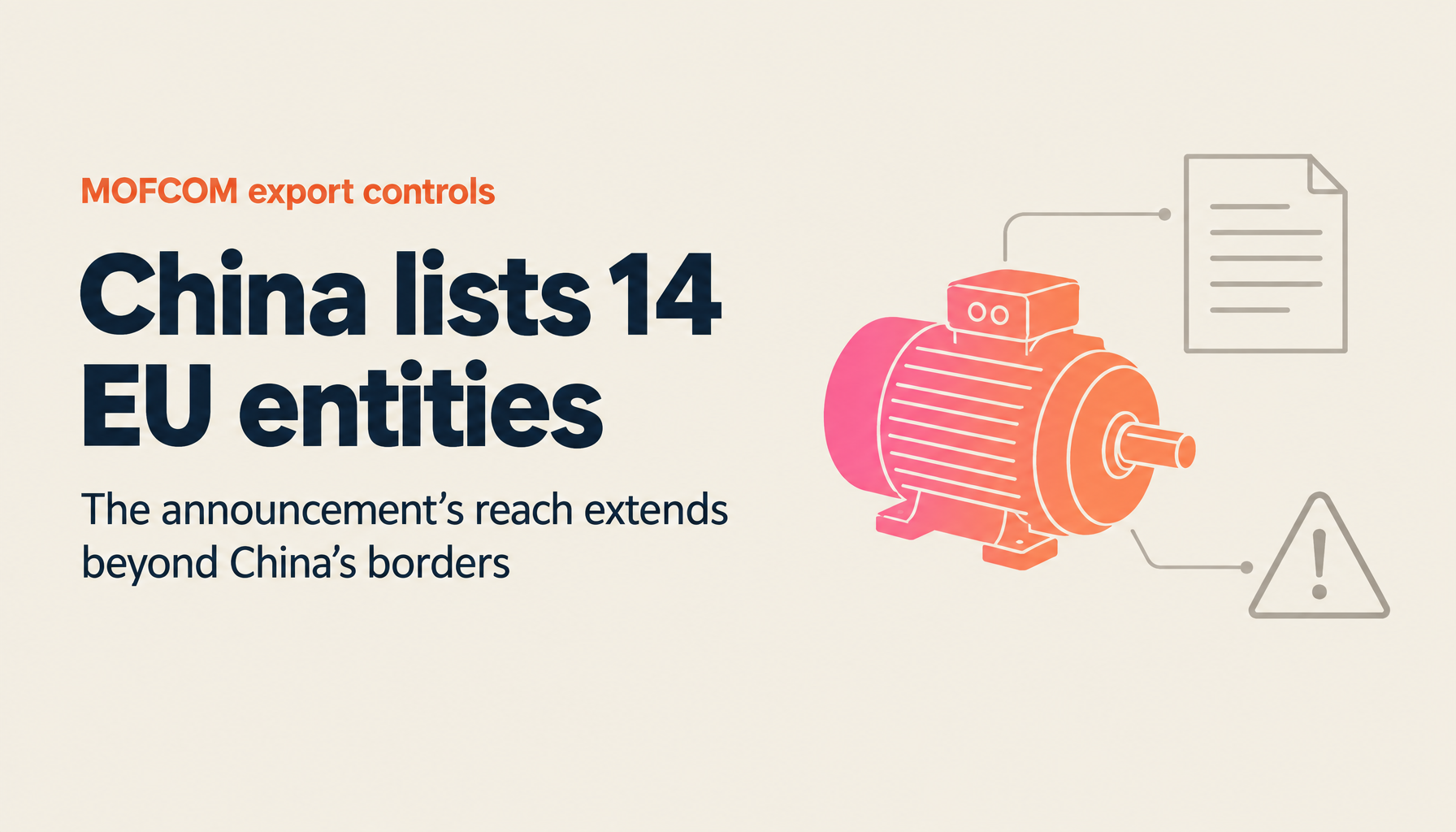
Late in the afternoon of 24 July 2026, China's Ministry of Commerce issued Announcement No. 30 [2026], placing 14 entities from eight EU member states on its export control list1.
News like this goes wrong in the details if you read only the secondary summaries. This case proves the point. Automated summaries rendered the first listed entity, 拉法特集团, as Lafarge, the French cement group. The ministry's own text gives the English name alongside the Chinese, and it is Lafert S.p.A., an Italian electric motor manufacturer. Two completely different companies. This is why Chinese measures need to be read in the Chinese original.
Below I work from the announcement itself: who is covered, the legal basis, and the piece that matters most to exporters outside China, which is how far the prohibition reaches. If you want to gauge your own exposure first, our free export control self-check gives you a starting position.
What the announcement actually says
The announcement is dated 24 July 2026 and was issued by the ministry's Bureau of Security and Control. It cites the Export Control Law of the People's Republic of China and the Regulations on Export Control of Dual-Use Items as its legal basis, and states its purpose as safeguarding national security and interests and fulfilling international obligations including non-proliferation1.
There are two operative measures.
First, export operators are prohibited from exporting dual-use items to the 14 listed entities. And, separately, organisations and individuals outside China are prohibited from transferring or providing Chinese-origin dual-use items to those 14 entities. Any ongoing related activity must stop immediately.
Second, where export is genuinely necessary in exceptional circumstances, an export operator may apply to the ministry.
On timing, the text says the announcement takes effect from the date of publication. That means 24 July. There is no grace period.
The part worth pausing on is the second half of the first measure. The prohibition is not addressed only to exporters inside China. It names organisations and individuals outside China as well. That is the crux for anyone reading this from Tokyo or Frankfurt, and I will come back to it.
If you need to check whether your own transactions are in scope: We publish a fill-in screening sheet that walks a single transaction through China's Export Control Law and Dual-Use Items Export Control Regulations, the announcements covering critical minerals and dual-use items, and all four counterparty-list systems (Control List, Watch List, Unreliable Entity List, countermeasure list). It is a procedure for what to verify before you trade, not a roster of who is listed, so the completed sheet becomes your internal record and the document you can share with a counterparty. Listing is a regulatory designation, not a judgment of the company. → Download the China-Related Transactions Export-Control Screening Sheet (2026)(Free. Your company name and work email are required.)
The 14 entities
The annex to the announcement gives the Chinese name, English name, address and postcode for each entity. Sorted by country1:
| Country | Entity (English name as given) | Location |
|---|---|---|
| Germany | Sindlhauser Materials GmbH | Kempten |
| Germany | Rheinmetall AG | Düsseldorf |
| Germany | Antraco Chemie-Handelsgesellschaft mbH | Duisburg |
| France | InPACT S.A. | Saint-Marcel |
| France | III-V LAB | Palaiseau |
| France | Cavok UAS | Sainte-Menehould |
| Italy | Lafert S.p.A. | San Donà di Piave, Venice |
| Italy | Garnet S.r.l. | Concorezzo (MB) |
| Poland | Vigo Photonics S.A. | Ożarów Mazowiecki |
| Poland | Politechnika Wrocławska (Wrocław University of Science and Technology) | Wrocław |
| Netherlands | IHC Merwede Holding B.V. | Kinderdijk |
| Czechia | TATRA TRUCKS a.s. | Kopřivnice |
| Bulgaria | Opticoelectron Group | Panagyurishte |
| Lithuania | Ekspla UAB | Vilnius |
The sectors are scattered: electric motors, materials, chemical trading, optics and infrared detectors, lasers, unmanned aircraft, shipbuilding, trucks, and a research university. What stands out this time is the geographic spread beyond Western Europe into Poland, Czechia, Bulgaria and Lithuania.
Given the subject, one caveat belongs up front rather than buried at the end. Placement on a control list is a regulatory designation under that country's export control regime. It is not a judgment about the listed company or institution. Lists differ by country in purpose, criteria and procedure. A listing means additional verification is now required before transacting. It is not evidence about the organisation's conduct, and treating these lists as rosters of bad companies both damages real firms and produces sloppy compliance work.
The tenth entry deserves a note. A university, not a company. Universities appearing on national control lists is now a recurring feature of these regimes, whichever country issues them. A research partner can be listed somewhere without warning. This is not hypothetical. I wrote recently about Japan's research security procedures manual, and the reason its due diligence checklist includes both listing status and relationships with researchers at listed institutions is precisely this scenario. For anyone managing international research collaboration, it is not somebody else's problem.
Replace siloed classification work with AI.
METI's FY2024 data shows 52% of foreign exchange law violations stem from classification errors. Download the TRAFEED product catalog covering features and rollout.
The extraterritorial reach is the part that bites
Here is the crux.
Read from Japan, the instinct is: China restricted some European companies, so this is not our problem. The text does not permit that reading. Once more: organisations and individuals outside China are prohibited from transferring or providing dual-use items originating in China to the 14 listed entities1.
So the test is not what nationality your company holds. The test is whether the item is a Chinese-origin dual-use item, and whether the counterparty is a listed entity. Two questions, neither of which is about your own passport.
The exposure looks like this in practice. A Japanese trading company or manufacturer sources components or materials from China. Those items fall within China's dual-use control list. That company's European subsidiary supplies one of the 14 listed entities, or supplies a European distributor that counts a listed entity among its customers. In that chain, the Japanese company sits inside the announcement's scope.
What makes this awkward is that you cannot see it by reading your customer list. Even if none of your first-tier customers is a listed entity, the route still completes if the goods move on. And Chinese origin is procurement-side information that the sales side usually does not hold. It only becomes visible when purchasing data and sales data are put side by side.
On the extraterritorial architecture of China's export control law generally, I have set out the provisions in China's extraterritorial application, and the wider system in China's export control law framework.
Legal basis, penalties, and the pattern since April
The control list rests on Article 18 of China's Export Control Law, which establishes the list for importers and end users and allows measures including prohibiting or restricting transactions in controlled items and ordering exports to stop2.
Penalties sit in Article 37. An export operator that transacts with a listed party faces warnings, orders to cease, and confiscation of unlawful gains. Where the value of the unlawful business is 500,000 yuan or more, the fine runs from 10 to 20 times that value; below 500,000 yuan, from 500,000 to 5 million yuan. In serious cases, qualifications to export controlled items can be suspended or revoked2. The arithmetic alone tells you this is not designed as a slap on the wrist.
Article 13 of the Regulations on Export Control of Dual-Use Items (State Council Order No. 792, in force 1 December 2024) also matters. It permits prohibiting export of specified dual-use items, or their export to specified destinations, organisations or individuals, where needed to safeguard national security and interests and meet non-proliferation obligations. Announcement No. 30 sits inside that framework.
This is also not a one-off. Announcement No. 20, dated 24 April 2026, had already placed seven EU entities on the list, the first being FN Herstal of Belgium3. Seven in April, fourteen in July. Second tranche, and the scope is widening.
On background, I will set out the sequence and stop there. The EU has listed Chinese companies in its Russia sanctions packages, and MOFCOM's spokespeople have repeatedly objected, characterising these as unilateral sanctions and long-arm jurisdiction lacking a basis in international law or UN Security Council authorisation. Whether the present measure is a response to that is not something either side has formally stated, so I will not assert it. What is not in dispute is that the EU and China each now place the other's entities on their own instruments. For companies, the useful question is not which side is right. It is that you can be subject to both regimes at once, and that is now a routine situation rather than an edge case.
What to do this week
The practical work is not exotic.
Start by mapping contact with the 14 entities. Not just direct customers, but the sales books of European subsidiaries and the onward customers of agents and distributors. The announcement gives addresses and postcodes, so you can match even where the company name is transcribed inconsistently. When you do the matching, allow for legal-form suffixes (S.p.A., GmbH, S.A., UAB) being dropped or altered in your master data, which happens constantly in real systems.
Next, establish whether you handle Chinese-origin dual-use items at all. That is purchasing information. Is the source in China, and does the item fall within China's dual-use control list? Without this you cannot even determine whether the announcement reaches you.
Then, where a transaction is in flight, decide on stopping it before anything else. The announcement says ongoing related activity should cease immediately. That collides with contractual obligations in uncomfortable ways, so the sequence is to nail down the facts and then take it to legal. The application route to the ministry exists for genuinely necessary cases, but it is an exception, not a workaround.
Finally, do not treat this as a single incident to be closed out. Seven entities in April, fourteen in July. Assume there will be a next one. Lists in different countries update on different schedules, in different languages. Expecting one compliance officer to notice a Chinese-language announcement on the day it posts and reconcile it against the customer master is not a plan.
Summary
- On 24 July 2026, MOFCOM Announcement No. 30 placed 14 entities from eight EU member states on the export control list, effective the same day, with no grace period
- The prohibition is not limited to exporters inside China. Organisations and individuals outside China are barred from transferring or providing Chinese-origin dual-use items to the listed entities. That is the provision that reaches Japanese companies
- The test is not your nationality. It is whether the item is Chinese-origin dual-use, and whether the counterparty is listed
- The basis is Article 18 of the Export Control Law; penalties under Article 37 run to 10–20 times the transaction value above 500,000 yuan
- This follows Announcement No. 20 in April (seven entities). The scope is expanding, so build for the next round
- Listing is a regulatory designation, not a judgment on the listed company or institution
One closing thought. The 14 entities on this list are companies, and a university, going about their business in their own countries. For most of them this is not a failure of their own making but the consequence of state-level regimes intersecting over their heads. Japanese companies find themselves in exactly that position under US rules, Chinese announcements and EU regulations too. Which is why the habit of reading control lists as rosters of bad actors is worth dropping. Adding nothing to the fact that a verification step is now required turns out to be the posture that protects your own company as well.
If you are unsure whether your network touches any of the 14 entities, or where to start, talk to our TRAFEED team.
References and primary sources
Footnotes
-
Ministry of Commerce of the People's Republic of China, "MOFCOM Announcement No. 30 of 2026: Adding 14 EU Entities to the Export Control List," 24 July 2026 https://www.mofcom.gov.cn/zwgk/zcfb/art/2026/art_2c9a32aa73bf4f5ea80ffa83e62fb259.html ↩ ↩2 ↩3 ↩4
-
Export Control Law of the People's Republic of China, Articles 18 and 37 https://exportcontrol.mofcom.gov.cn/article/zcfg/gnzcfg/flfg/202111/226.html ↩ ↩2
-
Ministry of Commerce of the People's Republic of China, "MOFCOM Announcement No. 20 of 2026: Adding 7 EU Entities to the Export Control List," 24 April 2026 https://www.mofcom.gov.cn/zwgk/zcfb/art/2026/art_cbb5d167f9004a58aee4b7a0f260c078.html ↩
- Regulations on Export Control of Dual-Use Items of the People's Republic of China (State Council Order No. 792, in force 1 December 2024), Article 13 https://www.mee.gov.cn/zcwj/gwywj/202410/t20241021_1089760.shtml