Hello, I'm Ryuta Hamamoto from TIMEWELL.
Update, November 22, 2026: We had written that the U.S. "banned" exports of HBM and other items to China. As the regulations state, these items were brought under license requirements for China; HBM (ECCN 3A090.c) requires a license and is not subject to a blanket ban.
Update, November 20, 2026: Corrected the timing of the AI Diffusion Rule's rescission (May 2025 was the announcement, made just before compliance was due; the text was formally rescinded on November 19, 2026). Otherwise the body reflects the situation as of June 2026, except where a later date is given.
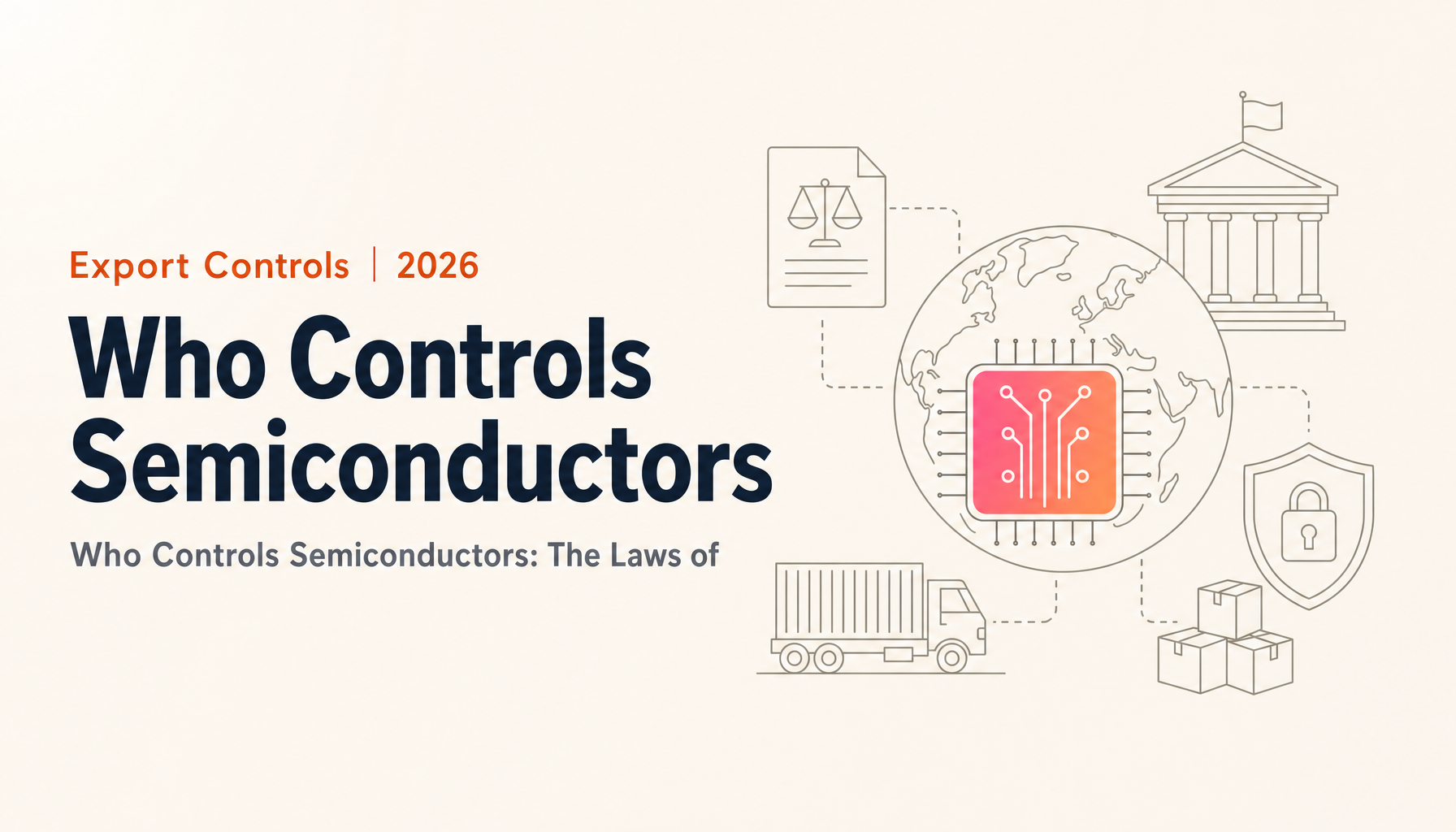
At the end of The Geopolitics of Semiconductors, I made the point that what ultimately drives concentration risk, soaring stocks, and leak incidents comes down to one thing: the law. This time, we look at the laws themselves. What rules have the US, China, Japan, and Taiwan each put in place over semiconductors, and what is each of them trying to protect?
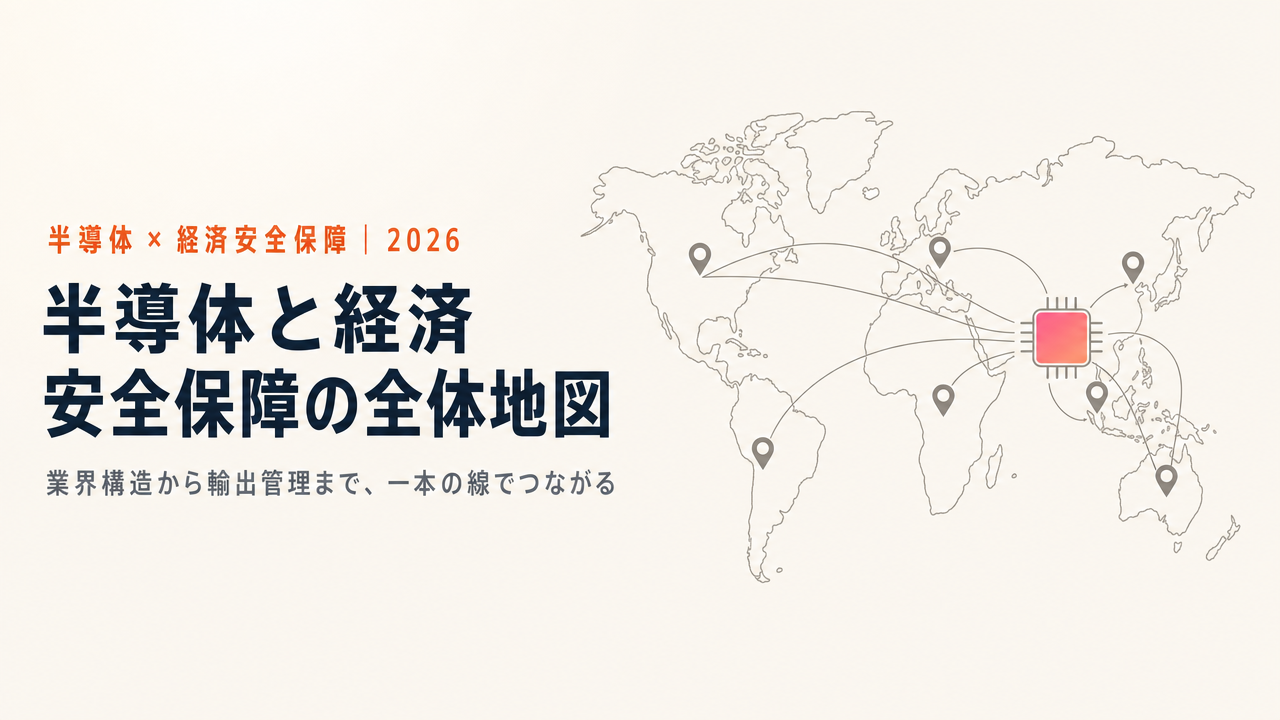
First, one map of the whole picture. Boiled down, there are only three things a country can do for the sake of economic security: keep it away from parties of concern (export controls), make sure you can build it yourself (industrial policy), and stop it from being stolen (leak prevention). The US and China mainly emphasize "keeping it away," Japan emphasizes "being able to build it," and Taiwan emphasizes "stopping it from being stolen." Keep these axes in mind and even complicated news sorts itself out neatly. As for "export controls," think of it as a national version of baggage screening. The state checks "may this item be taken out of the country?" and "may it be handed to this party?" and stops anything dangerous. The hard part is that each country rewrites this checklist often, in line with its own policy.
The United States: Opening and Closing Regulation Like a Faucet
The country that has led the world in export controls is the United States. Within the Department of Commerce, an agency called BIS (the Bureau of Industry and Security) administers the rules under the Export Administration Regulations (EAR). The mechanism has three pillars: the "ECCN," which assigns a number to a controlled item; the "Entity List," a blacklist of prohibited recipients (being added means a presumption of denial); and the "FDPR," an extraterritorial rule under which US regulation reaches a foreign-made product if even a little American technology or equipment was used. Because the most advanced semiconductors cannot be made without US software and equipment, this FDPR bites.
From 2022 through 2024, the US tightened its controls on China steadily. Advanced semiconductors, manufacturing equipment, and even HBM, the memory used for AI: one after another, they were brought under license requirements for exports to China (HBM was added as ECCN 3A090.c by a rule effective December 2, 2024). But under the Trump administration from 2025 onward, the picture changed completely. Regulation became not a wall that stays shut, but a "faucet" that can be opened and closed.
The most telling example is how policy on NVIDIA's high-performance chips has shifted. Following the timeline: in April 2025 exports to China were effectively banned; in July the policy reversed and resumed; in August came an unusual arrangement to "pay the US government 15% of China revenue"; and in December a policy was announced of approving the more powerful H200 on the condition that "25% of revenue be paid to the US government." As for the global AI-chip allocation rule created under the Biden administration (the AI Diffusion Rule), its rescission was announced just two days before compliance was due (the text was formally rescinded on November 19, 2026). How far controls are loosened or tightened is now decided in connection with trade negotiations. Even the CHIPS Act's semiconductor subsidies were restructured under the Trump administration so that the government invested about $8.9 billion in Intel and took an equity stake of roughly 9.9%. Since 2025, US controls have been run both as security measures and in connection with negotiations.
Replace siloed classification work with AI.
METI's FY2024 data shows 52% of foreign exchange law violations stem from classification errors. Download the TRAFEED product catalog covering features and rollout.
China: Licensing Exports of Rare Earths and Other Minerals
The part of China's export controls that affects Japanese companies most is mineral resources, rare earths chief among them. Where US controls center on advanced chips and manufacturing equipment, China places exports of materials under a licensing system.
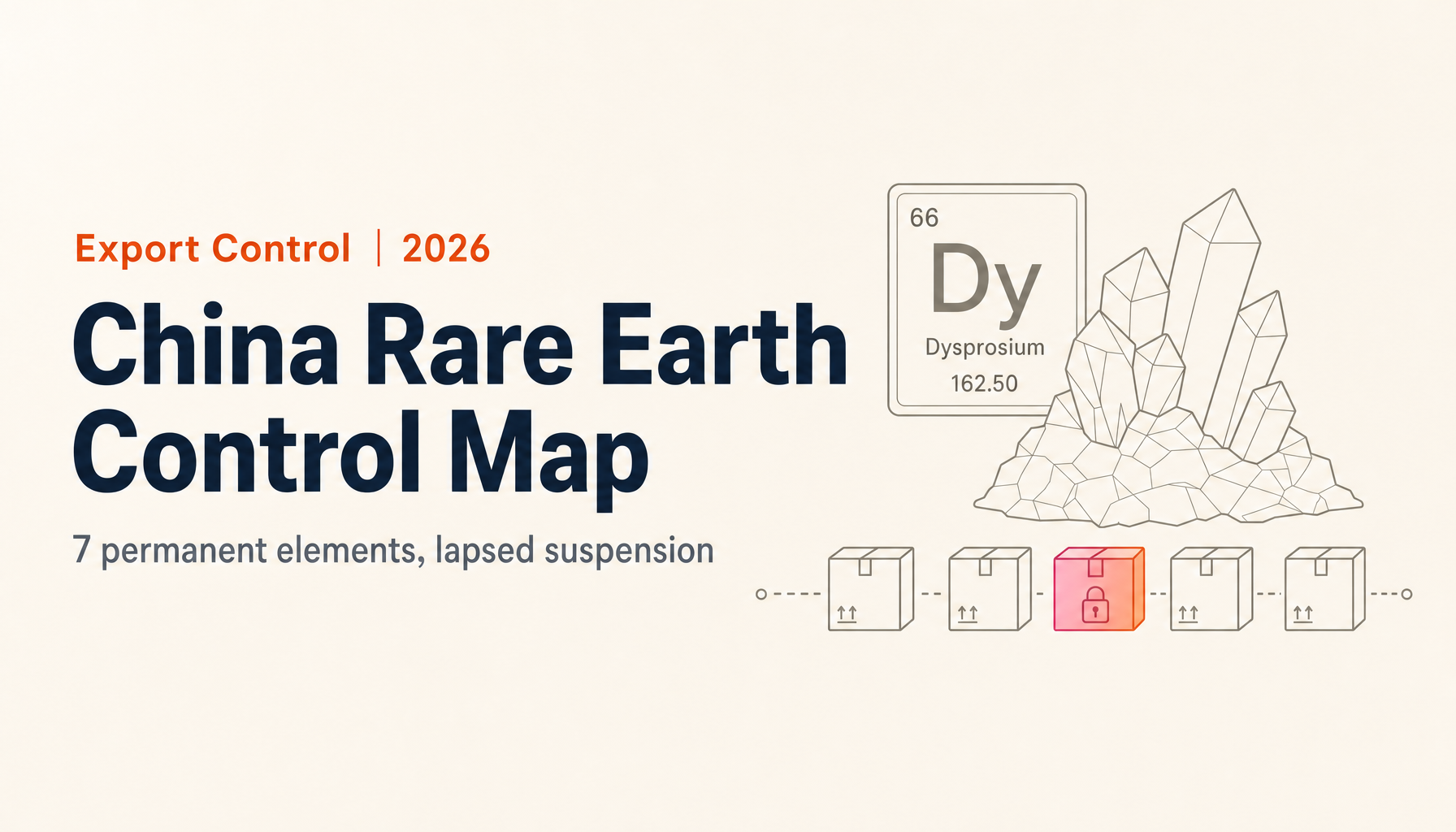
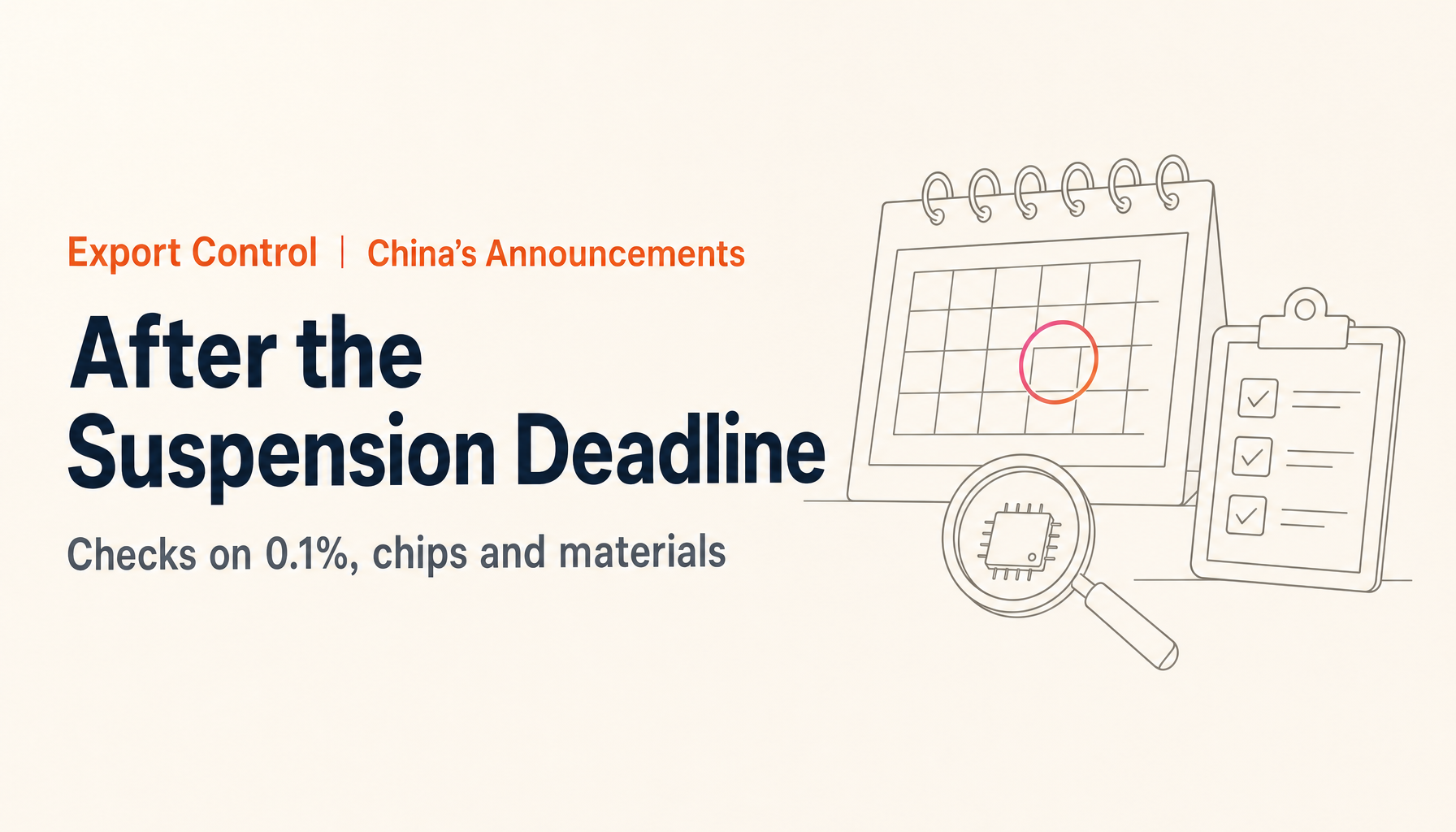
China controls the vast majority of the world's rare-earth refining, and it has added related items to its export licensing step by step. The semiconductor materials gallium and germanium (August 2023); graphite, used in EV batteries; and antimony, which also has military uses (2024, with shipments falling roughly 97% after the controls). In April 2025 it placed seven medium and heavy rare-earth elements under a licensing system, and that October it issued an announcement (No. 61) requiring approval for certain transactions outside China. Under this extraterritorial measure, foreign-made items in which Chinese-origin rare-earth items account for 0.1% or more of the value need Chinese approval even when a foreign company exports them from outside China to a third country. Like the US FDPR, it extends a country's export controls to products made abroad, with the threshold set low at 0.1% of value. (Announcement No. 70 suspended this October measure until November 10, 2026, and that date has passed. In MOFCOM's announcement list checked on November 21, 2026, we found no announcement amending the deadline. The April licensing of the seven elements was not among the measures suspended.)
In 2026, measures concerning Japan followed. In Announcement No. 1 of January 6, MOFCOM prohibited exports of dual-use items (goods with both civilian and military applications) to Japanese military users and military end uses, and to any other end users or end uses that would help enhance Japan's military capabilities. On February 24 it added 20 Japanese entities to its Export Control List (Announcement No. 11) and a different 20 to its Watch List (Announcement No. 12). As reasons, Announcements No. 1 and No. 11 cite safeguarding national security and interests and fulfilling international obligations such as non-proliferation; No. 12 cites the inability to verify the end users and end uses of dual-use items. Being listed is a regulatory designation under Chinese law, not a judgment about the companies or institutions concerned. For Japanese companies, the practical step is to check before a transaction whether a counterparty or a group company appears on China's lists.
Japan: Both Wheels of "Defense" and "Cultivation"
So how is Japan moving? Its distinguishing feature is that it runs both wheels at once: defense (leak prevention) and cultivation (domestic production). The legal foundation rests on two pillars: the Foreign Exchange Act and the Economic Security Promotion Act.
On the defense side, since July 23, 2023, the export of 23 categories of advanced semiconductor manufacturing equipment has required a license from the Ministry of Economy, Trade and Industry (METI). These are the families of tools-lithography, etching, deposition, cleaning, inspection-indispensable to leading-edge manufacturing. The timing overlapped with the period when the US tightened its controls on advanced semiconductors for China. Japan's framework, however, names no specific country and applies "to the whole world," while allowing 42 friendly countries and regions to use simplified procedures.
On the cultivation side, the Economic Security Promotion Act, enacted in 2022, designated semiconductors as a "critical material." This is an official seal of approval marking them as "goods whose supply chain the nation should protect," and it has translated into generous subsidies for domestic production. TSMC's Kumamoto plant and Hokkaido's Rapidus (with cumulative government support of about 2.9 trillion yen) sit atop this framework. The penalties for violations are by no means light: for a serious unlicensed export related to weapons of mass destruction, an individual faces up to 10 years' imprisonment and a fine of up to 30 million yen, while a corporation faces a fine of up to 1 billion yen. Japanese companies can be subject to China's export controls as well as to Japan's Foreign Exchange Act and the US EAR. Advancing defense and cultivation at the same time while complying with both US and Chinese rules-that is the reality.
Taiwan: The Laws of the "Vault Keeper" Protecting Talent and Know-How
Last comes Taiwan. Taiwan's concern differs slightly from that of the US and China: it puts the most effort into preventing its leading-edge manufacturing technology and talent from flowing to China-that is, into "stopping it from being stolen." It would be a disaster if the keeper of the household vault were poached away by a rival with a fat paycheck. So the idea is to protect the vault keeper by law.
The symbol of this is the 2022 amendment to the National Security Act. Infringing the trade secrets of a technology designated as a "national core key technology" for the benefit of China and the like was made a serious crime as the "economic espionage offense," carrying 5 to 12 years' imprisonment and a fine of up to NT$100 million. Behind it lies a sense of crisis over "talent poaching"-Chinese companies luring away Taiwanese engineers with high pay and carrying off the technology along with them. There is also a list compiling which technologies are "core," which began with 22 items and has expanded year by year to 32 and then 42. In semiconductors, this includes advanced manufacturing technology below 14nm.
This law is no ornament. In April 2026, a former engineer was given a 10-year prison sentence for leaking TSMC's 2nm technology-the first prison term handed down under the statute. On top of that, the Taiwanese government keeps its most advanced nodes on the island through the "N-2 rule" mentioned last time. It protects technology and talent by law and keeps the leading edge at home. For Taiwan, semiconductors are not only an industry but the very shield that defends the nation.
A Useful Aside: Controls Come in Two Kinds, "List" and "Catch-all"
Here is one aside that is more useful than anything else for understanding export controls. Japan's regime is broadly divided into two kinds: "list controls" and "catch-all controls." Knowing this makes the news look one notch clearer.
List controls are a predefined "list of dangerous goods." They specify items that are off-limits by performance (specs), and once the threshold is exceeded a license is required no matter which country the recipient is in. It is the same as how airport baggage screening sets a rule that "blades longer than X centimeters are prohibited"-the line is drawn mechanically by the item's specifications. Catch-all controls, on the other hand, are a complementary rule that stops even an item not on the list if it involves a "dangerous use or a dangerous party." Picture an officer pulling aside a suspicious-looking passenger; the focus is on the use and the recipient (who is going to use it for what). Even an ordinary general-purpose product requires a license if it turns out to be likely headed for the development of weapons of mass destruction.
In other words, "we're not a high-tech company, so this doesn't apply to us" does not hold. List controls look at the "goods," and catch-all controls look at the "use and the recipient." This two-tiered structure is the basic architecture of export controls.
Seen this way, four countries and regions each manage the flow of semiconductors and related resources and technology by different means. The US opens and closes its licensing policy, China licenses mineral exports, Japan pairs defense with cultivation, and Taiwan guards against the outflow of technology and talent. And export controls have at last spread beyond semiconductors themselves to reach AI models. A world that had been regulating chips has finally begun regulating the contents of AI. We take up that frontline in The Era When AI Models Become Subject to Export Controls.
Reference: The regulatory developments in each country are based on primary sources and reporting (2025-2026), including announcements from the US BIS, White House fact sheets, client alerts from law firms such as Hogan Lovells and Covington, Japan's Ministry of Economy, Trade and Industry, The Japan Times, Focus Taiwan, and Digitimes.
If you are reviewing export-control operations or classification workflows, download the TRAFEED product catalog (PDF) or contact us.