Hello, this is Ryuta Hamamoto from TIMEWELL.
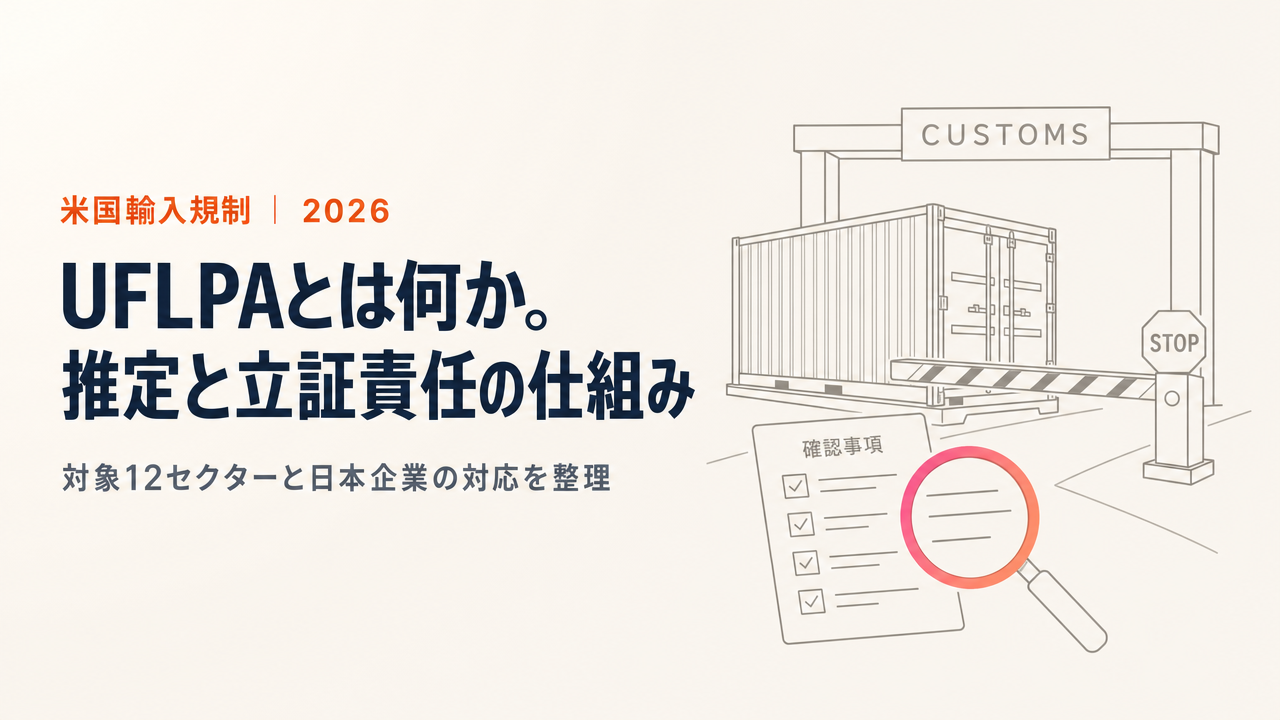
The UFLPA (Uyghur Forced Labor Prevention Act) is a law that presumes goods produced wholly or in part in the Xinjiang Uyghur Autonomous Region were "made with forced labor" and bars their import into the United States. It took effect on June 21, 2022.1
What makes this law formidable is not the import ban itself but the mechanism of "presumption." Ordinary regulations can only stop something once the authorities have proven a violation. The UFLPA works the other way around. Goods connected to Xinjiang are presumed from the outset to be forced-labor products, and it is the importer who wants to overturn that presumption who must assemble "clear and convincing evidence" to rebut it.12 The burden of proof is reversed onto the company. Once you see that, you understand why complying with this law is such a heavy undertaking.
Here is what this article covers: the mechanism, the target sectors, the latest Entity List movements (including the updates of August and October 2026), how the EU regulation differs, and four practical steps. What it cannot tell you is whether a specific product of yours is caught. That depends on your customs history and contracts, so confirm it with U.S. trade counsel. One more point: a listing on the Entity List is a regulatory designation, not a judgment on the company concerned.
Before you assemble rebuttal evidence, find your own weak points: A fill-in self-check covering the UNGP/OECD six steps, the US UFLPA, EU CSDDD and German LkSG obligations, conflict minerals (3TG) and Japan's guideline. Its UFLPA section walks you item by item through screening against the Entity List and how much origin and production-process traceability evidence you actually hold. Use it with procurement and legal, or as the basis for answering the questionnaires your customers send you. → Download the Supply-Chain Due Diligence Self-Check Sheet (Free. Your company name and work email address are required.)
Then and Now: What Has Changed Since the July 2026 Edition
In the three and a half months since this article first ran (July 18, 2026), the Entity List has been updated twice. Here is what I could confirm.
| Item | Earlier version | Now (November 6, 2026) |
|---|---|---|
| Size of the Entity List | 144 entities (as of the August 2025 FLETF announcement)13 | 43 entities added on August 3, 20264. A law-firm summary gives a total of 1875. A Federal Register notice of October 29 added three more6, bringing it to 190 by a law-firm count7 |
| Character of the August addition | (not covered) | The largest single addition since enactment; 19 of the 43 are located outside Xinjiang5 |
| October addition | (not covered) | BGI Genomics, MGI Tech and Shenzhen BGI Technology. DHS cites their involvement in genetic testing carried out with the Xinjiang government6. The three companies deny the allegations, and MGI Tech is reported to intend to challenge the designation78 |
| High-priority sectors | 12 fields (through August 2025) | I could not confirm any new annual FLETF strategy update as of November 6, 2026 |
| CBP statistics | Counting method changed in January 2026 | No change. Check CBP's dashboard for current figures |
I could not read a total directly from DHS's own list page. The figures 187 and 190 come from law-firm summaries, so pull the list itself from DHS for any operational work. DHS's October rationale is DHS's own finding, and the companies contest it. We do not assess any individual company.
How It Works: The "Rebuttable Presumption" and Two Categories of Targets
The UFLPA's import ban covers two lines of targets.
| Target | Description |
|---|---|
| Region-based | Goods mined, produced, or manufactured "wholly or in part" in the Xinjiang Uyghur Autonomous Region |
| List-based | Goods produced by entities on the UFLPA Entity List (including entities located outside Xinjiang) |
As for how this is administered, the FLETF (Forced Labor Enforcement Task Force), chaired by DHS (the U.S. Department of Homeland Security), develops the list and the enforcement strategy, while CBP (Customs and Border Protection) detains shipments at the border.1
The words "in part" carry real weight in practice. Even if you do not source finished products from Xinjiang, you are within scope if raw materials or intermediate inputs are mixed in after passing through several tiers of transactions. Upstream materials such as cotton yarn, polysilicon, and aluminum ingots are the typical examples, and looking only at Tier 1 (your direct suppliers) will not give you the answer.
Replace siloed classification work with AI.
METI's FY2024 data shows 52% of foreign exchange law violations stem from classification errors. Download the TRAFEED product catalog covering features and rollout.
The Scope Now Reaches 12 Sectors: A Net Widening to Core Materials
The "high-priority sectors" on which the FLETF concentrates enforcement have expanded with each annual update to its strategy.19
| When Added | Sectors |
|---|---|
| 2022 (initial) | Apparel; cotton and cotton products; silica-based products (including polysilicon); tomatoes |
| July 2024 | Aluminum; PVC (polyvinyl chloride); seafood |
| August 2025 | Caustic soda; copper; lithium; red dates (jujube); steel |
The direction is clear. From the initial debate about "cotton and solar," the net has widened to the core materials of modern manufacturing: lithium, copper, steel, and aluminum. For Japanese companies that handle batteries, automotive parts, and electronics, the UFLPA is no longer a story about the apparel industry.
A law firm describes the August 2026 additions as centered on businesses connected to aluminum, apparel, copper, cotton and tomatoes,5 which lines up with the priority sectors. At this point many readers will ask whether any of their own suppliers appear on the current list. How to pull a list and trace parent companies and affiliates is laid out, from the export-control side, in how to screen counterparties, including their ownership. The logic carries over to UFLPA screening.
Enforcement in Practice: Read the Numbers with Care
A law firm's analysis of CBP's statistics dashboard (February 2026) reports that by early 2026 CBP had reviewed more than 18,000 shipments with an aggregate value of about $3.81 billion, and that in fiscal year 2025 it stopped roughly 7,325 shipments for UFLPA review, more than 50 percent above fiscal 2024.10
There is one caveat when handling these figures, however. On January 28, 2026, CBP overhauled its dashboard and changed the method for counting cases.11 As a result, figures from 2026 onward cannot be compared directly with the past. When gauging the impact on your own company, I recommend checking CBP's latest dashboard directly.
Whether goods are covered depends not on the country they ship from but on whether production in Xinjiang is involved "in whole or in part." Goods shipped from a country other than China can be covered if Xinjiang is involved in their raw materials or intermediate goods, so "we are fine because we do not import directly from China" does not hold.
Separate from the import ban, a framework of additional tariffs tied to forced labor is also in motion. How those duties stack on Japan-origin goods is worked through in how the USTR Section 301 forced-labor tariff is calculated. A UFLPA detention and a tariff raise different questions and need different documents, so it is safest to check them separately.
How It Differs from the EU Regulation: The Design Is Reversed for the U.S. and the EU
Forced-labor regulation is not limited to the United States. The EU Forced Labour Regulation (Regulation (EU) 2024/3015) entered into force on December 13, 2024, and applies from December 14, 2027.12 Its design philosophy, however, differs greatly from the UFLPA's.
| Aspect | U.S. UFLPA | EU Forced Labour Regulation |
|---|---|---|
| Targeted region | Names Xinjiang plus the Entity List | Origin-neutral (the regulation names no specific country, though a Commission database is to flag sectors in specific geographic areas at high risk of state-imposed forced labour) |
| Presumption mechanism | Presumes forced labor; the importer rebuts | No presumption; the authorities investigate only after establishing a "substantiated concern" |
| Burden of proof | On the importer | On the authorities |
| Status | Enforced since 2022 | Applies from December 14, 2027 (currently in the lead-up period) |
In other words, the U.S. side is already in the enforcement phase, while the EU side is in the preparation phase. That said, the supply-chain visibility required for EU compliance is almost the same work as UFLPA compliance, so getting your U.S. response done first will greatly reduce the burden when the EU rules start to apply.
How Japanese Companies Should Respond: Four Steps
The practical work can be organized into the following four stages.
- Map your supply chain. For goods you export to the United States, make the supply network visible not just at Tier 1 but all the way back to raw materials. The starting point is to identify the items into which materials from the 12 high-priority sectors (cotton, polysilicon, aluminum, lithium, copper, steel, and so on) could be mixed
- Check against the Entity List. Regularly cross-check your suppliers and their parent and affiliated companies against the current list. It was updated in both August and October of 2026 alone, so checking is not a one-time task; it presupposes a routine tied to each update. Also check whether open purchase orders or in-transit shipments involve newly listed entities
- Prepare your documentary evidence. Gathering it only after a detention is too late. Secure the traceability of documents you can use for rebuttal, such as certificates of origin, transaction records, shipping records, and audit reports, in normal times
- Contracts and structure. Build forced-labor exclusion clauses and an obligation to cooperate with investigations into your supplier contracts, and designate the responsible department within your company
Step 2 is where teams run out of hands first. You investigate your business partners and their capital relationships one company at a time, and re-check every time the list changes. The final judgment rests with your own officers and trade counsel. For the full process, see the six steps of supply-chain due diligence.
Summary
- The UFLPA "presumes" Xinjiang-related goods to be forced-labor products and places the burden of rebuttal on the importer. This is the biggest difference from ordinary regulations
- The high-priority sectors have expanded to 12 fields. With core materials such as lithium, copper, steel, and aluminum now in scope, it has become an issue for manufacturing as a whole
- The Entity List gained 43 entities in August 2026 and 3 in October (190 by a law-firm count). Updates are irregular, so screening has to come with update monitoring
- The EU regulation applies from December 2027, but its design is reversed (the authorities bear the burden). Getting your U.S. response done first doubles as EU preparation
- The center of gravity of your response is due diligence on business partners and the supply chain. Preparing evidence in normal times is the lifeline of any rebuttal
Rather than chasing the headcount of the list, I think it works better in practice to decide first which priority sector your main materials sit closest to. If you do one thing on Monday morning, write down the parent companies of your ten largest suppliers.
If you export to the United States and want checks on business partners and their capital relationships to run as a process with records kept, you can contact us about TRAFEED.
References
Footnotes
-
FLETF, "2025 Updates to the UFLPA Strategy" — USTR (August 19, 2025) ↩ ↩2 ↩3 ↩4 ↩5
-
Federal Register, "Notice Regarding the UFLPA Entity List," 90 FR 3899 (effective January 15, 2025; 37 entities added) ↩
-
Federal Register, "Notice Regarding the Uyghur Forced Labor Prevention Act Entity List," 2026-15628 (August 3, 2026; 43 entities added, technical corrections to two existing entries) ↩
-
Troutman Pepper Locke, "DHS Adds 43 Companies to UFLPA Entity List in Largest-Ever Single Expansion" (August 3, 2026; total of 187 stated) ↩ ↩2 ↩3
-
Federal Register, "Notice Regarding the Uyghur Forced Labor Prevention Act Entity List," 2026-22094, 91 FR 68159 (October 29, 2026; three entities added; states that BGI Genomics conducts genetic testing in the XUAR alongside the XUAR government) ↩ ↩2
-
Brownstein Hyatt Farber Schreck, "DHS Adds Three Chinese Companies to UFLPA Entity List as China Threatens Retaliation" (October 2026; total of 190 stated) ↩ ↩2
-
DHS, "UFLPA Entity List" (listed entities and effective dates) ↩
-
DHS, "FLETF Adds Aluminum, PVC, and Seafood as New High-Priority Sectors" (July 9, 2024) ↩
-
Troutman Pepper Locke, "High-Voltage Enforcement: UFLPA Turns Up the Heat on Lithium-Ion and Energy Storage Imports" ↩
-
CBP CSMS #67538179, "Revamped Forced Labor Website and 2026 Update to the Uyghur Forced Labor Prevention Act (UFLPA) Enforcement Statistics Dashboard" (January 28, 2026; shipments now counted as individual import transactions) ↩
-
Regulation (EU) 2024/3015 (EU Forced Labour Regulation) — EUR-Lex ↩