Hello, this is Hamamoto from TIMEWELL.
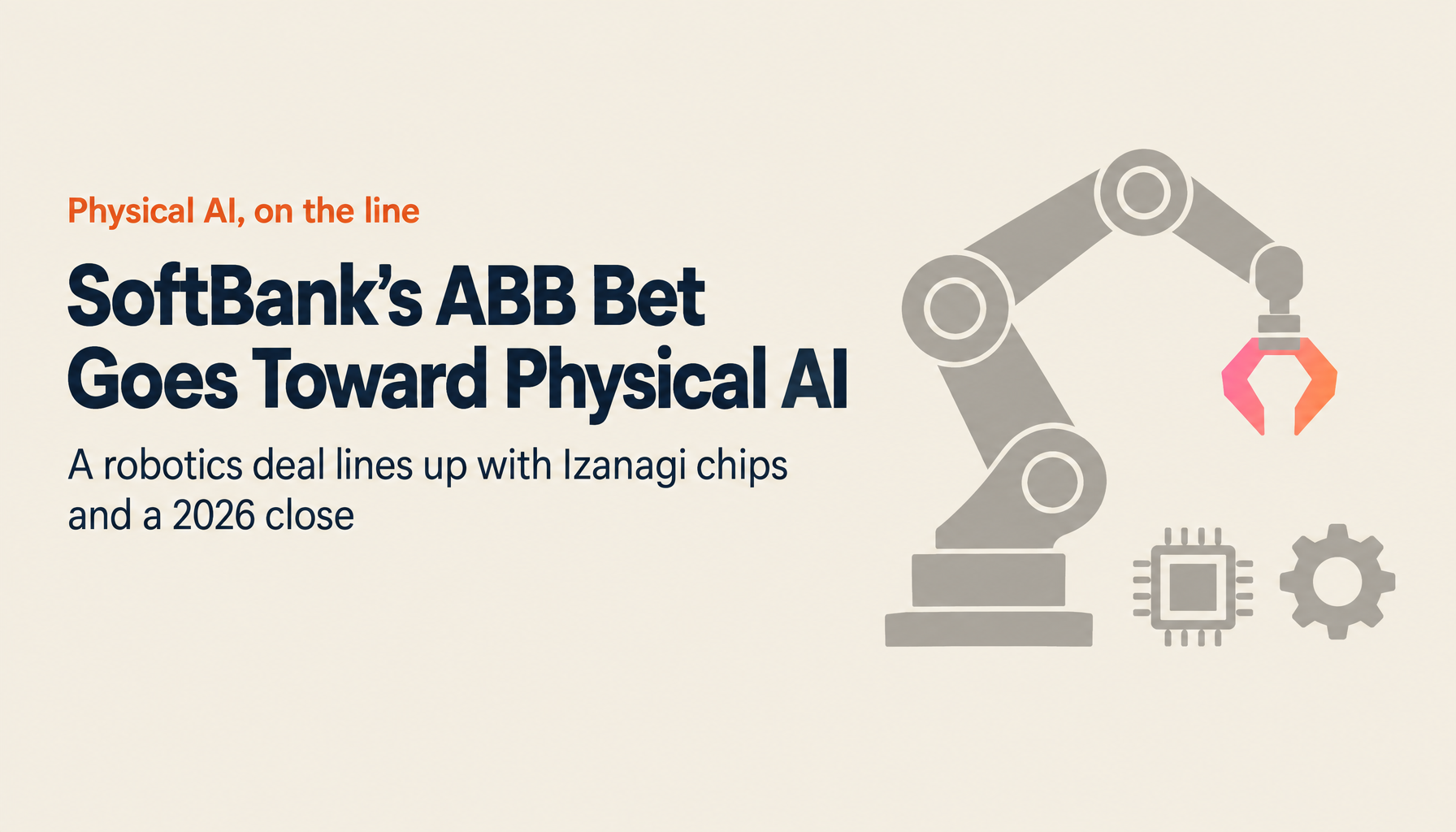
"SoftBank's next frontier is Physical AI" — in October 2025, Chairman and President Masayoshi Son made this declaration and signed a final agreement to acquire the robotics business of Swiss technology giant ABB for a total of approximately 818.7 billion yen. Expected to close in mid-to-late 2026, this acquisition is more than just an M&A deal. It is positioned as part of a grand vision to drive a groundbreaking evolution that advances humanity by fusing artificial superintelligence with robotics.
This article covers the background behind SoftBank Group's acquisition of ABB's robotics business, the developments expected after the acquisition closes in 2026, and the industrial revolution that Physical AI will bring.
SoftBank's Strategy: Background and Intent Behind the ABB Robotics Acquisition
Overview and Scale of the Acquisition
Acquisition details:
| Item | Content |
|---|---|
| Acquisition amount | $5.375 billion USD (approximately 818.7 billion yen) |
| Announced | October 8, 2025 |
| Expected completion | Mid-to-late 2026 |
| Approval conditions | Regulatory approvals including EU, China, and U.S. |
ABB holds one of the top four positions in the global industrial robot market alongside Fanuc, Yaskawa Electric, and leading Chinese manufacturers, with a track record of top-class performance by revenue. It has a long history and high market share in the industrial robot space, particularly in advancing automation for welding, painting, and assembly in manufacturing.
The Big Picture of the Physical AI Strategy
SoftBank Group is advancing investments in the following four key areas toward a vision of an autonomously automated society linked to AI.
SoftBank's investment areas:
- Semiconductors (Izanagi project): Mass production of proprietary AI chips to begin in 2026
- Data centers: Large-scale data center construction projects in the United States
- Power: Power infrastructure to meet AI demand
- Robotics: Full entry into industrial robotics via ABB acquisition
Chairman Son has stated: "Together with ABB Robotics, we will drive groundbreaking evolution that advances humanity by fusing artificial superintelligence with robotics" — making it clear that these investments are part of a coherent Physical AI strategy.
The Current State and Challenges of ABB's Robotics Business
Analyst Yamashita pointed out that ABB's robotics business faced the following challenges:
Challenges ABB faced:
- Intensifying competition in the Chinese market
- Declining profitability
- Need for portfolio restructuring
SoftBank Group viewed this profitability decline as an investment opportunity, deploying a strategy that "overcomes the current situation and expects significant performance improvement through integration with AI."
Justifying the Acquisition Scale
At approximately 818.7 billion yen, this deal is not an unusual scale compared to other large investment transactions SoftBank Group made in fiscal 2025.
Major investment transactions in fiscal 2025:
- U.S. data center construction projects
- Acquisition of a major semiconductor design company (approximately 970 billion yen)
- Plans for up to 6 trillion yen in additional investment
Analyst Morita noted: "818 billion yen is large for a Japanese M&A transaction, but when placed alongside other investment transactions this year, the scale feels quite natural." The robotics acquisition fits naturally into the overall strategy without any particular sense of incongruity.
Realizing Physical AI in 2026: Integration with Izanagi Chips
Integration with the Izanagi Semiconductor Project
SoftBank is advancing its proprietary AI chip development project "Izanagi," with mass production planned to begin in 2026.
Overview of the Izanagi project:
| Item | Content |
|---|---|
| Purpose | Developing AI chips optimized for Physical AI |
| Mass production start | Planned for 2026 |
| ABB integration | Izanagi chips planned for next-generation robot controllers |
| Advantage | Cost reduction and performance improvement through vertical integration of AI and robotics |
Given that the timing of ABB's acquisition completion in 2026 coincides with the mass production of Izanagi chips, next-generation ABB robot controllers are highly likely to incorporate Izanagi chips, realizing vertical integration from hardware to software.
Synergies Through Integration with Existing Portfolio Companies
After the acquisition, ABB's robotics platform will be integrated with the technology base of SoftBank's existing portfolio companies, accelerating innovation in the AI robotics space.
SoftBank's robotics-related portfolio companies:
- SoftBank Robotics Group: Pepper, Whiz (cleaning robot), etc.
- Berkshire Grey: Logistics automation robots
- AutoStore: Warehouse automation systems
- Agile Robots: Collaborative robots
- Skild AI: AI software for robots
Expected synergy effects:
| Area | ABB's Strengths | Post-integration Effects |
|---|---|---|
| Manufacturing | World top share in industrial robots | Increased autonomy through Skild AI integration |
| Logistics | Robot arm technology | Accelerated warehouse automation through Berkshire Grey and AutoStore integration |
| Services | High-precision control technology | New service creation through SoftBank Robotics integration |
| Collaborative robots | Industrial robot safety know-how | Collaborative robot market expansion through Agile Robots integration |
The Industrial Future That Physical AI Will Transform
Chairman Son envisions applying AI's computational and learning capabilities to real-world settings — factories, logistics, construction, healthcare, and more.
Physical AI application areas:
Manufacturing:
- Fully autonomous production lines
- Automated AI-driven quality management
- Flexible production systems (mass customization)
Logistics:
- Fully autonomous in-warehouse transport
- AI-optimized delivery route calculation
- Automated sorting and packaging of parcels
Construction:
- Autonomous construction robots
- Improved safety
- Resolving labor shortages
Healthcare:
- Advanced remote surgical robots
- AI-assisted precision surgery
- Rehabilitation support
Take AI-driven development all the way to production
WARP is a hands-on program for teams who want more than headlines. Former enterprise DX and data strategy leads work alongside you until it runs.
Fusing AI and the Physical: The Future of Autonomous Automated Society
From Digital to Physical
Until now, AI has primarily demonstrated its presence in digital domains — information processing, chat, image generation, and other virtual space applications. However, Physical AI will fundamentally transform industry by applying the power of AI all the way to real-world physical settings.
Digital AI vs. Physical AI:
| Digital AI | Physical AI |
|---|---|
| Information processing, chat, image generation | Real-world task execution (manufacturing, logistics, construction) |
| Self-contained in virtual space | Controls robots in physical space |
| Data input → data output | Sensor input → physical action |
| ChatGPT, Midjourney | Industrial robots, autonomous vehicles, drones |
Connecting with Global Trends
In U.S. and European markets, there are already reports of cases where AI enables robots to operate autonomously, improving efficiency in factory production lines and distribution centers.
Overseas leading examples:
- Tesla Bot (Optimus): Assembly work in factories
- Amazon Robotics: Autonomous transport in warehouses
- Boston Dynamics: Autonomous work at construction sites
SoftBank Group's acquisition strategy aligns perfectly with these global trends. Going forward, there is a high likelihood that more companies will steer investment toward realizing this kind of technology fusion.
Outlook Post-2026: Synergies from the ABB Acquisition
Integration Process After Acquisition Closes (Mid-to-Late 2026 Onward)
After the ABB acquisition closes in mid-to-late 2026, the following process is expected:
Integration roadmap (projected):
- Late 2026: Acquisition complete, management integration begins
- Q1 2027: Trial installation of Izanagi chips in ABB robots
- Q2 2027: Autonomy improvements through Skild AI integration
- Late 2027: New product lineup announced
- 2028: Mass production of next-generation Physical AI robots begins
Impact on Japan's Manufacturing Industry
For Japan's manufacturing industry, the ABB acquisition could have the following impacts:
Positive impacts:
- Accelerating technological innovation through intensifying competition with Fanuc and Yaskawa Electric
- Domestic spread of Physical AI technology
- Promoting fusion of AI with Japan's strengths in manufacturing
Concerning impacts:
- Intensifying competition with overseas manufacturers
- Risk of reduced market share for Japanese companies
Ripple Effects Across Society
The spread of Physical AI will have the following ripple effects across society:
Expected changes:
- Resolution of labor shortages (especially in manufacturing, logistics, construction)
- Reduction in workplace accidents (robotization of dangerous work)
- Dramatic improvement in productivity
- Creation of new employment (robot design, AI engineers)
Concerning challenges:
- Job displacement (automation of routine tasks)
- Need for retraining
- Ethical and legal challenges (liability issues for autonomous robots)
TIMEWELL's AI Support: Strategy Development for the Physical AI Era
Building Enterprise AI Strategy with ZEROCK
ZEROCK is an enterprise AI platform that supports strategy development for the Physical AI era.
Key features:
- GraphRAG technology: High-accuracy knowledge control utilizing company-specific robot operation data
- Prompt library: AI utilization templates for manufacturing and logistics industries
- AWS domestic servers: Ensuring security and privacy
Optimizing Physical AI Adoption Strategy with WARP
WARP supports companies' robot utilization strategies through Physical AI adoption consulting.
Support includes:
- ROI analysis for robot adoption
- Developing Physical AI strategy
- Automation design for production lines and distribution centers
- Strategic planning by former enterprise DX specialists
Summary: The Dawn of the Physical AI Era
Key Points
- Expected acquisition close: Mid-to-late 2026, approximately 818.7 billion yen
- Physical AI strategy: Son says "the next frontier is Physical AI"
- Izanagi chips: Mass production begins 2026; planned for integration in ABB robots
- Vertical integration: Integration of semiconductors, data centers, power, and robots
- Integration with existing portfolio: Collaboration with Skild AI, Berkshire Grey, AutoStore, etc.
- Global competition: Intensifying competition with Tesla Bot and Amazon Robotics
The Dawn of the Physical AI Era
In 2026, as SoftBank Group's ABB robotics acquisition closes, the Physical AI era will formally begin. With AI moving from virtual space into physical space, there is the potential to fundamentally transform every industry — manufacturing, logistics, construction, healthcare, and more.
Chairman Son's grand vision — driving groundbreaking evolution that advances humanity by fusing artificial superintelligence with robotics — is not merely a dream. From 2026 onward, it will take concrete shape and become reality.
What Companies Should Do Now
- Develop a Physical AI strategy: Explore the possibilities of robot utilization
- Start pilot deployment: Measure effectiveness in specific processes
- Develop talent: Improve robot operation and AI utilization skills
- Select partners: Consider collaboration with SoftBank, Fanuc, Yaskawa Electric, etc.
The arrival of the Physical AI era represents both a major opportunity for companies and a risk of losing competitiveness if not addressed properly. It is important to start preparing now to be ready for the industrial revolution from 2026 onward.
References
- SoftBank Group Announces Acquisition of ABB's Robotics Business
- SoftBank G to Acquire Swiss ABB's Robotics Business for Approximately 800 Billion Yen - Nikkei