Hello, this is Ryuta Hamamoto from TIMEWELL.
This piece is for anyone who buys gas that starts its life in Australia: power and gas utilities, factories that use a lot of gas or electricity, and trading houses and energy companies with stakes in Australian gas projects. I write from Japan, so Japanese buyers are my main example. The same questions apply to buyers in Korea and Taiwan. Australia's Parliamentary Library notes that about three quarters of Australian gas is exported, and 90% of those exports go to Japan, China, Korea and Taiwan1. Even companies with no direct contract will feel this eventually, through their power and gas bills.
Put simply, Australia is about to tell its LNG exporters (LNG is liquefied natural gas, chilled into a liquid so it can be shipped) that gas equal to up to 20% of what they export has to go to the Australian market first.
Why now? Because Australia's Federal Parliament passed the bill on November 27, 20262. In 2025, 39.7% of Japan's LNG imports came from Australia, the largest share of any country3. According to the ministers' announcement, the export licensing framework starts on January 1, 2027, and the domestic supply obligation applies from January 1, 20284. Buyers who ignore it may only notice at a contract renewal a few years from now, when the volumes or prices on offer are not what they expected.
When people hear "export restrictions," many think first of export classification, the check of whether a product falls under a control list. This law is a different kind of restriction with a different goal. If you want a refresher on security export controls, I keep a list of 20 frequently asked questions on export control basics. I am also not here to argue for or against Australia's policy. Every country thinks about securing its own energy, and that is a perfectly normal thing to do. What I want to sort out is which parts matter for the companies buying the gas.
The short version
- Exporting LNG from Australia will require a licence, and licence holders must supply the domestic market with gas equal to up to 20% of their exports (sections 14 and 17 of the Bill).
- 20% is a ceiling. Contracts made on or before December 22, 2025, state schemes, infrastructure constraints and the domestic demand outlook can all bring the volume down.
- For buyers, the impact is not a sudden drop in cargoes. It appears when long-term contracts are renewed or extended in the 2030s. Australia's LNG export contracts start to expire in 2031.
Here are the terms I use in this piece.
| Term | Meaning |
|---|---|
| LNG | Liquefied natural gas. Japan imports it as power station fuel and as feedstock for city gas |
| Gas reservation | A policy requiring a share of exported gas to be set aside for the home market |
| Domestic supply obligation (DSO) | The volume an export licence holder must supply to the domestic market |
| ADGSM | Australian Domestic Gas Security Mechanism. In place since 2017, it lets the government restrict LNG exports when a shortfall is expected |
| AER | Australian Energy Regulator. It will administer and enforce the new scheme |
| Existing contract | A contract made on or before December 22, 2025 and in force on that date (later extensions excluded) |
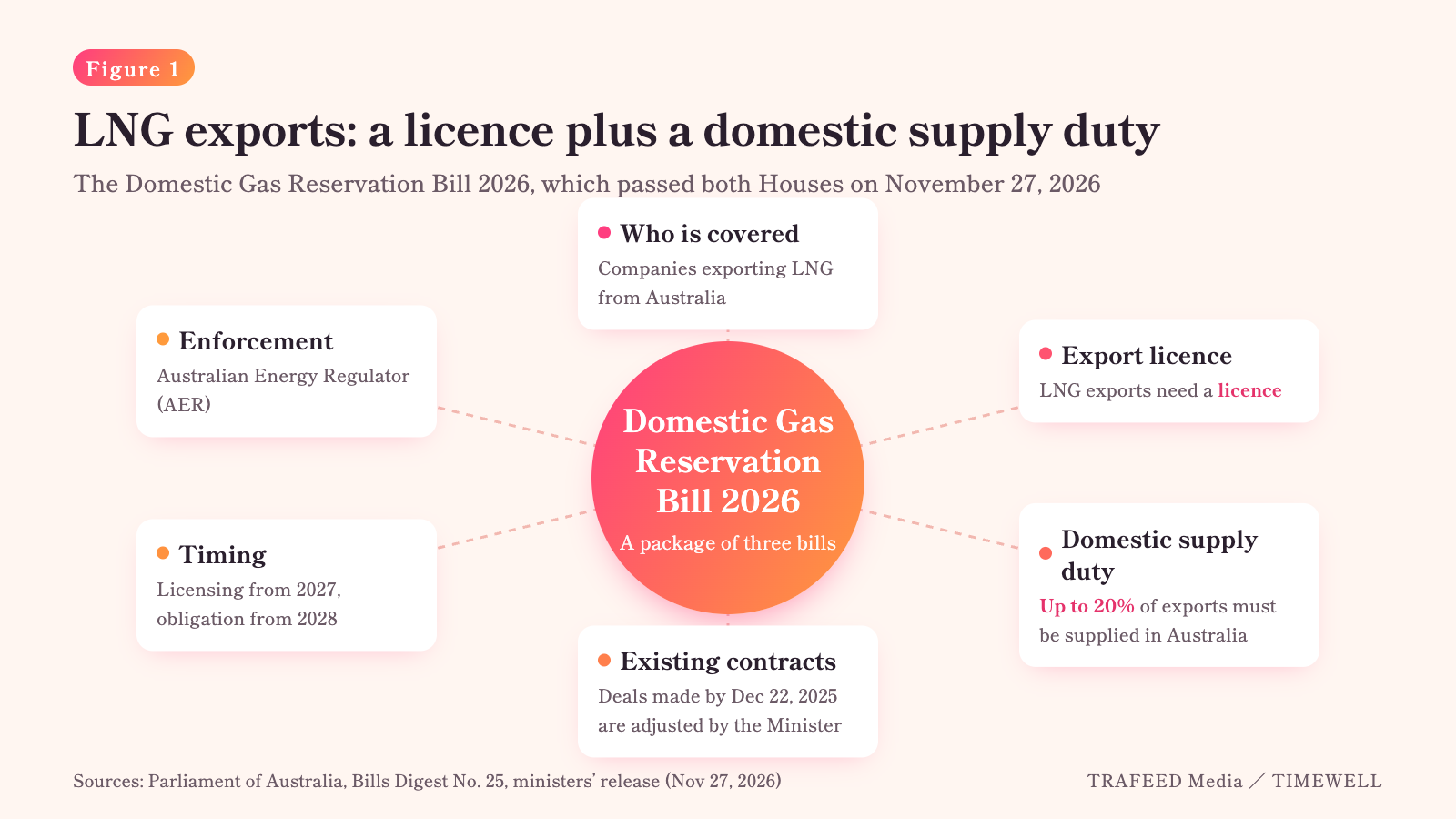
Figure 1. How the domestic gas reservation law is built. From the law in the center, it branches into six points: who is covered, the licence, the obligation, existing contracts, timing and enforcement. Sources: Parliament of Australia bill pages, Parliamentary Library Bills Digest, joint ministerial media release (November 27, 2026). Compiled by TIMEWELL
What the Domestic Gas Reservation Bill does: three bills and two dates
The core of it is this. Australia used three bills to make LNG exports subject to a licence, and to attach a domestic supply obligation to that licence. The substance sits in the main bill. The other two support it.
The first is the Domestic Gas Reservation Bill 2026 itself. From January 1, 2028, exporting LNG requires an export licence. Licence holders carry a domestic supply obligation, and the Australian Energy Regulator (AER) administers and enforces the scheme2. The second, the Domestic Gas Reservation Levy Bill 2026, imposes a levy on licence holders to fund the scheme. The third, the Domestic Gas Reservation (Consequential Amendments) Bill 2026, aligns the Competition and Consumer Act and the Gas Market Code with the new scheme and removes the legal basis for the Australian Domestic Gas Security Mechanism (ADGSM), which has been in place since 201751.
I traced the passage of the bills on the Parliament of Australia website. All three were introduced in the House of Representatives on October 14, 2026, and passed the House on October 29. The main bill was introduced in the Senate on November 16. On November 26, the Senate passed the main bill with 39 government amendments. Because it had been amended, the bill went back to the House, which agreed to the amendments on November 27, completing passage through both Houses2. The levy bill passed both Houses unamended on November 26. The consequential amendments bill passed both Houses on November 27, after the House agreed to one Senate amendment5.
One point on wording. In Australia, a bill that has passed both Houses becomes an Act only after it receives Royal Assent from the Governor-General. When I checked on November 28, the status on the Parliament website was "Passed Both Houses." Some Japanese news reports describe the law as already enacted. Strictly speaking, it only becomes an Act, with an Act number, after Royal Assent.
There are also two sets of dates. The joint media release issued on the day of passage by the Minister for Resources, the Minister for Climate Change and Energy, and the Minister for Industry and Innovation says the export licensing framework will start on January 1, 2027, and that the domestic supply obligation will apply from January 1, 2028 to align with industry contracting cycles4. Under the text passed by both Houses, LNG cannot be exported without a licence from January 1, 2028 (sections 13 and 14). Most of the Act (sections 3 to 110) commences on a day fixed by Proclamation, and if no Proclamation is made by July 1, 2027, those sections commence on that day (section 2)6. The two accounts do not contradict each other. The natural reading is that licence applications and assessments get under way during 2027, and licences and obligations bite from 2028. The January 1, 2027 date comes from the ministers' release. No Proclamation date has been published yet.
Take a Japanese power company receiving Australian LNG in the winter of 2028. From 2028, the Australian company loading that ship must hold a licence and must also have supplied a set volume of gas to the Australian market in the same year. The buyer does not gain any new paperwork. What changes is that "the share that goes to Australia" now sits inside the seller's numbers.
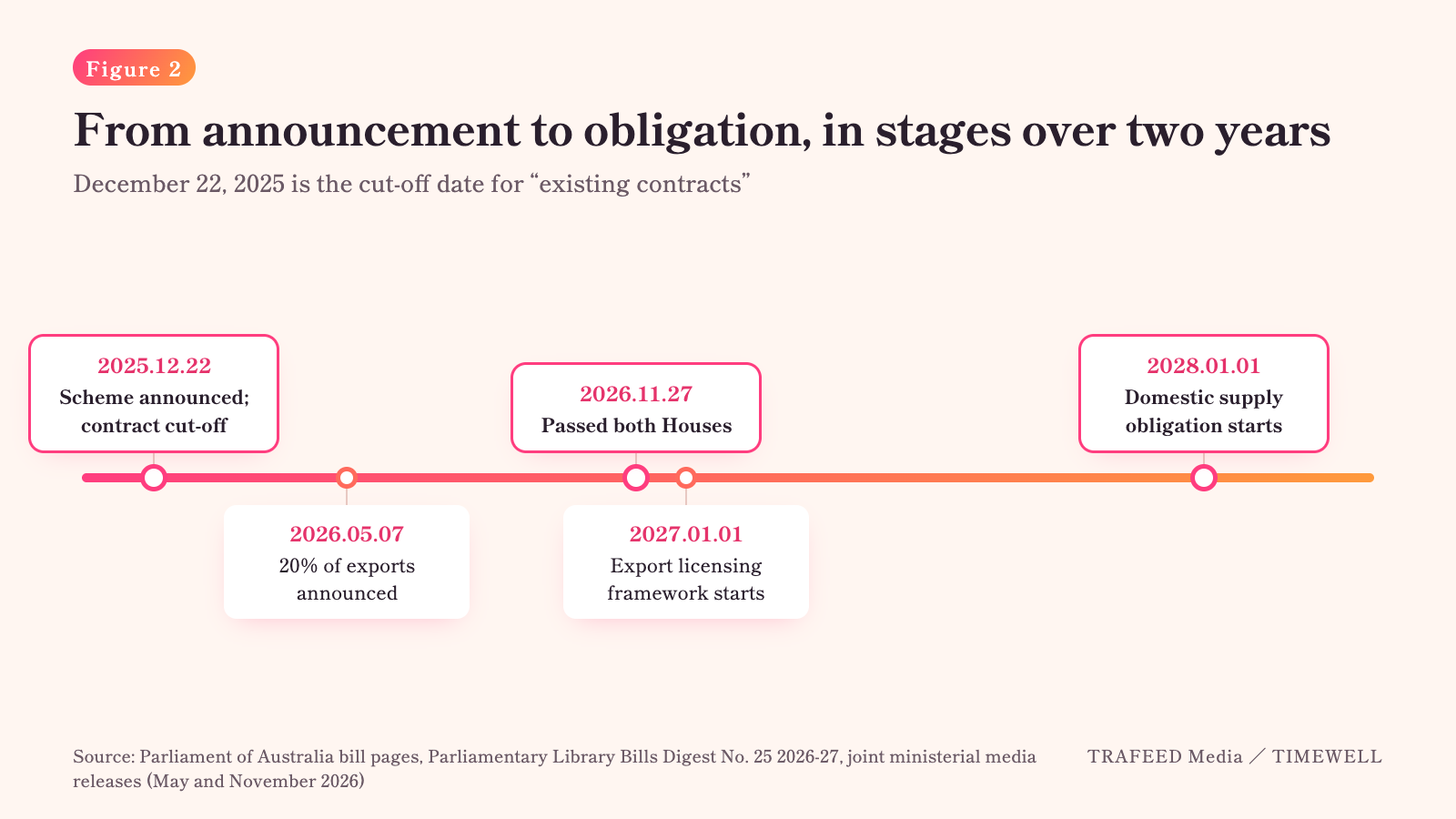
Figure 2. From announcement to the start of the obligation. Read it left to right: the announcement, the 20% figure, passage through both Houses, the start of licensing and the start of the obligation. Sources: Parliament of Australia bill pages, Parliamentary Library Bills Digest No. 25 2026-27, joint ministerial media releases (May 7 and November 27, 2026)
So November 27, 2026 is the day the bill cleared Parliament. Day-to-day practice changes in 2027 and 2028. If you write about this in internal briefings, I would keep passage, Royal Assent and commencement as three separate items. It saves confusion later.
Replace siloed classification work with AI.
METI's FY2024 data shows 52% of foreign exchange law violations stem from classification errors. Download the TRAFEED product catalog covering features and rollout.
Why Australia is reserving gas: east coast prices and the mechanisms that came before
This law did not come out of nowhere. It is closer to a standing answer to a problem on Australia's east coast that has been running for almost ten years.
Australia is one of the world's largest LNG exporters. The Parliamentary Library puts the value of exports at A$92 billion in 2022-231. At home, though, the gas market is split in two. The east coast market (which includes the Northern Territory) and the Western Australian market are separate markets with no pipeline between them.
Things changed on the east coast from around 2012. Three LNG export terminals opened in Queensland, and gas that had been sold domestically started flowing into long-term export contracts. The Australian Competition and Consumer Commission (ACCC) has explained that east coast gas prices, which had been low by international standards, became linked to international prices through export contracts and the spot market1. Household gas bills rose, and so did costs for factories that use gas as feedstock or for heat. The government responded in stages.
The main mechanisms so far look like this.
| Mechanism | Start | What it does | Under the new law |
|---|---|---|---|
| Australian Domestic Gas Security Mechanism (ADGSM) | July 2017 | Lets the Resources Minister restrict LNG exports when a domestic shortfall is expected the following year. Already extended to January 1, 2030 | Repealed (consequential amendments bill) |
| Heads of Agreement with east coast LNG exporters | October 2017 | A voluntary commitment to offer uncontracted gas to the domestic market first in a shortfall | Expired on January 1, 2026 |
| Wholesale price cap and code of conduct | December 2022 and July 2023 | A price cap of A$12 per gigajoule (for 12 months) and rules for negotiations | Code amended to fit the new scheme |
| Western Australia's domestic gas policy | Formalised in 2006 | Reserves the equivalent of 15% of LNG exports for the state, applied through individual state agreements | Continues as a state scheme |
You could think of the ADGSM as an emergency brake. It only worked in years when a shortfall was expected, and it was described at its introduction as a short-term, targeted measure1. The Gas Market Review that began in June 2025 credited these mechanisms with preventing shortfalls, but concluded that the longer-term structural problems needed a policy rethink, and it recommended a domestic gas reservation scheme. The government announced it on December 22, 202517.
Western Australia has had its own reservation policy for a long time. It goes back to the North West Shelf project in 1979. The September 2024 update keeps the reservation of gas equal to 15% of LNG exports for the state, and also asks new onshore gas projects to supply 80% of their production to the state until the end of 2030 and 100% after that1.
Picture the southern states on the east coast on a winter night, when heating demand and gas-fired power demand peak together. According to a summary by JOGMEC (Japan Organization for Metals and Energy Security), Australia's energy market operator has warned that winter peak supply may fall short from 2029 onward8. Gas already committed under export contracts cannot simply be redirected when the domestic market runs short. That is why Australia is making the rule to set domestic volumes aside in advance a permanent one.
Views on the policy differ. The government says it will lower prices, make long-term contracts easier to sign and support investment in manufacturing4. The Parliamentary Library also sets out concerns drawn from earlier analysis by government agencies and from industry submissions: that the scheme could slow investment in new gas fields, and that domestic prices may not necessarily fall1. Deciding who is right is not my job here. As a buyer, though, knowing that both views exist makes conversations with Australian sellers go more smoothly.
In other words, Australia is moving from a mechanism that stops exports when gas runs short to one that sends a set volume to the domestic market from the start. Domestic volumes become easier to forecast than under the ADGSM. On the other side, the ceiling on what can be exported is now something everyone plans around in advance.
What "up to 20%" really means: a ceiling that existing contracts and demand pull down
The point of this section is simple. The 20% is a ceiling written into the Bill. The volume actually sent to the domestic market is what is left after deductions and reviews. What follows is based on the text passed by both Houses and on the Parliamentary Library's Bills Digest, which analysed the bill as introduced61. The 39 Senate amendments changed some numbers, and I flag those as I go.
Start with section 17. For each financial year and each market, a licence holder must supply the domestic market with at least "20% of its total covered exports, measured by energy content, minus the adjustment amount." Three things count as adjustments: existing contracts, existing state reservation schemes, and infrastructure constraints. When the Minister sets these adjustments, the Bill sets out the steps: approval by the Minister responsible for energy, consultation with the Minister responsible for industry, and advice from the AER.
Existing contracts are defined in section 9. A contract made on or before December 22, 2025 and in force on that date counts as an existing contract. Renewals and extensions after that date do not count, even when the contract already contained an option to extend. For buyers, this is probably the most important line in the whole Bill.
There are other ways the volume can fall. The Minister can lower the percentage for a market to anywhere from 0% up to below 20% (section 23), consulting the state if it has an existing scheme, with the decision made by June 30 before the relevant year. The AER then takes its forecast of domestic demand, adds a buffer (10% by default, though the Minister can set a different figure), subtracts forecast supply from companies other than licence holders, and arrives at a target supply volume. If a company's share of that target is lower, the lower figure becomes its obligation (sections 24 and 25). The Energy Users Association of Australia (EUAA), which represents large energy users, has pointed out that this calibration only ever pushes the volume down, and there is no way to lift it above 20%1.
How companies meet the obligation is also flexible. If a company actually supplies at least 90% of its obligation, it can meet the rest through efforts to sell, such as offering gas to the domestic market on competitive terms and negotiating in good faith. Any shortfall must be made up within the next five years. Over-supply can be carried forward up to 10% and expires after five years (sections 20 and 21). In the bill as introduced, both periods were three years1. Gas produced above a producer's baseline (additional gas) and supplied to the domestic market can also count toward the obligation if the regulator approves.
Licences have an expiry date. They can be renewed, but not transferred (sections 50, 52 and 53). Facilities that were already exporting LNG and are not connected to the domestic pipeline network may be able to get an exemption from the Minister (section 48). Exporting without a licence carries heavy civil penalties. For a company, the maximum is the greatest of 50,000 penalty units (about A$18.2 million at the current rate), three times the benefit obtained, or 10% of annual turnover, capped at 2.5 million penalty units (about A$910 million) (section 14)61. According to the Parliamentary Library, liability can also extend to officers.
A simple example helps. Say a company exports 100 units of LNG a year from one market. The ceiling is 20. If the Minister accepts that 5 of those cannot go to the domestic market because of contracts made on or before December 22, 2025, the figure drops to 15. If the AER's outlook shows domestic demand in that market will be well covered, it could fall further, to 10 for example. It will never rise above 20, however tight the domestic market gets. These numbers are only for illustration.
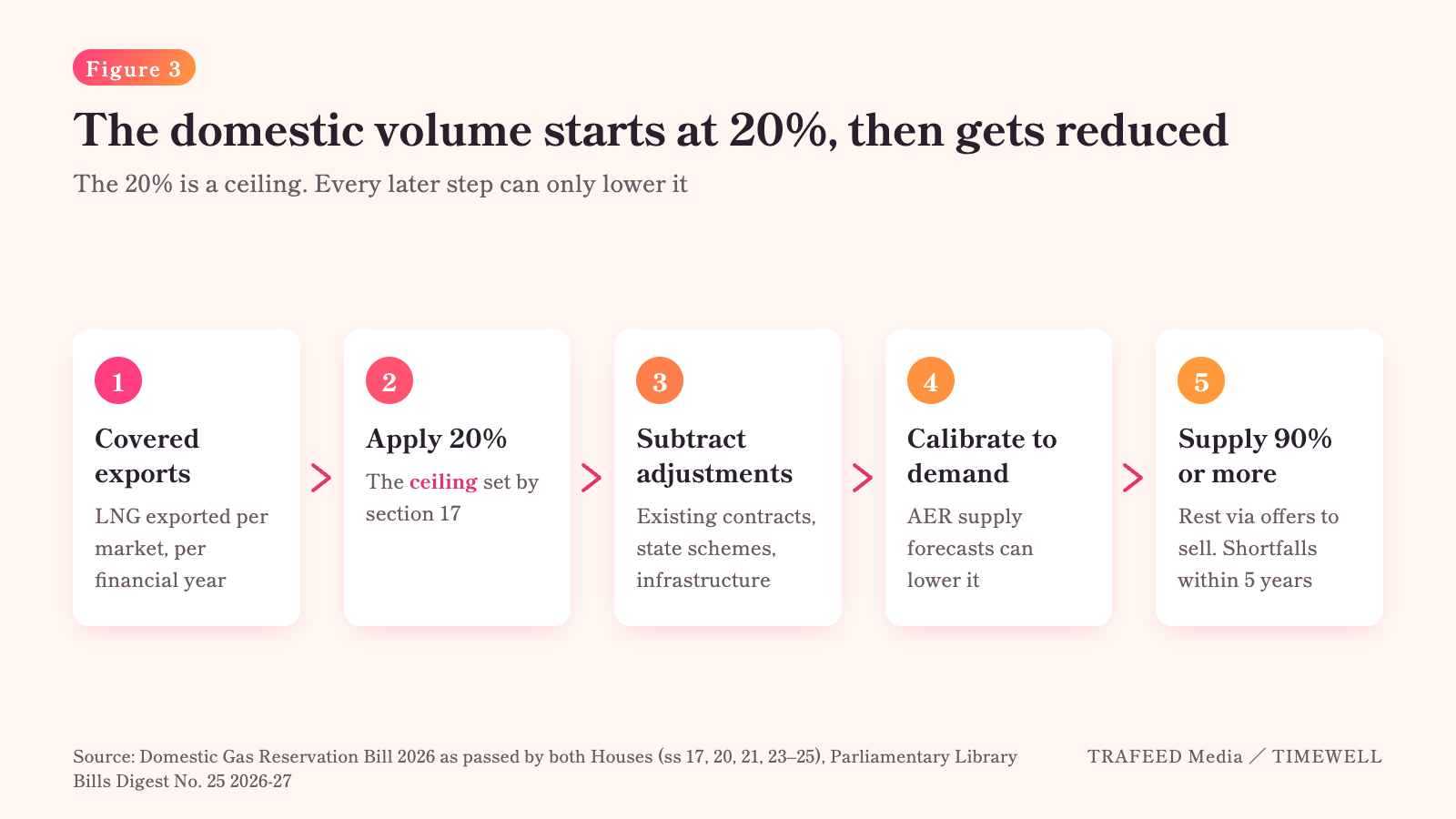
Figure 3. How the domestic volume is set. Left to right: work out the ceiling first, then deduct and review. Sources: Domestic Gas Reservation Bill 2026 as passed by both Houses (sections 17, 20, 21 and 23 to 25), Parliamentary Library Bills Digest No. 25 2026-27
Western Australia needs a careful read. International news reports say Western Australia was carved out of the scheme because it has its own 15% policy and no pipeline link to the east coast9. However, I could not find any provision in the obligation part of the text passed by both Houses (Part 3) that names Western Australia and excludes it. What the text contains is a mechanism that lets the Minister lower the percentage for a market to as low as 0% (section 23). For markets where a state has an existing scheme, the Minister consults that state's government and decides by June 30 before the relevant year. At 0%, the domestic supply obligation provisions do not apply in that market. The text passed by both Houses also exempts these decisions from sunsetting (automatic expiry after a set number of years), and provides that any change or revocation does not affect a year that has already begun6. The reported "carve-out" most likely refers to using this mechanism to set Western Australia's percentage at 0%. That is my inference, and no such decision had been made at the time of writing.
So "up to 20%" does not mean "always 20%." The real volumes will be set market by market and company by company through the rules due in 2027 and 2028 and through decisions by the Minister and the AER.
What it means for power, gas and long-term LNG contracts in Japan and the wider region
The main takeaway here: the impact on buyers is not a sudden fall in imports. It shows up at contract renewal time, which for most contracts means the 2030s. Here is how this looks from Japan, as one example. Buyers in Korea and Taiwan can run the same check against their own contracts.
First, how much Japan relies on Australia. According to Japan's Agency for Natural Resources and Energy, Japan imported about 64.98 million tonnes of LNG in 2025, and 39.7% of it came from Australia. Malaysia came second with 14.8%, so Australia supplied well over twice as much as the next country3.
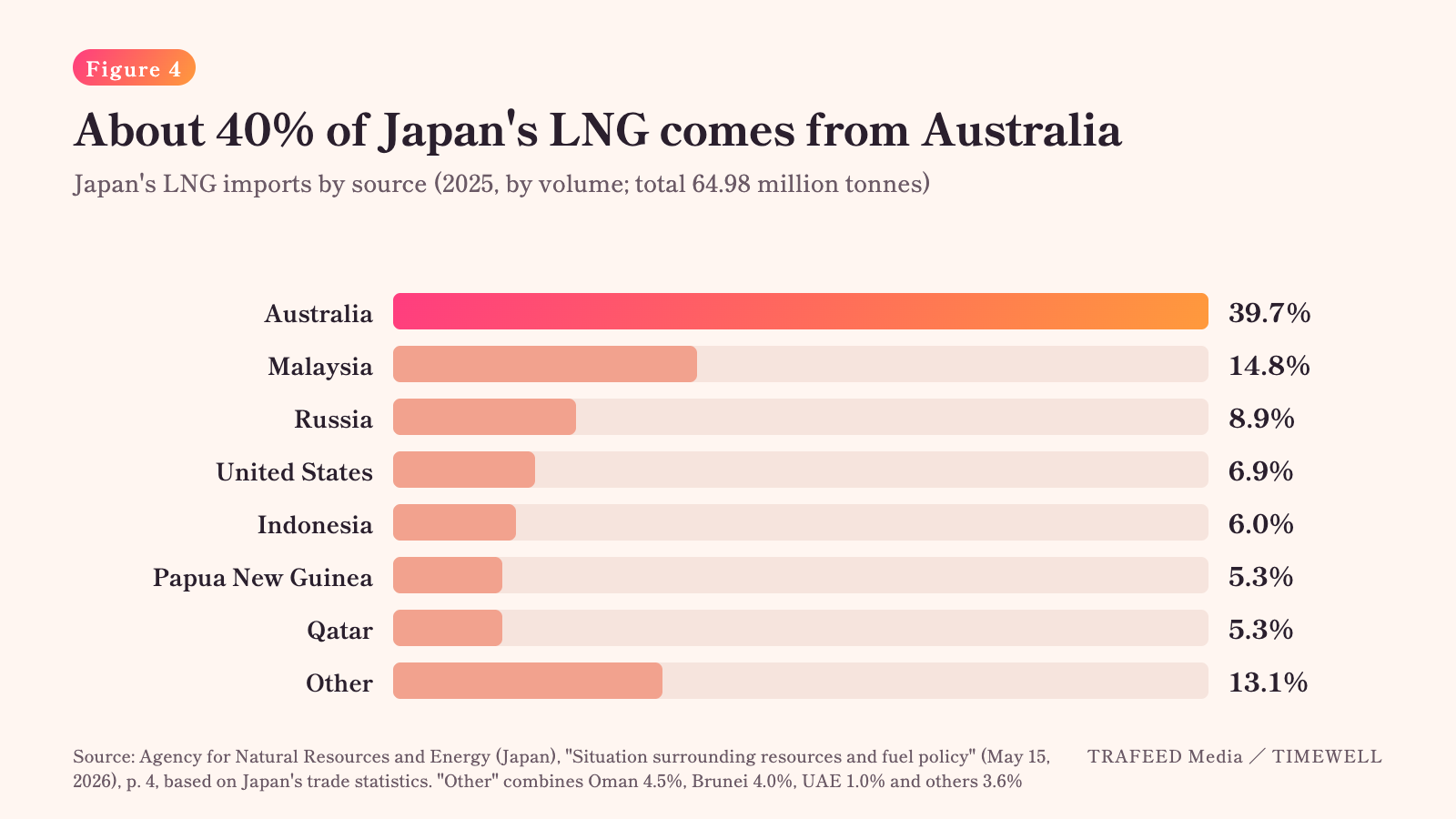
Figure 4. Japan's LNG imports by source (2025). Australia alone supplies more than the second, third and fourth largest suppliers combined. Source: Agency for Natural Resources and Energy (Japan), Resources and Fuel Department, "Current situation surrounding resources and fuel policy" (May 15, 2026), p. 4, based on Japan's trade statistics (in Japanese)
The same document puts Japan's dependence on the Middle East for LNG at 10.8%, with 6.3% passing through the Strait of Hormuz3. Compare that with crude oil, where more than 90% comes from the Middle East. Japan has spread its LNG sources more widely, and that is exactly why Australia carries so much weight. I cover how Middle East tensions feed into Japan's energy supply in my piece on the Strait of Hormuz closure and the conditions for reopening. Australia is the supplier Japan has leaned on to limit Middle East risk, and it is now putting a domestic-first rule in place.
So what happens to existing long-term contracts? The Australian Government says it will honour export contracts signed before the December 22, 2025 announcement and make sure exporters can meet their export commitments710. In the Bill, existing contracts are not automatically exempt. They are deducted from the obligation through the Minister's adjustment1. According to the Parliamentary Library, Australia had 51 LNG export contracts in 2024. They start expiring in 2031, and the rest expire by 20401.
That tells us when the effects arrive. Because the scheme is built to respect existing long-term contracts, it is hard to see cargoes to Japan suddenly dropping in 2028. What changes are new contracts signed after December 22, 2025, and existing contracts when they are extended or renewed. Extended volumes do not count as existing contracts, so when renewals come up for negotiation in the 2030s, sellers will build the domestic share into their numbers before offering volumes, prices and terms.
JOGMEC's summary, written at the design stage in May, suggested that some Queensland projects already supply more than 20% of their export volumes to the domestic market, and that any new burden was more likely to fall on projects in the Northern Territory8. The Ichthys LNG project, which JOGMEC cited as a Northern Territory project, also appears in the Agency for Natural Resources and Energy's materials as a project in which a Japanese company holds an interest3. That view was based on the design before the bill was introduced, though, so the treatment after the Senate amendments needs to be checked again.
The Japanese government has been talking energy with Australia for a while. At the Japan-Australia summit on May 4, 2026, the two governments issued documents including a joint statement on energy security, and the two leaders confirmed they would work together to secure "stable two-way energy supply"11. The 6th Japan-Australia Ministerial Economic Dialogue on May 19 reaffirmed that joint statement12. On November 26, one day before the bill cleared both Houses, Japan's Senior Vice-Minister of Economy, Trade and Industry, Takagi, signed a memorandum of cooperation with Premier Cook of Western Australia. They discussed the policy environment, including the federal domestic gas reservation scheme. According to Japan's Ministry of Economy, Trade and Industry, the Premier said he intends to maintain a stable business environment for LNG13.
Imagine a city gas company negotiating, around 2030, an extension to an Australian long-term contract that expires in 2032. The extended volumes are not an existing contract, so the seller will set its terms based on the domestic supply percentage in force at that time and the AER's supply and demand outlook. A buyer who understands where those numbers come from will negotiate very differently from one who does not.
In short, this will not show up in power or gas bills next month. It will shape procurement terms in the 2030s. I think it is well worth taking stock of your contracts now.
"Export restrictions" that are not export controls: how to tell resource export rules apart
The phrase "export restrictions" covers several types with different goals, and different teams inside a company own each type. Mix them up and the information never reaches the people who need it.
Security export controls exist to stop goods and technology being diverted to weapons. Under Japan's Foreign Exchange and Foreign Trade Act (FEFTA) or the US Export Administration Regulations (EAR), you look at the item's specifications, the counterparty and the end use to decide whether a licence is needed. The exporter classifies the item, and if the counterparty or the end use raises concerns, a licence may be needed even for items that are not on a list. That is the catch-all control. For a plain explanation, see What Are Catch-All Controls?.
Australia's gas reservation is a different animal. Australia also uses the word "export licence," but the condition attached to the licence is about whether you send a set volume to the domestic market, not about the destination country or the end use. The goal is stable domestic supply and prices. The objects clause in the text passed by both Houses (section 3) sets out three aims: making Australian gas available to domestic businesses and consumers, energy security and lower prices, and an effective and predictable regulatory framework for exporters6. The government's explanatory materials and ministerial statements repeatedly say Australia will remain a reliable LNG supplier14. The obligation falls on Australian exporters. Buyers in Japan or anywhere else are not being asked to classify anything.
A third type is an export ban designed to make resources get processed at home. According to JETRO, Indonesia has phased in bans on exports of unprocessed ore. It reimposed a full ban on nickel ore exports in January 2020 and added bauxite ore from June 202314. China says it runs its controls on critical minerals as export controls on dual-use items, so on paper they belong to the first type. For where China's rare earth and gallium controls stand now, see China's rare earth export controls 2025 to 2026 and why gallium cannot be sourced away from China.
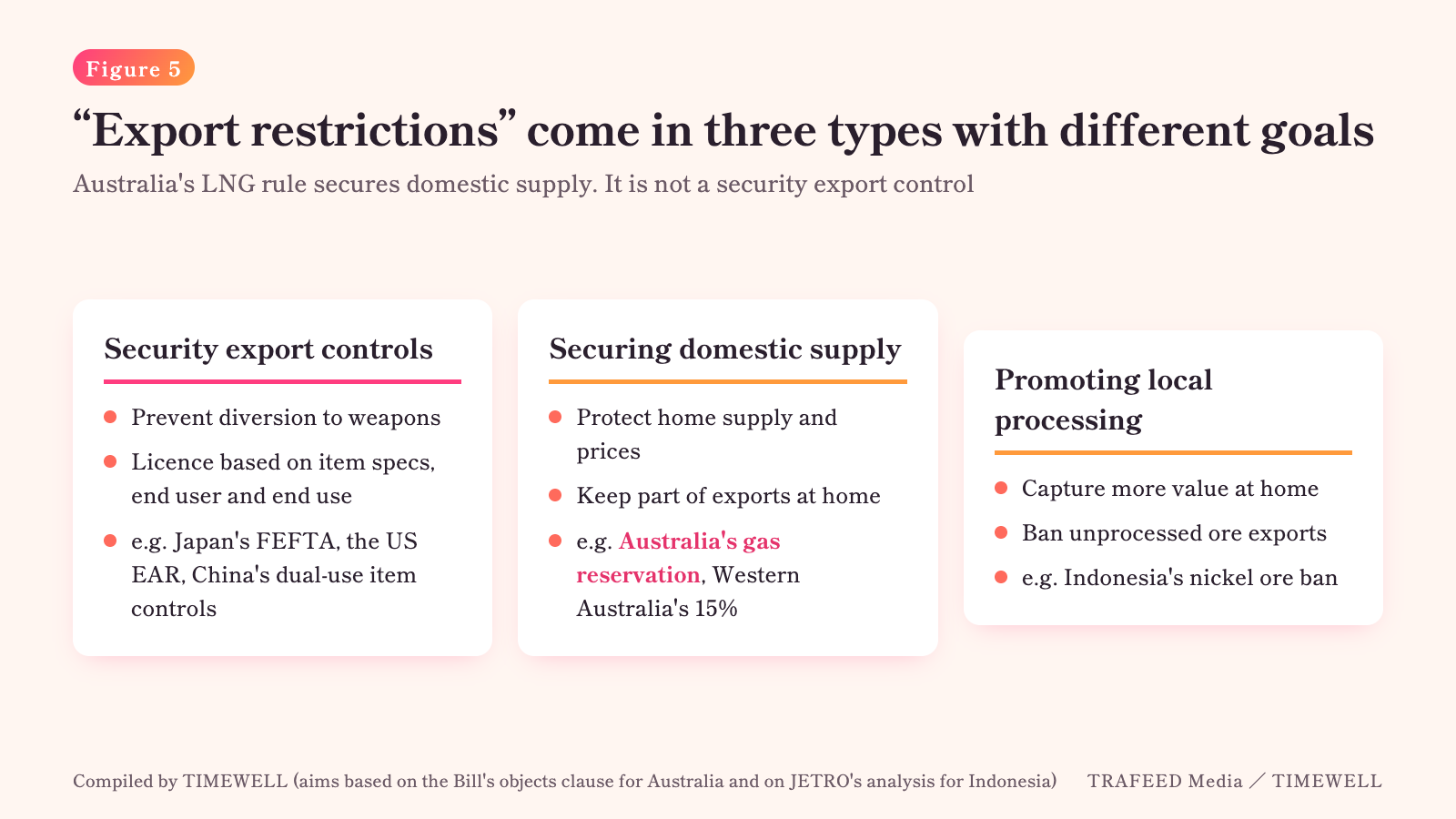
Figure 5. Three types of "export restrictions," sorted left to right by what each one is meant to protect. Source: compiled by TIMEWELL (aims based on the Bill's objects clause for Australia and on JETRO's analysis for Indonesia)
Japan treats natural gas as an economic security issue too. The Cabinet Order under the Economic Security Promotion Act lists combustible natural gas as one of the "specified critical materials," the goods essential to people's lives and economic activity (Article 1, item 9)15. I list all the designations in What Are Specified Critical Materials?. So even if Australia's scheme is not work for the export control team, it is squarely work for whoever handles economic security.
Picture an export control officer at a chemical company who sees the Australian news and decides it has nothing to do with the company's classifications. That judgment is correct. Stop there, though, and procurement and corporate planning will learn late about changes to fuel and feedstock terms a few years out. Export control teams are often the people inside a company who track regulatory changes around the world most closely. In my view, the ideal is to go one step further and ask, "This is outside our scope, but who else in the company needs it?"
The practical first step with any "export restriction" story is to identify its type. Security-type rules go to export control. Supply-security and processing-promotion rules go to procurement, business continuity (BCP) and corporate planning.
What to check now, and what to watch next
Finally, here is what each role can start on now. Nothing needs to change in a hurry, but deciding the order of checks ahead of 2027 and 2028 will make the next steps easier. I wrote the list with Japanese companies in mind, and the same checks work for buyers in Korea or Taiwan.
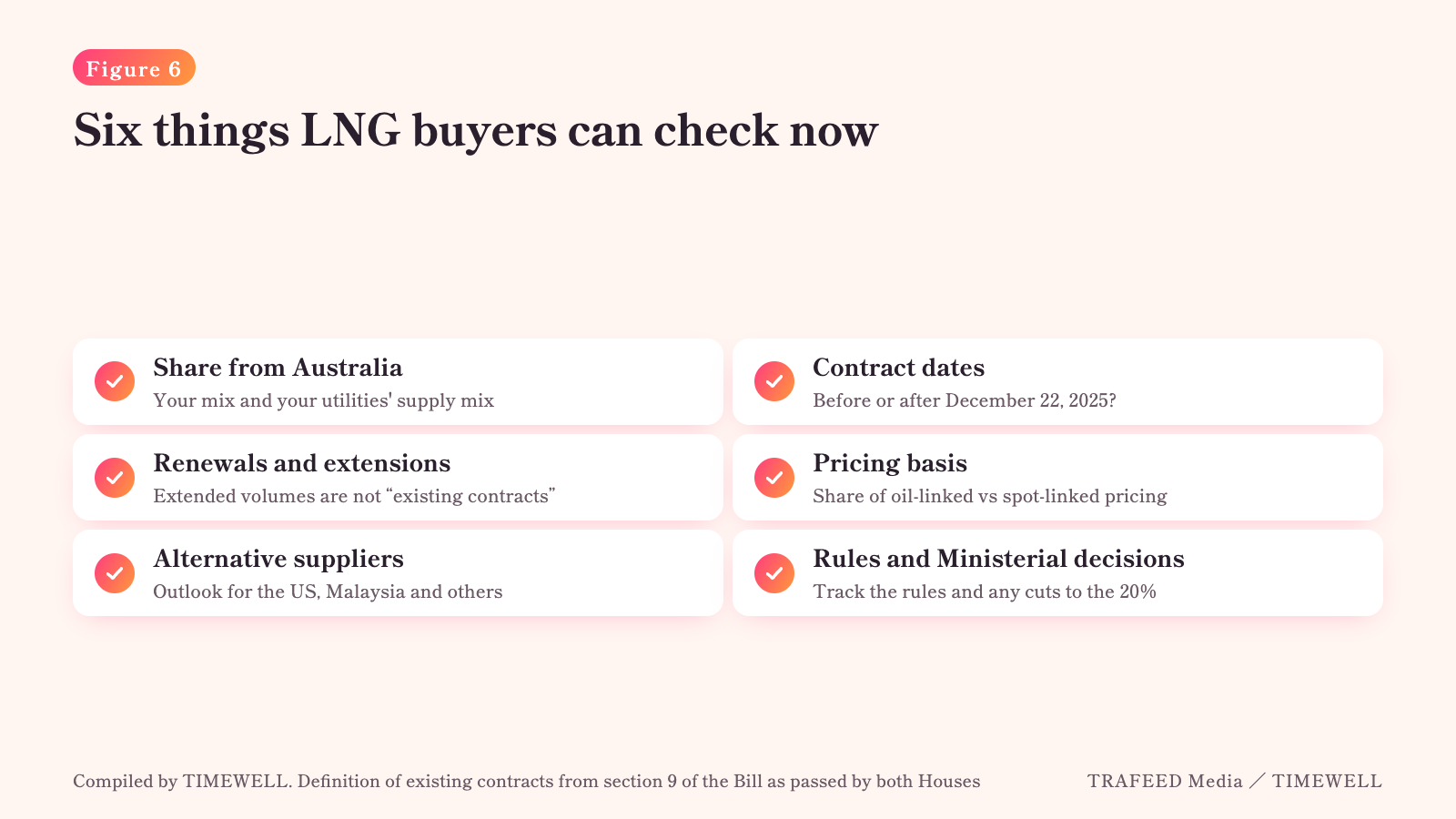
Figure 6. Six things to check now. The top rows can be checked quickly against documents you already have. The bottom rows are developments to track. Source: compiled by TIMEWELL. Definition of existing contracts from section 9 of the Bill as passed by both Houses
If you handle this day to day, start with the contracts on your desk. If your company buys LNG directly, list each Australian contract with the date it was signed (before or after December 22, 2025) and when its extension or renewal clauses kick in. Factories that do not buy LNG directly can still check when their power and gas supply contracts renew and how prices are set (linked to oil prices or to spot prices). That makes changes a few years out much easier to read.
If you are responsible for procurement or business continuity, it helps to have scenarios for the renewal window in the 2030s. If Australia makes up a large share of your supply, think about how much volume you could secure in renewal talks, alongside the outlook for other sources such as the United States and Malaysia. Chemicals makers that use gas as feedstock, and steel and glass makers that use it for heat, will feel this in their feedstock terms as well as their power bills.
For senior management, I would suggest two perspectives. First, resource-rich countries turning "domestic first" into law is not just an Australian story. Second, for companies with plants in Australia, Japanese or otherwise, domestic gas may become easier to secure. The Australian Government says the scheme will support investment in manufacturing4. The same rule looks different depending on where your sites are.
I see three things to watch from here. The first is the date of Royal Assent and the commencement date set by Proclamation. The second is the detailed rules (regulations and AER documents) and any Ministerial decisions lowering the percentage for a market. Decisions for the first year are due by June 30 before that year begins. The third is how Western Australia is treated, and how far adjustments for existing contracts are allowed. At TRAFEED Media, we also follow regulatory changes around the world in our weekly digest.
This piece is based on primary sources I checked up to November 28, 2026. In the main bill as passed by both Houses, I read sections 2 to 4, 9, 13 and 14, 17, 20 and 21, 23 and 24, and 48 to 53 in the original. Other sections (the details of the demand review, the procedure for adjusting for existing contracts, officers' liability and so on) and the list of 39 Senate amendments are based on the Parliamentary Library's analysis of the bill as introduced. I will update this piece once I have confirmed them.
When a resource-rich country puts its own market first, buyers on the other side tend to get nervous. Australia's law, though, states plainly that it will honour existing contracts and remain a reliable supplier, and it fixes the domestic share in advance. For buyers, what matters most is to understand the rules precisely and to map them onto the dates and renewal windows of their own contracts. If I had to pick a single task for Monday morning, it would be that contract list.
If you want a way to share changes in counterparties and regulations around the world across your company as one set of information, you can reach us through a TRAFEED consultation.
Footnotes
-
Parliamentary Library, "Domestic Gas Reservation Bill 2026 [and related Bills]," Bills Digest No. 25, 2026-27 (October 23, 2026; analysis of the bills as introduced). https://www.aph.gov.au/Parliamentary_Business/Bills_Legislation/bd/bd2627/27bd025 (accessed November 28, 2026) ↩ ↩2 ↩3 ↩4 ↩5 ↩6 ↩7 ↩8 ↩9 ↩10 ↩11 ↩12 ↩13 ↩14 ↩15
-
Parliament of Australia, "Domestic Gas Reservation Bill 2026," bill page (status: Passed Both Houses; introduced in the House of Representatives on October 14, 2026 and passed third reading on October 29; passed by the Senate on November 26 with 39 government amendments; House agreed to the Senate amendments on November 27). https://www.aph.gov.au/Parliamentary_Business/Bills_Legislation/Bills_Search_Results/Result?bId=r7559 (accessed November 28, 2026) ↩ ↩2 ↩3
-
Agency for Natural Resources and Energy (Japan), Resources and Fuel Department, "Current situation surrounding resources and fuel policy" (May 15, 2026, Document 3), p. 4, "Japan's fossil fuel imports by volume and share (2025)" (based on trade statistics), and the upstream development pages of the same document (Ichthys LNG in Australia, in which INPEX holds an interest). In Japanese. https://www.meti.go.jp/shingikai/enecho/shigen_nenryo/pdf/046_03_00.pdf (accessed November 28, 2026) ↩ ↩2 ↩3 ↩4
-
Joint media release by Minister for Resources Madeleine King, Minister for Climate Change and Energy Chris Bowen and Minister for Industry and Innovation Tim Ayres, "Australian gas reserved for Australians" (November 27, 2026). https://www.minister.industry.gov.au/king/media/australian-gas-reserved-australians (accessed November 28, 2026) ↩ ↩2 ↩3 ↩4 ↩5
-
Parliament of Australia, bill pages for the "Domestic Gas Reservation Levy Bill 2026" (passed both Houses on November 26, 2026) and the "Domestic Gas Reservation (Consequential Amendments) Bill 2026" (passed both Houses on November 27, 2026). https://www.aph.gov.au/Parliamentary_Business/Bills_Legislation/Bills_Search_Results/Result?bId=r7560 , https://www.aph.gov.au/Parliamentary_Business/Bills_Legislation/Bills_Search_Results/Result?bId=r7561 (accessed November 28, 2026) ↩ ↩2
-
Parliament of Australia, "Domestic Gas Reservation Bill 2026," text as passed by both Houses (ParlInfo HTML version, Parts 1 to 4). https://parlinfo.aph.gov.au/parlInfo/search/display/display.w3p;query=Id:%22legislation/bills/r7559_aspassed/0000%22 (viewed in Chrome on November 28, 2026) ↩ ↩2 ↩3 ↩4 ↩5
-
Joint media release by the same three ministers, "Albanese Government to secure Australian gas for Australian users" (May 7, 2026; 20% of exports, export contracts signed before the December 22, 2025 announcement honoured). https://www.minister.industry.gov.au/king/media/albanese-government-secure-australian-gas-australian-users (accessed November 28, 2026) ↩ ↩2
-
JOGMEC Oil and Gas Information, "Issues in Australia's domestic gas reservation scheme: effects on the east coast gas shortfall and on LNG exporters" (July 13, 2026; analysis based on the May 2026 design framework). In Japanese. https://journal.jogmec.go.jp/oilgas/info-reports/info-reports_02144.html (accessed November 28, 2026) ↩ ↩2
-
OilPrice.com, "Australia Passes Landmark Law to Reserve Gas for Domestic Consumers" (November 27, 2026; news report citing Reuters). https://oilprice.com/Latest-Energy-News/World-News/Australia-Passes-Landmark-Law-to-Reserve-Gas-for-Domestic-Consumers.html (accessed November 28, 2026) ↩
-
Department of Industry, Science and Resources (DISR), "Domestic Gas Reservation Scheme to secure supply for Australian market" (May 11, 2026). https://www.industry.gov.au/news/domestic-gas-reservation-scheme-secure-supply-australian-market (accessed November 28, 2026) ↩
-
Ministry of Foreign Affairs of Japan, "Japan-Australia Summit Meeting and Signing Ceremony" (May 4, 2026). In Japanese. https://www.mofa.go.jp/mofaj/a_o/ocn/au/pageit_000001_02933.html (accessed November 28, 2026) ↩
-
Ministry of Economy, Trade and Industry (Japan), "The 6th Japan-Australia Ministerial Economic Dialogue was held" (May 20, 2026). In Japanese. https://www.meti.go.jp/press/2026/05/20260520002/20260520002.html (accessed November 28, 2026) ↩
-
Ministry of Economy, Trade and Industry (Japan), "Senior Vice-Minister Takagi meets Premier Cook of Western Australia" (November 27, 2026). In Japanese. https://www.meti.go.jp/press/2026/11/20261127006.html (accessed November 28, 2026) ↩
-
JETRO, "The government's focus on mineral resources and downstream processing in the nickel industry (Indonesia (3))" (December 1, 2025). In Japanese. https://www.jetro.go.jp/biz/areareports/special/2025/1001/9bf2aa119d90d33e.html (accessed November 28, 2026) ↩
-
Cabinet Order for Enforcement of the Act on the Promotion of Ensuring National Security through Integrated Implementation of Economic Measures (Cabinet Order No. 394 of 2022), Article 1, item 9. Version in force from October 28, 2026, retrieved through the e-Gov law API on November 28, 2026. In Japanese. https://laws.e-gov.go.jp/law/504CO0000000394 ↩