Hello, this is Ryuta Hamamoto from TIMEWELL.
Anyone who talks about chemical export control for long enough hears the same question. "For chemicals, don't we also need Appended Table 2? And something called Table 3-2?"
The answer is yes to both, but the two do completely different jobs. Appended Table 2 lists goods that need export approval. Appended Table 3-2 lists destinations, not substances. And Item 3 of Appended Table 1, where most chemical teams start, exists for yet another reason. Because the table names sound alike, people often stop after "Item 3 does not apply" and assume they are done. They are not.
This article is for people at chemical makers, trading companies, and research institutions who want to know which table to open, and in what order, with their own product in hand. I checked the text against the Export Trade Control Order, the ministerial ordinance on goods and technologies, the Foreign Exchange Order, and the Chemical Weapons Prohibition Act as retrieved from e-Gov on November 6, 2026. The Chemical Weapons Convention (CWC) mapping comes from public material of the Organisation for the Prohibition of Chemical Weapons (OPCW).
Industry structures and how large chemical groups organize their compliance are already covered in our guide for chemical manufacturers. The full list of Appended Table 2 items is in the Appended Table 2 guide. I will not repeat either. This piece does one thing, which is to connect the three tables.
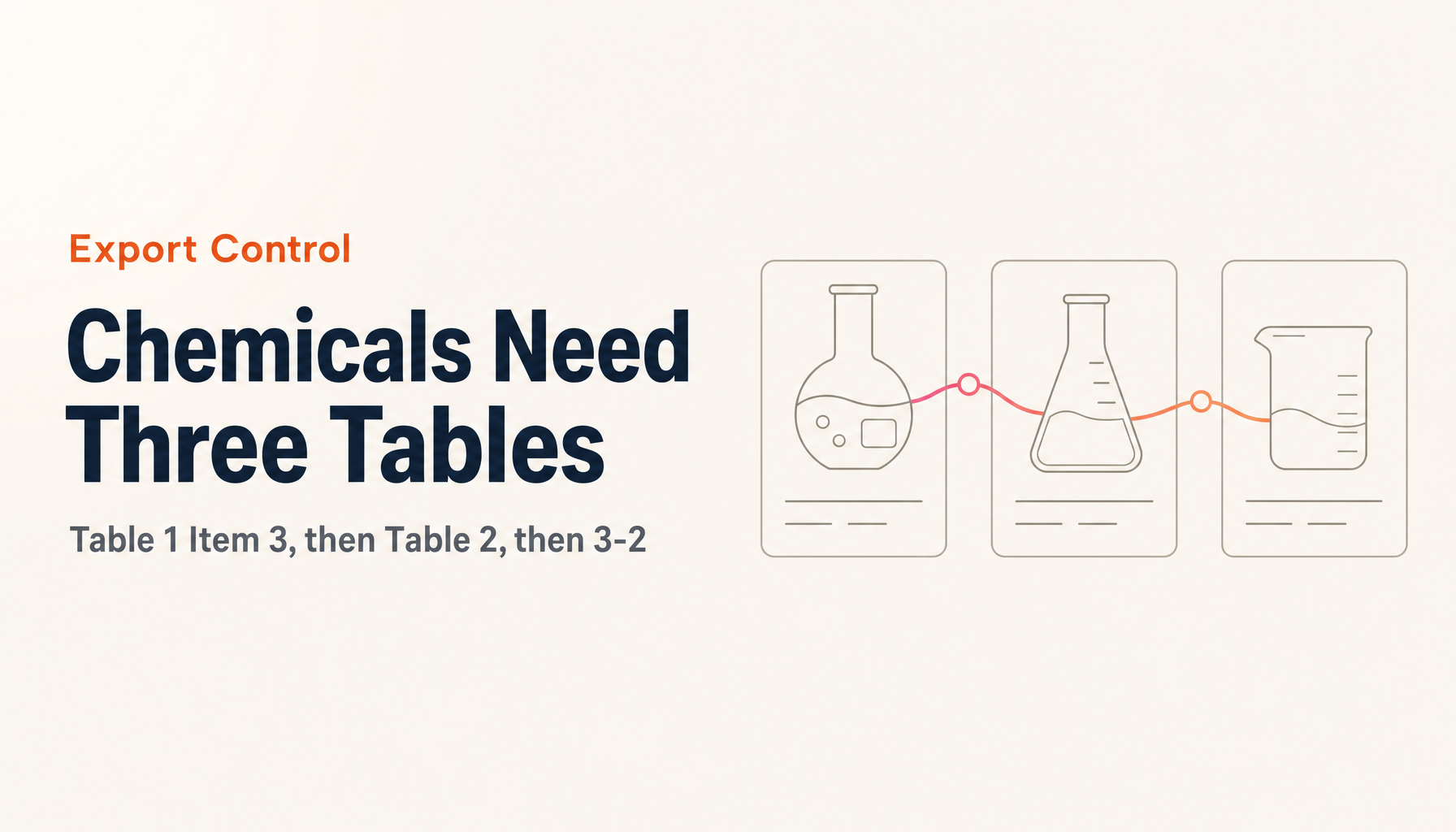
A thirty-second summary. Check chemicals in this order. First, Item 3 of Appended Table 1, which covers precursors, toxic chemicals, and manufacturing equipment tied to military chemical agents, and requires a license. Second, Appended Table 2, which lists chemicals that need approval for other reasons such as ozone depletion or mercury. Third, Item 16 together with Appended Tables 3 and 3-2, because chemicals that clear the lists can still need a license depending on end use, end user, and destination. Appended Table 3-2 is a destination group, not a substance list.
Terms to settle first
Let me align vocabulary before going further. If these blur together, you will lose track of which table is being discussed. Think of a building with controlled rooms.
| Term | Meaning | Analogy |
|---|---|---|
| Export Trade Control Order (the Order) | The cabinet order under the Foreign Exchange and Foreign Trade Act that names goods and destinations needing a license or approval | The main text of a building's access rules |
| Appended Table 1 | Goods and destinations that need a license, Items 1 to 16 | The list of restricted rooms |
| Item 3 of Appended Table 1 | Precursors and toxic chemicals tied to military chemical agents, their manufacturing equipment, and repair parts | The chemical storeroom among the restricted rooms |
| Appended Table 2 | Goods and destinations that need approval, for reasons such as the environment, health, treaties, or domestic law | The list of rooms where you must file a notice before entering |
| Appended Table 3 | Twenty-seven countries regarded as having export control systems in place, called Group A by the ministry | Familiar visitors |
| Appended Table 3-2 | Ten countries and regions, a destination category and not a list of substances | A visitor category that triggers one extra check at the door |
| Ministerial ordinance on goods | The ordinance that fixes substance names, concentrations, and specifications for each item | The detailed label on each restricted room |
| Item 16 | The catch-all control, which asks for a license for goods not on any list when end use or end user raises a concern | A reception desk that stops suspicious cases even when no label matches |
| Chemical Weapons Convention (CWC) | The treaty banning the development, production, stockpiling, and use of chemical weapons, administered by the OPCW | A shared rulebook for chemical storerooms worldwide |
| Classification | Deciding whether your goods fall under a listed item | Comparing your package against the labels |
Keep "license" and "approval" apart too. Goods in Appended Table 1 need a license under Article 1 of the Order. Goods in Appended Table 2 need an approval under Article 2. Both are applications to the Minister of Economy, Trade and Industry, but the legal basis, the scope, and the exceptions are separate. In principle, the same goods can appear in both tables.
The first table. Item 3 of Appended Table 1 looks at what the chemical is
For chemicals, the first stop is Item 3 of Appended Table 1. It has three parts.
Part (1) covers substances that serve as raw materials for military chemical agents, substances with toxicity comparable to such agents, and raw materials for those substances, as specified by ministerial ordinance. Part (2) covers equipment used to manufacture military chemical agents, along with parts and accessories, meeting specifications set by ministerial ordinance. Eleven equipment types are listed: reactors, storage vessels, heat exchangers and condensers, distillation and absorption columns, filling machines, agitators, valves, multi-walled pipes, pumps, incinerators, and devices that detect substances in air. Part (3) covers assemblies and parts used to repair reactors and storage vessels. The destination column says "all regions" for every part, so a license is needed wherever the goods go1.
Chemical staff will mostly work with Part (1). The Order itself does not say which substances, or how much of them. That detail sits in Article 2, paragraph 1 of the ministerial ordinance2.
Three categories and three concentration lines
The ordinance sorts substances into three categories.
| Category | What it covers | Concentration at which a mixture is caught (share of total weight) |
|---|---|---|
| Item 1 | Raw materials for military chemical agents | Any listed substance above 30 percent |
| Item 2 | Substances with toxicity comparable to military chemical agents | Amiton, PFIB, and BZ (entries a to c in the ordinance) above 1 percent. Carbonyl dichloride, cyanogen chloride, hydrogen cyanide, and trichloronitromethane (entries d to g) above 30 percent |
| Item 3 | Raw materials for the Item 2 substances | Entries from the phosphorus compounds through pinacolyl alcohol above 10 percent. Entries from phosphoryl chloride through methyldiethanolamine and triethanolamine above 30 percent |
Notice the three different lines. For mixtures, the thresholds are 1, 10, and 30 percent. The more toxic the substance, the lower the line. Without a formulation sheet showing ingredients and percentages, you cannot even begin to classify.
The Item 1 list includes hydrogen fluoride, potassium fluoride, potassium cyanide, dimethylamine, diethylamine, and phosphorus pentasulfide, all familiar industrial raw materials. Item 3 includes phosphorus trichloride, phosphorus pentachloride, thionyl chloride, phosphite esters, and triethanolamine, names any chemical company will recognize. One point matters here. A listing is a classification of the substance. It says nothing about the companies or buyers that handle it. Many of these substances serve ordinary civilian uses, and plenty of companies use them as inputs for pharmaceuticals, agrochemicals, resins, cleaners, and electronic materials.
How it maps to the Chemical Weapons Convention
Let me check how Item 3 connects to the international framework. The CWC sorts controlled chemicals into Schedules 1, 2, and 3. From OPCW public pages I confirmed that Schedule 2 lists amiton, PFIB, BZ, arsenic trichloride, and thiodiglycol, among others, and that Schedule 3 lists phosgene, cyanogen chloride, hydrogen cyanide, chloropicrin, and precursors such as phosphorus oxychloride, phosphorus trichloride, phosphorus pentachloride, thionyl chloride, and triethanolamine34.
Those names overlap with the substances in Items 2 and 3 of the ministerial ordinance. Entries a to c of Item 2 match the Schedule 2 toxic chemicals amiton, PFIB, and BZ, and entries d to g match the Schedule 3 toxic chemicals. Japan's Chemical Weapons Prohibition Act follows the same structure. Its enforcement order sorts substances into specified substances, Class I designated substances, and Class II designated substances. The Class I column holds amiton, PFIB, and BZ, and the Class II column holds phosgene, cyanogen chloride, hydrogen cyanide, and chloropicrin, which lines up with Schedules 2 and 35.
Some substances do not line up, though. Hydrogen fluoride and potassium fluoride, both in Item 1 of the ordinance, do not appear in the substance lists the OPCW publishes for Schedules 2 and 3. So reading the CWC tables alone will miss part of what Item 3 covers. The treaty schedules are a rough guide. The basis for classification is the list of substances in the ministerial ordinance. This is the first place chemical teams trip up.
One more distinction. An export license and a notification under the Chemical Weapons Prohibition Act are separate procedures. Article 28 of the Act requires anyone who exported or imported a designated substance to report the prior year's quantity to the Minister every year6. That is an after-the-fact report on actual volumes. Filing it does not replace an export license.
No low-value exemption, even for small samples
The most important feature of Item 3 is that it has no low-value exemption. Article 4, paragraph 1, item 5 of the Order lets goods valued at 1 million yen or less go without a license, but only for Items 5 to 13 and Item 15 of Appended Table 11. Item 3 is not on that list.
Picture a common situation. A research partner overseas asks for 50 grams of a reagent. The value is a few thousand yen. If that reagent contains a listed substance above the threshold in the ordinance, it falls under Item 3(1), and the value does not matter. "It is only a small amount" or "it is free of charge" does not take it out of scope.
Technology transfers are checked separately in the Foreign Exchange Order
Item 3 also has a technology side. Passing design documents or manufacturing know-how related to chemical weapons precursors abroad falls under Item 3 of the schedule to the Foreign Exchange Order. Part (1) controls technology for the design, manufacture, or use of Item 3(1) goods for all regions, with no further specification. Part (2) covers technology for the equipment in Items 3(2) and 3(3), limited to what a ministerial ordinance specifies7. If you share process conditions or formulations with an overseas site or a customer, check the technology side as carefully as you check the goods.
Replace siloed classification work with AI.
METI's FY2024 data shows 52% of foreign exchange law violations stem from classification errors. Download the TRAFEED product catalog covering features and rollout.
The second table. Appended Table 2 grants approval and borrows its substances from other laws
A chemical that clears Item 3 can still stop at Appended Table 2. That table lists goods and destinations that need the Minister's approval under Article 2 of the Order. Unlike Appended Table 1, which was built around military diversion, it rests on environmental protection, human health, treaty implementation, and domestic enforcement1.
The items that matter for chemicals are these.
| Item | Coverage | Destination |
|---|---|---|
| 21-3 | Chemicals that are raw materials for narcotics or psychotropic substances, as set by ministerial ordinance | All regions |
| 35 | Substances listed in Annexes A, B, C, and E of the Montreal Protocol on ozone-depleting substances | All regions |
| 35-3 | Rotterdam Convention Annex III chemicals, ingredients of certain pesticides and insecticides, specified poisons, certain substances in the Industrial Safety and Health Order, and Class I Specified Chemical Substances under the Chemical Substances Control Law | All regions |
| 35-4 | Mercury as defined in the Minamata Convention, and certain mercury-added products | All regions |
Item 35-3 has six parts. Part (1) is the Rotterdam Convention, (2) is pesticide ingredients, (3) is specified poisons, (4) is insecticide ingredients, (5) is substances named in the Industrial Safety and Health Order, and (6) is the Class I Specified Chemical Substances1. Read the text and you will find almost no substance names. It says "listed in an annex to the treaty" or "as defined in Article so-and-so of the Act." The references point to other laws and notices.
I think this structure is the trickiest thing about Appended Table 2. When the referenced law or treaty adds a substance, the scope of what needs approval grows without a single character of the Order changing. Additions to the Class I Specified Chemical Substances continue in 2026, and the Appended Table 2 guide lists the specific substances and effective dates. Chemical teams need to follow not only the Order but the source laws, including the Chemical Substances Control Law, the Agricultural Chemicals Regulation Act, and the Poisonous and Deleterious Substances Control Act.
Value-based exclusions hardly help with chemicals
I said Item 3 of Appended Table 1 has no low-value exemption. Appended Table 2 is similar. Article 4, paragraph 4 of the Order drops the approval requirement when total value is at or below the amount in Appended Table 7, but that table has only three categories. The one that touches chemicals is Item 21-3, acetone, ethyl ether, and others set by ministerial ordinance, with a limit of 300,000 yen. There is no such exclusion for chemicals in Items 35, 35-3, or 35-41.
Appended Table 2-3 for Russia and Belarus
Some branches of Appended Table 2 are defined by destination instead of substance. Appended Table 2-3 lists goods that need approval when exported to Russia or Belarus. For chemicals it includes raw materials for military chemical agents and equipment such as reactors, storage vessels, distillation columns, and pumps. Exports to the ten countries and regions in Appended Table 2-4 need approval only for transactions with parties the Minister designates by notice1. This part keeps changing in step with sanctions. Always check the original text on the day you ship.
The third table. Item 16 and Appended Tables 3 and 3-2 decide by destination
The first two tables classify the goods themselves. The third step looks at the end use and the destination.
Item 16 of Appended Table 1 is the home of the catch-all control. It asks for a license for unlisted goods when they may be used to develop weapons of mass destruction or conventional weapons. The goods column has two tiers. Tier (1) names specified items such as machine tools, radar, integrated circuits, aircraft, and analytical and measuring instruments. Tier (2) covers goods in Chapters 25 to 40, 54 to 59, 63, 68 to 93, and 95 of the Customs Tariff Law schedule. Chapters 28 (inorganic chemicals) and 29 (organic chemicals), where most chemicals are classified, sit inside Chapters 25 to 401.
So a chemical that missed both Item 3 and Appended Table 2 almost always falls under Item 16, Tier (2). That is why "not on the list" does not mean "no export control." The difference between list controls and the catch-all is covered in the list control and catch-all guide, and the October 2025 overhaul is explained in the catch-all revision guide.
Appended Tables 3 and 3-2 split destinations into three groups
The destination column for Item 16 reads "all regions (excluding the regions in Appended Table 3)." That single phrase divides destinations into three groups.
Appended Table 3 lists twenty-seven countries, including Argentina, Australia, Canada, Germany, France, South Korea, the United Kingdom, and the United States. The ministry calls this Group A. Because these destinations are carved out of Item 16, the objective requirement does not apply. That requirement asks the exporter to check end use and end user and to seek a license when there is a concern. Since the revision effective October 9, 2025, however, a license is needed even for Group A when the Minister has sent an inform notice, which says the goods may be diverted to a country of concern1.
Appended Table 3-2 lists ten countries and regions, namely Afghanistan, the Central African Republic, the Democratic Republic of the Congo, Iraq, Lebanon, Libya, North Korea, Somalia, South Sudan, and Sudan. The text of the Order simply names them. They are usually understood to track destinations covered by United Nations arms embargoes, and I read them that way, but that link is not written into the Order, so please confirm it against the ministry's latest explanation. For destinations in this category, a check on whether the goods may be used for conventional weapons is added, as shown below. Being listed in Appended Table 3-2 is a legal classification of a destination. It is not an assessment of any company or person there.
Any destination in neither Table 3 nor Table 3-2 is a general country.
What applies to a Tier (2) chemical, by destination
Rewriting Article 4, paragraph 1, item 4 of the Order as a table gives this1.
| Destination | End-use requirement for weapons of mass destruction | Inform notice for weapons of mass destruction | End-use requirement for conventional weapons | Inform notice for conventional weapons |
|---|---|---|---|---|
| Appended Table 3 (27 countries) | Does not apply | License needed only if a notice is received (Article 1, paragraph 3) | Does not apply | Same as left |
| General countries | Applies | Applies | Does not apply | Applies |
| Appended Table 3-2 (10 countries and regions) | Applies | Applies | Applies | Applies |
The end-use requirement asks whether the goods fall into the circumstances that a ministerial ordinance defines as a risk of use in weapons development. An inform notice is the individual notice from the Minister telling the exporter to apply for a license. As the table shows, being in Appended Table 3-2 changes exactly one thing, namely that the conventional-weapons end-use requirement is added. So Appended Table 3-2 is not a table for studying the chemical. It is a table for checking where the chemical is going.
In practice, a general-purpose solvent or intermediate that is not under Item 3 gets one more layer of checking when it ships to a destination in Table 3-2. And even a shipment to one of the twenty-seven Table 3 countries stops when you have received an inform notice about possible diversion. Those notices are hard for an exporter to anticipate, so I think a habit of consulting the ministry early is worth building into the process.
Where the international framework fits
Many of the substances in Item 3 are discussed alongside the Australia Group (AG), an arrangement through which countries coordinate controls on precursors of chemical weapons. It began in 1985 on Australia's proposal, with fifteen countries, to harmonize export controls on chemical precursors8. Participation has grown, and an Australian government page reports forty-two countries plus the European Union. I could not open the official site directly, so I am relying on search results here. Please confirm the current number there. Which AG list each substance corresponds to should be checked in the ministerial ordinance and the ministry's matrix tables.
Walking the three tables with three hypothetical products
Let me turn this into a procedure. Follow the numbers in order and you will see where each product stops.
- Identify the substance. Put the name, CAS number, composition and percentages, and the safety data sheet side by side. A mixture needs its formulation sheet.
- Check Item 3 of Appended Table 1. Compare against the substance names in Article 2, paragraph 1 of the ministerial ordinance and the concentration lines of 1, 10, and 30 percent. For equipment and parts, use the specifications in the following paragraphs.
- If you are transferring technology, check Item 3 in the schedule to the Foreign Exchange Order.
- Check Appended Table 2. Confirm whether the product falls under the references in Items 21-3, 35, 35-3, and 35-4 by consulting the source laws and notices.
- Check Item 16, Tier (2). Chemicals nearly always fall here, so sort the destination into Table 3, Table 3-2, or general country.
- Check end use and end user. According to the destination group, review the end-use requirement, the ministerial requirements about the buyer, and any inform notice.
- Record your basis. Even for a non-applicable result, write down which items you compared against and why you decided as you did.
The three examples below are hypothetical, there only to show how the mechanism works. They are not real transactions.
| Hypothetical product | Item 3 | Appended Table 2 | Item 16 and destination | How to word the conclusion |
|---|---|---|---|---|
| Product X. Industrial-grade triethanolamine at 98 percent | Falls under Item 3 of the ordinance, entry for triethanolamine, above the 30 percent line. Applicable | Confirm the references | Because Item 3 applies, a license is needed whatever the destination | Prepare the license application. Show the concentration from the safety data sheet |
| Product Y. A 20 percent solution of thionyl chloride in an organic solvent | The line for thionyl chloride is above 30 percent, so 20 percent is outside Item 3. Confirm that no other listed substance is present | Confirm it is outside each reference | Falls under Item 16, Tier (2). For a general country, check end use and inform notices | Non-applicable, with the basis and the end-use check on record |
| Product Z. A refrigerant that is a substance listed in the Montreal Protocol annexes | Confirm it is outside the Item 3 list | Falls under Item 35. Approval needed | Stops at Appended Table 2, so move the approval application first | Apply for approval. Do not mix it up with a license |
Cases like Product Y are the most uncomfortable ones in practice. Calling a 20 percent solution non-applicable is easy, but if a new product raises the concentration to 35 percent, the answer flips. You need a process that re-runs classification every time a formulation changes. Linking the formulation sheet to the classification result already makes later reviews much easier.
For the paperwork that explains a non-applicable result to a customer or to customs, see the guide on certificates of non-applicability. For ideas on streamlining the work itself, this guide to streamlining classification is a good companion.
Common misunderstandings, and questions to ask when you are unsure
Here are the misunderstandings I hear most in chemical settings, each checked against the text.
| Misunderstanding | What the text says |
|---|---|
| Only dangerous-sounding chemicals are covered | Item 3(1) includes substances such as triethanolamine and diethylamine, which have many industrial uses. What matters is whether the concentration exceeds the line |
| A small sample needs no license | The low-value exemption covers only Items 5 to 13 and 15 of Appended Table 1. Item 3 is not included. In Appended Table 2, only a few items such as part of 21-3 have a value-based exclusion |
| If it is not in the CWC schedules, it is not applicable | Hydrogen fluoride and potassium fluoride in Item 1 of the ordinance are not in the OPCW lists for Schedules 2 and 3. The basis is the list in the ministerial ordinance |
| Appended Table 2 is a continuation of Table 1, with the same license | Appended Table 1 is a license under Article 1. Appended Table 2 is an approval under Article 2. The basis and the exceptions differ |
| Appended Table 3-2 is a list of substances | It is a destination category. The text names ten countries and regions |
| If the buyer's country is a CWC party, I am safe | The destination column for Item 3 is all regions. There is no country-based exemption. The destination groups matter on the catch-all side |
| I filed under the Chemical Weapons Prohibition Act, so the export is done | The Article 28 report covers the prior year's import and export volumes. It is a separate procedure from an export license |
When you are unsure, return to three questions. What is the substance? That is the question for Item 3. Is this a license or an approval? That is the question of legal basis. Where is it going, and for what use? That is the question of destination. The three questions map onto the three tables.
What to check next
According to our separate article, the public comment on the draft revision that opened on October 19, 2026 would affect Items 3-2, 5, 6, 7, and 12 of Appended Table 1. Item 3 itself is not described there as moving. But Appended Table 2 tends to grow whenever a referenced law changes, so I recommend reviewing it once a quarter. The overview of the draft is in the Appended Table 1 guide.
My own view is that the most important habit in chemical export control is to split every decision into the three questions of substance, basis, and destination, and to keep it on record. Expecting people to remember everything is unrealistic. If the formulation sheet, the safety data sheet, the destination, and the result sit in one record, the reasoning survives a change of staff or a revision of the tables.
TRAFEED is an AI agent for export control that supports matching texts to specifications and checking buyers and destinations. The final classification remains the decision of your export control officer, but it can do the groundwork of walking through the three tables. You can see an overview on the TRAFEED page and reach us through an individual consultation.
References
Footnotes
-
e-Gov Law Search, Export Trade Control Order (Cabinet Order No. 378 of 1949), Articles 1, 2, and 4, Appended Table 1 (Items 3 and 16), Appended Tables 2, 2-3, 2-4, 3, 3-2, and 7. Retrieved November 6, 2026. https://laws.e-gov.go.jp/law/324CO0000000378 ↩ ↩2 ↩3 ↩4 ↩5 ↩6 ↩7 ↩8 ↩9
-
e-Gov Law Search, Ministerial Ordinance Specifying Goods or Technologies Pursuant to Appended Table 1 of the Export Trade Control Order and the Appended Table of the Foreign Exchange Order (MITI Ordinance No. 49 of 1991), Article 2. Retrieved November 6, 2026. https://laws.e-gov.go.jp/law/403M50000400049 ↩
-
OPCW, Chemical Weapons Convention, Annex on Chemicals, Schedule 2. Checked November 6, 2026. https://www.opcw.org/chemical-weapons-convention/annexes/annex-chemicals/schedule-2 ↩
-
OPCW, Chemical Weapons Convention, Annex on Chemicals, Schedule 3. Checked November 6, 2026. https://www.opcw.org/chemical-weapons-convention/annexes/annex-chemicals/schedule-3 ↩
-
e-Gov Law Search, Order for Enforcement of that Act, Appended Table. Retrieved November 6, 2026. https://laws.e-gov.go.jp/law/407CO0000000192 ↩
-
e-Gov Law Search, Act on the Prohibition of Chemical Weapons and the Regulation of Specified Chemical Substances, Articles 2 and 28. Retrieved November 6, 2026. https://laws.e-gov.go.jp/law/407AC0000000065 ↩
-
e-Gov Law Search, Foreign Exchange Order, Appended Table Item 3. Retrieved November 6, 2026. https://laws.e-gov.go.jp/law/355CO0000000260 ↩
-
Australia Group Secretariat, Origins. Confirmed through search results on November 6, 2026. The official site could not be opened directly, so the participant count needs to be rechecked there. https://www.dfat.gov.au/publications/minisite/theaustraliagroupnet/site/en/origins.html ↩