Hello, this is Ryuta Hamamoto from TIMEWELL.
Three years ago, I launched a business genuinely believing I could win on features. Faster than the competition, more features than the competition—with that mindset I poured people and money into development, and I was satisfied that I had built something good. But within six months of launch, several services with similar features appeared. And thanks to generative AI, the newcomers were catching up faster than I ever had. That was the moment I had to admit that the very premise—differentiating on features—had been wrong.
I still hear the same concern all the time: "Our strength is our features, but they get copied right away." I understand that pain deeply. But if you are thinking about starting a company or launching a new venture, there is something I want you to know from the very beginning. Features are no longer the main battlefield for differentiation. So what do you fight on? This article is a map for actually rolling up your sleeves and answering that question.
First, let me summarize the three key points of this article.
- AI has slashed development costs, so a feature advantage "starts depreciating the moment you ship it and falls to almost zero within six months." Being able to build a feature is, in itself, no longer a source of differentiation.
- The differentiation axes beyond features are four: emotion, personality, community, and data. The first three work for almost any business; the data axis works only for businesses where customer logs naturally accumulate.
- You cannot strengthen all of them at once. In the early stage, start with personality, then add emotion and community as you grow. Paste the prompts in this article into an AI and you can pressure-test each step against your own business.
Before you make AI a partner in building your business, if you want to check where your own AI fluency stands today, try the free three-minute AI Literacy Check first. It will also make the prompts in this article far easier to put to work.
Why features stopped setting you apart
At the center of the reason is that the cost of building software has fallen dramatically. Not long ago, building a decent feature required a team of five working for half a year. Now, with generative AI as a partner, it is increasingly common for one person to reach the same point in about a month. What this change brings is not merely "development got faster." It means we now live in a world where a feature you spent six months polishing can be matched by a competitor in a few weeks.
In other words, a feature advantage starts depreciating the moment you ship it. Accounting depreciation spreads the loss of value over several years, but a feature's value fades far faster. Within six months, the mere presence of that feature becomes "table stakes," and it can no longer justify a higher price. What I ran into three years ago was exactly this phenomenon. The feature I had worked so hard to build had, before I knew it, been demoted to "something everybody has."
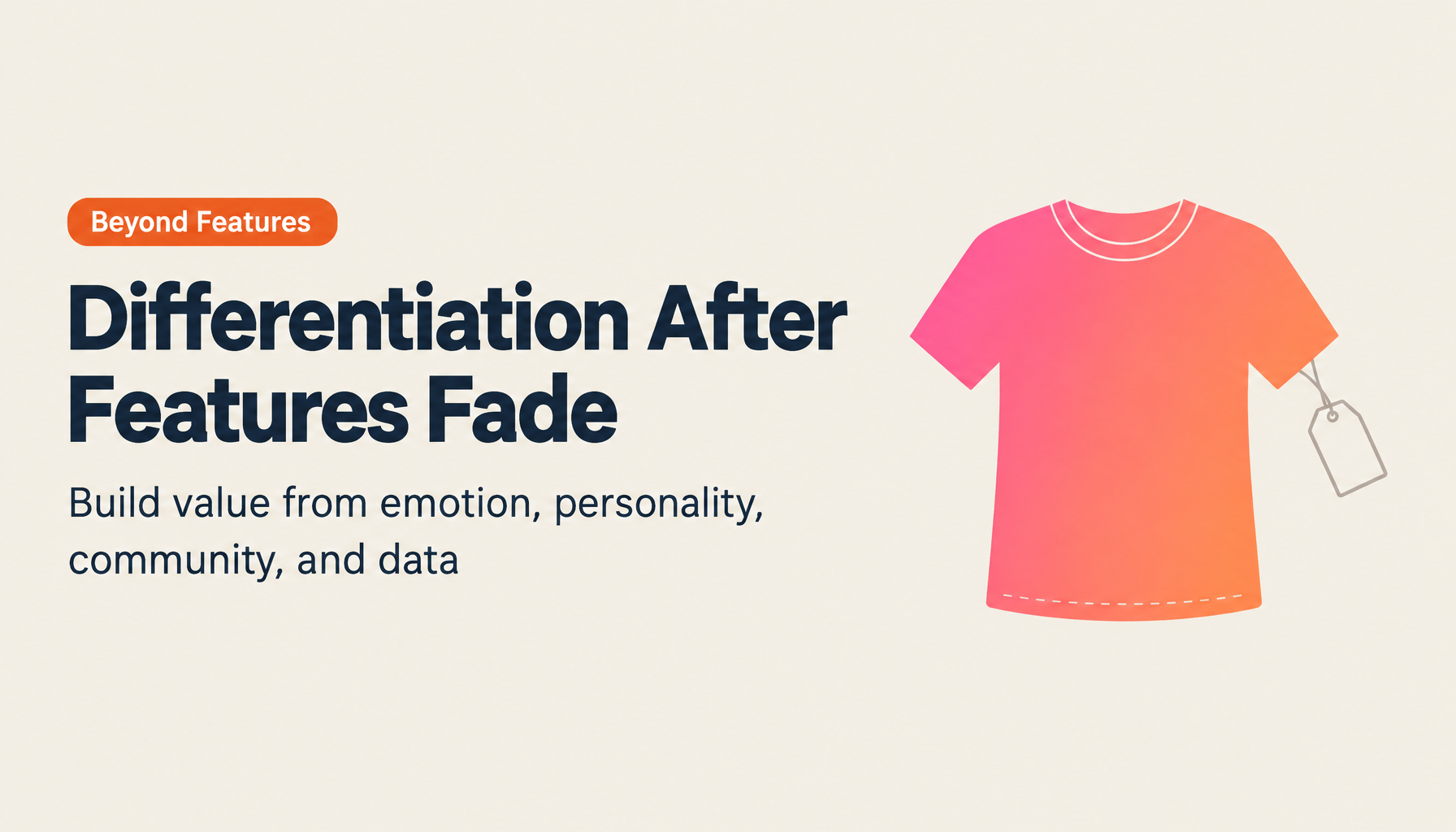
So where does the money come from? Here, picture two 100% cotton T-shirts. From a fast-fashion retailer, one sells for around 1,500 yen; from a luxury brand, the other sells for 30,000 yen. The material is almost the same, yet the gap is 20x. A single piece of Kyoto lacquerware sells for 200,000 yen even though, as a feature, it is just "a vessel that holds soup." Where does this price gap come from? The answer lies "outside" the material and the feature. The brand, the story, the background from which that vessel was born, the pride of owning it. The difference lives not in the feature itself, but in everything that surrounds it.
I accepted this fact, with no small amount of frustration. As long as we compete on features, we are trapped forever in a race to the bottom on price. The only way out is to shift the center of gravity of differentiation to the outside of features. That is the real subject of this article.
Looking for AI training and consulting?
Learn about WARP training programs and consulting services in our materials.
The four differentiation axes beyond features
Even if I say "outside of features," a vague "brand matters" won't get your hands moving. I organize differentiation around four axes: (1) emotion (worldview and story), (2) personality (the founder), (3) community (the connections among customers), and (4) the data flywheel. Those four.
There are two important premises. One is that the first three axes—emotion, personality, community—work for almost any business. Food and beverage, local services, traditional crafts, SaaS: they all apply. The other is that only the fourth, the data flywheel, has a limited scope. It works only for businesses where customer usage logs naturally accumulate in large volumes as a byproduct of operations—that is, types like SaaS or AI agents. If you strain to "differentiate on data" in face-to-face craftsmanship or a locally rooted service, your savings will run out before the logs pile up. Don't get this confused.
Let me be honest about one more thing. Strengthening all four axes at once is impossible. In the early stage you lack people, money, and time. My recommendation is to make personality the top priority in the early stage (years 0–2). It requires the least capital and works fastest. Once the business grows, add emotion and community, and only for applicable businesses, design the data axis later. There is an order to it.
So first, let's diagnose how much your current business depends on features. Paste the following prompt into Claude or ChatGPT, and replace the text inside 【 】 with your own business. It is designed to return a blunt diagnosis, not empty reassurance.
You are a business strategy consultant for the AI era. Give me a blunt diagnosis of my business: am I differentiating on features, or have my features already become commoditized so that I should be competing outside of features?

# My business
- What the business does: 【e.g., A small-batch subscription that uses AI to forecast demand while delivering "seasonal vegetables + the grower's story" from 20 contracted farms to dual-income urban households】
- Core feature / selling point: 【e.g., AI-based taste recommendations, next-day delivery, meal-kit format】
- Direct and indirect competitors: 【e.g., major food-delivery services, countless meal kits, supermarket online grocery】
- Current price range: 【e.g., 2,980 yen per week】

# What I want diagnosed
1. Estimate, with reasoning, how many months it would take for competitors or AI tools to copy my "core feature" (3 months / 6 months / 1 year or more).
2. Is that feature advantage the "starts depreciating the moment you ship it" type, or a structurally defensible type?
3. Among the axes outside of features (emotion, worldview, personality, community, data), name exactly one axis I should bet on first, and explain why.
4. If I wanted to create the same price gap as "two identical 100% cotton T-shirts selling at 1,500 yen and 30,000 yen" in my business, where could I locate the source of that difference?

Please be blunt. I don't need reassurance. At the end, specify exactly one action to take tomorrow.
In this article, I'll use a fictional business, "Meguru Vegetables," as a running example. A founder in their thirties who spent 10 years working in produce wholesale runs it alone, delivering the seasonal vegetables of 20 contracted farms—along with the growers' stories—as a small-batch subscription to dual-income urban households. Competitors are major food-delivery services and countless meal kits. Read on while swapping in your own business.
Axis 1 — Emotion: worldview lives in the "process," and story is dug out, not invented
Emotion means worldview and story. Kyoto lacquerware sells for 200,000 yen not because of the vessel as a feature, but because people are paying for the background from which that vessel was born. I believe emotional differentiation has three elements.
The first is the uniqueness of your worldview. This is born at "the intersection of time × place × person." For Meguru Vegetables, that is the 10 years the founder spent in produce wholesale, watching vegetables that tasted the best get thrown away simply for being off-spec. It is the relationship with those 20 farms that continues directly to this day. No one else can copy this intersection. The second is the storyteller. Emotion reaches the other person only through a human personality. The same story lands completely differently when the person who lived it tells it versus when an ad agency ghostwrites it. That is why a worldview must be told in the founder's own words.
The third, and the most overlooked, is the resolve on pricing. If you have decided to differentiate on emotion, you must not discount. The moment you mark down off-spec vegetables as "seconds," the worldview you built up collapses—and it wounds the farmers' pride too. Discounting is the easiest, and the most irreversible, form of self-destruction.
Where many people stumble here is in getting worked up over "I have to create a good story." Let me be clear. A story is not something you create. It is a fact already inside you that you dig out. And emotion lives not in the finished product, but in "the process by which the product is born." What Meguru Vegetables should show customers is not a photo of neatly packed vegetables, but the field the night before harvest and the farmer's face. It is in the process that the texture no one can copy resides. This excavation work moves along surprisingly well when you make AI your listener. Try the following prompt.
You are an interviewer who draws out the "worldview and story" of a craftsperson or brand directly from the person. Help me put my emotional differentiation into words. There are three rules: (1) Do not invent a good story—only dig out facts already inside me. (2) Emotion lives not in the finished product but in "the process by which the product is born." (3) Do not entertain any premise of lowering the price.

# My business
【e.g., Meguru Vegetables. Having worked 10 years in produce wholesale, I run a subscription delivering the seasonal vegetables of 20 contracted farms to urban households.】

# How to proceed
First, ask me one question at a time from the following angles (move to the next question after I answer).
- Uniqueness of worldview: Where is "the intersection of time × place × person"? (e.g., my X-year relationship with the farms, the history of that place)
- The storyteller: How can I tell this worldview through "my own personality"?
- Scenery of the process: Which "behind-the-scenes scene," rather than the finished product, should I show customers?
- Resolve on pricing: What is the reason I should decide not to discount?

Once all questions are done, using only the facts gathered, output:
(a) One worldview statement I can deliver in 30 seconds
(b) Three headline options for a "story of the process" usable on a landing page or social media
(c) A metric to measure whether the emotion is working (which of price-premium ratio, name-recognition purchase rate, or repurchase rate to use)
Do not add any heartwarming embellishment that isn't in the facts.
With this prompt, the facts Meguru Vegetables could dig out might look like this. The uniqueness of the worldview: "In my produce-wholesale years, I spent 10 years watching vegetables that tasted the best get thrown away for being off-spec. I'm still directly connected to those 20 farms." The scenery of the process: "Not the finished vegetable box, but the field the night before harvest and the farmer's face." The resolve on pricing: "Marking down off-spec vegetables makes them look like seconds and collapses both the farmers' pride and the worldview, so I don't discount." The 30-second statement born from this is: "Delivering the best of what was being thrown away—along with the maker's story—straight to your table." The work of polishing this value proposition into a single sentence goes more precisely when paired with the Value Proposition Canvas guide.
Axis 2 — Personality: growing an account called your trust balance
Among the four axes, the one I consider strongest is personality. It is the axis where the founder becomes the differentiator. The reason is simple: because AI erased the differences between products, the difference in human personality has become relatively larger. When features are similar, the final choice comes down to "who is doing it."
The key here is a concept I call the "trust balance." The trust balance is the number of people who think, "If that person is doing it, I want to support them." It is like an account that underpins the product—the larger the balance, the more people gather around you when you take on a new challenge. For the founder of Meguru Vegetables, that would be former colleagues and business partners from the wholesale days, and the restaurants that trusted their eye for quality. Those people are the initial balance.
Which part of your personality to put forward can be organized through the four types of Founder-Market Fit: (1) Personal Pain (you personally suffered the pain as one of the affected), (2) Deep Insight (you deeply understand the industry's distortions from the inside), (3) Unfair Advantage (a strength so lopsided others can't hold it), and (4) Domain Expertise (expertise in that field). The important thing is to choose one main type and one sub-type, and decide not to talk about the other two. If you appeal on all of them, the outline blurs and you stay in no one's memory. For Meguru Vegetables, the main type is Domain Expertise (10 years in produce wholesale) and the sub-type is Deep Insight (having seen the distortion of off-spec distribution from the inside). Personal Pain and Unfair Advantage are weak, so it is more honest not to force those into the story.
As for putting yourself out there, don't strain. "I have to aim for tens of thousands of followers"—people brace for that and burn out on daily posting. This is the most common failure. Design followers in stages: from 0 to 100, to 500, to 3,000 or more. And your first hundred people respond to you, not to your information. So you don't need elaborate know-how posts. For introverts who dislike social media, there is also a Plan B that runs on one-on-one sales and a circle of referrals. In fact, some people reach 300,000 yen in monthly sales with almost zero followers. Use the following prompt to design an approach that matches your own fuel efficiency.
You are a companion for an individual entrepreneur's "personality differentiation." Rather than pushing me to aim for "tens of thousands of followers," design a realistic approach that matches my fuel efficiency.

# My premises
- Business: 【e.g., Meguru Vegetables】
- My background / formative experience: 【e.g., 10 years in produce wholesale, kept watching vegetables that tasted the best get thrown away for being off-spec】
- What I'm good and bad at when putting myself out there: 【e.g., bad at daily social posts / good at long-form writing and small-group dialogue】
- Current followers / number of customers: 【e.g., 80 followers / 12 households】

# What I want you to do
1. Diagnose my main type and sub-type using the four Founder-Market Fit types (Personal Pain / Deep Insight / Unfair Advantage / Domain Expertise), and state clearly that the remaining two are "better left untold."
2. Assess how much trust balance (the number of people who'd think "if that person is doing it, I want to support them") I have now, and how I can grow it.
3. Among the stages of 0 → 100 → 500 → 3,000+ followers, present only the concrete tasks for the stage I'm in now and the next stage (don't give me later stages).
4. If I'm bad at social media, also include a Plan B that runs on one-on-one sales + a circle of referrals (how to build a list of 20 people to meet in three months).

Don't push me to "have to broadcast information." Design on the premise that my first hundred people respond to me, not to my information.
Axis 3 — Community: human relationships become the true barrier to entry
The third axis is community—that is, the connections among customers. There is a misconception here. When people hear "community," they tend to think "I have to gather 10,000 people," but 30 people is plenty. If anything, the smaller it is, the denser it becomes.
There are three points in community design. The first is that members are the protagonists. Don't make it a "fan club" where the company broadcasts and members merely receive. Only when there is a mechanism for members to post and cheer each other on does it become a community. For Meguru Vegetables, that could be members sharing photos of the dishes they made with the seasonal vegetables that arrived. The second is to gather only people with the same pain. Deciding whom not to let in matters as much as deciding whom to let in. Whom Meguru Vegetables should gather are "parents who carry guilt over sloppy eating because they're busy, and who want to teach their children about seasonality." Mix in people after only the low price and the homogeneity thins out and the space breaks down. The third is a design where no one graduates. When beginners, mid-level members, and veterans coexist and veterans support beginners in a circulating cycle, people stop leaving.
Why does community become differentiation? The answer is switching cost. If customers are connected only through the product, they'll move the moment a competitor ships the same feature. But what if human relationships have formed there? Companions who share the same struggle, relationships where people call each other by name. Almost no one switches at the cost of abandoning that. Build in human relationships and switching cost skyrockets. This is the true barrier to entry that features cannot create. You can work out the design with the following prompt.
You are a community design specialist. Add "connections among customers" to my business, and design a state where customers don't leave even if a competitor ships the same feature (i.e., raise switching cost through human relationships). The scale can be small (design on the premise that even 30 people works).

# My business and customers
- Business: 【e.g., Meguru Vegetables】
- The "same pain" my customers commonly carry: 【e.g., guilt over sloppy eating because they're busy, wanting to teach their kids about seasonality】

# Three things to design
1. Members-as-protagonists design: a mechanism where members post and cheer each other on, so it doesn't become a "fan club" where the company broadcasts and members merely receive.
2. Homogeneity: which "people with the same pain" only to gather (also define whom not to let in).
3. No-graduation design: how to build a circulating cycle where beginners, mid-level members, and veterans coexist and veterans support beginners.

At the end:
- Select one minimal configuration (a LINE group / a monthly meetup / a message board, etc.)
- What to do in the first 30 days of launch
- A metric to measure whether this community is becoming a barrier to entry against competitors (churn rate, referral rate, etc.)
Don't aim for 100,000 people right out of the gate.
On a side note, I'm getting more requests to support community operations with systems. At TIMEWELL, we offer BASE, an AI-native community platform where you can build a page in 60 seconds. But before the tools, come the three design principles I just described. Don't get the order wrong.
Axis 4 — Turning "emotion" into a durable moat with data and 7 Powers
Let me start with the fourth axis, the data flywheel. This is the virtuous cycle where customer logs accumulate as a byproduct of operations, that data improves accuracy, better accuracy brings in more customers, and more logs accumulate again. It is a powerful axis that compounds exponentially, but as I've repeated, its scope is limited. It works only for businesses where customer logs naturally accumulate in large volumes—like SaaS or AI agents. A subscription like Meguru Vegetables can use data for demand forecasting, but not to the point of becoming an exponential barrier to entry. Here, it is fine to honestly conclude, "the data flywheel won't be our main engine." Betting on data in a business where logs don't accumulate means eating into your savings during the unprofitable stretch.
Now, let's verify whether you're actually growing these four axes into a "strength you can truly defend" (a moat). The framework to use is Hamilton Helmer's 7 Powers. In particular, differentiation through emotion is what you want to grow into what 7 Powers calls Branding Power. The crucial thing here is the criterion for judging Branding. High awareness and high likability are not Branding. Only when you can command a price premium—selling more than 20% higher than competitors even for a similar product—can you call it Branding. This criterion is blunt, but extremely practical.
Branding can be broken down into two elements. One is Affective Valence, the emotional value that owning it is itself a source of pride. The other is Uncertainty Reduction, the reassurance that choosing this won't go wrong. For Meguru Vegetables, the former is "empathy for a lifestyle that delivers food to your table along with the maker's story," and the latter is "the reassurance that a former produce-wholesale pro is doing the selecting, so you won't get a dud." But Branding can only be protected by decades of consistency and a refusal to discount. Check right now whether there is any action that could break it yourself—such as easy discounting or drifting from the worldview.
One more important thing is alignment with the phase of your business. Branding takes effect in the Stability phase, when the business has settled. If you're still in the Origination phase right after launch, Branding may be premature. What you should take at that stage is, for example, Counter-Positioning—striking a position that would break the incumbent's own efficiency model if they copied it. For Meguru Vegetables, you'd enter on the single point that "if a major player handled off-spec, small-batch, story-driven products, it would contradict their own mass-distribution model," and shift to Branding after customers grow. This order is realistic. How you view competitors becomes more three-dimensional when read alongside How to do competitor analysis, and estimating market size alongside the TAM, SAM, SOM article. You can run through this verification in one pass with the following prompt.
You are a strategy analyst well-versed in Hamilton Helmer's 7 Powers. Verify whether the "differentiation through emotion and worldview" I'm trying to build is becoming a durable Moat (Branding Power), not merely likability.

# My differentiation hypothesis
【e.g., Meguru Vegetables is chosen over major food-delivery services, even at a higher price, through "the grower's story × the founder's personality."】

# Verification items
1. Branding judgment: Is my advantage merely "awareness / likability," or is it Branding that can command a price premium of 20%+ over competitors even for a similar product? (Judge bluntly by Helmer's criterion.)
2. Break down the two brand elements: What do Affective Valence (the emotional pride of owning it) and Uncertainty Reduction (the reassurance that choosing this won't go wrong) each correspond to in my business?
3. Barrier: This emotional advantage is the type protected by "decades of consistency and a resolve not to lower prices." What action could I take right now that would break it (discounting, drifting from the worldview)?
4. Phase alignment: Branding works in the Stability phase. If I'm now in the Origination / Take-off phase, what Power (such as Counter-Positioning) should I take first?
5. Necessity of the data axis: Is my business the type where "customer logs naturally accumulate in large volumes"? If No, you may state clearly that "the data flywheel won't be the main engine."

Assign each item a rating of ○ / △ / × and output a Moat description (200 words) I can pitch to an investor in one minute.
Conclusion: start with personality, and you don't have to do all of it
When I realized I couldn't win on features, honestly, I felt the ground give way beneath me. I was being told the weapon I'd relied on was useless. But look at it another way and this is a tailwind. Because AI erased the differences between products, the room to compete on personality and trust balance, on story and community, has opened up wider than before. I feel this is an era that especially favors individuals and small teams with little capital.
Finally, let me summarize what I wanted to convey in this article, in the form of your next actions.
- In the early stage (years 0–2), make personality the top priority. It requires the least capital and works fastest. Start by telling 20 people in your trust balance that you've started the business.
- Once the business grows, add emotion (worldview and story) and community. Don't invent a story—dig out facts already inside you.
- The data flywheel is only for businesses where customer logs naturally accumulate. If it doesn't apply, drop it cleanly.
- Don't try to strengthen all four axes at once. Rather than spreading thin, concentrate on one or two axes and dig deep.
There is no template of the right answer for differentiation. Your intersection of time, place, and person is the only one of its kind in the world. AI can help, as a patient listener, with the work of digging it out and putting it into words. Please paste the prompts in this article into your own business today. If you want to survey the whole picture of differentiation again, The Complete Guide to Building a New Business helps, and if you want to start over from the customer's problem, the article on digging into problems is a useful reference too.
For those who want to seriously master AI as a partner in building a business, TIMEWELL offers the AI consulting service WARP. It is a service that walks alongside you monthly, from designing your AI strategy to implementing it on the front lines. If you want to think through, concretely and together, how to design your own differentiation axis and how to embed which prompts into which workflows, reach out via a WARP consultation. We'll help you find your one-and-only intersection.