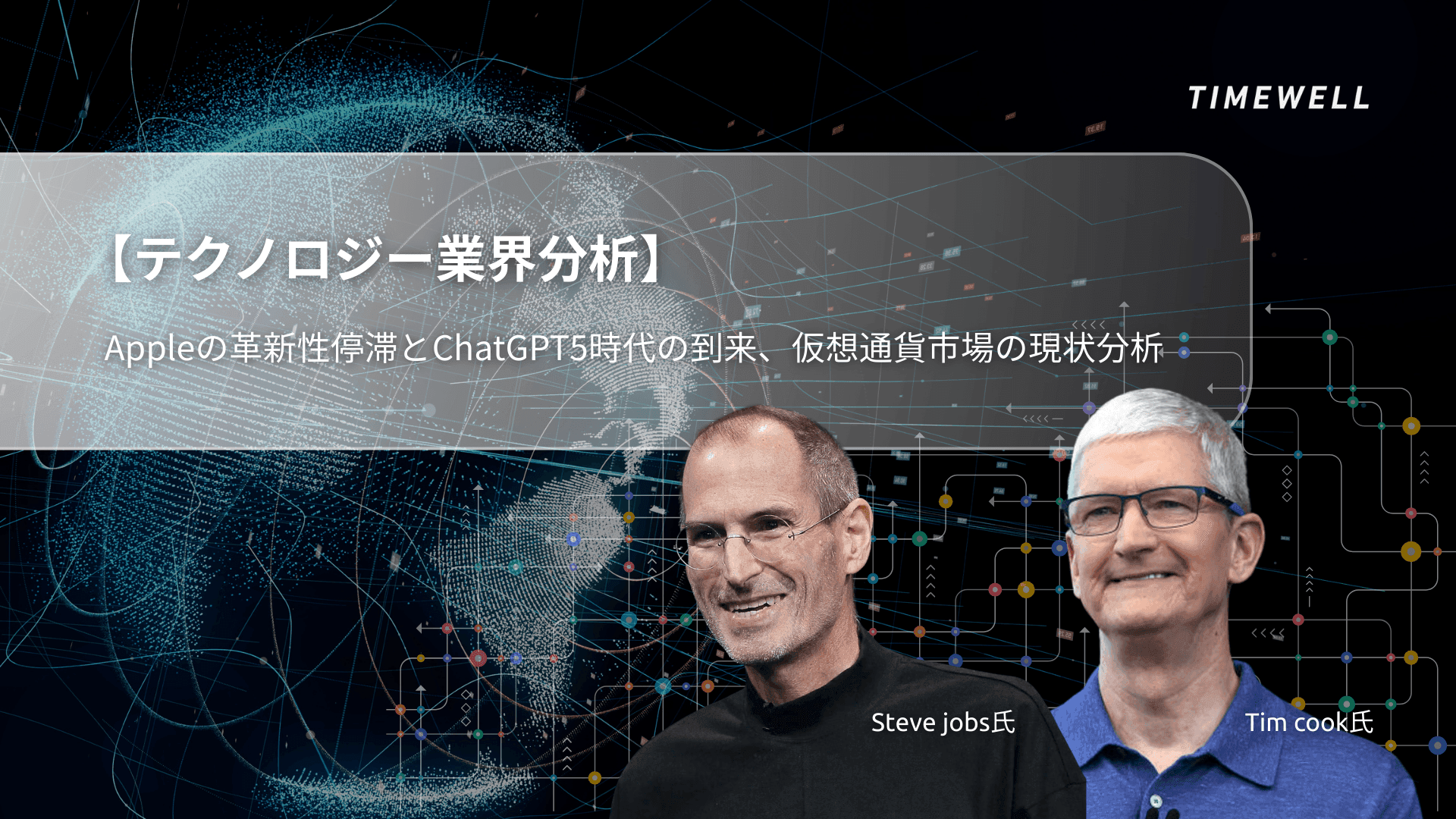
This is Hamamoto from TIMEWELL.
Apple's Innovation Gap: Jobs vs. Cook
One of the ongoing debates in the tech industry is whether Apple has lost its innovation edge since the passing of Steve Jobs. Under Tim Cook, Apple has undeniably excelled at execution — supply chain management, services revenue, and sustained profitability have all reached new heights. But the core question remains: where is the next iPhone-level breakthrough?
The Jobs era was defined by transformative leaps — the Mac, the iPod, the iPhone, the iPad. Each redefined entire industries. Cook's Apple has delivered refinements: faster chips, better cameras, incremental software updates. Apple Intelligence, announced as the company's AI strategy, has been met with muted enthusiasm compared to rivals moving faster in the generative AI space.
This is not purely a leadership critique. Apple operates at a scale that makes radical disruption far more difficult than it was for a smaller, hungrier company. But the gap between Apple's market expectation and its delivered innovation is real — and investors, developers, and users are noticing it.
Looking for AI training and consulting?
Learn about WARP training programs and consulting services in our materials.
ChatGPT-5: What's Actually New
OpenAI's ChatGPT-5 represents a meaningful step forward across several dimensions. Here are the features generating the most attention:
Vibe coding: This is the capability that has captured the developer community's imagination. ChatGPT-5 can now take a natural language description of what you want to build — a web app, a data pipeline, a script — and generate working code end-to-end. The model reasons about architecture, writes the implementation, and iterates based on feedback. It is not perfect, but the velocity it enables for prototyping is genuinely new.
Enhanced memory: The new memory system allows ChatGPT-5 to retain context across sessions in a more structured and controllable way. Users can now explicitly manage what the model remembers about them — their preferences, ongoing projects, communication style — and the model applies this context proactively rather than waiting to be reminded.
Reasoning improvements: GPT-5 shows measurable gains on complex multi-step reasoning tasks, particularly in domains like law, medicine, and technical analysis. The model is better at acknowledging uncertainty and avoiding confident wrong answers.
For businesses evaluating AI adoption, ChatGPT-5 raises the baseline for what an AI assistant can be expected to do without specialized prompting or custom configuration.
Ripple's Stablecoin Strategy: $200M for Rail
Ripple has been one of the more aggressive players in the enterprise blockchain space, and its recent moves confirm a major strategic pivot toward stablecoins.
The company acquired Rail — a payments infrastructure provider — for $200 million. Rail's technology enables compliant fiat-to-stablecoin conversion at scale, which directly supports Ripple's RLUSD stablecoin ambitions. RLUSD is designed for enterprise use cases: cross-border payments, treasury management, and institutional settlement.
The strategic logic is clear. Ripple's XRP-based payment network has always been strongest in the interbank and cross-border corridor. Stablecoins — particularly USD-pegged ones — are becoming the preferred settlement layer for institutional crypto activity. By controlling both the stablecoin (RLUSD) and the rails (Rail acquisition), Ripple is positioning itself to capture a significant share of the emerging institutional stablecoin market.
This matters beyond crypto. As stablecoins gain regulatory clarity in the US — the GENIUS Act and similar legislation are moving through Congress — enterprise adoption will accelerate. Ripple is betting that it can be the infrastructure layer for that wave.
DoorDash and Airbnb: Platform Momentum
Two platform businesses worth watching for different reasons:
DoorDash has expanded well beyond restaurant delivery. The company now operates in grocery, convenience, and retail delivery across dozens of markets globally. Its DashPass subscription has become a meaningful loyalty mechanism, and its merchant services (marketing tools, payment processing, logistics software) are generating revenue independent of delivery volume. The company is still not consistently profitable, but its path to profitability through services attachment is becoming more credible.
Airbnb continues to face a bifurcated market. Urban short-term rentals remain under regulatory pressure in major cities. But rural and unique-stay inventory — treehouses, barns, remote cabins — is growing and commanding premium pricing. Airbnb's "Experiences" product is underperforming relative to expectations, but the core accommodation business is durable. The company's cash generation is strong, and it is returning capital to shareholders while investing in product improvements.
Both companies illustrate a common pattern in mature platform businesses: the core marketplace is stable but slow-growing, and differentiation increasingly comes from adjacent services and subscription products.