 Japan patent granted
Add an AI first-pass analyst to your export control team.It does the research. You make the call.
It screens counterparties against U.S., Japanese, EU, Chinese and Taiwanese lists, checks ownership under the BIS 50% rule, and drafts the Japan export classification — with the evidence on file.
Only the cases that need a decision go to your export control officer, who makes the final call.
Japan patent No. 7862062 · Okayama University validation · 20+ organizations
“Another matrix row?” “What does this local site even say?” — sound familiar?
METI matrices never finish
Jumping between item numbers and thresholds late at night—never sure it is fully right.
Counterparty research burns hours per case
Local-language sites, ownership chains, end-use checks. Too many tabs, not enough certainty.
Classification paperwork lives in one person’s head
Specs, evidence, forms. When that person is out, the shipment waits.
Crossing list, catch-all, and EAR leaves doubt
Japan and U.S. views differ. You checked—and still worry something slipped.
Headcount is flat; case volume is not
Specialists are hard to hire. Overtime becomes the process.
From the field
Matrix-to-spec matching can take half a day. I fear inconsistent judgments across staff.
New-party website research is the bottleneck. Sales wants speed; legal wants certainty.
Partner screening eats the time we meant to spend supporting researchers.
Scope
Not only shipping goods
When technology moves on trips or in meetings, a review may still be needed. U.S. EAR and the BIS 50% rule (parent/group ownership stakes) are also coming up more often.
Travel and field work
Installation, repair, guidance—with laptops and drawings. “It is just a trip” is a phrase we hear before teams discover a check was needed.
Not only shipping goods
Wherever technical information moves, screening can apply
Meetings and technical disclosure
Screen shares, joint R&D files, cloud specs. You may never leave the room—and still release controlled technology.
U.S. EAR / BIS 50% rule
The BIS rule published in 2025 suspends the Affiliates Rule from November 10, 2025 through November 9, 2026, and provides for reinstatement on November 10. Check subsequent amendments when preparing ownership reviews.
Not only shipping goods
Wherever technical information moves, screening can apply
Travel and field work
Installation, repair, guidance—with laptops and drawings. “It is just a trip” is a phrase we hear before teams discover a check was needed.
Meetings and technical disclosure
Screen shares, joint R&D files, cloud specs. You may never leave the room—and still release controlled technology.
U.S. EAR / BIS 50% rule
The BIS rule published in 2025 suspends the Affiliates Rule from November 10, 2025 through November 9, 2026, and provides for reinstatement on November 10. Check subsequent amendments when preparing ownership reviews.
Organizational load
Is export control still on one person’s shoulders?
Shipping, hiring, joint research, trade shows—more teams touch it, while screening work stays concentrated.
Where load concentrates
Export-control owner
Screening, explanation, and deadlines pile onto one role
Effort
Hours vary wildly
One case may take an hour—or half a day
People
Quality is tribal
It stalls when the veteran is out
Explain
You must show why
Audits and managers ask for the trail
Easy to wave through
“Business as usual”
is not a control
Goods exports still need a clear process
- 1Selling parts or equipment overseasExport
- 2Sharing specs or drawings before a saleMay need review
- 3Technology transfer to an overseas subsidiaryMay need review
- 4Onboarding a new overseas distributorParty screening needed
Compliance risk
This is not “extra work.” It is compliance risk.
Penalties depend on law and facts—but the worst case still hits people and the company.
Japan (FEFTA)
- Criminal imprisonment up to 10 years in severe cases
- Substantial corporate and individual fines
- Export bans that can halt the business
United States (EAR)
- Civil and criminal sanctions under U.S. law
- Large monetary penalties
- Denial of export privileges and deal restrictions
Missed checks are not “business as usual.” Design export control as compliance risk.
* Penalties vary by statute and case. Near-worst examples only—not legal advice.
Start from the forms you already use
No special prep day—METI Excel or party CSV as-is.
You get the why, not only a score. Final decisions stay with you.
01
Upload your forms
METI Excel or partner CSV as-is—no special data prep.
02
AI runs the screening
Classification, counterparties, and relationship chains in one pass.
03
Score + evidence
S–C concern scores with rationale and source URLs.
04
Human decides
Your export-control officer decides. AI prepares the investigation.
01
Upload your forms
METI Excel or partner CSV as-is—no special data prep.
02
AI runs the screening
Classification, counterparties, and relationship chains in one pass.
03
Score + evidence
S–C concern scores with rationale and source URLs.
04
Human decides
Your export-control officer decides. AI prepares the investigation.
VALUE 01
Just upload the file
METI-specified Excel forms or party lists as CSV. No half-day of data wrangling to start.
- METI-designated format (Excel) — Works with the official formats teams already use
- CSV file (batch processing) — Batch many counterparties in one flow
VALUE 02
You can explain the “why”
We do not stop at a score.why the risk level came out that way stays with evidence—so audits and internal reviews are not “because the AI said so.”
- Concern Score (S/A/B/C) — Clear 4-level risk assessment
- Detailed Reasoning — Logical explanation of what information led to the judgment
- Source URLs — Direct links to reference sources. Ready for audit explanations.
From upload to first-pass screening support and structured evidence. Spend human time on judgment and explanation.
Start with a 3-minute diagnostic
Three low-pressure steps. Begin by seeing the gaps in your current export-control setup.
3-minute diagnostic
In 5 or 10 questions, see the gaps in your setup and your top priorities.
Download the brief
Get a service brief covering features, case studies, and pricing.
Demo & consultation
We walk through how it fits your operations and the impact you can expect.
Is your export-control setup enough today?
Start with 5 questions (about 2 minutes). Add 5 more only if you need detail—or take all 10 from the start. Everything stays on this page.
輸出管理リスク診断ページを離れずに、今すぐチェック
まず5問(約2分・メール不要)。詳細が必要なら追加5問だけ。最初からなら10問ちょうど。すべてこの枠内で完結します。
外為法違反の罰則
最大10年以下の懲役、3,000万円以下の罰金、輸出禁止処分
ライト5+追加5=フル10 / 詳細レポートはメール解放

Brief for internal sharing
Features, rollout, and scope (goods / technology / EAR) in one file for managers and stakeholders.
What changes per case
Time to first pass (illustrative)
* Varies by case complexity. “Tens of seconds” is a guide for first-pass visibility.
Before
- Time on matrix vs specs
- Time on party back-checks
- Hard to re-explain later
After · TRAFEED
- Faster first-pass cross-checks
- Risk level with rationale
- Humans still decide
AI does the work; people make the final call — governance that stands up to audit
Designed around the Human-in-the-Loop principle that AI governance guidelines call for. Every determination keeps its basis and history, so you can explain it in an audit.
Complete record of the decision basis
We store why the AI reached each determination and the data it referenced, ready to present in audits or customs reviews.
Multi-step approval workflow
Analyst review → manager review → export-control officer sign-off. Every review, approval, and send-back is logged.
A clear line of responsibility (HITL)
The AI assesses concern levels and supports the work; the final classification is made by your export-control officer.
Screening lists refreshed automatically
The U.S. Consolidated Screening List and other countries' sanctions lists are imported automatically, and the date each list was last updated is shown on screen.
Adoption across universities, companies, and public bodies
An AI export-control agent patented in Japan (No. 7862062). After joint validation with Okayama University, adoption is also confirmed at multiple national/public universities and across materials, electronics, equipment, machinery trading, and U.S. manufacturers.
The core risk-assessment logic is patented in Japan (Japan Patent No. 7862062).
20+ universities, research institutions, and companies are deploying or piloting TRAFEED
Following Okayama University, multiple national and public universities have decided to adopt TRAFEED (names under NDA)
Materials, electronics, and equipment manufacturers, machinery trading companies, and U.S. manufacturers have also decided to adopt
Multi-LLM Consensus
Check the mechanism before you trust the output
Cross-checks across multiple LLMs—not a single model. Evidence is retained; final decisions stay with people.
Cross-Check & Consensus
Final Judgment & Output
Reliability Points
What helps practitioners sleep at night
Multi-model cross-check
Do not bet everything on one model’s wording
Deterministic list matching
Match what can be matched—not vibes
Open rationale
Reasons and sources stay visible
Human final say
AI assists research; your export-control officer decides
Presented at FY2025 University Export Control Seminar (Osaka)
Following the presentation at this seminar, we have received numerous inquiries from universities and research institutions primarily in Western Japan, and we are currently responding to these requests.
Individual organizations are not disclosed due to NDAs. Contact us for details.


Takao Funakura
Deputy Director, Headquarters for Collaborative Research with Industry and Government, Research and Innovation Co-Creation Organization, Okayama University
Okayama University has long been strengthening its security export control framework. We see this collaboration with TIMEWELL as an excellent opportunity to return the university’s expertise to society and contribute to Japan’s industrial security as a whole. We are confident that this service will become a powerful tool for many companies and universities to make export control work more efficient and more sophisticated.
* This comment is based on content published in the press release.
Adoption segments
Building on joint validation with Okayama University, TRAFEED is being adopted by multiple national and public universities and companies across industries (individual organization names are withheld under NDA).
Individual organization names are not disclosed under NDA. Please contact us for details.
For organizations where these checks show up every week
“We want to be careful—we just run out of hours.” Universities and companies share the same structure.
Universities & Research Institutes
- Partner checks pile up right before contracts
- Visiting researcher / student screening with a small team
- Tech + party checks collide before conferences and shows
- Tech transfer and audits demand explainable evidence
Enterprises
- New-party and foreign-company screening clashes with sales speed
- Technology-leakage checks and overseas-distributor reviews keep slipping downstream
- Pre-shipment classification and party checks hit the same owner
- Supplier reviews and M&A DD create sudden spikes
Government & Public Agencies
- High-volume checks on grantees and contractors
- Manual review cannot keep up with bulk cases
- Accountability and throughput are both required
Not just front-line efficiency — lower risk for the business
An oversight in export control leads straight to business risk: criminal penalties, export bans, and reputational damage. TRAFEED makes classification, foreign-company screening, and technology-leakage checks visible company-wide, and supports decisions.
Lower director-level risk
Contain the risk of criminal penalties and export bans with well-documented determinations and multi-step approval.
Company-wide governance and audit readiness
Centralize determination history across departments, so you can show who decided what, when, and on what basis for audits and authorities.
Capital-relationship due diligence
Trace the capital relationships of partners and investees to grasp risk before an M&A or a new transaction.
Key Features & Concern Scores
An export control AI agent with the capabilities your team needs day to day.
Feature List
Classification (Designation) Support
From product specs, model numbers, and spec sheets, TRAFEED maps goods and technologies against Japan's control lists under FEFTA. For the U.S. EAR, it reads the ECCN or EAR99 stated in suppliers' classification documents and flags inconsistencies — it does not determine ECCNs. The rationale and cited clauses are shown together to support the human's final call.
Individual Partner Deep-Dive
Deep-dive each counterparty—company, lab, or person—across ~100M company records, multi-country sanctions/control lists, and technology sources (about 300M records total including tech data), surfacing ownership, related entities, and people links.
Preparing for the EAR / BIS Affiliates Rule
Early accessSupports ownership-chain checks for early-access customers. Confirm the rule’s effective dates separately from the features available to your organization.
AI Analysis of Technical Documents
AI directly analyzes parameter sheets including drawings, engineering design documents, and specifications. From technical elements that text alone cannot reveal, we score regulatory applicability and concern level.
Pre-screening (Students & New Partners)
Pre-admission screening for international students and visiting researchers, plus pre-onboarding due diligence for new business partners. Concern level is auto-reported, fully integrated with relationship chain analysis.
Automatic List Updates + Approval Workflow
The U.S. Consolidated Screening List and other countries' sanctions lists are imported automatically, with each list's update date shown on screen. Multi-stage approvals, reviews, and pushbacks are fully logged — combining internal control with audit trails.
Batch Processing & Evidence-Backed Reports
Check hundreds of records in a CSV batch. Variant-name and notation drift handled automatically. Reports auto-generate with source URLs, decision rationale, and concern scores (S/A/B/C).
Research integrity & security support
For research institutionsFor universities and research institutions, TRAFEED supports due diligence on collaborators, foreign researchers and funding sources. It screens against the End User List and the U.S. Consolidated Screening List, checks disclosure of foreign funding and affiliations, and helps assess deemed-export applicability, following the confirmation items set out in Japan's government procedures. The final judgment rests with your institution.
Concern Score
4-level risk assessment from S to C.
Clear reasoning and source URLs for every judgment.
See the connections hand research cannot finish
Related entities, people, and technology links that single list lookups miss—the graph takes that investigation load.
Open a counterparty site, chase ownership, line up sanctions lists—and the tree keeps branching: related companies, inventors, prior research. That sprawl is the daily pain. TRAFEED unifies multi-country sanctions/control lists, company records (~100M scale), and technology sources (papers, patents, design context) on one graph for cross-search. Non-public sources are expanding within legal and contractual bounds. Total volume is about 300M records including technology data.
~100M
Company records
Multi-country org data for “who is related to whom?”
Multi-country
Sanctions & control lists
Entity lists and sanctions targets, continuously refreshed
Tech corpus
Papers, patents & designs
Technology context on the same graph for classification work
Data you can search across (incl. technology)
~300M records
~100M company records, multi-country sanctions/control lists, papers & patents. Non-public expansion underway (lawful, contractual scope).
Domains the graph connects
Papers
Co-authorship & affiliations
Patents
Applicants, inventors, cites
Researchers
Career & networks
Orgs
~100M company graph
Control lists
Sanctions & entities (multi-country)
Why this lightens manual investigation
Do not hunt classification cues and party facts in separate silos
Technical context and ownership / related entities / sanctions sit on one base—so handoffs do not fracture the story.
Touch related-entity and people links in the first pass
For cases that will not end on a single name hit, surface investigation branches earlier.
Leave a trail for “why it flagged”
Less re-work when managers or auditors ask. Final decisions stay human.
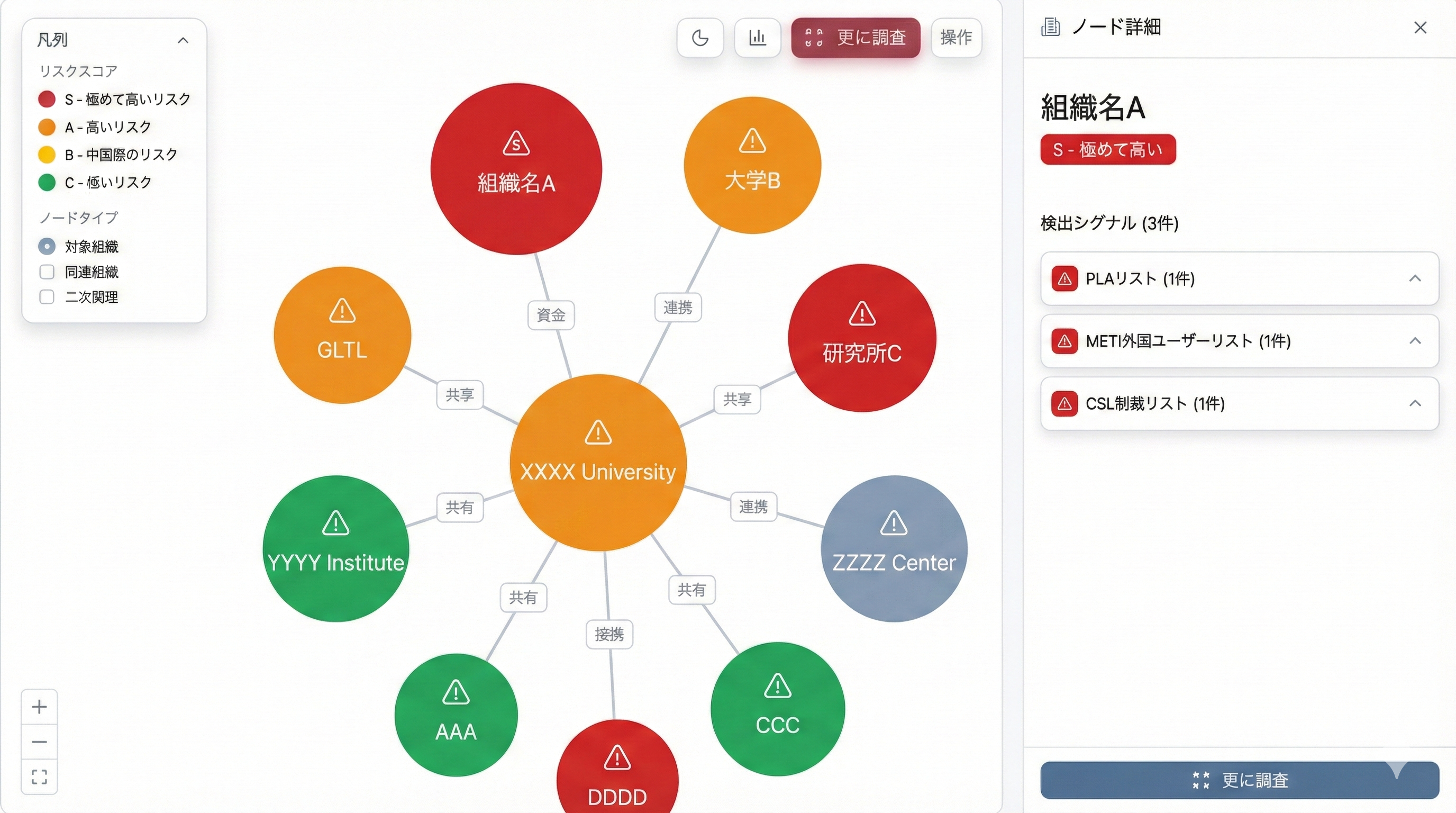
Relationship Chain Analysis
Track not just your counterparts, but their entire network of relationships
Before entering transactions with overseas partners, automatically analyze the subject's relationship chain.
Cross-reference shareholder structures, affiliated entities, and sanction histories across multiple data sources to uncover hidden risks.
- Network analysis of overseas agents and distributors
- Automated capital relationship chain tracking
- Cross-matching against sanctions and concern lists
Automate METI Matrix Table
Cross-Checking Work
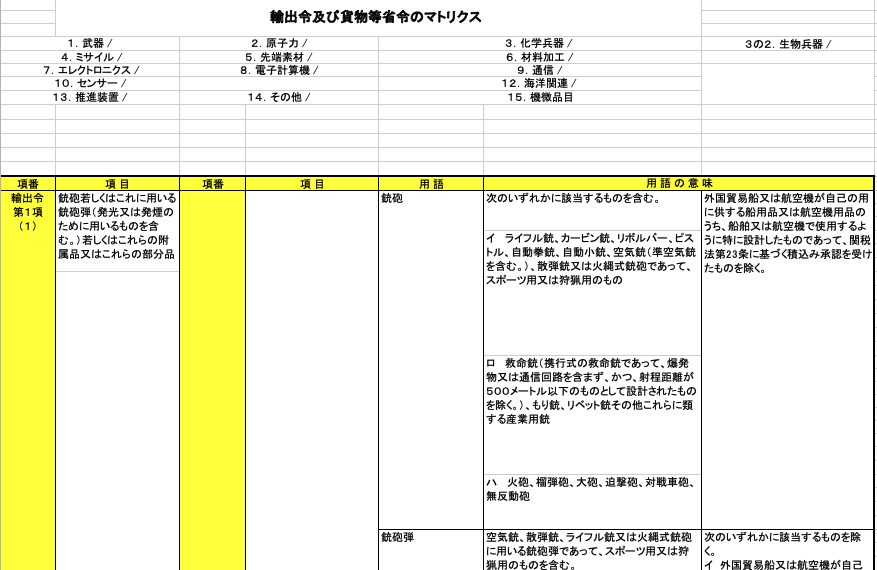
The Export Control Order Appendix and Goods Ministerial Order Matrix Table is essential for export control. AI solves technical jargon and the time required for cross-checking.
Conventional Challenges
METI Matrix Table
- !Technical jargon barrier: Legal-specific expressions make cross-checking with in-house products difficult
- !Vast number of items: Hundreds of items across 15 categories require visual inspection
- !Reliance on individual judgment: Interpretations differ between staff, making consistency hard to maintain
TRAFEED Solution
AI Term Translation
AI automatically translates technical terms in the matrix table into common expressions. Enter a product name or specification to identify potentially applicable items.
- 90% reduction in cross-checking time: Work that used to take hours is completed in seconds
- Transparent rationale: Displays the reasoning for why a given item may apply
- Consistent quality: AI applies the same criteria, eliminating variation between staff
- Audit-ready: Determination history and supporting documents are saved automatically
* AI determinations are a support tool. Final export-control decisions remain your company’s responsibility.
Where we are expanding next
EAR / BIS 50% rule support has already started with early customers (see Features). Below are the areas we are building out next: item-by-item comparison tables, and research integrity and research security.
Item-by-Item Comparison Table Support
Full support for the item-by-item comparison tables of the Export Trade Control Order Appendix 1 and the Foreign Exchange Order Appendix, streamlining applicability determination work.
Beyond prior screening, cross-comparison with actual export records is legally required.
- Comparison table format data import
- Cross-checking of prior screening against actual export records
- Output support for CISTEC format
Research Integrity and Research Security Support
Support for the due diligence required by the Cabinet Office procedures manual on research security. We apply our existing knowledge graph of papers, patents and researchers, together with national control lists, to the risk management research institutions now have to run.
From FY2026, some competitive research funding programmes have made risk management under the manual a condition of application.
- Due diligence aligned with the 13 verification items in the manual
- Visualisation of co-authorship and co-filing networks
- Researcher profiles and shareholder / ownership research
Official Documents Used
in Export Control
Security export control requires prior confirmation using forms prescribed by the Ministry of Economy, Trade and Industry (METI).
TRAFEED fully supports this official format.
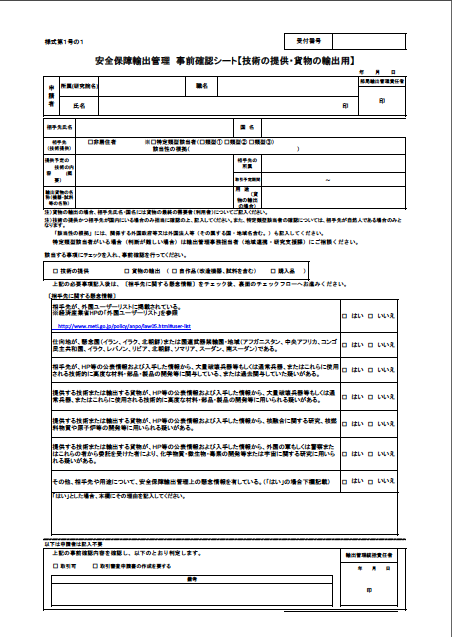
METI "Security Export Control Prior Confirmation Sheet" format
What is the Prior Confirmation Sheet?
An official document used to confirm in advance whether the technology or goods to be exported fall under List Controls or Catch-All Controls.
The destination country, counterparty, and end use must be recorded in detail to determine whether the transaction is subject to controls. Specialist knowledge is required and the work has traditionally consumed considerable time and effort.
Key Capabilities of TRAFEED
- Full support for Forms 1–3
AI automatically recognizes each form for technology transfer and goods export
- Automatic field validation
Instantly assesses risk level from counterparty, country, and end use
- Bulk processing via Excel
Large volumes of confirmation cases can be uploaded in bulk
Export Control Basics in 3 Minutes
Technical terms explained simply
What is List-Based Control?
Regulations that list items and technologies usable for weapons/military, restricting exports to certain countries. 'Classification' determines if your product specs match controlled items.
What is Catch-All Control?
Comprehensive regulations applied even to non-listed items if there's risk of WMD development use. Requires checking end-user purpose and identity.
What is Classification?
The process of determining if goods/technology you're exporting fall under export control lists. Compare product specs against control lists to judge controlled/non-controlled status.
What Does TRAFEED Do?
Upload your counterparty information and the AI shows the level of concern. It links the supporting evidence and drafts the reasoning automatically, so your team can make the final call.
Lists refreshed automatically — new features every week
Export control lists change constantly. TRAFEED imports the U.S. Consolidated Screening List and other countries' sanctions lists automatically and shows when each list was last updated. On top of that, weekly releases ship customer feedback in the shortest possible cycle.
The U.S. Consolidated Screening List and other countries' sanctions lists are imported automatically, with each list's update date shown on screen
Automatic list imports
Automatic import of the U.S. Consolidated Screening List, the OFAC SDN List, and other countries' sanctions lists, with update dates shown on screen
Approval workflow capability
Multi-stage approval, pushback, and full history logging — combining internal controls with audit trails
Expanding sanctions, company lists, and tech knowledge
Continuous multi-country list and company-graph growth (~100M company records; ~300M total with technology data). Non-public sources expanding where allowed
Enhanced pre-screening
Improved accuracy of background checks for international students and new business partners
Lists refreshed automatically, customer feedback reviewed within a week
Screening lists are imported automatically, and each list shows when it was last updated. Feedback from design-partner customers is reviewed within a week as a rule, and high-priority items go into the next weekly release.
Pricing Plans
Assign the first-pass analyst you would struggle to hire, on an annual plan.
Standard
About $1,333 per month
Initial fee $2,400
- Up to 500 pt/month (500 classifications or screenings)
- All features, unlimited users
Growth
$3,200 per month
Initial fee $2,400
- Up to 1,300 pt/month (1,300 classifications or screenings)
- All features, unlimited users
Large-scale
$4,800 per month
Initial fee $2,400
- Up to 2,500 pt/month (2,500 classifications or screenings)
- All features, unlimited users
- Priority support
Every plan includes the same features
The only difference between plans is the monthly point allowance. All of the following comes with every plan.
- Screening & classification
- Auto evidence linking
- Audit-ready reports
- Automatic screening-list updates
- Approval workflow (built in)
- Unlimited users, no per-seat fees (invite anyone in your organization)
- Auditors can be invited too
Large-scale Use & Special Programs
We tailor the best plan to your volume and specific requirements
Enterprise
Large-scale use & API integration / The more you use, the lower the per-pt cost
- 12,500+ pt/month, high-volume processing
- API & ERP integration
- Dedicated support
- All features, unlimited users
Design Partner
Offered at a special price
- Up to 500 pt/month
- All features, unlimited users
- Priority support
- Feature development input
※ Limited to companies that can provide feedback on product improvements
About point (pt) consumption
Usage is managed in points (pt). The points consumed vary with the type of processing.
The estimated points for each operation are shown on screen before you run it.
Support
Frequently Asked Questions
Stop carryingmatrix matching & party checks
alone
Share the brief internally, or walk us through the step that hurts most—either is fine.
We'll fit a Japan-patented system into your classification and counterparty workflow.
We reply within one business day. We start from operational load—not a hard pitch.
The 95%+ AI assessment accuracy refers to Japan’s security export classification. It is based on our own research as of March 2026, from validation jointly conducted with Okayama University on approximately 30,000 past review cases, and does not measure U.S. ECCN or other countries’ classification. TRAFEED assesses and supports risk determination; the final export-classification decision is made by the customer’s export-control officer. Japan Patent No. 7862062.
Related columns
Most read this month
Deepen your understanding with our in-depth articles, then explore the service.
![China's Dual-Use Export Control List and Watch List — Full 80 Japanese Entity Names for Counterparty Screening [June 29, 2026 Update]](/images/columns/china-japan-export-control-2026/cover.en.png)
China's Dual-Use Export Control List and Watch List — Full 80 Japanese Entity Names for Counterparty Screening [June 29, 2026 Update]
How Long Will the Strait of Hormuz Closure Last? October 2026 Status and Conditions for Reopening
China's Rare Earth Export Controls 2025–2026 — 7 Permanent Elements, Suspended Rules, and Licensing for Global Supply Chains
![Japan's Certificate of Non-Applicability Explained — What Foreign Suppliers Must Provide Japanese Buyers [Feb 14, 2026 Update]](/images/columns/non-applicable-certificate-guide/cover.en.png)
Japan's Certificate of Non-Applicability Explained — What Foreign Suppliers Must Provide Japanese Buyers [Feb 14, 2026 Update]
What Is Appended Table 1 of Japan's Export Trade Control Order? Items 1–16 Explained
What Is EAR99? EAR99 vs. ECCN, NLR, and 'Not Subject to the EAR' (2026)
Japan's July 2027 Local-Government IT Procurement Rule: JC-STAR, ISMAP and the 'China Ban' Reports
JC-STAR and Chinese Products: Label Status and the "De Facto Exclusion" Debate (October 2026)
Japan Export Classification (Gaihi Hantei): The 5 Steps and What Is Current in October 2026
Japan Export Trade Control Order Amendments (October 2026): FPGA Modules and the Full Change Log
CISTEC Item-Specific Comparison Table: How to Fill It In, With Sample Entries (October 2026)