Hello, this is Ryuta Hamamoto from TIMEWELL.
I first wrote this piece on 2 August 2026 to flag that two suspensions, one American and one Chinese, were set to expire on the same day. In late September the two governments announced an extension of their arrangement to 10 January 2027, so I have rewritten it with what could be confirmed as of 3 October. The confirmed facts first.
| Measure | Expiry as written | Extension status (as of 3 October 2026) | |
|---|---|---|---|
| United States | Stay of the BIS Affiliates Rule (50 percent rule) | Stayed until 9 November 2026 (returns 10 November absent further rulemaking) | Extension to 10 January 2027 announced; no BIS extension in the Federal Register yet |
| China | Suspension under MOFCOM / GACC Announcement No. 70 of 2025 | "From the date of issue until 10 November 2026" | MOFCOM states the arrangement runs to 10 January 2027; no announcement extending No. 70 found |
| China | Suspension under MOFCOM Announcement No. 72 of 2025 | "From the date of issue until 27 November 2026" | Same; no announcement extending No. 72 found |
If both governments complete the legal steps, the "same day" picture moves to around 10 January 2027. As of 3 October, neither had. And Announcement No. 72, which the August version did not mention, ends on 27 November, not 10 November.
Below I go through both sets of primary texts and the September announcements, then lay out what to finish in the roughly five weeks to 9 November and, if the extension materialises, by 10 January. My conclusion up front: even after the announcement, 9 November is still the date to plan to.
The U.S. side: what is on hold
The BIS Affiliates Rule, generally called the 50 percent rule, works like this:
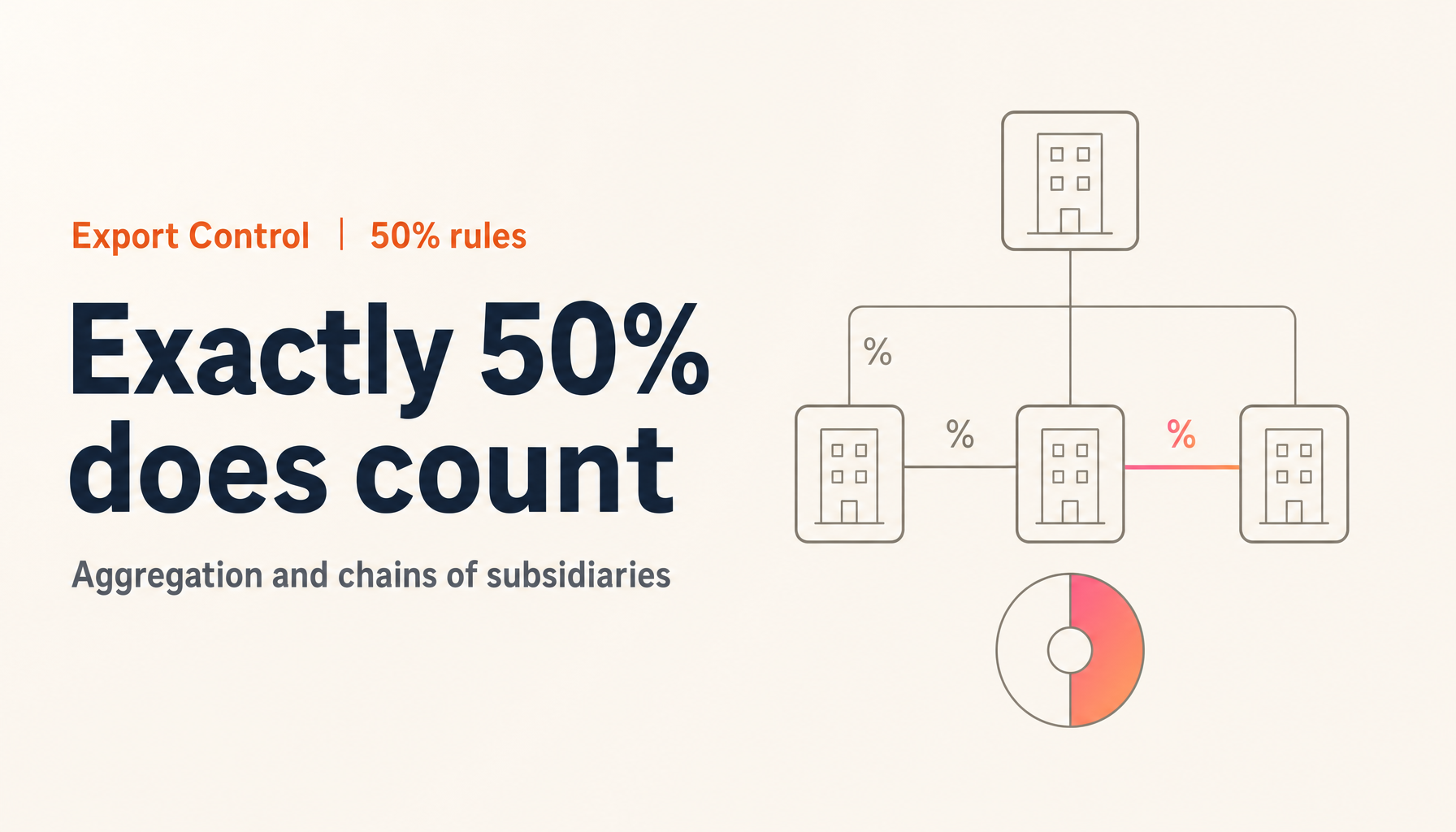
A company that is 50 percent or more owned, directly or indirectly, individually or in the aggregate, by parties on the U.S. Entity List and similar lists becomes subject to the same restrictions, even though its own name never appears on any list.
That was published as an interim final rule on 30 September 2025 (90 FR 47201).
A stay rule followed on 12 November 2025 (90 FR 50857–50858, Vol. 90, No. 216):
Effective 10 November 2025, the amendments to 15 CFR parts 732, 734, 736, 744 and 748 made by 90 FR 47201 are stayed until 9 November 2026.
And the SUMMARY of that rule reads:
"The suspension is set to end November 9, 2026, absent a future extension."
The body goes further. It describes a "second phase," effective 10 November 2026 and "extending indefinitely," in which the suspended amendments go back into the EAR. Extending the stay requires BIS to publish a new rule. Without one, the rule returns automatically.
The China side: what is on hold
China's measures sit in at least two announcements.
The first is MOFCOM and General Administration of Customs Announcement No. 70 of 2025, issued 7 November 2025. It suspends six announcements:
- MOFCOM / GACC Announcement No. 55 of 2025
- No. 56
- No. 57
- No. 58
- MOFCOM Announcement No. 61 of 2025
- No. 62
They cover superhard materials, certain rare earth equipment and feedstock, certain medium and heavy rare earths, lithium batteries and synthetic graphite anode materials, rare earth items outside China, and rare earth related technology. The suspension runs, as written, "from the date of issue until 10 November 2026."
The second is MOFCOM Announcement No. 72 of 2025, issued 9 November 2025. It suspends paragraph 2 of Announcement No. 46 of 2024, which tightened controls on dual-use exports to the United States. That paragraph provided that exports to the US of items related to gallium, germanium, antimony and superhard materials would in principle not be licensed. The suspension runs "from the date of issue until 27 November 2026." The August version of this piece missed it, and its date is not 10 November.
Replace siloed classification work with AI.
METI's FY2024 data shows 52% of foreign exchange law violations stem from classification errors. Download the TRAFEED product catalog covering features and rollout.
Why the dates lined up
Not coincidence.
The White House fact sheet of 1 November 2025 lists, in the same deal, the US suspension of the Affiliates Rule for one year from 10 November 2025 and China's suspension of "the global implementation of the expansive new export controls on rare earths and related measures that it announced on October 9, 2025." MOFCOM's 30 October 2025 statement pairs the same two items.
In August I wrote that Announcement No. 70 itself explained the link. That was not accurate. The text of No. 70 says only that it was issued "upon approval" and does not mention the US-China talks. The link comes from a MOFCOM spokesperson, who said at the 9 April 2026 press conference that, "in accordance with the consensus of the China-US Kuala Lumpur economic and trade consultations," the export control measures China announced on 9 October 2025 are suspended until 10 November 2026.
The two are halves of a single arrangement, and the aligned dates followed from that. That is also why the extension was announced as a joint matter.
September 2026: both governments announce an extension
On the US side, NBC News reported that Treasury Secretary Scott Bessent, speaking on Fox News on 23 September (US Eastern time) after talks with Vice Premier He Lifeng, said the "Busan Agreement" due to end on 10 November would be extended until 10 January. I could not find a Treasury document, so this one rests on press reports.
On the Chinese side, the head of MOFCOM's Department of American and Oceanian Affairs explained the outcome of the talks on the ministry's website on 28 September. The two sides agreed, "on the basis of extending the Kuala Lumpur economic and trade joint arrangement to 10 January 2027, to continue actively discussing this matter, with the aim of reaching a mutually agreed solution." The Kuala Lumpur arrangement is Beijing's name for what Washington calls the Busan Agreement. The same text expresses confidence that high-level exchanges before year-end will find a positive solution on extending it further.
The White House fact sheet of 25 September, issued after the 24 September summit, does not mention the extension.
As of 3 October, neither government had completed the legal steps. In the US, no BIS extension had appeared in the Federal Register. In China, no new announcement extending Nos. 70 or 72 appeared in MOFCOM's announcement list. The new dates are also unknown until the texts appear: whether the US stay runs "until 9 January" or "until 10 January," and how China words any new announcement.
The US rule's path and what can happen between 9 November and 10 January are covered in detail in where the BIS 50% Rule delay stands.
What can land at once
For exporters, these dates cut both ways.
From the U.S. side. A counterparty can become restricted without ever being listed. That is the difficulty with the 50 percent rule: screening counterparty names against the lists will not surface it, because the affected company is by definition not on them. Whether aggregate ownership reaches 50 percent only shows up if you trace the shareholders.
From the China side. Rare earths, lithium battery materials, synthetic graphite anode materials, superhard materials, and for the US market gallium and germanium related items. These can return to licensing or to a presumption against licensing. For anyone in batteries, magnets, tooling or semiconductors, that reaches into the supply plan itself.
If the legal steps do not arrive in time, both land in the same month: 10 November for the US, 10 and 27 November for China. Whichever absorbs your attention first, the other lands alongside it. Handling both from a standing start in November is, candidly, not realistic.
How to treat the extension announcement
Stated plainly: the extension has been announced, and the legal steps have not happened. I think they will probably arrive in time. That is not the same as certain.
So can you pause? I would not, for three reasons.
One: the work is not specific to this rule.
Mapping counterparty ownership is already required by OFAC's 50 percent rule, by MEU screening, and by ordinary counterparty due diligence. None of that disappears if the Affiliates Rule stay is extended.
Two: the work takes time.
This is the substantive reason. Tracing shareholders two or three layers up scales with the number of counterparties. A hundred entities is weeks; a thousand is months. It does not finish in the final fortnight. "Wait and see whether the extension is published, then start" is not a viable strategy. By the time you can see the answer, you are out of runway.
Three: an extension only moves the date two months.
It is not a withdrawal. MOFCOM says further extension will be discussed before year-end, and nobody knows how that ends. You may face the same decision again on 10 January.
Using the five weeks to 9 November, and the time after
The tasks differ in nature, so the order matters.
October: scope it and work the high-risk ownership
What: identify which counterparties and items could be in range, then trace shareholders starting with the highest-priority counterparties.
Scoping needs no tooling. Your existing counterparty and item lists are enough.
- U.S. side: which counterparties are involved with items that could be subject to the EAR, and which shipments are scheduled for 10 November or later
- China side: where your sourcing of rare earths, lithium battery materials, synthetic graphite anode materials, superhard materials and gallium actually sits
Ownership tracing is where the time goes, and where most programmes hit the wall of "we cannot get the data." The important part is to record what you could not find as what you could not find. Not a blank, but "traced two layers, the third is not published in that jurisdiction, checked on this date." It is unglamorous, and when an auditor or customer asks what you did to reach your conclusion, it is the only answer you have.
1–9 November: check the notices daily and name the decision-maker
What: check the US Federal Register (including public inspection) and MOFCOM's announcement list every business day. Name who decides, if the legal steps do not arrive, whether each undetermined transaction is held or sent for a license.
Export control failures do not start in legal or compliance. They start when sales commits to a customer, when engineering fixes a specification, when procurement places an order. If there is no way to check at those moments, an org chart does not help. If your internal tooling is priced per seat, the number of people who can check is being set by budget rather than by risk. That is worth examining once.
If the extension is formalised: finish the rest by 10 January
Read the new end dates in the published texts and update your internal deadlines. Then finish the counterparties you could not reach in October by mid-December, and do a final check alongside year-end shipping plans. Around 10 January, confirm in the original texts whether the outcome is another extension, a broader deal, or a return.
If it is not: prepare for 10 November in the US and 10 and 27 November in China
On the US side you operate under the 50 percent rule from 10 November. The temporary general license that came with the original rule expired under the rule text on 1 December 2025, and no new transition measure has been announced. On the Chinese side, review sourcing and inventory on the assumption that each measure comes back on its date. Either way, move on the notice, not on the date you expected. That one habit is worth keeping.
What happens if you do nothing
The other side of the ledger. If you wait for the extension, start in November, and the legal steps do not arrive in time:
- The ownership work does not finish. With no prioritisation done, time goes into deciding where to begin
- You cannot answer customer requests. "We're looking into it" gets repeated
- The Chinese sourcing impact and the U.S. counterparty impact arrive together and both get handled halfway
- And so you end up stopping transactions you cannot resolve, the most expensive option available
Stopped business does not always come back. That asymmetry is the whole argument between preparation cost and non-preparation cost.
What you can use now
Working through it internally, these help:
The BIS Affiliates Rule Readiness Checklist (PDF, free) covers what the rule does mechanically, where ownership data typically breaks, and a six-phase preparation list you fill in as you go. It is built to work whether the rule returns on schedule or the stay is extended.
The BIS 50% Rule quick check (free, no registration) takes a counterparty name and traces the ownership chain to compute aggregate holdings. Running one company tells you quickly where your own data runs out. (Currently available in Japanese only.)
When the number of counterparties passes what people can carry by hand, that is TRAFEED's range: screening counterparties against the major control and sanctions lists, investigating capital structure and affiliated networks, and attaching the supporting evidence to each determination. Pricing is based on how much you run rather than how many people log in, so you do not have to ration who is allowed to check.
Final determinations rest with your export-control officer and the authorities' current published guidance. That line does not move.
Key takeaways
- On paper, the US and Chinese suspensions still expire within weeks of each other. The US stay of the BIS Affiliates Rule runs to 9 November (90 FR 50857); China's Announcement No. 70 runs to 10 November and No. 72 to 27 November
- In September 2026 both governments announced an extension to 10 January 2027, the US through the Treasury Secretary's remarks (press-reported), China on MOFCOM's website
- As of 3 October, neither had completed the legal steps. No BIS extension in the Federal Register; no Chinese announcement extending Nos. 70 or 72
- Keep preparing, for three reasons: (1) the work is not specific to this rule (2) ownership tracing takes time and does not finish at the last minute (3) an extension only moves the date two months
- Sequence: scope and high-risk ownership in October → daily notice checks and a named decision-maker from 1 to 9 November → finish the rest by 10 January if the extension is formalised
- Record what you could not find. Auditors ask for the process, not only the conclusion
When I wrote this in August, the story was one shared date. Now the announced dates and the dates in the texts have come apart, and China's side has two dates of its own. With more dates on the calendar, the habit of confirming which one is legally live, from the notice itself, matters more than it did.
If you are unsure whether your current setup is enough, get in touch. We will start from how you actually run things today and map what you can realistically reach by 9 November.
Sources
- One Year Suspension of Expansion of End-User Controls for Affiliates of Certain Listed Entities — Bureau of Industry and Security — published 12 November 2025 — 90 FR 50857 — https://www.govinfo.gov/content/pkg/FR-2025-11-12/pdf/2025-19846.pdf
- Expansion of End-User Controls to Cover Affiliates of Certain Listed Entities — Bureau of Industry and Security — published 30 September 2025 — 90 FR 47201 — https://www.govinfo.gov/content/pkg/FR-2025-09-30/pdf/2025-19001.pdf
- MOFCOM / GACC Announcement No. 70 of 2025, suspending MOFCOM / GACC Announcements Nos. 55, 56, 57 and 58 and MOFCOM Announcements Nos. 61 and 62 of 2025 — Ministry of Commerce of the People's Republic of China — 7 November 2025 — https://www.mofcom.gov.cn/zwgk/zcfb/art/2025/art_b1ec77dd3f0d4762952904df7cdaadec.html
- MOFCOM Announcement No. 72 of 2025, adjusting implementation of Announcement No. 46 of 2024 — Ministry of Commerce of the People's Republic of China — 9 November 2025 — https://www.mofcom.gov.cn/zwgk/zcfb/art/2025/art_5c68985a6b1a46778e2e8dbff1bb1601.html
- MOFCOM regular press conference (Xinhua report, 9 April 2026, reposted on MOFCOM's export control bureau site, Chinese) — https://exportcontrol.mofcom.gov.cn/article/gndt/202604/1219.html
- MOFCOM spokesperson on the China-US Kuala Lumpur joint arrangement — 30 October 2025 (Chinese) — https://www.mofcom.gov.cn/syxwfb/art/2025/art_e8453c07ce374814ba65bdb6ff5813c4.html
- MOFCOM Department of American and Oceanian Affairs on the eighth round of China-US talks — 28 September 2026 (Chinese) — https://www.mofcom.gov.cn/syxwfb/art/2026/art_d9ea01824fc44fd8a29f7dc3f8ca9c72.html
- Fact Sheet: President Donald J. Trump Strikes Deal on Economic and Trade Relations with China — The White House — 1 November 2025 — https://www.whitehouse.gov/fact-sheets/2025/11/fact-sheet-president-donald-j-trump-strikes-deal-on-economic-and-trade-relations-with-china/
- Fact Sheet: President Donald J. Trump Advances a Fair and Reciprocal Relationship with China While Hosting Historic State Visit — The White House — 25 September 2026 (no mention of an extension) — https://www.whitehouse.gov/fact-sheets/2026/09/fact-sheet-president-donald-j-trump-advances-a-fair-and-reciprocal-relationship-with-china-while-hosting-historic-state-visit/
- U.S. and China agree to extend trade truce through Jan. 10, Bessent says — NBC News (press report) — 23 September 2026 — https://www.nbcnews.com/business/economy/us-china-extend-trade-truce-trump-rcna599525
- 15 CFR Part 744 — End-User and End-Use Based Controls; Supplement No. 4 (Entity List); Supplement No. 7 (MEU List) — eCFR (as of 1 October 2026) — https://www.ecfr.gov/current/title-15/part-744
- Consolidated Screening List — International Trade Administration — https://www.trade.gov/consolidated-screening-list
※ Listing or becoming subject to a control is a regulatory classification, not a judgement about a company. Content reflects primary government sources and press reports confirmed as of 3 October 2026 (first published 2 August 2026). Dates and scope may be extended or amended. Treat the authorities' current published guidance as authoritative and route final determinations through your export-control officer.