Hello, this is Ryuta Hamamoto from TIMEWELL.
On November 24, 2026 (U.S. Eastern time), a jury in the federal district court in Brooklyn, New York (the Eastern District of New York) returned guilty verdicts against Chinese telecom equipment maker Huawei Technologies and three of its subsidiaries1. Of the 12 counts (the individual charges in an indictment) that went to trial, the jury convicted on 10 and acquitted on 223. The verdict comes nearly eight years after Huawei's CFO (chief financial officer), Meng Wanzhou, was arrested in Canada in December 2018.
The headlines read "trade secret theft, bank fraud, sanctions violations." Read past them, though, and the part an export control manager should stop at is somewhere else. Most of the convictions trace back to one question: how Huawei described its Iran business to its banks. And the heaviest count, the one prosecutors used to tie everything together as a "criminal enterprise" running for 20 years, was rejected by the jury.
Below, I keep the primary sources (the Justice Department's announcement, the indictment, Meng's deferred prosecution agreement and Huawei's statement) apart from the reporting by journalists who covered the courtroom. The verdict is the jury's finding. Sentencing and the appeal are still to come, and Huawei has said it will appeal34.
The short version
- The convictions were for conspiracy to steal trade secrets, wire fraud and bank fraud, conspiracy to defraud the United States, violations of the International Emergency Economic Powers Act (IEEPA) relating to Iran sanctions, and money laundering conspiracy. The jury acquitted on racketeering conspiracy (under the RICO Act) and conspiracy to obstruct justice12.
- At the center is Skycom, a Hong Kong company doing business in Iran, which Huawei described to its banks as a "local business partner" while it kept its dollar transactions going. Meng herself acknowledged in her 2021 agreement that this description did not match the facts5.
- Sentencing is scheduled for September 14, 20271. The restrictions that come with Huawei's place on the Entity List are the same as before the verdict. For Japanese companies, the points to look at are how you explain yourself to banks and business partners, how you describe your affiliated companies, and how you manage confidential information you hold for others and what your employees do.
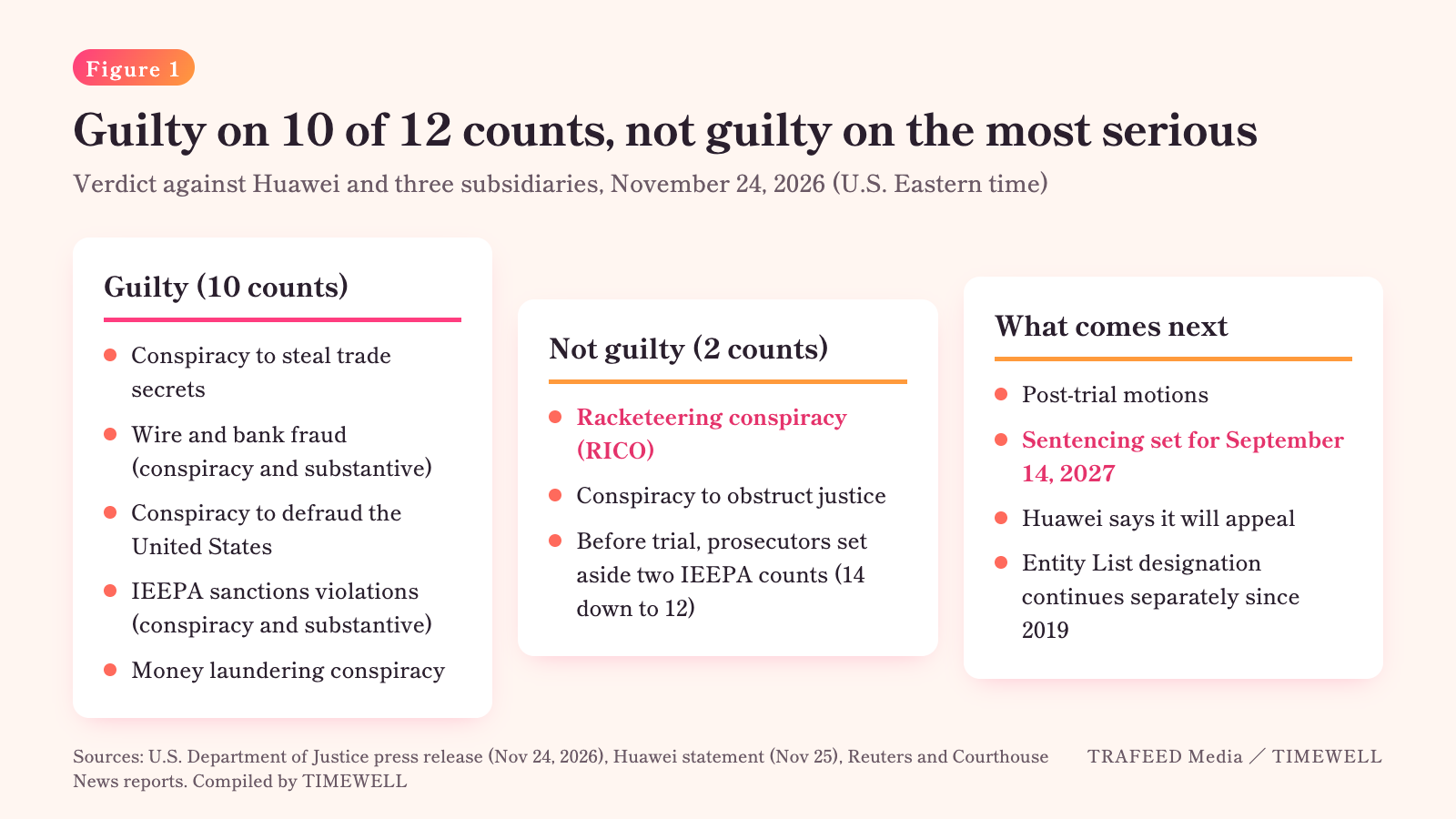
Figure 1. The verdict at a glance. Sources: U.S. Department of Justice press release (November 24, 2026), Huawei statement (November 25), Reuters and Courthouse News reports (November 24 and 25). Compiled by TIMEWELL.
What the jury decided: guilty on 10 of 12 counts, not guilty on racketeering conspiracy
Four companies stood trial: Huawei Technologies Co., Ltd. itself, its Chinese subsidiary Huawei Device, and its U.S. subsidiaries Futurewei Technologies and Huawei Device USA1. No individuals sat at the defense table. U.S. District Judge Ann Donnelly presided. Jury selection began on September 8, 2026, and opening statements followed the next day67. According to Reuters, the prosecution called more than 60 witnesses and the defense called 153. The jury began deliberating on the afternoon of November 18 and reached its verdict on November 242.
The count total has a backstory. The fourth superseding indictment, filed in April 2026, had 14 counts. On September 4, just before trial, prosecutors told the judge they would not try two of the IEEPA counts this time68. According to reports, they also dropped one of the trade secret episodes (involving a company the indictment calls only "Company 2") from the acts supporting the racketeering conspiracy8. The jury decided the remaining 12 counts.
Here is the verdict by type of offense. The statutes are those cited in the 2020 superseding indictment, and the fine caps are what each statute provides for organizations910.
| Offense | Verdict | Statute | Statutory maximum fine for an organization |
|---|---|---|---|
| Racketeering conspiracy (RICO) | Not guilty | 18 U.S.C. §1962(d) | Not applicable |
| Conspiracy to steal trade secrets | Guilty | 18 U.S.C. §1832(a)(5) | $5 million or three times the value of the stolen trade secrets, whichever is greater |
| Wire fraud and bank fraud (conspiracy and substantive) | Guilty | 18 U.S.C. §§1343, 1344, 1349 | $1 million per count (the same applies to wire fraud affecting a financial institution) |
| Conspiracy to defraud the United States | Guilty | 18 U.S.C. §371 | $500,000 (the general cap for felonies) |
| IEEPA violations (conspiracy and substantive) | Guilty | 50 U.S.C. §1705 | $1 million per count |
| Money laundering conspiracy | Guilty | 18 U.S.C. §1956(h) | $500,000 or twice the value of the property involved, whichever is greater |
| Conspiracy to obstruct justice | Not guilty | 18 U.S.C. §1512(k) | Not applicable |
The amounts in the table are statutory ceilings, not actual penalties. U.S. law also has a general provision allowing a fine of up to twice the gain from the offense or twice the loss it caused to others (18 U.S.C. §3571(d)), so the figures could end up larger than those above9. The actual sentence will be set by the judge, who will consider the U.S. Sentencing Guidelines and other factors. The Justice Department says the defendants also face forfeiture and restitution on top of fines1. An organization can be sentenced to a fine or to probation, and the two can be combined (§3551(c))9.
One caveat. The Justice Department's announcement doesn't break the verdict down by defendant and by count. In other words, it doesn't say which subsidiary was convicted on which count, and I had not been able to see the verdict form itself when I wrote this. The announcement says the jury convicted "Huawei and three subsidiaries" of the offenses above1.
The acquittal on the most serious count, racketeering conspiracy, is no small thing. The RICO Act was originally aimed at organized crime such as the Mafia, and prosecutors used it to argue that Huawei was an "enterprise" that had grown its business through unlawful means over many years11. After the verdict, defense attorney Brian Heberlig told reporters, "That was the only count that brought all of the allegations together," and treated the acquittal as the jury rejecting the government's overall story11. Still, the jury did find the separate conspiracies on trade secrets, fraud, sanctions and money laundering. Huawei has received a guilty verdict as a company, and that doesn't change.
Replace siloed classification work with AI.
METI's FY2024 data shows 52% of foreign exchange law violations stem from classification errors. Download the TRAFEED product catalog covering features and rollout.
What was argued at trial: how the Iran business was described, and five trade secret episodes
This case has been running for eight years. Here are the main events on a timeline first.
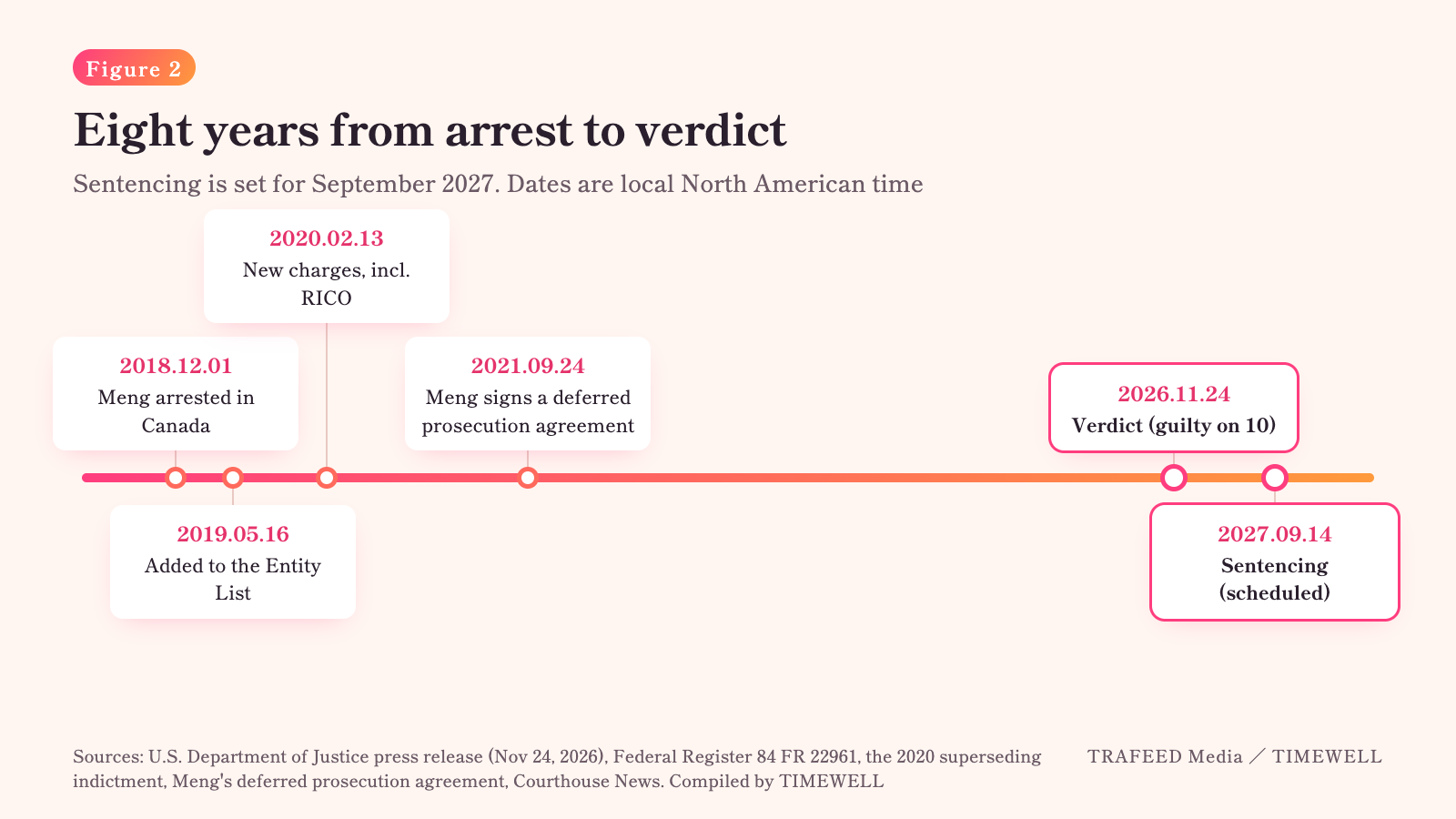
Figure 2. Main events in the case. Sources: U.S. Department of Justice press release (November 24, 2026), Federal Register 84 FR 22961, the 2020 superseding indictment, Meng's deferred prosecution agreement and Courthouse News reports. Compiled by TIMEWELL.
The first indictment was announced on January 28, 2019, with 13 counts including bank fraud, sanctions violations and obstruction of justice12. The February 2020 superseding indictment added racketeering conspiracy and conspiracy to steal trade secrets, along with allegations about business in North Korea10. Meng entered a deferred prosecution agreement in September 2021, and the charges against her were dismissed in December 2022513. The case against the company went on, and that is what came to trial.
The prosecution built its case on two pillars. The first was the Iran business. According to the Justice Department, Huawei did business in Iran under the name "Skycom" and told banks, journalists and the U.S. government three things: that Skycom was a business partner rather than a wholly owned subsidiary, that it had begun restricting its Iran business in 2011, and that it complied with all applicable sanctions. The Justice Department calls these statements "materially false" and says Huawei used them to obtain billions of dollars and access to U.S.-dollar clearing services1. It also cites Huawei's help to the Iranian government in building out its telecommunications networks.
The second pillar was trade secrets. Five episodes came up at trial. Here are the prosecution's allegations next to the defense's answers.
| Episode | Prosecution (Justice Department) | Defense (Huawei) |
|---|---|---|
| T-Mobile's testing robot "Tappy" | An employee who entered the lab under a nondisclosure agreement walked out with a part of the robot | The employee was wrong to do it, but he was trying to get a phone through testing |
| Cisco router source code | Huawei copied the source code and used it in its routers | The episode is more than 20 years old, and once it came to light Huawei recalled the routers it had sold in the U.S. |
| Fujitsu equipment | At a trade show, an employee wearing a badge with a different company name photographed the equipment | The employee was fired right away, and what he photographed was not secret |
| CNEX (U.S. chip company) | Huawei used a university researcher to propose a collaboration without disclosing its involvement, and gained access to confidential information | All five matters were settled as civil disputes, and no court has found willful misappropriation (statement) |
| Quintel (U.S. antenna company) | Almost immediately after receiving material under an NDA, Huawei filed a patent application with that material attached | Same as above |
Sources: Justice Department press release1, AP11, Courthouse News27, Inner City Press courtroom notes14, Huawei statement4
The defense's theme never wavered. Prosecutors, it argued, had strung together isolated wrongdoing by a handful of Huawei's more than 200,000 employees into a story about a grand conspiracy that didn't exist11. In his closing argument, Heberlig said much of the material allegedly taken was already public, and told jurors that 75% of the licensing fees Huawei has paid went to U.S. companies11. On the banks, the defense countered that they knew about the Iran business and were competing for Huawei's business anyway3. In rebuttal, the prosecution reminded the jury: "Remember, a conspiracy is an agreement. That's the crime; the agreement itself"15.
One more thing to keep in mind while reading all this. According to a reporter in the courtroom, on the first day of jury selection Judge Donnelly told prospective jurors that "China and the Communist Party ... are not on trial"14. What the jury decided was the criminal liability of companies for specific acts described in the indictment. China as a country was not on trial, and neither was the security of Huawei's products. In its statement, Huawei said the remaining charges are "equally without legal or factual merit" and that it will take all necessary legal action4.
Why describing your business to a bank can become fraud: where dollar clearing meets sanctions
Readers in Japan may wonder how what a company told its bank about its business can turn into a charge as serious as fraud or a sanctions violation. The key is dollar clearing.
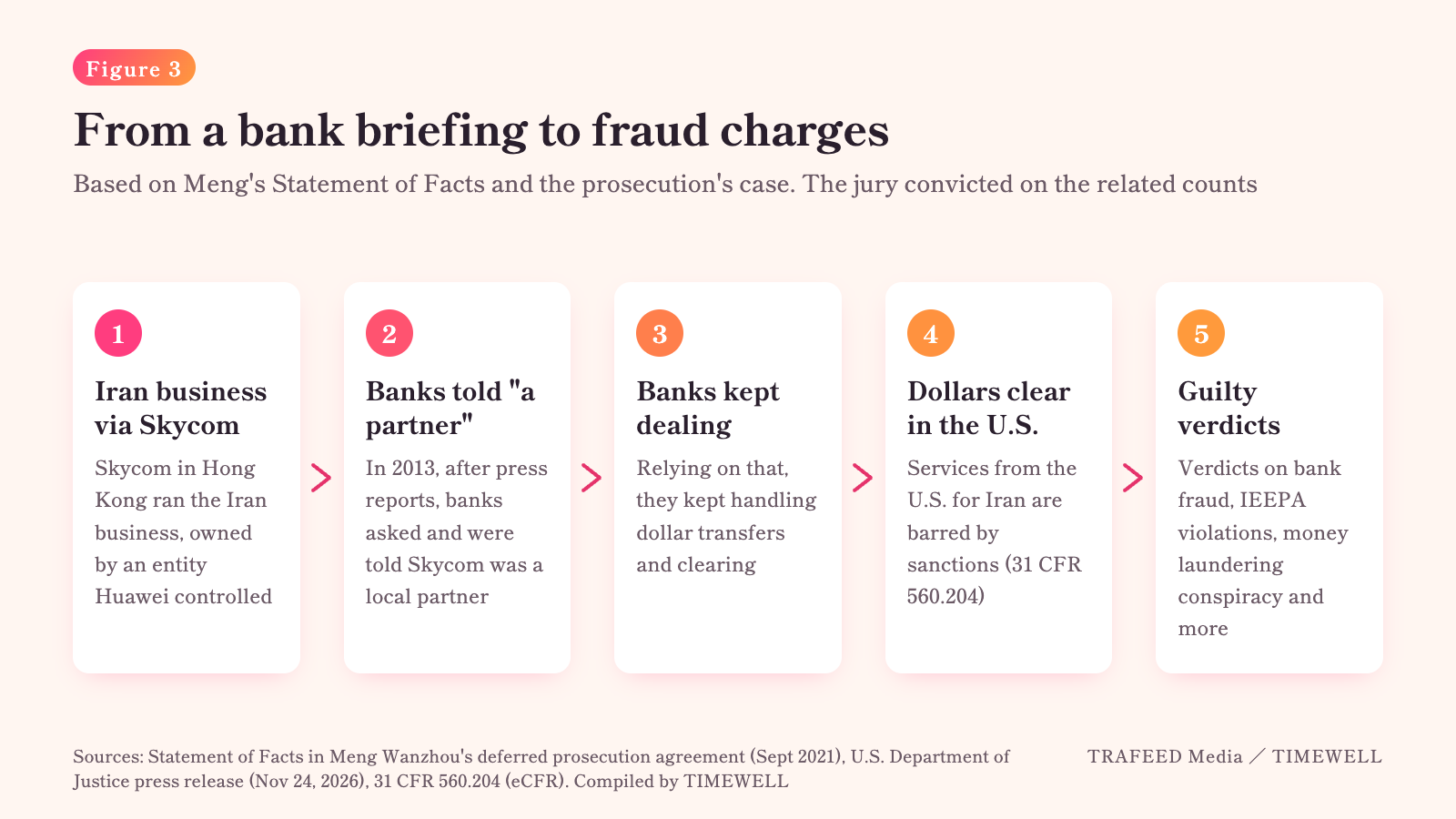
Figure 3. How statements to banks led to fraud and sanctions charges. Sources: Statement of Facts attached to Meng Wanzhou's deferred prosecution agreement (September 2021), U.S. Department of Justice press release (November 24, 2026), 31 CFR 560.204 (eCFR, retrieved November 25, 2026). Compiled by TIMEWELL.
U.S. Iran sanctions rules generally prohibit the export of goods, technology or services to Iran or the Government of Iran from the United States or by a U.S. person (31 CFR 560.204)16. International U.S. dollar transfers ultimately clear through banks inside the United States, so clearing a transaction for Iran in dollars risks putting a U.S. bank in breach of that prohibition. That's why international banks ask their customers how they're connected to Iran, and turn down transactions that would run into sanctions.
The Statement of Facts that Meng admitted in her 2021 agreement spells this out5. Skycom was a Hong Kong company that did business mainly in Iran. It was owned by an entity controlled by Huawei, and from 2010 to 2014 Huawei controlled Skycom's business operations. Skycom's bank account sent at least $7.5 million to a U.K. staffing company in about 80 payments to cover contractors on the Iran business, and those payments were made in dollars and cleared through the United States. When reports about Huawei's ties to Skycom came out in late 2012 and early 2013, the financial institutions Huawei banked with started asking questions. Huawei employees told them Skycom was just a local business partner. On August 22, 2013, Meng met a senior executive of one of those financial institutions in Hong Kong and described the relationship with Skycom as "normal business cooperation." The Statement of Facts acknowledges that these statements did not match the facts.
Strictly speaking, that statement belongs to Meng's personal agreement. Even so, in June 2026 Judge Donnelly overruled the defense's objection and held that it could be used as evidence against the company. Her reasoning, in substance: Meng was, and still is, Huawei's CFO, and it makes no sense for the company to object to its own senior executive's statement about conduct in her job being admitted as evidence6. At trial, the banker who met Meng also testified3.
The lesson I'd draw for Japanese companies here has less to do with knowing trade rules and more to do with controlling what you say. Replies to bank inquiries, written undertakings to business partners, explanations to the press: these often get written from habit by people in sales or accounting. If the ownership structure or business scope you describe drifts from reality, that statement itself can later become the way in for liability. An explanation given in 2013 ended up at the center of a criminal trial 13 years later. That's what this case was. It's also worth remembering that facts an executive admitted in an agreement with the authorities were used as evidence against the company.
The Entity List and your transactions: what the verdict changes and what it doesn't
In export control practice, the first question is probably whether the verdict changes the rules on dealing with Huawei. The short answer: the verdict itself doesn't change any export control rules.
Huawei was added to the U.S. Commerce Department's Entity List by a rule that took effect on May 16, 2019 (Federal Register, 84 FR 22961)17. Since then, sending items subject to the U.S. Export Administration Regulations (EAR) to Huawei has required a license. In 2020, the expansion of the foreign direct product rule (FDPR) brought products made abroad with U.S. technology or software within reach of the controls too. I explain how that works in our guide to the FDPR, and how the lists differ in our comparison of the Entity List, the MEU List and the SDN List. These are administrative measures, separate from the criminal case.
Here's what changes after the verdict and what is still to be decided.
| Item | Status after the verdict |
|---|---|
| Entity List designation | In place since May 16, 2019. The verdict doesn't change it |
| Licenses for transactions subject to the EAR | Still required, including where the FDPR reaches foreign-made products |
| Fines, forfeiture, restitution, probation | To be decided by the judge at sentencing on September 14, 2027 |
| Finality of the conviction | Post-trial motions and the appeal are still ahead |
| Treatment under Japan's Foreign Exchange and Foreign Trade Act | No change from the verdict. Japanese classification and transaction screening continue as before |
Sources: Federal Register 84 FR 2296117, U.S. Department of Justice press release1, Reuters report3
If your company deals with Huawei or its affiliates, what you need to check is the same as before the verdict. Confirm, with records, whether the items you handle are subject to the EAR, whether the FDPR applies, and which Entity List entry your counterparty falls under. For keeping screening records, our counterparty screening record template and operations design sheet (Excel, in Japanese) gives you a record format for each screening and a log of how each hit was judged. For a procedure that checks the U.S., EU, U.K. and UN lists together with Japan's End User List, see the five sanctions-list systems screening procedure.
What I'm watching next is sentencing. Beyond the size of the fine, whether probation is imposed, and on what conditions, will matter to companies that do business with Huawei as well, in my view. Around the time of sentencing, the judge will also rule on post-trial motions. Huawei continues to operate in more than 170 countries and regions, and its statement says it will keep serving customers and partners and keep its operations stable4. Right after the verdict, the Chinese Embassy in Washington did not immediately respond to a Reuters request for comment3.
Points Japanese companies can apply to themselves
Reading this verdict only as news about U.S.-China friction would be a waste, I think. Read it as a case in which things that happened inside a company were charged as the company's own liability, and you'll find items a Japanese company can check as they are.
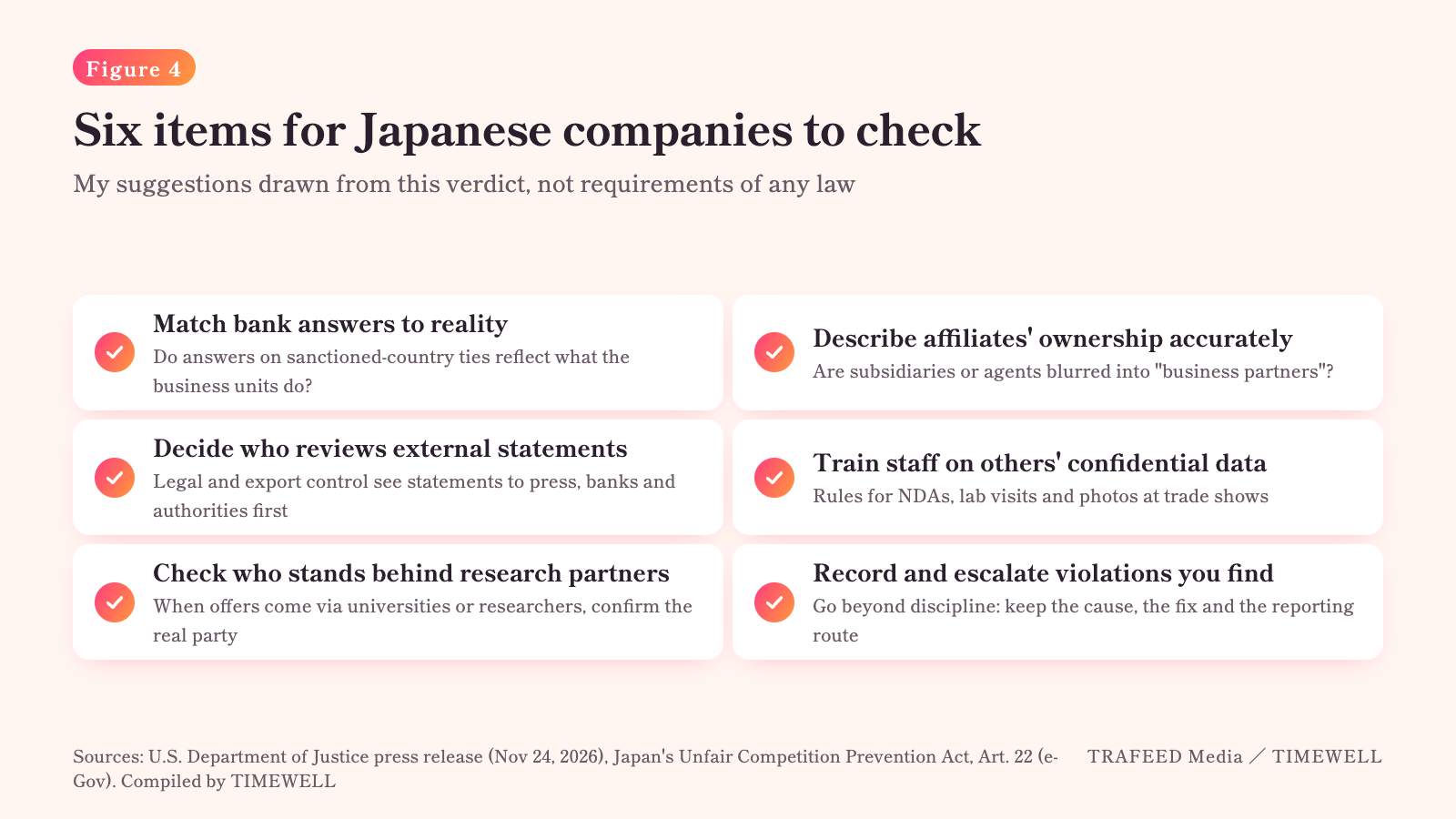
Figure 4. Six items for Japanese companies to check. Sources: U.S. Department of Justice press release (November 24, 2026) and Japan's Unfair Competition Prevention Act, Article 22 (e-Gov). Compiled by TIMEWELL. The items are my suggestions, not requirements of the law itself.
First, check what you've told banks and business partners against how the business actually runs. Three topics matter: ties to sanctioned countries, end users, and the ownership of affiliates. I recommend that your export control and legal teams take what you've said on these points in bank inquiries and partner questionnaires and compare it, at least once a year, with what the business units actually do. In the Skycom episode, the heart of the charge came down to a single word: wholly owned subsidiary, or business partner? Whether you've blurred a subsidiary, an agent or a joint venture into a "business partner" when explaining yourself is something you can check today. For checks site by site, you can use our group and overseas site governance set (Excel, in Japanese), which covers site classification, self-assessment sheets and an audit plan.
Second, assume that what employees do becomes the company's liability. Under U.S. federal law, a company can face criminal liability for acts its employees commit within the scope of their jobs and for the company's benefit, a principle followed since a 1909 Supreme Court decision18. Here, the defense argued that the conduct was that of a few employees and that the company had put things right through discipline and recalls, but the jury convicted on the conspiracy counts. Japan's Unfair Competition Prevention Act also has a provision that punishes the company when an employee infringes trade secrets in connection with the company's business (a dual liability provision). The company can be fined up to 500 million yen, or up to 1 billion yen for certain offenses such as infringement for use outside Japan (Article 22)19. When you find misconduct, don't stop at disciplining the people involved. A record of the cause, the fix and the reporting route is what will protect the company later.
Third, how you handle confidential information that business partners entrust to you. Entering a lab under a nondisclosure agreement, taking photos at a trade show, using material a partner gave you inside your own company: every episode raised at trial grew out of ordinary day-to-day work. Note, too, that in the Fujitsu equipment episode a Japanese company appears as the party that was harmed11. Employees need concrete rules on both sides, both for protecting your own secrets and for handling the secrets of other companies that you hold.
Fourth, check who stands behind a research partner. In the CNEX episode, prosecutors alleged that Huawei, without disclosing its involvement, proposed a collaboration through a university researcher1. For universities and research institutes, an offer of joint research that comes through an individual researcher is nothing unusual. Checking where the funding and samples come from, and who will actually receive the results, is basic research security. Pre-contract checks and sample clauses are in our joint research and contract research checklist and model clauses (Excel, in Japanese). I've also written up the thinking behind it in a checklist for joint research contracts and export control.
What to watch next, and what I couldn't confirm
Next on the calendar are post-trial motions, sentencing on September 14, 2027, and then the appeal13. At sentencing, I'm watching not only the size of the fine but whether probation is imposed and, if so, on what conditions. How the two IEEPA counts that prosecutors set aside before trial will be handled is also still unknown.
Some things I couldn't confirm. I had not obtained the verdict form (the breakdown by defendant and by count), the text of the April 2026 fourth superseding indictment or the trial transcripts when I wrote this. The courtroom exchanges are based on notes by reporters who were there. I also haven't confirmed how the Chinese government will officially respond to the verdict. I'll update this piece when new primary sources come out.
What export control teams can take home from this verdict, in my view, isn't the conclusion that "Huawei was convicted." It's the fact that a single explanation given to a bank more than a decade ago can end up at the center of a criminal trial today. Where are the copies of the explanations your company has given to banks and business partners, and who reviewed them before they went out? Take this chance to go and find them.
If you'd like to turn counterparty checks and the records behind them into a system, you can reach us for a one-on-one consultation about TRAFEED. Final classification and transaction decisions remain with your company's export control officer.
Footnotes
-
U.S. Department of Justice, Office of Public Affairs, "Chinese Tech Giant Huawei and Subsidiaries Convicted of Sanctions Violations, Fraud, Conspiracy to Steal Trade Secrets, and Money Laundering" (Press Release Number 26-1413), November 24, 2026. https://www.justice.gov/opa/pr/chinese-tech-giant-huawei-and-subsidiaries-convicted-sanctions-violations-fraud-conspiracy (retrieved November 25, 2026) ↩ ↩2 ↩3 ↩4 ↩5 ↩6 ↩7 ↩8 ↩9 ↩10 ↩11
-
Courthouse News Service, "Huawei found guilty of stealing trade secrets in US trial," November 24, 2026. https://www.courthousenews.com/huawei-found-guilty-of-stealing-trade-secrets-in-us-trial/ ↩ ↩2 ↩3 ↩4
-
Reuters, "China's Huawei convicted in sprawling US criminal trial over Iran business," November 24, 2026 (read via the Free Malaysia Today reprint). https://www.freemalaysiatoday.com/category/business/2026/11/25/china-s-huawei-convicted-in-sprawling-us-criminal-trial-over-iran-business ↩ ↩2 ↩3 ↩4 ↩5 ↩6 ↩7 ↩8
-
Huawei, "Statement on the Jury Verdict in the U.S. District Court for the Eastern District of New York," November 25, 2026. https://www.huawei.com/en/news/2026/11/statement-on-jury-verdict (retrieved November 25, 2026) ↩ ↩2 ↩3 ↩4
-
Deferred Prosecution Agreement between Meng Wanzhou and the U.S. Department of Justice, with its Statement of Facts (Exhibit A), September 2021. https://www.justice.gov/opa/press-release/file/1436211/dl (retrieved November 25, 2026) ↩ ↩2 ↩3
-
Courthouse News Service, "Feds take on Chinese tech giant at trial over Iranian sanctions," September 8, 2026. Quotes the June 2026 ruling that Meng's statement can be used as evidence against the company. https://www.courthousenews.com/feds-take-on-chinese-tech-giant-at-trial-over-iranian-sanctions/ ↩ ↩2 ↩3
-
Courthouse News Service, "Huawei rebuts criminal charges at trial over trade secrets, Iranian sanctions," September 9, 2026. https://www.courthousenews.com/huawei-rebuts-criminal-charges-at-trial-over-trade-secrets-iranian-sanctions/ ↩ ↩2
-
Fierce Network, "Opinion: Huawei trial opens in Brooklyn as DOJ drops some charges," September 7, 2026. Describes the prosecution's September 4 filing. https://www.fierce-network.com/broadband/opinion-huawei-trial-opens-brooklyn-doj-drops-some-charges ↩ ↩2
-
United States Code, retrieved from Cornell Law School's Legal Information Institute on November 25, 2026. 18 U.S.C. §1832(b), §1343, §1344, §1956(a) and (h), §3551(c), §3561(c), §3571(c) and (d); 50 U.S.C. §1705(c). https://www.law.cornell.edu/uscode/text/18/3571 and related pages ↩ ↩2 ↩3
-
United States v. Huawei Technologies Co., Ltd., et al., Cr. No. 18-457 (S-3) (AMD) (E.D.N.Y.), Superseding Indictment, ECF No. 126 (filed February 13, 2020; 56 pages, 16 counts). https://www.justice.gov/archives/opa/press-release/file/1248961/dl (retrieved November 25, 2026) ↩ ↩2
-
AP via PBS News, "U.S. jury finds Chinese tech giant Huawei guilty of conspiracy to steal trade secrets, bank fraud," November 24, 2026. https://www.pbs.org/newshour/nation/u-s-jury-finds-chinese-tech-giant-huawei-guilty-of-conspiracy-to-steal-trade-secrets-bank-fraud ↩ ↩2 ↩3 ↩4 ↩5 ↩6
-
U.S. Department of Justice, "Chinese Telecommunications Conglomerate Huawei and Huawei CFO Wanzhou Meng Charged With Financial Fraud," January 28, 2019. https://www.justice.gov/archives/opa/pr/chinese-telecommunications-conglomerate-huawei-and-huawei-cfo-wanzhou-meng-charged-financial (retrieved November 25, 2026) ↩
-
Euronews (AP), December 2, 2022. Judge Donnelly dismissed the charges against Meng. https://www.euronews.com/2022/12/02/usa-china-huawei-meng ↩
-
Inner City Press (Matthew Russell Lee), "Courtroom Extra: Huawei Jury After Count 12 Question," November 24, 2026. Courtroom notes covering the judge's remarks on the first day of jury selection (September 8) and the closing arguments. https://matthewrussellleeicp.substack.com/p/courtroom-extra-huawei-jury-after ↩ ↩2
-
The Bureau, "Breaking: Huawei Convicted on 10 Counts, Including Trade-Secret Conspiracy, but Acquitted of Racketeering," November 24, 2026. Quotes the prosecution's rebuttal argument (November 17). https://www.thebureau.news/p/breaking-huawei-convicted-on-10-counts ↩
-
31 CFR 560.204 (Iranian Transactions and Sanctions Regulations). eCFR, version current as of November 20, 2026, retrieved November 25, 2026. https://www.ecfr.gov/current/title-31/section-560.204 ↩
-
Federal Register, "Addition of Entities to the Entity List" (84 FR 22961, FR Doc. 2019-10616, published May 21, 2019, effective May 16, 2019). https://www.federalregister.gov/documents/2019/05/21/2019-10616/addition-of-entities-to-the-entity-list ↩ ↩2
-
New York Central & Hudson River Railroad Co. v. United States, 212 U.S. 481 (1909). https://www.law.cornell.edu/supremecourt/text/212/481 (retrieved November 25, 2026) ↩
-
Unfair Competition Prevention Act (Act No. 47 of 1993), Articles 21 and 22, in Japanese, via e-Gov. https://laws.e-gov.go.jp/law/405AC0000000047 (version in force from May 21, 2026, retrieved through the e-Gov law API on November 25, 2026) ↩