Hello, this is Ryuta Hamamoto from TIMEWELL.
"What price do we quote for this?" It may be the hardest question to answer on a manufacturing shop floor. Quote low and you win the order but keep no profit. Quote high to be safe and you lose to a competitor in the bidding. And in most cases, the basis for that pricing lives only inside a veteran's head. The rush job always seems to land on the day that person is out, and there is no one who can answer in their place. If any of this rings a bell, you are far from alone.
The phrase "cost estimation" carries a certain accounting-department ring to it. But for a manufacturer, cost estimation is frontline work for the shop floor and sales — looking at a drawing and pinning down "how many hours will this part take, and at what cost can we make it?" As long as this stays a matter of gut feel, profit will never stabilize no matter how good the products you make.
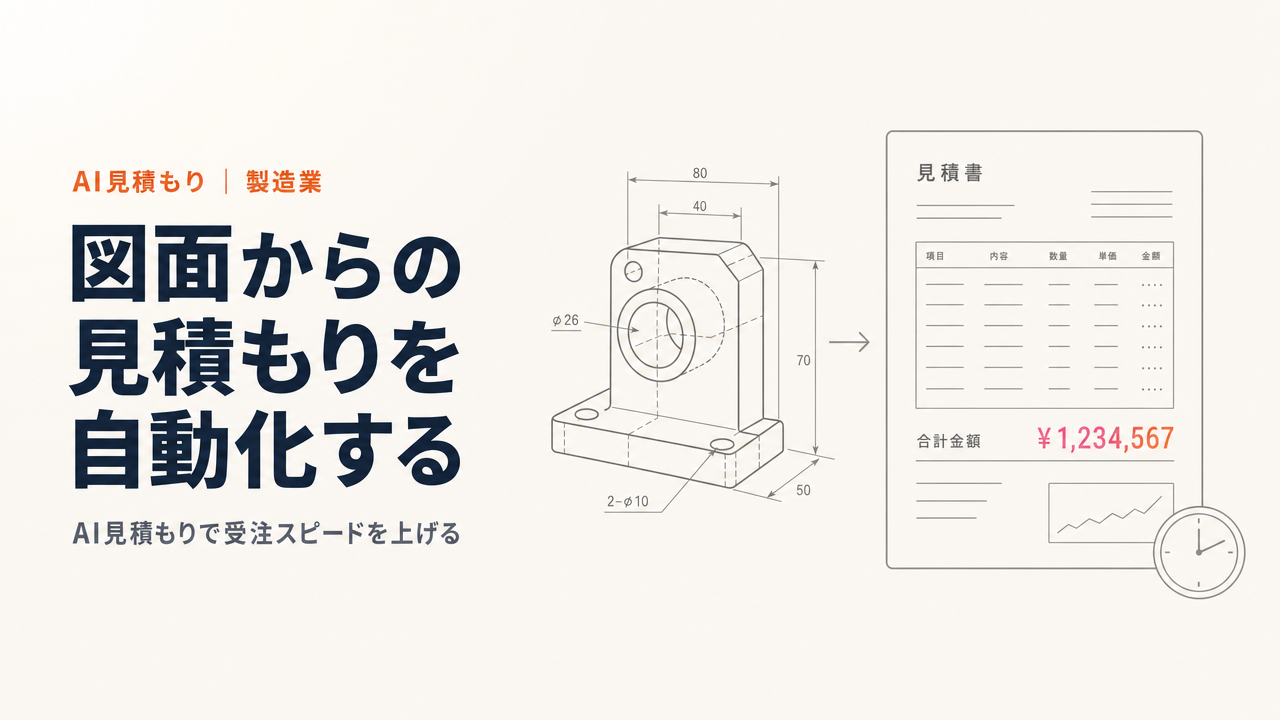
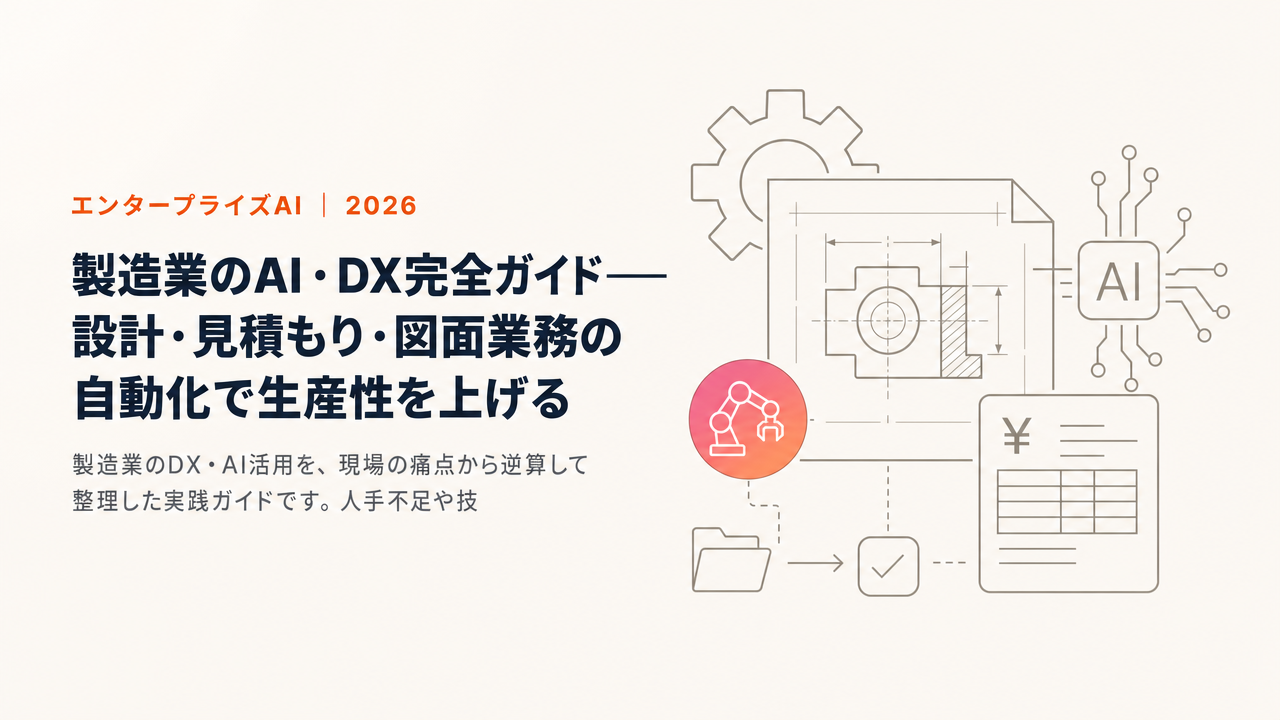
In this article, I want to lay out why cost estimation in manufacturing becomes dependent on specific individuals, what losses this leads to if left unaddressed, and how far AI — especially AI that reads drawings — can automate quotation and cost estimation. I will do this from the hands-on perspective of design, sales, quotation, and management. There is a single goal: to balance the speed of quoting with the accuracy that protects profit. If you want a rough sense of how much easier AI could make your own quotation work, starting with the AI readiness check is a good way in.
Let me put the key points up front.
- Cost estimation in manufacturing centers on job-order costing, which builds up the "three cost elements" (material, labor, and overhead) for each job
- The true nature of machining cost is charge rate (hourly rate) x machining time + setup cost + material cost. When this rests on gut feel, unit prices scatter
- Losing control to individuals invites two losses: unprofitable orders from quoting too low, and profit left on the table from discounting without a basis or from being unable to pass on rising costs
- Drawing AI estimates man-hours from a drawing to create a first-draft cost estimate, and lets you preserve a veteran's sense of pricing as a company asset
- But AI only goes as far as the first draft. A workflow in which people handle the final pricing and approval is the key to balancing speed and profit
What cost estimation in manufacturing actually is
Even in the single phrase "cost estimation," there are two meanings in practice. One is the estimated cost used before an order to judge "is it safe to take this at this price?" The other is the actual cost you close out after the order to determine "how much did it really cost?" Only by reconciling these two do you learn whether the pricing was correct. In many workplaces, this reconciliation never happens before moving on to the next quotation — and that is a breeding ground for the losses I describe later.
Cost can first be broken down into three elements. The money spent on materials is material cost, the portion where people move their hands is labor cost, and electricity bills, equipment depreciation, and outsourcing fees are overhead. These further split into direct costs, which can be tied directly to the product, and indirect costs, which are incurred across the whole plant and are hard to allocate to individual products. How much indirect cost to apportion to which product — so-called allocation — sits at the heart of what makes cost estimation difficult.
There are also several calculation methods. In metal machining and parts manufacturing, where high-mix, low-volume is the norm, job-order costing — building up material, labor, and overhead per job — plays the lead role. For processes that run the same product in large volumes, process costing is a better fit. And by deciding in advance "for this machining, the standard is this much" and watching the gap against actual cost (cost variance), so-called standard costing, you can catch which jobs cost more than expected sooner.
| Method | Suited production style | How cost is captured | Main use cases |
|---|---|---|---|
| Job-order costing | High-mix, low-volume, made-to-order | Built up per job (manufacturing order) | Metal machining, parts manufacturing, contract machining such as dies |
| Process costing | Low-mix, high-volume, continuous production | Total cost over a period divided by output | Line production that runs the same product continuously |
| Standard costing | Used alongside the two above | Analyze the variance between standard and actual cost | Early detection of unprofitable jobs, building cost-improvement metrics |
For a contract machining company, I believe the realistic order is to first run job-order costing properly, then add the concept of standard costing on top.
How "machining cost" builds up
Most people searching for "machining cost" want to know the build-up logic — "so how much should I actually quote?" — rather than a textbook classification. This is the most hands-on part of the article.
Machining expenses roughly build up in the following form. The machining fee is the charge rate (hourly rate) multiplied by machining time, and you add setup cost and material cost to that. As a formula, machining cost is charge rate x machining time, plus setup cost, plus material cost. On top of this ride expenses such as inspection, outsourcing, and transportation.
The tricky part is how to set the charge rate (hourly rate). If you calculate it from the operator's labor cost alone, no profit remains even when the machine runs. You need to fold in indirect costs — equipment depreciation, plant rent and utilities, indirect-department labor — in the form of how much it costs per hour of that equipment running. The weaker this fold-in, or the longer a company goes without updating its price table, the more likely it is to quote at an old rate even as electricity and labor costs rise, quietly eroding profit without realizing it.
To make this concrete, let me place some numbers purely as a model case. Suppose you set the hourly rate for a certain machining center at 4,000 yen, having folded in labor and indirect costs. If a certain part has 1.5 hours of net machining time, 0.5 hours of setup, and 3,000 yen of material cost, then the machining cost is roughly 4,000 yen x 2 hours = 8,000 yen, plus 3,000 yen of material cost, for 11,000 yen. You then add inspection and profit to set the selling price. It looks like a simple calculation, but in reality reading the net machining time and setup time from the drawing is itself hard, and what you load into the hourly rate and how far differs from company to company. That is precisely why the person who can make these reads is called a "veteran," and why the work concentrates on them.
How you view yield also sways profit. In machining that cuts material away from stock, material cost changes depending on how efficiently you use the material. A single choice about sheet nesting or stock diameter moves the cost, so this too is a domain where experience matters.
Struggling with AI adoption?
We have prepared materials covering ZEROCK case studies and implementation methods.
Why it becomes person-dependent, creating unprofitable orders and lost bids
Boiled down, the reason cost estimation becomes person-dependent is that it is "a continuous stream of reads and judgments." You read man-hours from a drawing, decide how to load in indirect costs, and gauge the market rate against similar past jobs. This chain of judgment is hard to turn into a manual and accumulates as tacit knowledge inside a veteran's head. Even at companies that maintain standard cost tables and price tables, if only a limited number of people can update them, accuracy drops the moment that person leaves.
Leaving this person-dependence unaddressed produces losses in two main forms. One is unprofitable orders. When you read man-hours too low, or overlook the effort of setup and inspection, and quote cheap, you win the order but the actual cost exceeds the selling price. And if you never reconcile against results, you never notice that job was in the red — and you repeat the same pricing next time.
The other is profit left on the table. Without a cost basis, you end up judging "how far can we drop the price?" by feel in a competitive bid, and you discount more than necessary. Conversely, you may quote high without being able to explain the basis and lose the bid. More serious still is the case where material and labor costs have risen but you cannot pass them on to price. Negotiating a pass-through requires data showing "costs have risen by this much" — and without that in hand, you cannot even broach the subject of a price increase.
Slow quoting is itself a loss. It takes time to read man-hours from a drawing, and while your reply drags on for two or three days, the job flows to another company. The lower the volume and higher the mix, or the more urgent the job, the harder this read becomes and the more the reply tends to lag. Speed and accuracy are not inherently a trade-off, yet on a person-dependent shop floor you fall into the dilemma of "quote fast and accuracy drops; do it carefully and you fall behind."
Labor shortages and skills transfer: "no time to lose," seen in primary data
Why AI for cost estimation, and why now? In the background lies a structural reality: it is becoming impossible to keep quoting on gut feel. The urgency comes through clearly in the numbers.
According to the 2024 edition of the Monodzukuri (Manufacturing) White Paper compiled by Japan's Ministry of Economy, Trade and Industry, the Ministry of Health, Labour and Welfare, and the Ministry of Education, Culture, Sports, Science and Technology, the number of manufacturing workers stood at roughly 10.55 million in 2023. What stands out is the shift in age composition: young workers aged 34 and under fell sharply from 3.84 million in 2002 to 2.59 million in 2023, while those aged 65 and over rose from 580,000 to 900,0001. Fewer young people and aging veterans is exactly the flow of people who hold cost-estimation and quotation know-how leaving the shop floor. The same white paper cites "a shortage of people to provide instruction" as the single largest human-resource challenge, at 61.8%1. It is not just the learners who are lacking — so are the teachers.
The labor shortage shows up clearly in data too. In a Teikoku Databank survey, 50.6% of companies reported a shortage of full-time employees as of April 2026, exceeding half for the fourth straight year. Bankruptcies attributed directly to labor shortages also hit a record high in the first half of 20262. Being forced to handle quotation and cost work with fewer people is the reality of manufacturing today. As symbolized by the so-called 2024 problem that made headlines in logistics and construction, managing working hours has grown stricter across society, and the time that can be spent on indirect work like quotation and cost estimation is, if anything, shrinking.
Pressure on the cost side is mounting as well. According to the White Paper on Small and Medium Enterprises, the national weighted average of regional minimum wages reached 1,004 yen in fiscal 2023, up 43 yen — 4.5% — from the prior year, exceeding 1,000 yen for the first time3. Amid rising material and electricity costs on top of this, a Small and Medium Enterprise Agency survey on price negotiations reports that passing rising costs on to price still remains partial4. A delay in pass-through is profit left on the table, plain and simple.
Meanwhile, digital adoption in manufacturing is advancing. The Monodzukuri White Paper states that the share of companies using digital technology grew from 49.3% in 2019 to 83.7% in 2023. But the white paper also points out that much of this stops at improving individual processes and has not reached whole-system optimization1. Flip that around and it means "untouched despite being directly tied to management" areas like cost and quotation still remain largely unaddressed. Whether you can get your hands on this is, in my view, what will make the difference from here on.
How AI changes cost estimation
So where does AI change cost estimation? The key is AI that reads drawings — so-called drawing AI. That most time-consuming step, where a veteran looks at a drawing and reads the man-hours, is what AI drafts.
Drawing AI extracts shape, dimensions, material, and machining content from a drawing PDF or a scan of a paper drawing. From there it estimates the required machining processes and man-hours (machining time and setup time), and generates a first-draft quotation or cost estimate — building up material, labor, and overhead costs — in minutes. Sales and quotation staff can start their work from reviewing and adjusting the draft that comes out, rather than building up the cost from zero. This alone opens room for that two-or-three-day reply to shrink to same-day.
What works even better is that you can train the AI on your past quotation records, your own price tables, and material prices. Once it starts producing drafts that reflect your own equipment, processes, and sense of unit prices — rather than a generic market rate — the intuition for cost build-up that was locked inside individuals takes shape as reproducible logic. This is not mere efficiency gain. It is skills transfer itself: turning what is in a veteran's head into a company asset. ZEROCK's strengths in knowledge control and GraphRAG (a mechanism that connects knowledge in a graph structure for search) come alive here.
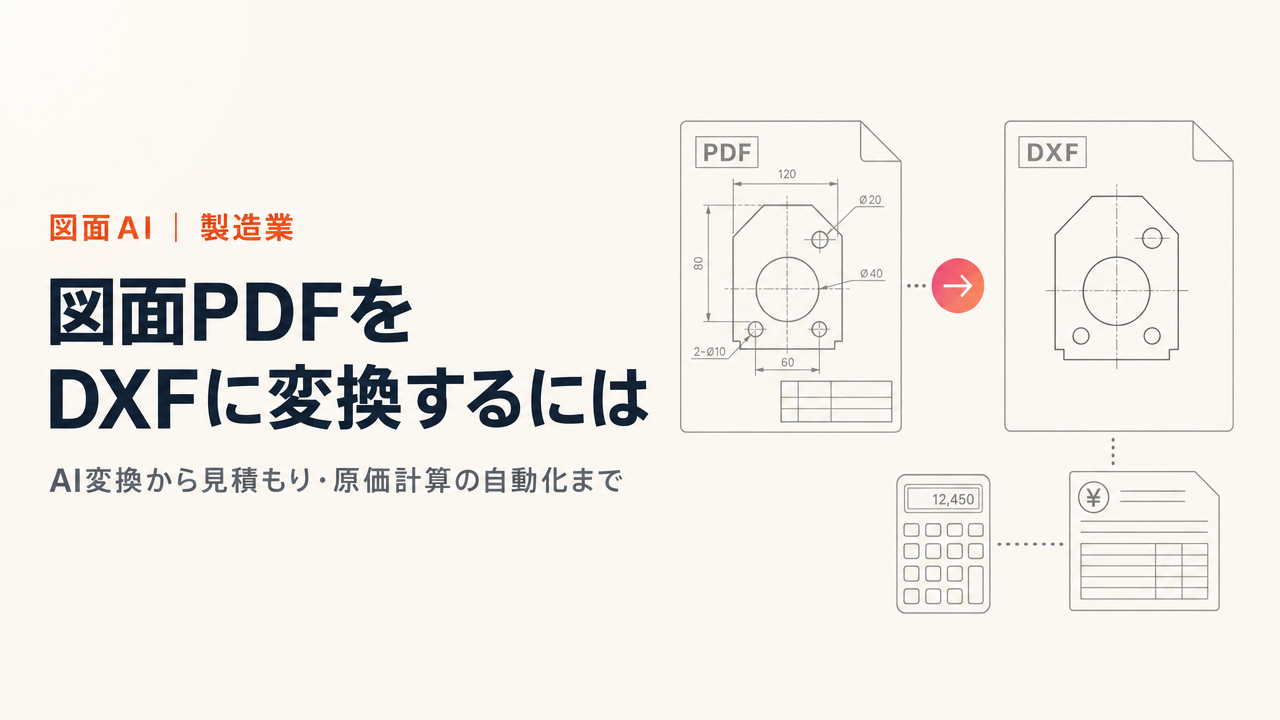
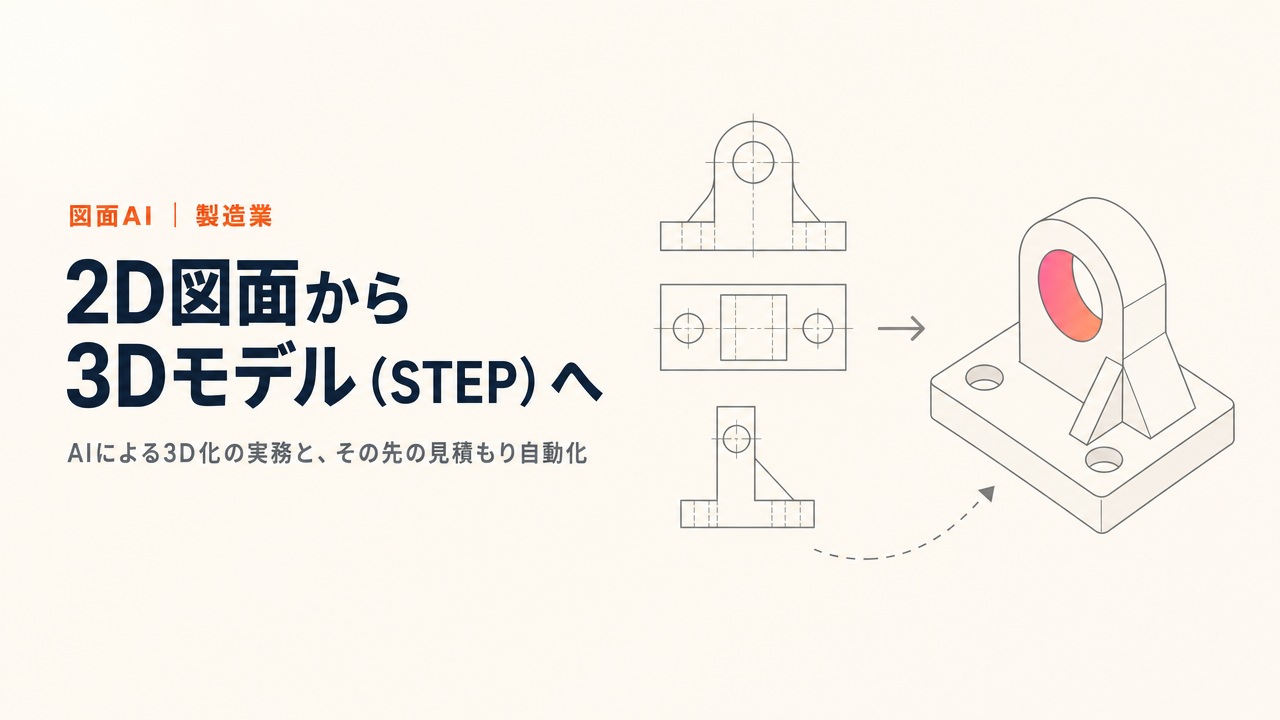
AI enters material cost estimation too. If you can generate a 3D model (STEP format) from a 2D drawing with AI, you can calculate volume and weight, and from there objectively compute material cost and yield. Material cost that once relied on visual inspection and hand calculation becomes a number grounded in shape data. The flow from digitizing drawings to quotation and cost is also laid out in detail in How to Convert Drawing PDFs to DXF and Automate Quotation and Cost Estimation with AI, so reading it alongside this will give you the full picture.
And though it is often overlooked, there is great value in being able to turn the gap between estimated cost at quotation and actual cost into data. Once you can see which machining and which customers yield thin profits, you can detect unprofitable orders in advance and use it as a basis for price revisions and pass-through negotiations. In other words, you can move pricing decisions from gut feel toward data. On top of that, if you can search past similar drawings and quotations, you eliminate the waste of building up costs from zero for every similar job. Drawings that were buried in file servers and cabinets become searchable assets.
How to start small
You do not need to roll this out company-wide from the start. First, organize your past quotation data, charge rate (hourly rate) and price tables, and material prices. This becomes the foundation for AI learning and cost build-up. Next, narrow the target product group, have the AI create drafts, and have people adjust and approve them. Then reconcile quotations against actual costs and feed the causes of any gaps back into the AI's cost build-up logic. As you run this small cycle, the accuracy of the drafts approaches your own sense of pricing. As a first step, even just taking inventory of your price tables and organizing recent quotation data is meaningful enough.
Drawing the line so you do not hand everything to AI
This is where I want to be emphatic. AI is merely a tool for creating drafts; people handle the final man-hour adjustment, pricing, and approval. Not breaking this line protects both accuracy and trust. Always verify the dimensions of a generated 3D model or converted drawing in CAD. Maintain your price tables regularly and reflect risen costs. And because you are handling confidential information — drawings — always confirm where the data is stored and that it will not be used to retrain the AI. It is precisely with this workflow in place that speed (not missing business opportunities) and accuracy (preventing unprofitable orders) coexist. A design that leaves everything to AI, on the contrary, undermines trust. The full picture of AI utilization for manufacturing is also introduced on the ZEROCK service page.
About ZEROCK's drawing AI
At the risk of sounding self-serving, ZEROCK — the AI agent for manufacturing that we provide — brings the flow described in this article together on a single platform. DXF conversion of scanned drawing PDFs, 3D model (STEP) generation from 2D drawings, creating first-draft quotations and cost estimates by reading drawings, searching past drawings, and skills transfer that preserves veterans' know-how in-house — all of it is handled just by uploading a drawing.
In the context of cost estimation, what I especially want to convey is that you can train it on your own price tables and past quotation records to produce drafts aligned with your own sense of pricing. Because the numbers that come out reflect your equipment and unit-price sense rather than a generic market view, your staff can return well-grounded quotations quickly just by reviewing and adjusting them. Because drawings are your technical information itself, data is stored encrypted on domestic AWS servers in Japan, and your customers' drawings are never used to retrain the AI.
Since accuracy varies with the condition of the drawing and how well your own data is organized, we offer a trial with your actual drawings and past quotations before adoption. We believe judging based on your own real work — rather than catalog figures — is the most convincing way.
Summary
- Cost estimation in manufacturing centers on job-order costing, which builds up the three cost elements per job. Layering in standard costing lets you catch unprofitable jobs sooner
- Machining cost is charge rate (hourly rate) x machining time + setup cost + material cost. Correctly loading indirect costs, equipment depreciation, and utilities into the hourly rate is the premise for protecting profit
- Person-dependence invites two losses: unprofitable orders and profit left on the table. A structure that never reconciles quotations against actual costs is what keeps these invisible
- Primary data — falling young workers and aging, labor shortages, rising costs and delayed pass-through — makes it hard to keep quoting on gut feel
- Drawing AI supports everything from man-hour estimation to cost build-up, material cost calculation, and visualizing the gap between quotation and results, turning a veteran's sense of pricing into a company asset
- But AI only goes as far as the draft. A workflow where people handle the final adjustment, pricing, and approval is what balances speed and profit
Person-dependence in cost estimation only gets harder to untangle the longer it is left. Now, while your veterans are still on staff, is the chance to move what is in their heads into a system. Start with the small step of taking inventory of your price tables and organizing recent quotation data. If you would like to discuss specifically how to incorporate drawing AI into your quotation work, please feel free to reach out via a one-on-one consultation about ZEROCK. We also offer a demo using your own drawings.
References
Related Articles
- How to Convert Drawing PDFs to DXF: Automating Quotation and Cost Estimation with AI
- ZEROCK: AI Utilization for Manufacturing
Footnotes
-
Ministry of Economy, Trade and Industry, Ministry of Health, Labour and Welfare, Ministry of Education, Culture, Sports, Science and Technology, "2024 White Paper on Monodzukuri (Manufacturing Industries)" (Annual Report under Article 8 of the Basic Act on the Promotion of Core Manufacturing Technology) ↩ ↩2 ↩3
-
Teikoku Databank, "Survey on Corporate Trends Regarding Labor Shortages" ↩
-
Small and Medium Enterprise Agency, "White Paper on Small and Medium Enterprises," and Ministry of Health, Labour and Welfare, "National List of Regional Minimum Wages" ↩
-
Small and Medium Enterprise Agency, "Follow-up Survey for the Price Negotiation Promotion Month" ↩