Hello, this is Ryuta Hamamoto from TIMEWELL.
When I talk with manufacturing clients, there is one misconception I hear more than any other: "DX is not moving forward because we do not have the right tools." I believe the opposite is true. There are more than enough tools out there. The real reason things stall is that so much of design, quotation, and quality judgment lives inside the head of a specific veteran — in other words, the work is locked to individuals. Buy the latest system without touching that, and it will sit on the shelf because no one ever appears who can actually run it.
This article is a map that organizes AI and DX in manufacturing not as "buzzword explanation" but in the order of "how do we solve the pain on the shop floor." After confirming the labor shortage and skill-succession crisis with primary data, we break the pain down into four areas — design, quotation and cost, shop floor and quality, and company-wide knowledge — and take an aerial view of how AI can solve each. Let me give you the conclusion up front: the right answer is not "change the whole company at once" but "start with the single most painful task." The detailed how-to for each area is linked from this article. Let's begin with the big picture.
If you only want to know where your own company could start using AI, the AI Readiness Check helps you take stock of where you stand in about ten minutes. You can do it before or after reading on — either is fine.
Why Manufacturing AI and DX, and Why Now — the Crisis in Primary Data
The feeling that "we're still fine" wobbles when you look at the numbers. According to Japan's Ministry of Economy, Trade and Industry (METI) 2024 White Paper on Manufacturing Industries, the number of people employed in manufacturing has fallen by roughly 1.57 million over the past 20 years1. This is not mere economic fluctuation but a structural decline driven by the combination of a falling birthrate, an aging population, and hiring difficulty. On the shop floor, the inability to fill the holes left by those who leave with newly hired people has become the norm.
Two "problems" pile on top of that. One is the "2025 problem." As the baby-boomer generation reaches advanced old age, the mass retirement of skilled technicians has become reality. The ability to tell good from bad by sound, vibration, and feel, and to instantly judge where and how to fix a defect when one appears — this kind of tacit knowledge disappears from the company along with retirement, never having been written into a manual. The White Paper on Manufacturing continues to point to skill succession and human-resource development as ongoing challenges for the industry1.
The other is the "2024 problem." With the full application of the overtime cap under the work-style reform legislation, truck drivers in particular were given an annual limit of 960 hours2. This looks like a logistics story, but it connects directly to manufacturing production planning. Procuring parts and shipping products now takes more time than before, so the very way you assemble a delivery schedule has to be reconsidered. Fewer people, and less time to move them. Both are pressing at once on today's shop floor.
So why DX? METI's DX Report warned that if aging systems are left unmodernized, an economic loss of up to roughly 12 trillion yen per year could arise from 2025 onward. This is the so-called "2025 digital cliff"3. At the same time, the DX White Paper from the Information-technology Promotion Agency (IPA) shows that while Japanese companies' engagement with DX itself is spreading, the share of companies that can say they are seeing results — and their ability to secure DX talent — continues to lag behind the United States4. Tools have increased, but results have not. That gap is precisely the basis for my opening claim that the reason things stall is not a shortage of tools.
The true nature of the crisis is a "people" problem: labor shortage and the loss of skills. That is exactly why AI's role should be positioned not as "have it do the judgments only people can make, in place of people," but as "help people judge, and leave past know-how within the organization." That is the logically consistent direction.
What Manufacturing AI and DX Actually Mean — Translating the Terms into Shop-Floor Language
Let's start by sorting out the terms. I often see meetings where DX, AI, generative AI, and GraphRAG all fly around at once and the conversation stops connecting. The table below maps what each of them refers to on the shop floor.
| Term | In plain words | Concrete example in manufacturing |
|---|---|---|
| DX | Rebuilding the way work is done on the assumption of digital | Turning paper-drawing search and manual quotation into a flow that runs on data |
| AI | Technology that learns patterns from past data to assist judgment | Reading machining content from a drawing and producing a first-draft quote |
| Generative AI | AI that newly creates text, images, design proposals, and the like | Drafting test cases from a spec, summarizing meeting minutes |
| GraphRAG | AI search that follows the connections between pieces of knowledge to find answers | Pulling up "past drawings with a similar design philosophy" or "how we handled that defect," along with related context |
DX is often mistaken for "turning paper into PDF," but that is just digitization. Piling scanned drawings into a folder is meaningless if you cannot find them. It only becomes DX when you redesign the flow of the work itself into a form that is "searchable, reusable, and preserves judgment." Get this wrong and you end up spending a lot of money only to turn a mountain of paper into a mountain of PDFs.
GraphRAG is an especially good fit for manufacturing. The reason is that the value of a drawing lies not in the "single file" but in its "connections to other information." A given drawing has past drawings of similar shape, a history of defects that occurred with that part, and linked information on material and unit price. Rather than checking whether keywords match, GraphRAG's strength is presenting candidates by following those relationships wholesale — and it is the foundation for the similar-drawing search and skill transfer described below.
Struggling with AI adoption?
We have prepared materials covering ZEROCK case studies and implementation methods.
Organizing the Pain Points into Four Areas — Design, Quotation and Cost, Shop Floor and Quality, Company-wide Knowledge
Stepping away from abstract DX theory, let me line up the shop-floor pain concretely. The voices we hear from clients are astonishingly consistent. They break down into four broad areas.
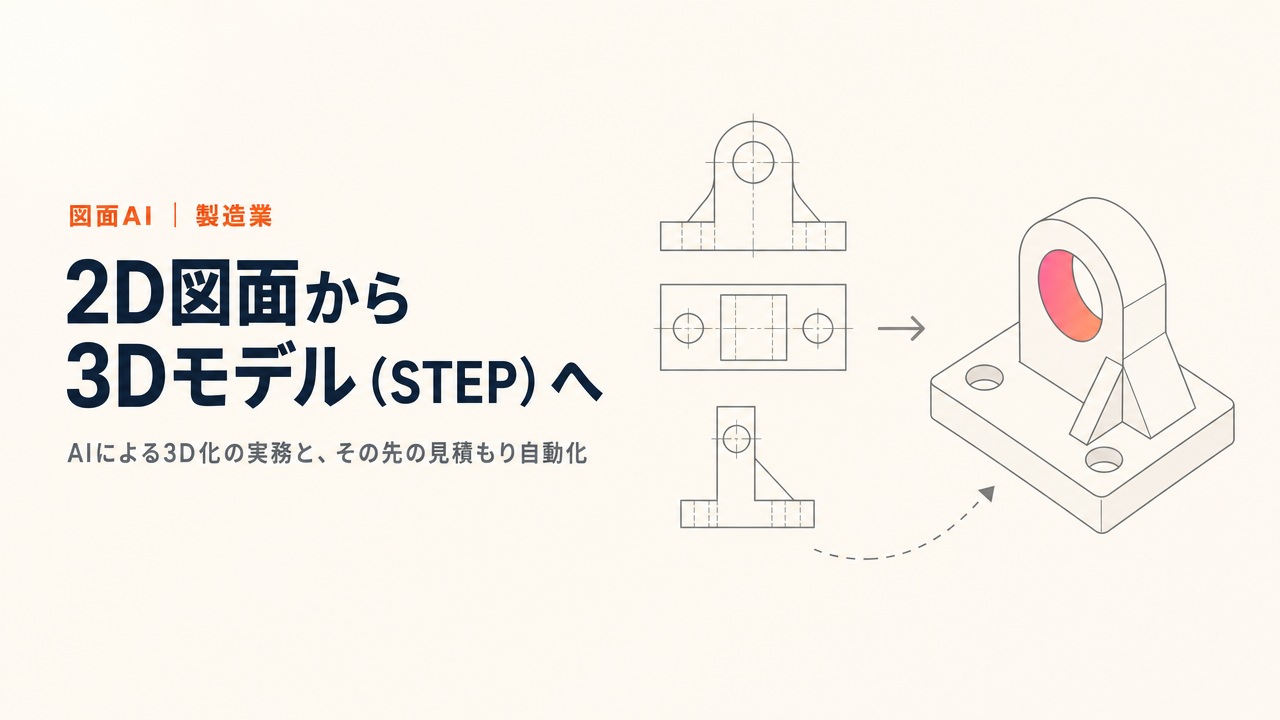
The first is design. Finding a past or similar drawing takes more than 30 minutes every time; you cannot even tell whether a similar drawing exists in the first place; and you end up redrawing from scratch. This "reinventing the wheel" has become a daily routine. On top of that, old drawings remain only as paper or scanned PDFs, so using them in CAD requires redrawing. At companies that operate in 2D, every time a customer asks for 3D data (STEP), a full day vanishes into modeling. We cover how to solve this area in How to Convert Drawing PDFs into CAD Data, How to Convert 2D Drawings into 3D Models (STEP), How to Search for Similar Drawings with AI, and How to Think About Making Design Work More Efficient with AI.
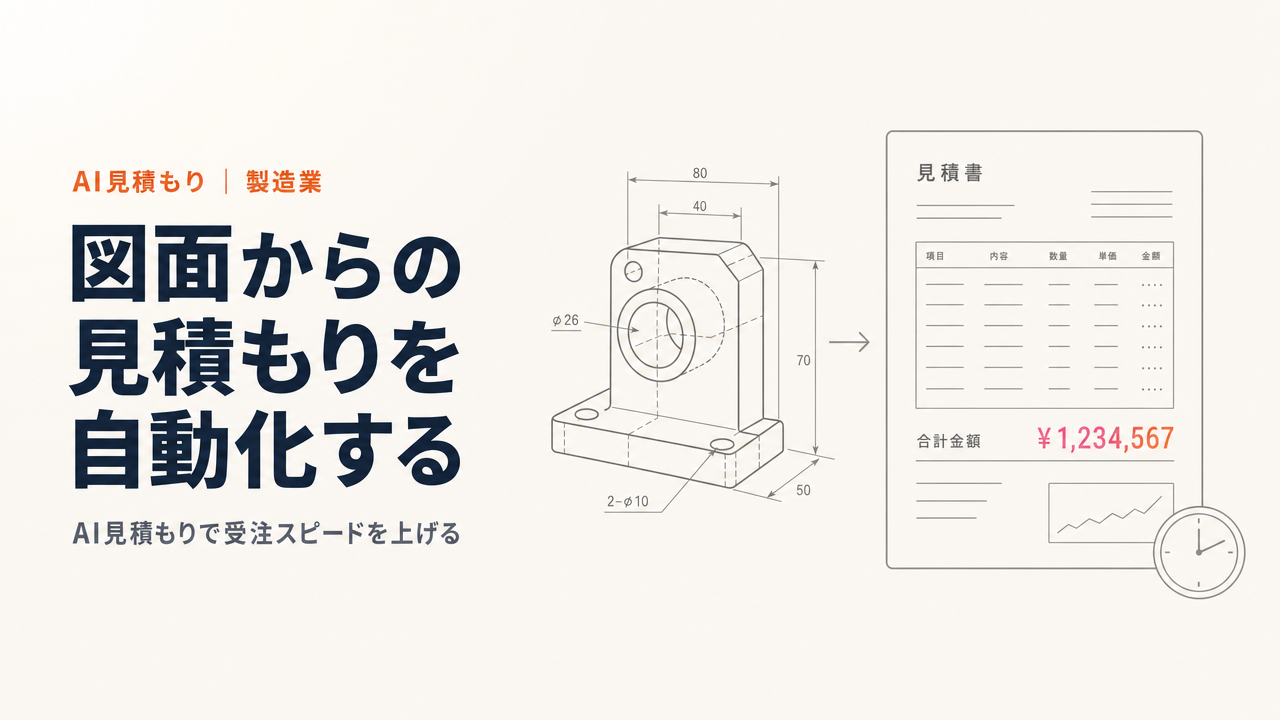
The second is quotation and cost. Only veterans can look at a drawing and read the labor hours and market rate; younger staff have no choice but to go around asking design and manufacturing. A single quote response takes two to three days, and during that time the deal flows to a competitor and is lost. This is the classic losing pattern. Furthermore, the build-up of unit prices and labor hours depends on the veteran's intuition, cost calculation is a black box, and you cannot judge with grounded numbers whether "this price will actually turn a profit." We handle the details in Automating Quotation from Drawings, Cost Calculation Using AI, and How to Speed Up Quotation Responses.
The third is the shop floor and quality. When you want to investigate the cause of a quality defect, you have no means to search across past defect records, corrective actions, and 4M-change history, so the same failures repeat and root-cause identification takes days. Because the linkage between drawings, specs, BOM (bill of materials), and inspection standards is done by hand, related documents get missed during design changes. The skill-succession issue is entangled here too. How to preserve veterans' judgment criteria is detailed in How to Support Manufacturing Skill Succession with AI, and managing drawings and related documents in Drawing Management and PLM/PDM x AI.
The fourth is company-wide knowledge. Chronic labor shortage means there simply are not enough people; you sense the need for DX but get stuck on "where do we start" and "our data is not organized." Not a few companies introduced AI or DX tools in the past, failed, and now carry a resigned mood on the floor that "AI is useless." This fourth area is, in fact, the foundational problem running through the other three.
The Map of AI Use by Area
The table below gives a single-page aerial view of the four areas' pain points from the angle of "what AI can do." We recommend grasping the big picture first, then moving to the detailed article from whichever row hurts your company most.
| Area | Main pain points | What AI can do | Read more |
|---|---|---|---|
| Design and drawings | Paper/PDF drawings, redrawing, 3D-supply requests | CAD-data conversion of scanned drawings, 2D-to-3D model generation | CAD-data conversion / 2D-to-3D conversion |
| Design and search | Cannot find similar drawings, reinventing the wheel | Suggesting past drawings with similar design philosophy, design efficiency | Similar-drawing search / Design efficiency |
| Quotation and cost | Individual dependence, days to respond, opaque cost | First-draft quotes from drawings, automatic rough-cost generation | Quotation automation / Cost-calculation AI / Quotation speed |
| Shop floor, quality, knowledge | Recurring defects, skill loss, missed document updates | Quality traceability, skill transfer, design-change impact analysis | Skill-transfer AI / Drawing management x AI |
One thing worth sorting out here is how this relates to "predictive maintenance" and "AI visual inspection," which are often discussed as manufacturing AI. Predictive maintenance is an effort to detect equipment failure in advance, and visual inspection uses image recognition to find scratches and defects; both have value. However, these are mainly about "the shop floor of equipment and lines that are running." What this article centers on is the office-side work that comes before that — design, quotation, and drawings, so to speak the upstream individual dependence where the product is born. Lumping the two together under the same phrase "manufacturing DX" scatters the discussion, so I recommend deliberately thinking of them separately. Personally, I believe the drawing and quotation area, which you can start tomorrow, is better suited as a first step for many small and mid-sized manufacturers than predictive maintenance, which involves capital-investment decisions.
A Playbook That Does Not Fail — Five Small-Start Steps and a Selection Checklist
Companies that stalled on DX in the past almost all stumbled in the same way: they thought "let's organize the data first," and that organizing itself never finished. The day when data is perfectly complete never comes. So we change the order. The five steps I recommend to clients are these.
The first is understanding the current state. Take a rough inventory of which tasks consume how much time — a ballpark is fine. The second is choosing just one task where the pain is most concentrated. Do not try to do everything at once. At most companies, that one task turns out to be either drawing search or quotation. The third is running a PoC (pilot) on that task. What matters here is testing with your own real drawings — faded ones and handwritten corrections included — not the clean drawings printed in catalogs. The fourth is designing the operation: decide from the start on the line that "AI builds the draft and a person makes the final call." Not letting it advance processing automatically without approval is the condition for earning the floor's trust. The fifth is horizontal rollout: once results are visible in one task, expand to the neighboring one.
Show results small, and show them first. Just keeping this order dramatically changes the success rate of DX. The resignation that "AI is useless" usually comes from the experience of introducing it big and missing big.
Here is a checklist for choosing tools, narrowed to five points.
- Can you test with your own drawings? Being able to trial it on quirky, real drawings — not catalog-grade ones — is the top priority.
- Is it end-to-end, from CAD-data conversion of drawings, to 3D, to quotation? When tools are split apart, handing off drawings and double-managing data both crop up.
- How is training data handled, and where is it stored? Does the contract guarantee your uploaded drawings will not be used to retrain the AI, and is the data stored domestically? Drawings are technical information itself.
- Can it accumulate knowledge? Is there a mechanism to teach it your unit-price tables, past records, and in-house notation to raise accuracy?
- Does it cover work beyond drawings? If meeting minutes and internal-document search can run on the same foundation, the return on investment changes.
Let me add a note on subsidies. For introducing equipment and software, programs such as manufacturing subsidies, IT-introduction subsidies, and DX-investment tax incentives can sometimes be used. For small and mid-sized enterprises these are a realistic option for lowering the initial-investment hurdle, so please confirm the requirements and application windows with the latest official information.
ZEROCK for Makers as an Option
We have drawn a "map" up to here, but how do you actually solve these four areas on a single foundation? At the risk of tooting our own horn, ZEROCK, the manufacturing AI agent we provide, is built to aim for exactly this end-to-end coverage.
ZEROCK's features for manufacturing can be organized into six broad capabilities. The first is AI similar-drawing search. Upload drawings, scan data, and specs, and GraphRAG analyzes the relationships among design intent, material, and dimensions, then presents past drawings with a similar design philosophy — not by keyword match — as candidates. The second is a skill-transfer knowledge base that structures veterans' judgment criteria and past troubleshooting and returns candidate answers to "how did we handle that defect before." The third is an embedded-software inspection agent, and the fourth is quality-defect traceability, which searches across defect records, corrective actions, and 4M-change history to help identify causes. The fifth is design-change impact analysis, which follows the dependencies among drawings, BOM, and inspection standards to surface the scope of impact and prevent missed updates. The sixth is a quotation-and-cost AI assistant that builds first drafts of quotes and rough costs from drawings and past records.
To give you a sense in numbers: drawing search that used to take 30 minutes becomes a candidate suggestion in about 30 seconds; cause identification goes from days to hours; and quotation accuracy stabilizes as you train it on your own data. These are the guideline figures shown on our manufacturing page. They are based on model cases and the felt experience of adopting companies, and the effect varies with the state of your drawings and how well your data is organized. That is exactly why we take the approach of having you try it on your own real drawings before adoption.
Let me also touch on the trust design. ZEROCK sticks to suggesting candidates; the final decision is made by a person. It never advances processing automatically without approval. Data is stored encrypted on domestic AWS servers, your drawings are never used to retrain the AI, and once no longer needed they are completely deleted within seven days with a certificate issued. When you entrust something as sensitive as drawings — technical information itself — this is a design point we cannot compromise on. We also offer a seven-day free trial and a demo using your own real drawings, so for feature details please see the ZEROCK service page.
Frequently Asked Questions
Where should we start with manufacturing AI and DX? Rather than aiming for company-wide reform all at once, the surest order is to start with the single task where the pain is most concentrated. In most cases, drawing search or quotation is that entry point. Run a PoC on your own real drawings rather than catalog-grade ones, and operate on the principle that AI builds the draft and a person makes the final call — that way you earn buy-in and visible results first.
Can small and mid-sized manufacturers use it even if our data is not organized? Yes. Even without perfect data, you can start with areas where results are easy to see, such as searching paper or scanned PDF drawings and generating first-draft quotes. In fact, to avoid stalling at the "data-preparation wall," it is important to choose a system that can ingest your existing drawings and past records as-is.
If we hand our drawings to an AI, won't our technical information leak? Drawings are technical information itself, so always confirm three points: domestic-server encryption, no use for retraining, and complete deletion with proof. In my view, a service that is vague on this is hard to choose for manufacturing even if its features are good.
Can quotation that depends on a veteran's intuition, or tacit skills, be transferred? By training the system on your own unit-price tables and past records — not generic market rates — you get draft quotes close to your own pricing sense. On the skills side too, structuring judgment criteria and defect-response history creates a foundation that lets younger staff reach past know-how on their own. It does not fully replace the sound and feel themselves; the realistic view is to treat it as a foundation that accelerates learning.
Summary
Finally, let me organize the key points.
- The main reason DX stalls in manufacturing is not a shortage of tools but the individual dependence of design, quotation, and quality judgment
- Employment has fallen by roughly 1.57 million over the past 20 years, with skill loss (the 2025 problem) and delivery-schedule ripple effects (the 2024 problem) pressing at the same time
- The pain points organize into four areas — design, quotation and cost, shop floor and quality, and company-wide knowledge — and AI can solve each
- Predictive maintenance and AI visual inspection are about on-site equipment; what you should tackle first is the upstream individual dependence of drawings and quotation
- A small start is the iron rule for the how-to. Run a PoC on one task, operate with "AI drafts, a person decides," and roll it out horizontally
Manufacturing AI and DX are not a story of distant, future company-wide reform. Let's make the one task that is melting away the most of your time right now just a little easier, starting this month. Stacking those up is what builds a shop floor that keeps running even as people decrease. Start by trying it with a single drawing in front of you, or a single quote. If you would like to discuss concretely whether it fits your company, we can talk through your actual work in a one-on-one ZEROCK consultation.
References
Related Articles
- How to Convert a Drawing PDF into DXF (From AI Conversion to Quotation Automation)
- ZEROCK for Makers | AI for Manufacturing
Footnotes
-
METI, "2024 White Paper on Manufacturing Industries (Annual Report Based on the Basic Act on the Promotion of Core Manufacturing Technology)" ↩ ↩2
-
Ministry of Health, Labour and Welfare, "Work-Style Reform Legislation (Overtime Upper Limit Regulation)" ↩
-
METI, "DX Report: Overcoming the '2025 Digital Cliff' of IT Systems and the Full-Scale Deployment of DX" ↩
-
Information-technology Promotion Agency (IPA), "DX White Paper" ↩