Hello, this is Ryuta Hamamoto from TIMEWELL.
"We're not losing on technical capability. So why do orders somehow keep going to competitors?" I hear this a lot when talking with manufacturing executives and sales leaders. When we trace the cause together, it usually ends up in the same place: the quotation reply is slow. And there are only one or two people in the company who can produce a quote. When those people are busy, inquiries sit in a queue on someone's desk.
Slow quotations are a quiet cause of lost bids — you drop orders for reasons unrelated to your technical strength. No matter how good the deal a salesperson brings back, nothing moves forward if the quotation is jammed inside the company. In this article, I'll lay out — from the perspective of design, estimation, and management on the ground — why quotations end up concentrated in specific people, what happens to a company that leaves this dependency unaddressed, and the path to resolving it step by step, from standardization to digitalization to the use of drawing AI. If you'd first like to gauge where your own quotation work stands, checking your current position with the AI Readiness Check before reading on should help the pieces connect.
Let me summarize the key points of this article up front.
- Slow quotation replies lead directly to lost bids. Now that competitive bidding and shorter lead times have taken hold, the company that puts a reasonable figure on the table first seizes control of the discussion.
- The root of the slowness is dependency on individuals. The estimation know-how lives in a veteran's head, and drawing interpretation and the basis for costs rely on that individual.
- Left unaddressed, it works on you slowly — as chronic lost bids, unprofitable orders from price inconsistency, and the loss of quotation capability when a veteran retires.
- The order of the solution is "standardize, digitalize, then use AI." The realistic starting point is to write down your estimation criteria, which costs nothing.
- Drawing AI supports everything from drawing conversion to man-hour and material cost estimation, similar-drawing search, and passing down expertise — turning quotations into a sales weapon.
Why "companies that are slow to quote" start losing
Before an order is decided, a quiet selection is already underway in the customer's mind. High-mix, low-volume production has become the norm, and buyers throw the same drawing to several companies at once. The company that comes back first with a reasonable figure and lead time is more likely to be placed at the center of subsequent meetings. Conversely, if your reply is several days late, competitors advance concrete conversations in the meantime and you get pushed into the position of "a company we included in the bid just in case." You didn't lose on price — you lost by being late to the table. That's the reality of inquiry competition.
Behind the customer's urgency is a lack of time slack across the entire supply chain. The so-called "2024 problem" — the cap on overtime hours for logistics — spilled over into manufacturing as transport delays for materials and products and as higher logistics costs.1 With less buffer left in lead times, purchasing staff are under constant pressure to "lock in the figure quickly and move to the next process." That is exactly why the structure now rewards companies with fast initial responses.
What often gets overlooked here is that the cost of a lost bid is hard to see. A deal lost on discounting leaves a number — "how much short we were" — but a deal where a slow reply kept you off the field never even makes it into the records. Orders you could have won quietly flow to competitors. The reason I call manufacturing quotation work a "quiet cause of lost bids" is that this invisibility is what makes it so troublesome. Response speed is determined less by a salesperson's enthusiasm or pitch and largely by the estimation setup inside the company.
The structure where "only one person can quote": the three faces of dependency
So why do quotations concentrate on specific people? Rather than dismissing it as "dependency" in one word, breaking the true nature into three parts reveals where to aim your countermeasures.
The estimation know-how lives in a veteran's head
The first is that the estimation criteria themselves are never put into words. Judgments like "for this shape, roughly this many processes; this much for setup; for this material, about this yield" accumulate as the veteran's experience. A unit-price table may exist, but the knack for applying it lives in that person's head. So without them, estimation can't even begin. It's genuinely common to see a state where the unit prices are laid out in Excel, yet only one person can actually use that Excel correctly.
There are individual differences in the skill to read drawings
The second is the gap in drawing-reading ability. What arrives from customers is a PDF, paper, or sometimes a faxed scan, and reading machining features, tolerances, materials, and required post-processing out of it takes skill. Hand the same drawing to a junior and you get missed items or slow judgment. Since estimation goes wrong if the reading isn't accurate, the veteran ends up having to look at everything from the start after all. This is a bottleneck in inquiry handling at more than a few companies.
The basis for cost becomes a black box
The third is that the basis for the figure that comes out can't be explained. A veteran's quotes are highly accurate, but there are times when they can't break down and show why the figure is what it is. Then, in a discount negotiation, the judgment of "how far we can go down" rests on that individual, and internal checks can't verify whether the amount is reasonable. The lack of reproducibility — the figure changes when the person changes, and quotations vary for similar parts — is born from this black-boxing of the basis.
These three are intertwined. The criteria live in someone's head, drawing interpretation is personal, and the basis is invisible. That's why quotations concentrate on one person, and that one person becomes the bottleneck. Turn it around, and if you externalize these three points one at a time, the dependency comes undone.
Struggling with AI adoption?
We have prepared materials covering ZEROCK case studies and implementation methods.
The headwinds facing manufacturing, seen in the data
Dependency on individuals has always been a challenge, but the reason it can no longer be ignored is that the layer of people who used to sustain it is thinning out. First there is the labor shortage. The number of people employed in manufacturing has shrunk over the long term, from a peak of roughly 16 million to a little over 10 million in recent years. The Ministry of Internal Affairs and Communications' Labor Force Survey, and the "Monodzukuri (Manufacturing) White Paper" compiled by the Ministry of Economy, Trade and Industry (METI) and others, repeatedly treat the decline and aging of the workforce, and the difficulty of passing on skills, as major themes.2 The veterans who handle quotations are part of this shrinking population.
A shortage of digital talent compounds this. A study commissioned by METI estimated that IT talent would fall short by as many as roughly 790,000 people in 2030.3 The people who can advance digitalization on the shop floor overlap with this population, and those who also understand the practical work of drawings and estimation are rarer still. Even if you try to solve it by hiring, that person is hard to find. Isn't that the felt reality for many small and mid-sized manufacturers? Small and mid-sized enterprises account for about 99.7% of companies in Japan, and the majority of manufacturers are among them.4 The fewer people running the floor, the harder it is to escape the structure where work concentrates on one person.
On top of that, lagging systems and data use deliver another blow. METI's "DX Report" estimated that if the overhaul of legacy systems and individual-dependent work fails to progress, economic losses of up to 12 trillion yen per year could arise from 2025 onward — the so-called "2025 digital cliff."5 The Information-technology Promotion Agency (IPA)'s "DX White Paper" also points out that Japanese companies lag other countries in digitalization and data use, with especially large room for improvement in on-the-ground operations.6 Quotation work that depends on paper and a veteran's memory is, I believe, an area standing right at the edge of that cliff. People are declining, there's no time to train replacements, and systematization is behind. There's almost no grace period left to keep putting off dependency with "we'll deal with it eventually."
What happens to a company that leaves the dependency unaddressed
Amid these headwinds, if you leave quotation dependency unaddressed, the symptoms grow heavier little by little but surely. The first to appear is chronic lost bids. More deals slip away because a slow reply kept you off the field, and the win rate gradually drops. Yet, as noted in the earlier section, these lost bids are hard to record, so people miss that the cause lies in the quotation setup and write it off as "competitors have gotten stronger lately."
Next to bite is price inconsistency and unprofitable orders. When the assumptions behind a quote differ by estimator, the figure swings even for similar parts. Furthermore, when cost calculation relies on copying past results or on feel, rising material and energy costs don't get reflected, and you end up taking an order only to find almost no profit left. Because the basis for the estimate is invisible, the seeds of a loss are also hard to spot.
And the most serious is the loss of quotation capability itself when a veteran retires. If the estimator retires before skill transfer has progressed, the company loses the "ability to put a price on a drawing." The drawing — the paper — remains, but the power to read it and turn it into a price does not. This is a risk on a different plane from a single lost sales opportunity; it concerns business continuity. And in daily operations, even when sales brings back a deal, it jams in the internal estimation process, so sales activity itself is chained to the estimation bottleneck. Quotation dependency is not just a bit of back-office inefficiency; it quietly erodes both sales and management.
The order of the solution is "standardize, digitalize, then use AI"
Reading this far, it's tempting to jump to "let's bring in the latest AI," but getting the order wrong leads to failure. The essence of the dependency problem is that the criteria live in one person's head, so even if you suddenly bring in a tool, without criteria to load onto that tool you're still relying on the veteran. What I recommend is proceeding in three stages: standardize, digitalize, then use AI.
The first stage, standardization, can be started today at no cost. Interview your veterans and write out the assumptions behind estimation — machining unit prices, man-hour base units, the way you handle setup and overhead, the yield guidelines by material. You don't need to aim for perfection. Even just putting the estimation criteria for your "frequently quoted parts" into words reduces price inconsistency and creates a foundation for juniors to build on. This writing-down is, I believe, the single most important step in removing dependency.
The next stage, digitalization, turns the criteria you wrote out into unit-price masters and estimation templates within a system. Excel is fine, but if you arrange things here so that drawings and past quotations can be searched, the next stage of AI use becomes much easier. And in the final stage of AI use, you automate reading drawings and drafting the first-pass estimate. If the criteria and data are in order through standardization and digitalization, the AI can produce consistent quotations fast, in line with those criteria. I've also laid out the full picture of this sequence in a systematic guide to DX and AI use in manufacturing, so please read it alongside this one.
How drawing AI resolves quotation dependency (ZEROCK)
ZEROCK, provided by TIMEWELL, is an AI agent for the design and sales floors of manufacturing. It is designed on the premise of handling drawings as confidential information, and it can be used to unravel quotation dependency on top of the criteria you've put in order through standardization and digitalization. Here, I'll walk through what it can do concretely, mapping each capability to the three faces of dependency.
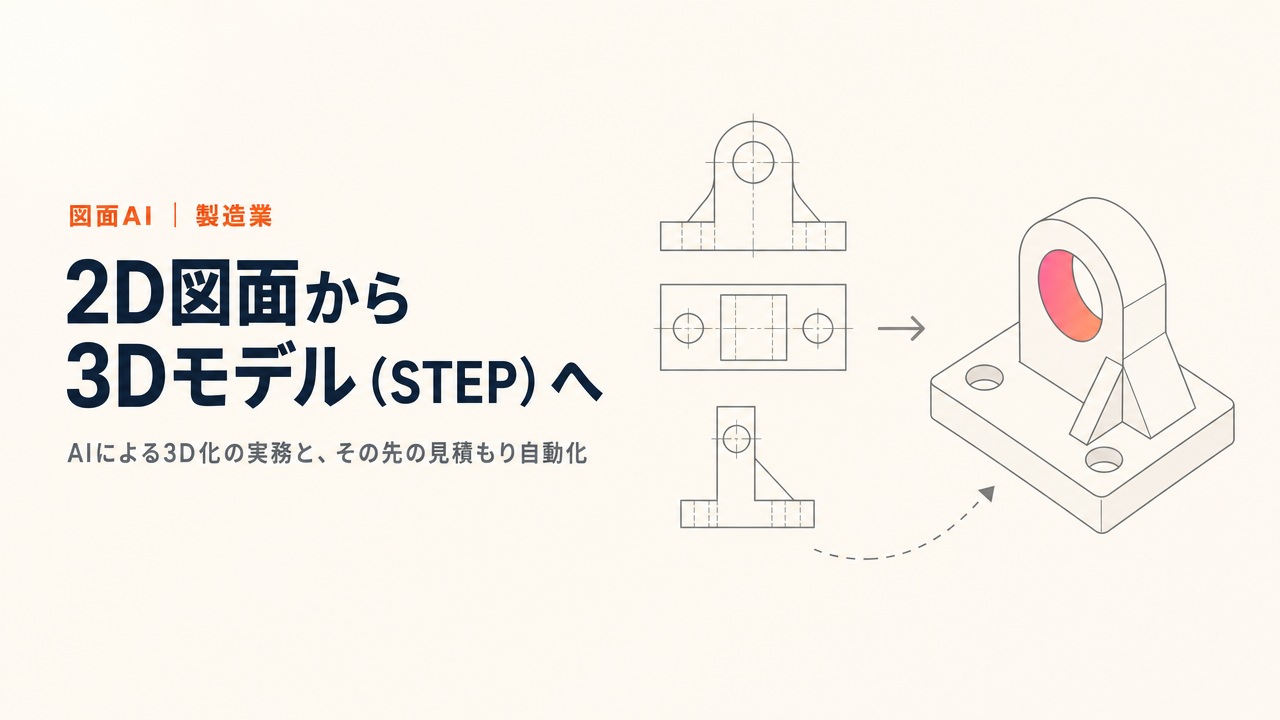
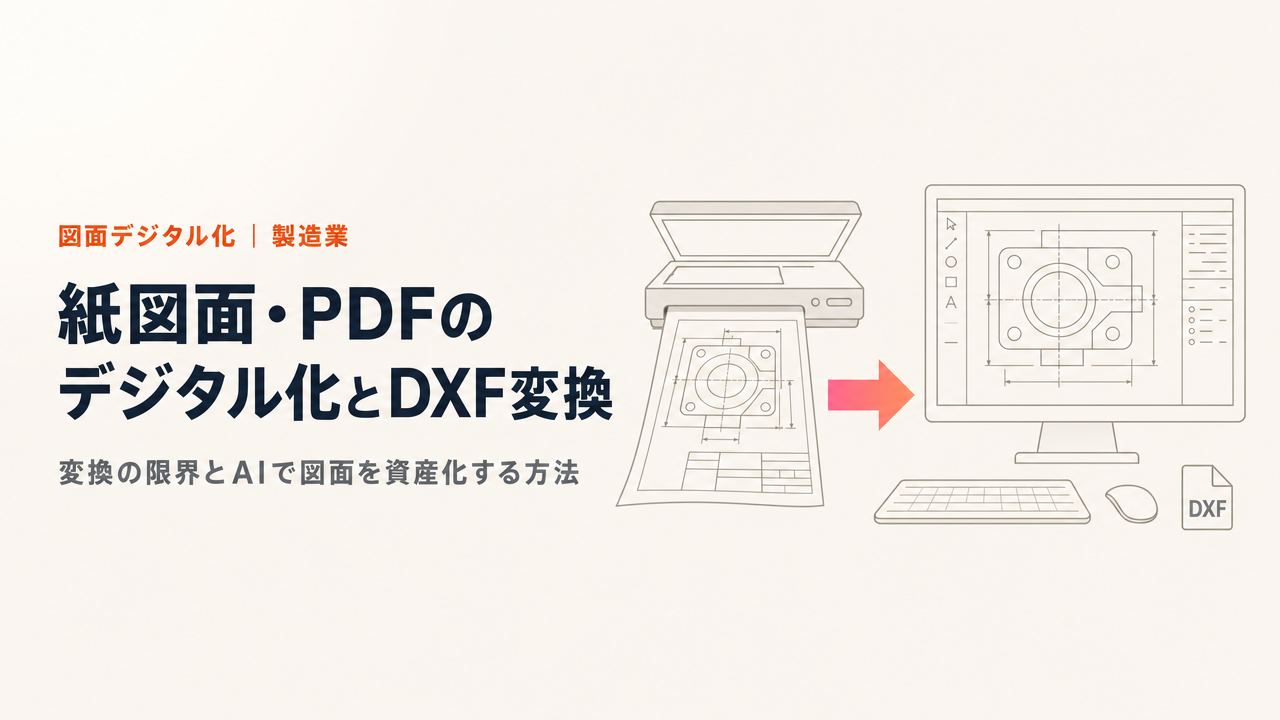
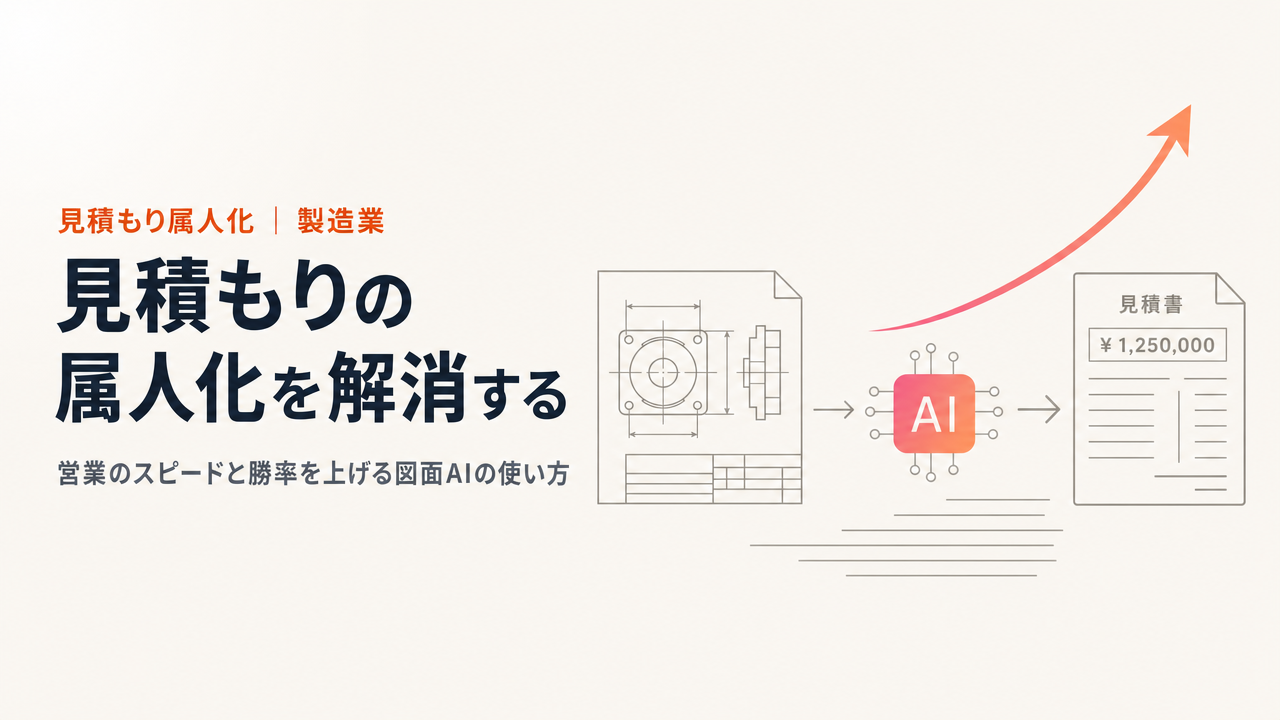
The first is automating drawing conversion. It recognizes line segments, arcs, dimensions, and symbols in PDFs, paper scans, and 2D drawings that arrive from customers, converts them into data that CAD can handle (DXF), and, when needed, supports converting 2D to 3D (STEP). Reducing the manual work of CAD conversion and 3D creation clears the jam at the entrance to quotation and production preparation. This is also the part that fills individual differences in drawing interpretation. I dig into this in how to digitize paper drawings and PDFs into CAD data.
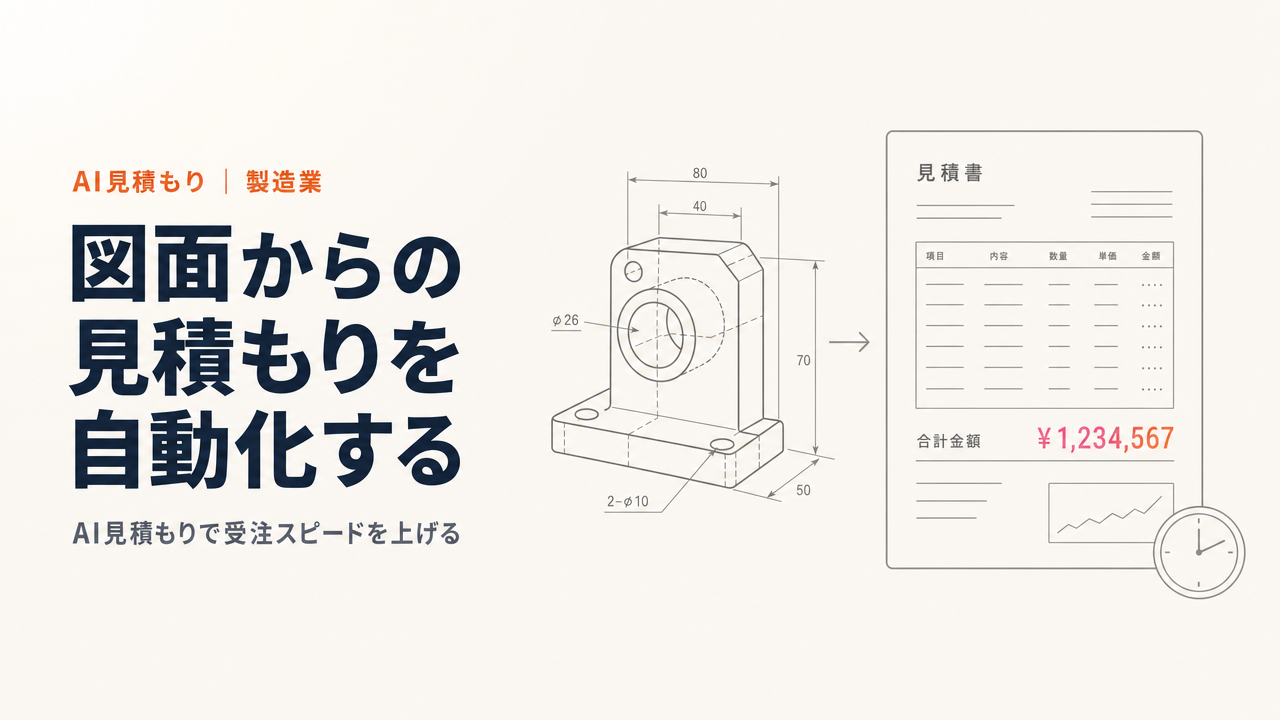
The second is estimating man-hours and material costs. The AI extracts machining features, number of faces, holes, materials, and more from the drawing, and assembles a first draft based on your in-house unit-price master and man-hour base units. Think of it as reproducing, in line with standardized criteria, the "for this shape, these man-hours" mapping the veteran did in their head. Once anyone can produce a rough estimate at a consistent level, estimation stops being a bottleneck. The mechanism for creating quotations from drawings and the approach to standardizing cost calculation with AI are each covered in detail in their own articles.
The third is curbing unprofitable orders through cost standardization. Build up material, machining, setup, and overhead costs with standard logic, and updating the unit-price master lets you reflect material cost spikes all at once. Because the basis for the figure becomes visible and can be broken down, you can explain "why this amount" in discount negotiations and internal approvals alike. Cost that used to be a black box turns into numbers you can verify.
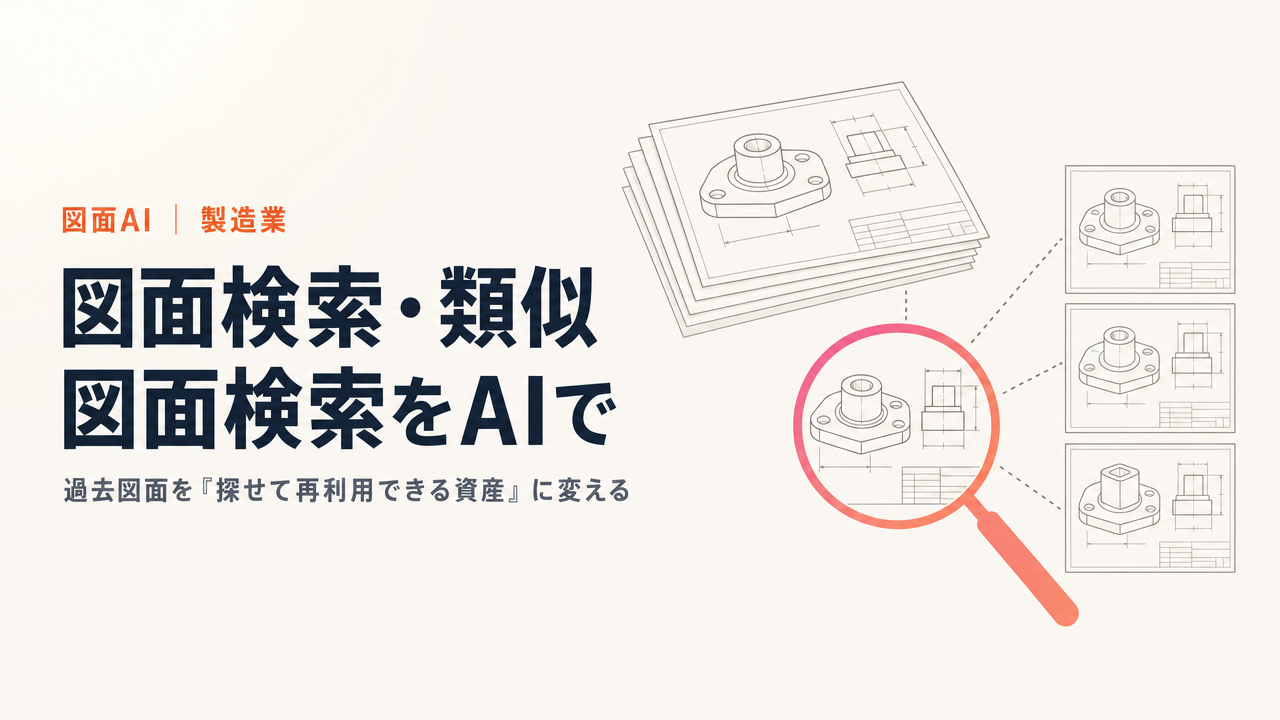
The fourth is searching similar drawings and past quotations. ZEROCK is built on GraphRAG (a technology that connects the relationships between pieces of knowledge as a graph for search), so it can call up "we must have done a similar part before" in seconds. Being able to find past similar deals and quotations eliminates the waste of estimating from scratch every time. I write about the practical effect of this search concretely in the mechanism for finding similar drawings with AI.
And the fifth is passing down expertise. Accumulate a veteran's estimation logic, unit-price criteria, and judgment rules as AI knowledge through mechanisms like a prompt library and knowledge control. Because you can preserve tacit know-how as a company asset, you lower the risk of losing quotation capability to retirement or an aging workforce. Juniors can learn on the job while checking the first draft the AI produces, so training speed also rises. I've separately summarized the skill-transfer angle in how to support skill transfer in manufacturing with AI.
Note that in every case the AI only produces a first draft; finalizing the amount or making the applicability judgment is premised on being done by your own staff. Because drawings are the source of your competitiveness, ZEROCK is designed around operation on domestic AWS servers and knowledge control that governs internal information access. Because it's a configuration where you can use AI in-house without leaking confidential drawings outside, it should be easy for small and mid-sized manufacturers to adopt.
The sales speed and win rate that adoption changes — and how to proceed
When you build drawing AI into quotations, the sales landscape changes. The first-draft quotation that used to take a half-day to several days as an initial response can potentially be compressed to a same-day or a few-minute rough estimate. Faster replies raise the probability of taking the center seat at the table in inquiry competition. With a setup that produces rough estimates regardless of who's in charge, inquiries don't stop even when a veteran is out. With the estimation burden lowered, sales can devote time to promising deals more likely to convert, and are less jerked around by fruitless quotations. What matters here is positioning drawing AI not as a "back-office efficiency tool" but as a "sales weapon." Being able to produce figures fast, without wobble, and with a basis translates directly into win rate.
That said, there are a few points to keep in mind to roll this out well. First, a small start. Rather than trying to process all drawings at once, it's realistic to begin with high-inquiry-frequency part families or areas where quotations are under strain. Next, developing the unit-price master. The more the criteria and unit prices — the deliverables of standardization touched on in the earlier section — are in order, the higher the accuracy of the AI's first draft. Skip this and it tends to disappoint, so consider it as a set with standardization.
And one thing not to forget is involving your veterans on the floor. AI is not a tool to take a veteran's job; it's a tool to preserve their knowledge for the company and bridge it to younger staff. The cooperation of veterans is essential to putting estimation logic into words and to reviewing the first drafts the AI produces. Position them as "the ones who create the criteria," and adoption goes much more smoothly. Finally, security. Before adoption, confirm where drawings are processed, who can access them, and whether they'll be used to retrain the AI. With a configuration premised on domestic processing and access control, you can proceed while protecting confidential drawings.
Summary
Quotation dependency is a hard-to-see management issue that eats into your orders somewhere other than technical capability. Let me organize the key points at the end.
- Slow quotations lead directly to lost bids. Now that competitive bidding and shorter lead times have taken hold, the speed of putting a reasonable figure out first sways the win rate.
- The essence of the slowness is dependency on individuals. Three points — estimation know-how, drawing interpretation, and the basis for cost — rely on one person.
- Left unaddressed, it eats into the business as chronic lost bids, unprofitable orders, and the loss of quotation capability when a veteran retires.
- The solution goes in the order "standardize, digitalize, then use AI." Start with the free step of writing down your estimation criteria.
- Drawing AI supports everything from conversion to estimation, search, and passing down expertise, turning quotations into a sales weapon.
If I may add just one thing, this effort is not about "replacing veterans." It's an investment to preserve the intuition veterans have built up as a company asset, so the next generation can use it. If you feel even a little that "our quotations might depend on one person," first take stock of where your company stands with an individual consultation. What to standardize first and where you can make drawing AI effective differ from company to company. Start by sizing that up together, and you should be able to move forward without detours.
Frequently Asked Questions (FAQ)
What does it mean for quotations to depend on one person, and why is it a problem? Quotation dependency is when the work of reading a drawing, estimating man-hours and material costs, and setting a price relies on the experience and intuition of one specific veteran. When that person is absent, busy, or leaves the company, inquiry responses stall — replies come late and bids are lost, or prices vary by estimator and you win orders at a loss. Because your company's ability to quote is tied to an individual, it directly affects sales speed, win rate, and business continuity risk.
How much does quotation response speed affect the win rate? Now that high-mix, low-volume production and competitive bidding are the norm, customers send the same inquiry to several companies at once. The company that presents a reasonable quotation first tends to take the lead in the discussion, so a slow reply means dropping out of the shortlist — pure opportunity loss. Simply cutting your initial response from a half-day-to-several-days scale down to a same-day or a few-minute rough estimate can dramatically change your win rate and the number of inquiries each salesperson can handle.
What exactly does drawing AI (ZEROCK) help with in quotation work? ZEROCK's drawing AI supports converting PDFs, paper, and 2D drawings into CAD data (DXF conversion) and converting 2D to 3D (STEP), reading machining features, dimensions, and materials from drawings, building up man-hours and material costs based on your in-house unit prices, and searching past similar drawings and quotations. By putting a veteran's estimation logic onto AI and a knowledge base, the goal is a state where anyone can produce a consistent first draft quickly. Finalizing the price still assumes review by your own staff.
Can we maintain quotation quality without a veteran? Can expertise be handed down? By turning a veteran's estimation criteria, unit prices, and judgment rules into explicit knowledge for the AI, you can preserve tacit know-how as a company asset. Younger staff can build on the AI's first draft, checking and adjusting rather than estimating from scratch on gut feel. This lowers the risk of losing quotation capability to retirement or an aging workforce while helping younger staff become productive sooner.
Is the security of confidential drawing data okay? ZEROCK is designed around operation on domestic AWS servers and knowledge control that governs internal information access. Because you can use AI in-house without leaking confidential information such as drawings outside, it's a configuration that's easy for small and mid-sized manufacturers to adopt. Where processing happens, access permissions, and the handling of not using data to retrain the AI can be discussed according to your specific requirements.
Where should we start? Do we have to introduce AI right away? The first step is not adopting a tool but standardizing — writing down your estimation criteria, machining unit prices, and cost items. The essence of the dependency problem is that the criteria live in one person's head, so putting them into words first lets you load those same criteria straight onto drawing AI. Proceeding in the order of standardization, digitalization, and then automation with drawing AI is, in our experience, the way to avoid failure.
Footnotes
-
Ministry of Health, Labour and Welfare, "Work Style Reform Related Act (Cap on Overtime Hours)" ↩
-
Ministry of Economy, Trade and Industry (METI), "Monodzukuri (Manufacturing) White Paper" (themes on the decline and aging of the manufacturing workforce and skill transfer; workforce figures are approximate, based on the Ministry of Internal Affairs and Communications' "Labor Force Survey") ↩
-
Small and Medium Enterprise Agency, "White Paper on Small and Medium Enterprises in Japan" (the share of SMEs among all companies) ↩
-
METI, "DX Report: Overcoming the '2025 Digital Cliff' of IT Systems and Full-Scale Development of DX" ↩
-
Information-technology Promotion Agency (IPA), "DX White Paper" ↩