Hello, this is Ryuta Hamamoto from TIMEWELL.
"I'm sure I made something like this before." There can't be many designers who have never muttered that in front of a drawing. The part you must have drawn in the past is nowhere to be found, so in the end you draw it again from scratch. You bounce between the shared server, the PDM system, and someone's local PC, and finally you go looking for a person: "The one who worked that project — are they even still here?" The time spent on this "searching" grows steadily as the number of drawings increases.
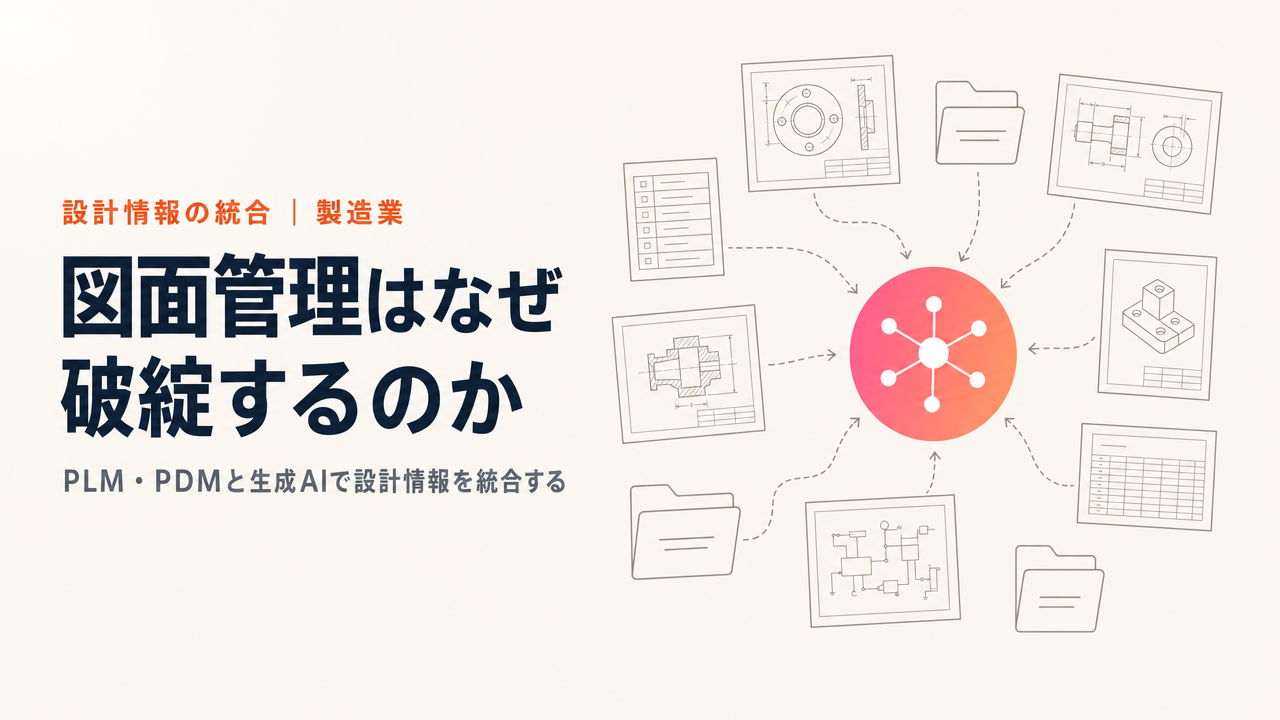
What I feel keenly when I talk with manufacturing clients is this reality: the problem isn't a shortage of drawings, it's that the drawings exist but can't be found. Past drawings should, by rights, be an asset packed with the company's own engineering. Yet when they can't be found, can't be reused, and remain dependent on someone's memory, they risk becoming not an asset but a liability that generates drawing costs every single time. In this article, centered on "similar-drawing search" — finding drawings by their content rather than by drawing number or file name — I'll connect the whole picture in the order it plays out in practice: digitizing old paper and scanned-PDF drawings, preventing duplicate design, and what lies beyond search, namely quotation, cost estimation, and knowledge transfer. If you want to gauge where your own AI adoption could start, checking your current position first with the AI Readiness Check is one good way to begin.
Let me lay out the key points up front. Boiled down, the pain of drawing search comes down to one thing: you can't get there unless you know the drawing number. AI-based similar-drawing search pulls up close matches from the content of the drawing — shape, dimensions, material, machining — so you can find drawings without remembering the exact number. Old paper and scanned-PDF drawings can join the search scope once digitized with OCR and shape recognition. And you can reuse the past drawings you find as DXF or 3D (STEP), connect them to first-draft quotations and cost estimates, and link design intent and defect history to build a foundation for knowledge transfer. Whether you can design all of this as one continuous flow is what separates a good return on investment from a poor one.
Why past drawings "exist but can't be found"
The reason past drawings can't be found is not that someone's housekeeping is sloppy. There is a more structural cause, and it is really three problems layered on top of one another.
The first is scattered storage. Design data lives in the PDM system or the file server, work-in-progress drawings live on individual local PCs, and drawings received from suppliers live in email attachments. From the start, drawings never gather in one place. The work begins with deciding where to even look, so people who are used to searching can rely on a hunch — "probably around there" — while less-experienced younger staff get stuck at the entrance.
The second is inconsistency in naming rules and drawing numbers. Numbering schemes that differ by division or era, file names littered with words like "latest," "revised," or "this one's OK" — you see this at many sites. The effort to solve things through naming is itself sound, but as long as the rules waver from person to person, search-by-name will break down somewhere.
The third is the deepest-rooted problem. Conventional drawing search assumes an exact match on the drawing number or file name. Turn that around, and it means only someone who already knows the correct number can search. The clue in the designer's head — "about 30 millimeters in diameter, with a flange, and I think it was stainless steel" — can't be typed into a search box as-is. In the end, asking a veteran who remembers the contents of the drawings becomes the fastest route, and the power to search concentrates in specific people.
These three cannot be resolved by fixing just one of them. Tidy up the folders and the naming still wavers; unify the naming and the "can't search by content" problem remains. That is precisely why we need to change the very idea of what search is.
Facing the costs that "can't be found" adds up
When you talk about search time, it tends to get waved off with "well, it takes a bit, sure." But put it into numbers and it can't be treated so lightly. At a precision-parts manufacturer we supported (roughly 800 employees), information search in the engineering department took an average of one hour and fifteen minutes per day1. Per person, that is around 300 hours a year — about 37.5 working days. Internally, seven different document-management systems coexisted, and staff had to first agonize over which one to look at. The simple act of searching was quietly eating up this much time.
And what's being lost isn't only time. In design, similar parts have certainly been made before but can't be found, so people redraw from scratch every time. As a result, similar parts proliferate under different drawing numbers, part count swells, and that pushes up inventory and purchasing costs too. On the quotation front, sales receives a drawing but can't pull up similar past projects or unit prices, so they go and check with design or a veteran — and a reply takes two or three days. Losing the deal to a competitor in the meantime is not unusual. Cost estimation follows the same pattern: because the past cost of similar drawings can't be referenced, everything is built up from scratch each time, and the market sense of "does this price actually turn a profit" lives only in a veteran's head. Look at the shop floor and you also find rework — version and revision history can't be traced, so parts get ordered or machined from an old drawing.
Let me organize this against the approaches used so far.
| Approach | Clue you can search by | What it's good at | Where it stumbles |
|---|---|---|---|
| Folder tidying / naming rules | Storage location and file name | Intuitive if the rules are followed rigorously | Breaks down when rules waver by person or era; re-organizing the backlog is heavy |
| Full-text search | File name and text information | Documents with embedded text are quick to find | Drawings whose content is an image, like scanned PDFs, are out of scope |
| Attribute search in a drawing-management system | Registered attributes like drawing number and material | Filter by conditions once the entries are complete | Requires attribute entry; you can't search from the "content" like shape or dimensions |
| AI-based similar-drawing search | Shape, dimensions, material, machining | Surfaces similar drawings even without the drawing number | Accuracy depends on the state of the original; a verification workflow is a premise |
None of these approaches is useless. Folder tidying and attribute search are effective as a foundation. But they share one trait: every one of them is a tool for people who already know the correct key. What can remove that premise is similar-drawing search, which I'll explain next.
Struggling with AI adoption?
We have prepared materials covering ZEROCK case studies and implementation methods.
Similar-drawing search finds by "content"
The heart of similar-drawing search is shifting the starting point of the search away from the drawing number. AI reads the drawing and uses features — the outer shape, key dimensions, material, machining — as clues to line up and present similar past drawings. In other words, you can now ask, "show me the ones close to this drawing." Even without remembering the drawing number, you can dig up past assets starting from a drawing in hand or a half-finished sketch.
This works not merely because search time drops. It's because the doorway to reuse widens. Once you can reliably pull up similar parts, redrawing from scratch decreases, and it also puts a brake on the lack of standardization where similar parts keep appearing under different drawing numbers. For designers, "take the previous design as a base and tweak it a little" becomes a realistic option; for sales, "if it's this shape, here's what we quoted before" becomes a reference point. That single move of searching by drawing content works simultaneously on multiple pains across design, quotation, and purchasing. This, I believe, is the decisive difference from conventional search. I've also organized this way of thinking and the division of roles with a drawing-management system in Using AI with Drawing Management, PLM, and PDM, so if you're weighing a system, please read them together.
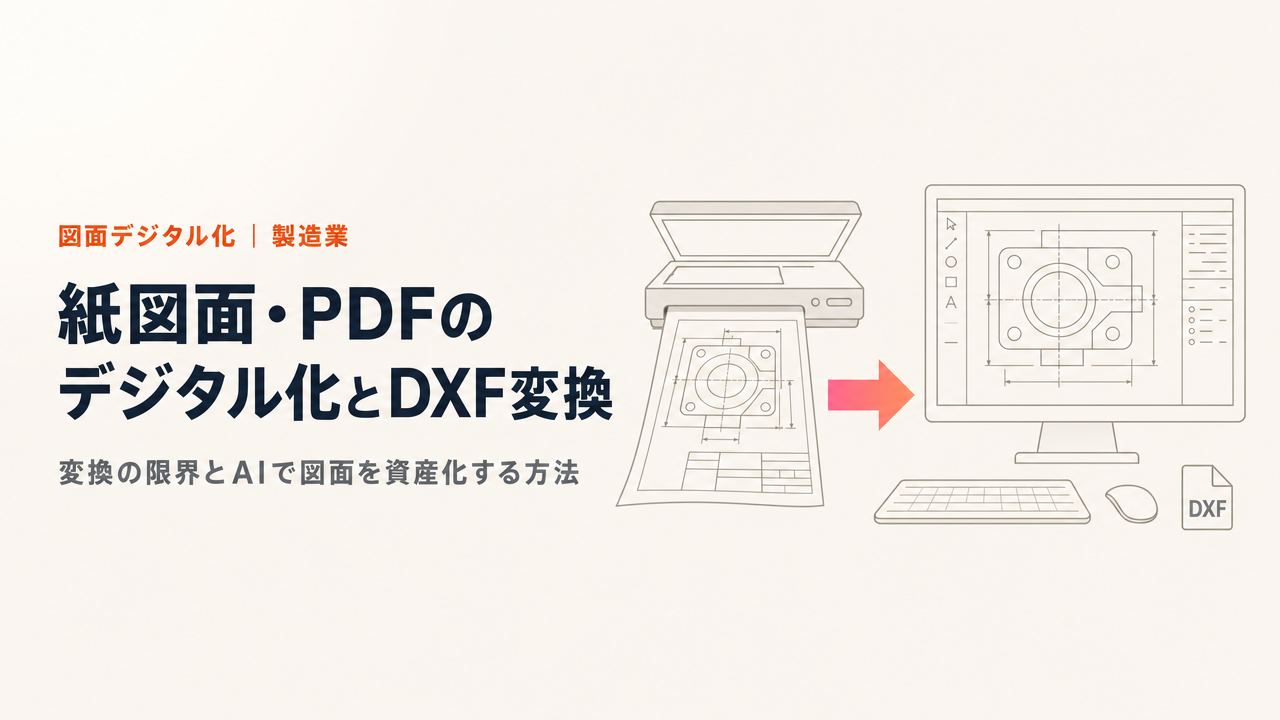
That said, plenty of companies still have most of their past drawings sleeping as paper or scanned PDFs. A PDF whose content is an image looks like a drawing to the human eye, but to a computer it is a collection of pixels — it holds no information about which lines are outlines and which are dimensions. So as-is, it can't be a target for similar search. This is where AI OCR and shape recognition come in. Recognize the lines, arcs, and text from the image and digitize them, and old drawings can be brought into search scope. Think of it as the process of turning dormant assets into "searchable assets." Actual accuracy depends on the state of the original — scan resolution, faded lines, traces of handwritten corrections — so I'll be honest about that. The procedure for digitization itself is covered in Digitizing Scanned Drawings into CAD Data, and the hands-on side of converting drawing PDFs to DXF is covered in detail in How to Convert Drawing PDFs to DXF.
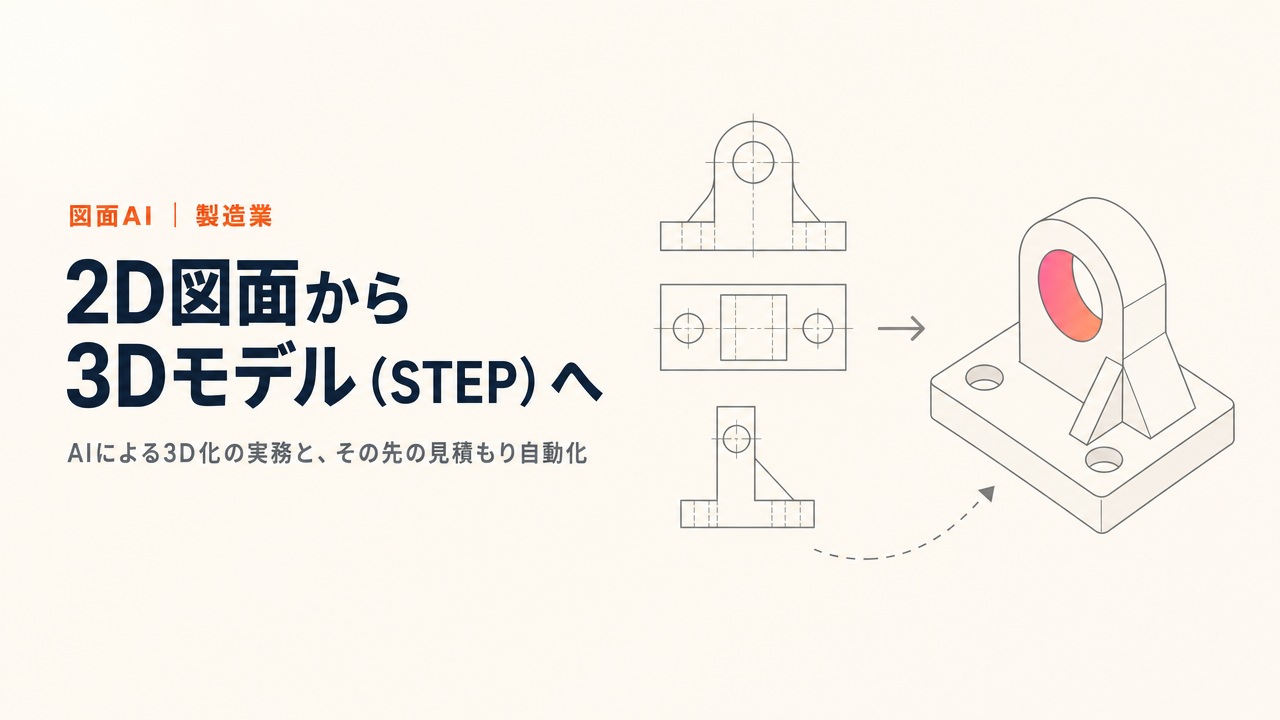
The perspective of making the drawings you find immediately usable is also essential. When conversions are inserted — turning a drawing PDF into DXF so it can be edited in CAD, or raising a 3D model (STEP) from a 2D drawing to meet a supplier's request for 3D data — the barrier to reuse drops dramatically. DXF is a standard format for passing drawing data between CAD applications2, and STEP is the international standard for 3D CAD data exchange (ISO 10303)3; both have the advantage of being exchangeable regardless of the software. The reality of 2D-to-3D conversion is explored further in Converting 2D Drawings to 3D (STEP).
Automate what comes "after" search, and preserve expertise
Once you can find drawings, the next question is what you can do with what you found. What ties directly to a manufacturer's bottom line is, in fact, not the search itself but how you use the drawings you find — or so I believe.
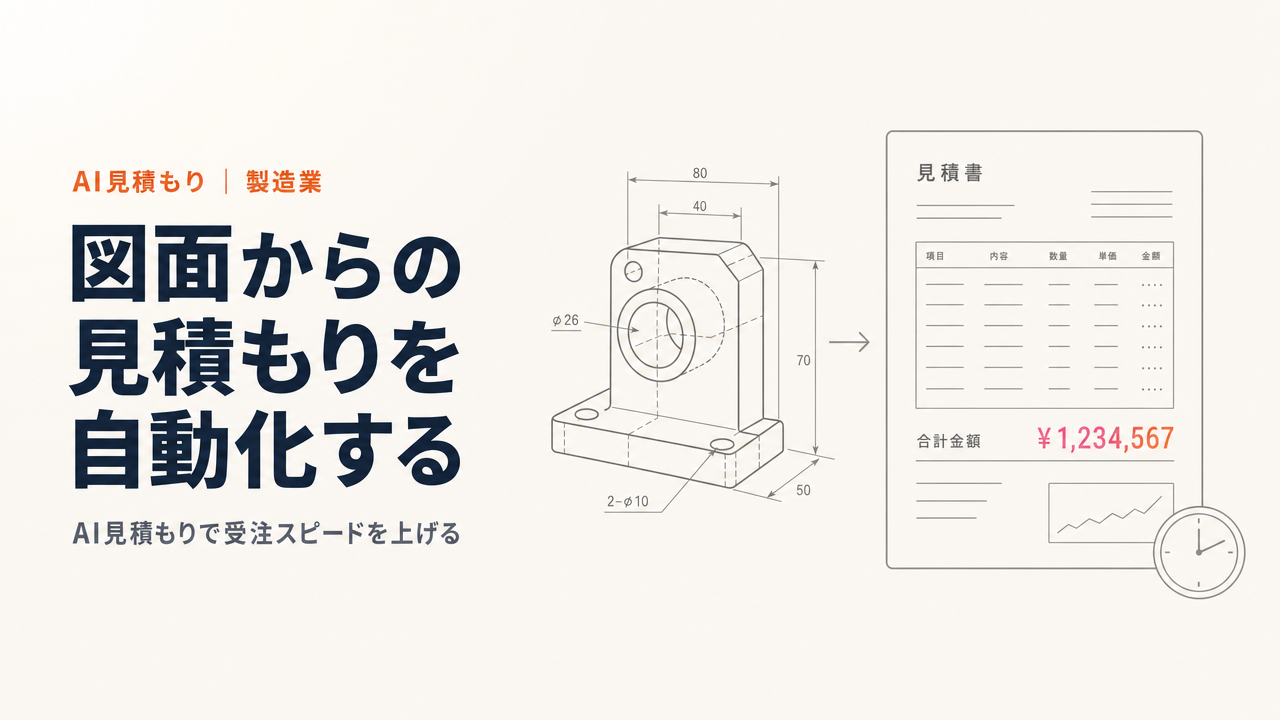
Picture the quotation front line. Sales receives a drawing, reads off the material, dimensions, and tolerances, imagines the machining steps, and builds up the labor hours and unit price. A veteran sees a going rate the moment they look at the drawing, but younger staff have no choice but to go around asking design and manufacturing, and a reply takes two or three days. If similar-drawing search finds a comparable past project, and AI references those past records together with your own price lists and cost tables to produce a first-draft quotation, sales can review and adjust it and reply the same day. That means you can use a mechanism to reduce deals lost to slow responses. Cost estimation follows the same structure: AI supports the buildup of material and machining costs, and the more you teach it your own cost tables, the closer it gets to your company's sense of pricing. The flow of quoting from a drawing is explained concretely in Automating Quotation from Drawings, and how to build up costs in AI-Based Cost Estimation.
What I want to stress here is that we don't claim full automation. What AI produces is only a first draft; the final dimensional verification and price judgment are made by a human. Introduce this with that line blurred, and inflated expectations of accuracy get betrayed, ending in a curt "it's useless." Make a draft in tens of minutes, then verify it in CAD and with the eyes of the person in charge. This workflow is the realistic answer — that is our position, formed after seeing many sites.
There's one more big theme beyond search: knowledge transfer. The drawings may remain, but the design intent and history — "why this tolerance was chosen," "what defects came up in the past," "which drawing can be reused" — usually live only in a veteran's head. Using GraphRAG (a mechanism that holds the relationships between pieces of knowledge as a graph and searches by tracing related information) and hybrid search, which ZEROCK employs, you can link drawings with related documents (specifications, defect histories, meeting minutes) and pull across them. Once you can ask, starting from a drawing, "what troubles occurred with this part before," tacit knowledge gradually turns into explicit knowledge. As a hedge against the risk of departures, this carries meaning beyond mere efficiency. The design of knowledge transfer is summarized in detail in Supporting Manufacturing Skill Succession with AI.
The labor shortage behind this, and a selection checklist
Why is this being rushed now? Behind it lies a structural situation in manufacturing. White papers on manufacturing compiled by bodies such as Japan's Ministry of Economy, Trade and Industry have consistently pointed out that the manufacturing workforce has shrunk significantly over the past twenty years, with a particularly conspicuous drop among younger workers aged 34 and under4. As people decrease, a way of working where veterans hold the location and content of drawings in their memory will eventually stop functioning. From April 2024, the upper limit on overtime under Japan's Work Style Reform legislation came into full effect5; while it draws less attention than in logistics or construction, manufacturing too is being handed the assignment of "making the same or more with a limited number of people and limited overtime hours." The Information-technology Promotion Agency (IPA)'s DX white paper likewise repeatedly reports that Japanese companies lag in company-wide diffusion of DX, and that a shortage of digital talent is a major wall6. Reducing search time and making past drawings reusable is, amid these currents, an unavoidable move.
Let me summarize into five the points we check together with clients when they are considering adoption.
- Can you test it on your own real drawings? What matters most is being able to test how well it hits on actual drawings — with fading and in-house quirks — rather than on catalog-spec accuracy.
- Is it end-to-end, from similar search through DXF, 3D conversion, and quotation? When tools are split apart, drawings get handed back and forth and end up managed twice.
- Are drawings kept out of retraining and stored domestically? A drawing is technical information itself. Always confirm whether the contract keeps uploaded drawings out of AI retraining, and whether storage is within the country.
- Can you raise accuracy by training it on your own price lists and notation? Whether the mechanism can reflect your own equipment and pricing sense — not a generic market rate — changes how practical it is.
- Does it cover work beyond drawings? If meeting minutes, internal document search, and document creation can run on the same platform, you avoid the double management of carrying many single-function tools.
This checklist is, put another way, the flip side of "the conditions for not failing with drawing AI." The third point in particular — how data is handled — touches on compliance, so it's worth confirming before price or features.
About ZEROCK's drawing AI
At the risk of sounding self-serving, the manufacturing-focused AI agent we provide, ZEROCK, brings the flow described in this article together on a single platform. Similar-drawing search by shape and dimensions, DXF conversion of scanned drawing PDFs, 3D model (STEP) generation from 2D drawings, first-draft quotation creation and cost-estimation support from drawings, and knowledge transfer that links drawings with related documents — all of it is handled simply by uploading a drawing. Data is stored encrypted on domestic AWS servers in Japan, and your drawings are never used to retrain the AI.
Because accuracy varies with the state of the drawing, we have you try it on your own actual drawings before adoption. How far can it search on drawings with fading and in-house quirks, and from where does human verification become necessary? The surest way to decide is to confirm it on your own drawings rather than on catalog figures. We offer a 7-day free trial and a demo using your real drawings. If you'd like to discuss concretely how to unwind the reliance on individuals around drawings, cost included, please reach out via Individual Consultation (ZEROCK). The overall picture of drawing-AI use in manufacturing is summarized in The Complete Guide to Manufacturing DX and AI.
Summary
- Past drawings become assets only when they can be found and reused. A state where they exist but can't be found is close to a liability that generates drawing costs every time.
- The cause of not being able to find them is three problems layered together: scattered storage, wavering naming, and the limits of exact-match search. Fixing just one won't resolve it.
- Similar-drawing search finds by content — shape, dimensions, material, machining — not by drawing number. You can get there without knowing the number, and it puts a brake on duplicate design and swelling part count.
- Old paper and scanned-PDF drawings become searchable once digitized with OCR and shape recognition. Converting to DXF or 3D (STEP) also lowers the barrier to reuse.
- The real prize lies beyond search. Whether you can make first-draft quotations and cost estimates from the drawings you find, and link design intent and defect history to build a foundation for knowledge transfer, is what determines the return on investment.
The reliance on individuals around drawings only gets costlier to unwind the longer it's left alone. The further generational change progresses, the more quietly precarious a memory-dependent operation becomes. Start by trying just one drawing in hand and seeing whether "similar ones actually come up." If you feel a response there, the path to reclaiming search time comes into view.
References
Related Articles
- The Complete Guide to Manufacturing DX and AI
- How to Convert Drawing PDFs to DXF
- Automating Quotation from Drawings
- Supporting Manufacturing Skill Succession with AI
Footnotes
-
Our ZEROCK case study (precision-parts manufacturer, approx. 800 employees; from a survey of information-search practices in the engineering department and measurement of adoption effects) ↩
-
Autodesk "DXF Reference" (specification of the DXF format) ↩
-
ISO 10303 (STEP: Standard for the Exchange of Product model data) — ISO ↩
-
Ministry of Economy, Trade and Industry "White Paper on Manufacturing Industries" ↩
-
Ministry of Health, Labour and Welfare "Work Style Reform legislation (upper limit on overtime)" ↩
-
Information-technology Promotion Agency (IPA) "DX White Paper" ↩