Hello, this is Ryuta Hamamoto from TIMEWELL.
"We can't keep up with quotes. We're slammed, yet somehow orders aren't growing the way we'd expect." Talking with our manufacturing customers, we run into this contradiction almost every time. The inquiries are coming in. But only one veteran can read a drawing and build up the labor hours, and the week that person is away on a business trip, quoting stops entirely. Meanwhile, the competitor in the same bid comes back with a number the next day. The deals where our answer lagged two or three days behind usually close with someone else.
Slow quoting is not a mere clerical backlog. It is a problem tied directly to revenue: you lose orders you could have won. In this article, I want to lay out — from the perspective of design, sales, and production engineering on the floor — what it actually means to automate quotation from drawings with AI, why quoting ends up depending on a few veterans, and everything from the root cause to the mechanism and how to approach rollout. If you are curious where your own company stands, it is also worth taking the AI Readiness Check first to confirm your starting point before reading on.
Let me give you the key point up front. What decides a quote is not only the accuracy of the number but the speed of the response. And what constrains that speed is a structure in which reading drawings and building up labor hours is done by hand, while the criteria for judgment stay locked inside a veteran's head. AI drawing-based estimation, as we see it, is the move that goes after both of those at once.
Why quotation speed now decides who wins the order
Buyer behavior has clearly changed over the past decade. They send a drawing to several companies at once, compare price and delivery, and then decide where to place the order. Competitive bidding has become the norm, and a psychological effect kicks in on top of it: "I want to talk to the company that came back quickly." The company that presents a reasonable figure first tends to hold the initiative in the later spec discussions too. Conversely, when the answer is slow, the deal drifts away before it ever reaches the table for consideration.
Shorter delivery windows are accelerating this trend. On the logistics side too — the so-called "2024 problem" — caps on overtime work began to apply in earnest from April 2024 to sectors such as trucking and construction, under the work-style reform legislation1. The harder transport lead times become to predict, the more buyers value the speed of the upstream step, the quotation response. From a procurement officer's point of view, a company that answers immediately — even at a slightly higher price — makes it easier to plan the whole schedule.
On the floor, the sense is that quoting speed maps directly onto win rate. Try to muscle through this with sheer manpower, and during busy periods the load concentrates on the veterans, which actually makes responses slower — a vicious cycle. Can you lift quotation speed across the board without adding headcount? That is where the line gets drawn. I go deeper into this theme in Raising your win rate through quotation speed as well.
Four structural reasons quotes become slow and person-dependent
There is no point blaming a company for slow quoting. The reasons it slows down are built into the very structure of the work. The causes we have seen on the floor sort into roughly four.
The first is that reading the drawing and building up labor hours is entirely manual. The estimator follows a PDF, a paper drawing, or 2D CAD by eye, picking out dimensions, materials, plate thickness, tolerances, and machining features one at a time, then imagines the process and stacks up the hours. The more high-mix low-volume or one-off the work, the longer this reading takes. Tens of minutes per quote is the good case; a complex drawing is a several-hour affair.
The second is that the criteria for judgment live in the veteran's head, unwritten. Reads like "for this shape, roughly this much setup" or "for this material and tolerance, this coefficient" are instincts acquired over years of experience. The person can explain them, but nothing is left on record, so you can neither standardize nor check them. As a result, when the estimator changes, the quoted figure wobbles.
The third is the inability to search across past similar jobs. What was a similar shape won for in the past, and what did it actually cost to make? This information should be the most reliable basis of all, yet drawings are scattered across file servers and paper, often searchable only by drawing number. Even when you think "this resembles that job," just digging up the drawing eats your time.
The fourth is that the basis for cost calculation is vague. Because the assumptions behind the build-up differ from person to person, you can end up taking an order at a loss without realizing it. Or you swing to the safe side, quote too high, and lose the bid. In reality, companies thread this dilemma every time on instinct alone.
What makes these four so troublesome is that the risk quietly compounds the longer they go unaddressed. If a veteran retires, the quoting know-how leaves with them, and precious expert time is consumed producing quotes that may or may not close. It is not unusual to see a company spending its most expensive labor on quotes that don't land. The question of how to preserve skills is covered separately and in more detail in How AI supports skills succession in manufacturing.
Struggling with AI adoption?
We have prepared materials covering ZEROCK case studies and implementation methods.
The background data pointing to a "no time to lose" labor shortage and skills succession
On top of the structural problem, the external environment is also moving in a direction that makes leaving quoting person-dependent untenable. The "Monozukuri (Manufacturing) White Paper" compiled by Japan's Ministry of Economy, Trade and Industry and others has, in recent years, consistently placed labor shortages, the succession of skills and technology, and the need for labor-saving and digital investment at the center of its themes2. The number of people employed in manufacturing is on a long-term downward trend; as the inflow of younger workers thins, the veteran cohort ages and retires. Skills succession confronts us not as a matter of spirit but as a matter of numbers.
The lag in digitalization cannot be overlooked either. The Information-technology Promotion Agency's (IPA) "DX White Paper 2023" carried the subtitle "Digital has started moving, but the transformation has not," noting that DX at Japanese companies is only halfway there, and citing the shortage in both the quantity and quality of the people who drive DX as a challenge3. There is still a wide gap between introducing a tool and changing the way the work itself is done.
Quotation work sits right where these two challenges cross. At small and midsize manufacturing sites, a high share of quoting and cost calculation reportedly depends on Excel, paper, and individual experience, which becomes the breeding ground for person-dependence and slow responses. That is exactly why I believe AI-driven quoting should be seen not as an efficiency play you do "because it's convenient," but in the context of labor-saving investment that keeps the business running even as the workforce shrinks. I will leave the detailed figures to the latest editions of each white paper, but the direction is clear. The time has come to rework the very premise of continuing to rely on people.
Breaking down how AI drawing-based estimation works
Here is the heart of it. When you hear "automate quoting with AI," you might picture magic that produces a number at the push of a button, but in reality it is an accumulation of down-to-earth processing. Break it down and it splits into several stages, from laying the foundation for the quote to building up the total.
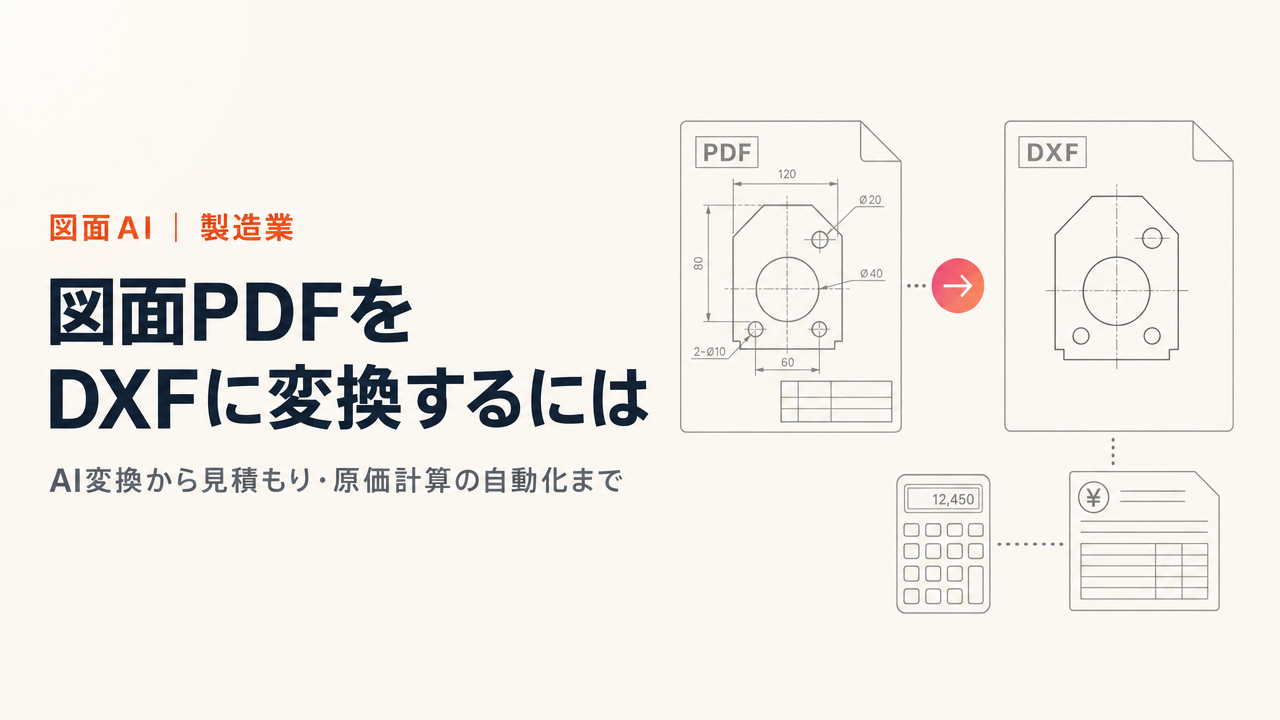
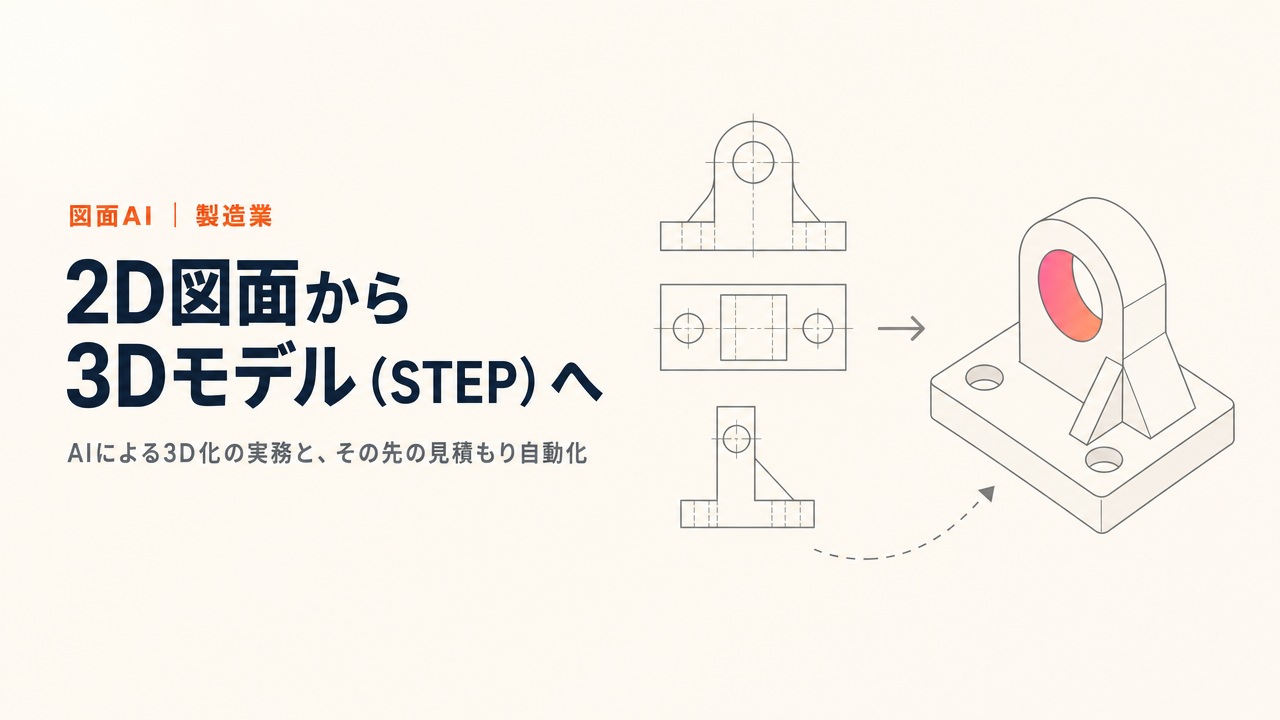
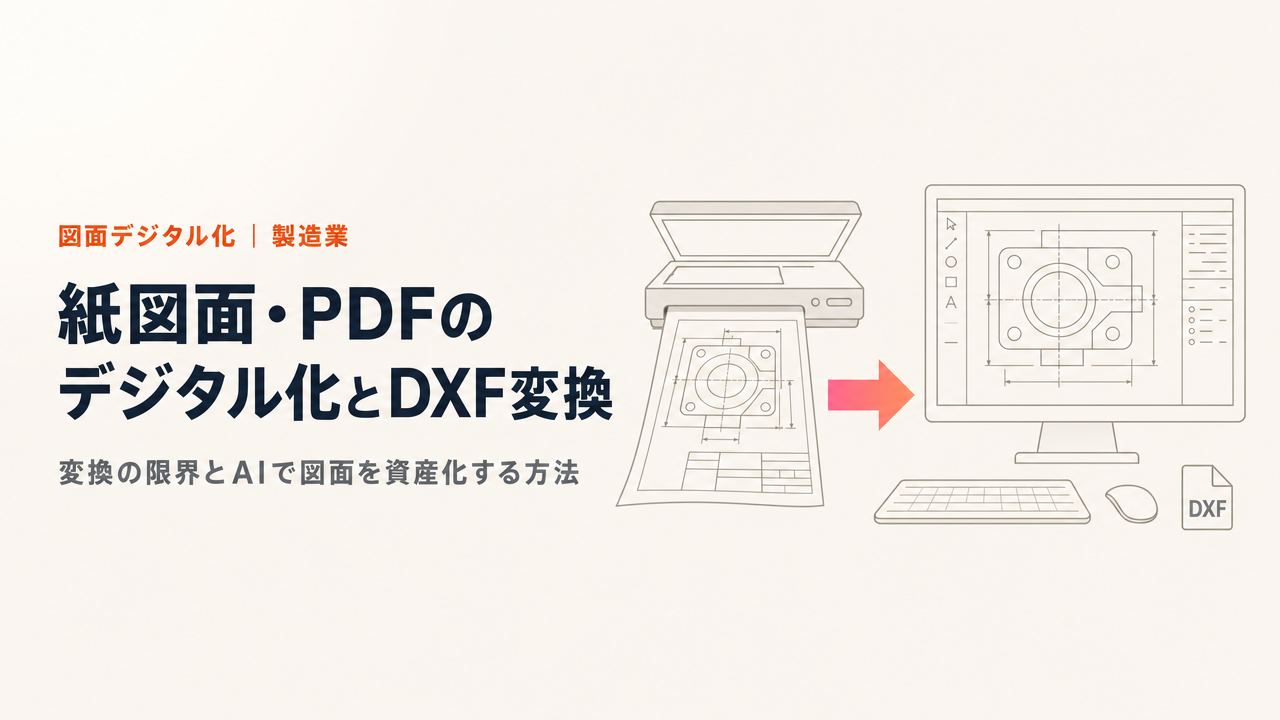
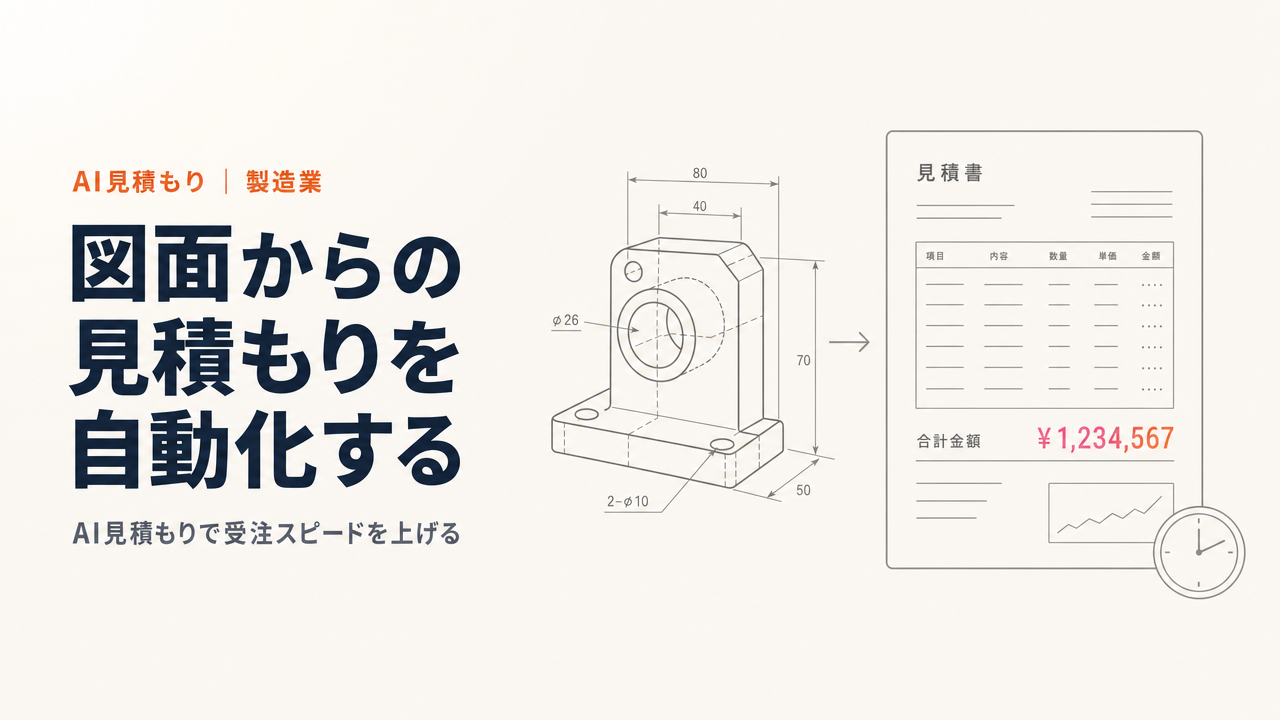
The starting point is reading the drawing. Drawing AI ingests drawings in formats like PDF, scanned paper, and 2D CAD, and extracts machining features such as dimensions, shapes, materials, plate thickness, tolerances, holes, and threads. It is the step that structures — as data — the information a person used to pick out by eye. At this point, drawings that exist only as paper or PDF are hard to work with as-is, so you prepare foundation data usable for the build-up: converting PDF to DXF to restore lines and arcs to editable CAD data, or generating a 3D model (STEP) from the 2D drawing. On digitizing drawings, see Digitizing drawings and turning them into CAD data; on 3D generation, see Generating a 3D model (STEP) from a 2D drawing, each explained in detail.
Next is searching past similar drawings and quotations. Based on the extracted shapes and specs, AI pulls up "similar jobs" from past records. It is a shift from a world where you could only search by drawing number to one where you can search across records by shape itself. What was a similar shape won for in the past, and what did it actually cost to make? This record-based sense of the going rate is what underpins the validity of the quote. The mechanics of drawing search are summarized in Searching drawings by similarity with AI.
Then comes the build-up. It cross-references the extracted machining content, the past records surfaced by the search, and your own price tables to assemble machining hours, material cost, machining cost, and total cost, generating a first draft of the quoted figure. What matters here is the ability to learn and standardize the veteran's estimation logic. If you have it memorize, as data, how to read hours, the coefficients, and the key points of setup, anyone can quote on the same basis regardless of who is in charge. The estimator's job shifts from building up from scratch to reviewing and fine-tuning the draft AI produced. It is easy to overlook, but this — being connected end to end from drawing recognition through shape extraction, 3D conversion, similarity search, and build-up — is the decisive difference from mere quotation software. The finer points of building up cost are explored in Improving the accuracy of manufacturing cost calculation with AI.
Manual quoting versus AI quoting: what actually changes
With the mechanism in mind, let me line up how the day-to-day changes between manual quoting and AI quoting, point by point.
| Aspect | Manual quoting | AI drawing-based estimation |
|---|---|---|
| Response speed | Tens of minutes to several hours per quote for reading and build-up | AI generates a first draft; finished with review and adjustment. Less likely to pile up |
| Person-dependence | Relies on veterans; work stops when they are away | Anyone can quote on the same basis. Removes the single point of failure |
| Variability in figures | Reads differ by estimator | Standardized on learned criteria, so wobble is small |
| Basis for cost | Tends to rely on instinct; risk of loss-making orders | Breakdown made visible; figures presented with a basis |
| Skills succession | Tacit knowledge stays with the individual | Estimation logic remains as a company data asset |
The important thing here is that this is not about handing everything to AI and taking people out of the loop. A veteran still reviews the final figure. What changes is that they are freed from building up from scratch. Set the roles up this way, and you can lift expert staff off routine build-up and shift their time to higher-value work — judging difficult jobs, pricing strategy, and customer relations. Amid a labor shortage, where you spend your veterans' time is the question. Being able to change that allocation may be the single biggest effect.
Let me also touch on how to roll this out without failing. Rather than aiming for a company-wide deployment from the start, begin by taking inventory of your current estimation logic and organizing your past drawings and quotation data. From there, run a PoC (trial rollout) narrowed to a specific machining type or product group you handle often, and measure the actual time saved and accuracy. Standardize only after you have confirmed the results, then widen the scope. That sequence is the realistic one.
Let me also answer the common worries head-on. To "does AI do everything?" the answer is no — it goes as far as producing a draft, and people hold the judgment. On "will it be accurate for one-off and high-mix low-volume?" — that is precisely where person-dependence tends to arise and where AI earns its keep, and accuracy rises as data accumulates. "Can we use paper or PDF drawings?" — yes, with a conversion step in between. Both excessive expectations and excessive worry lead you to misjudge the rollout. Seeing it at life-size is the shortest path. For how to change the whole of drawing-related work, I take a bird's-eye view in The full picture of manufacturing DX and AI adoption. For how far you can go with ZEROCK, please also see the ZEROCK service page.
About ZEROCK's drawing AI
If you'll forgive the self-promotion, the manufacturing AI agent we provide, ZEROCK, implements the flow described in this article on a single platform. Upload a drawing and it prepares the foundation data through PDF-to-DXF conversion and 3D model (STEP) generation from 2D drawings, reads dimensions and machining features, searches past similar drawings, and then produces a first draft of the quotation and cost calculation. Drawing search and the accumulation of knowledge for skills succession also run on the same foundation.
Precisely because we handle drawings — dense repositories of technical information — we put real effort into protecting data. Data is stored encrypted on domestic AWS servers in Japan, and your drawings are never used to retrain the AI. With knowledge control that governs who can see what and how far, it fits your in-house permission design. Because it uses GraphRAG — a mechanism that assembles answers by tracing the connections between pieces of knowledge — it is good at pulling up the "similar jobs" that a simple keyword search would miss.
Accuracy varies with the condition of the drawing. That is exactly why we take the approach of having you try it on your own actual drawings, rather than on catalog numbers. On real drawings — faded lines, in-house notation quirks and all — how much can it read, and how much time does it save? Confirming that first is the surest way.
Summary
- What decides an order is not only the number but the response speed. Amid competitive bidding and shorter delivery windows, the company that can respond quickly and accurately gets chosen
- Quotes become slow and person-dependent because of four structures: manual drawing reading and build-up, unwritten judgment criteria, the inability to search past records, and a vague basis for cost
- Labor shortage and skills succession are bearing down as a matter of numbers, so AI-driven quoting should be seen as labor-saving investment for business continuity, not mere efficiency
- The value of AI drawing-based estimation lies in being connected end to end, from drawing reading through 3D conversion, similarity search, and build-up
- Resolving person-dependence and achieving skills succession are not a trade-off; AI can deliver both at once
- The realistic way to start is by organizing past data and running a PoC on a specific product group
The person-dependence of quoting only gets more expensive to unwind the longer you leave it. Can you preserve a veteran's quoting instinct as data while they are still active? This is an area where I feel the earlier a company moves, the greater the advantage. If you are curious what you could do with your own drawings, please reach out through a ZEROCK individual consultation to discuss a demo using your actual drawings.
References
Related Articles
- The full picture of manufacturing DX and AI adoption
- Improving the accuracy of manufacturing cost calculation with AI
- Raising your win rate through quotation speed
- Digitizing drawings and turning them into CAD data
- How AI supports skills succession in manufacturing
Footnotes
-
Ministry of Health, Labour and Welfare, "Work-Style Reform Legislation (Overtime Work Upper Limits)" ↩
-
Ministry of Economy, Trade and Industry, "Monozukuri (Manufacturing) White Paper (Annual Report under the Basic Act on the Promotion of Core Manufacturing Technology)" ↩
-
Information-technology Promotion Agency (IPA), "DX White Paper 2023" ↩