(November 21, 2026) We have corrected the description of Tesla. We had said it handles the full chain from ore extraction to battery manufacturing; we now describe it only as far as we can confirm, as an example of vertical integration in battery cells and factories.
The Smartphones, Laptops, and Earphones That Define Modern Life
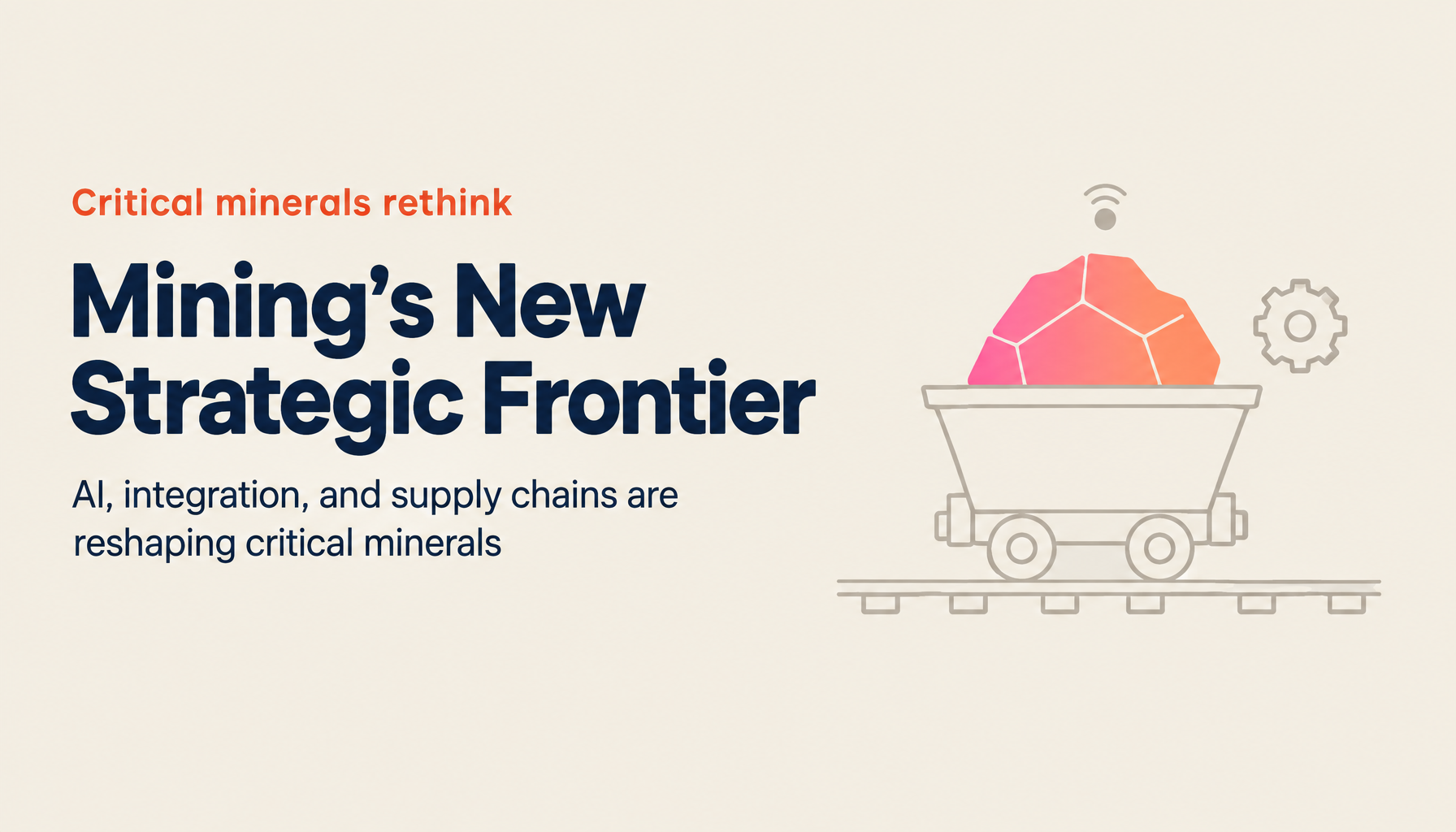
Smartphones, laptops, earphones, automobiles — the products we rely on every day are largely made possible by a class of essential resources known as critical minerals. These resources travel through long, complex supply chains spanning extraction, refining, and final integration into products.
In recent years, rising geopolitical tensions and concerns about the environment and national security — compounded by the rapid pace of technological advancement — have begun to drive significant change in this industry. Processes that once depended heavily on human labor are shifting toward automation and optimization through AI and machine learning. At the same time, new business models centered on "vertical integration" — where a single company manages the entire supply chain — are accelerating.
Tesla, the electric vehicle maker, is a well-known example of vertical integration, bringing battery cell production, component sourcing, and factory design in-house. The video this article draws on discusses what that approach could mean for mining. In the refining process, too, a shift is drawing attention: rather than relying on fixed flowcharts, companies are exploring reinforcement learning (RL), where AI dynamically adapts processing methods to the specific properties of each ore batch.
U.S. startup Mariana is pursuing a model that integrates digital technology and hardware to create a unified management framework from extraction through to final product.
This article provides a comprehensive overview of the strategic importance of critical minerals, the logic behind vertical integration, and the case for structural reform in global supply chains. The story of the behind-the-scenes technologies that underpin our daily lives — and the companies navigating this period of transformation — offers insights for riding the next wave of change.
Topics covered:
- The importance of critical minerals and the potential of new technologies
- Vertical integration and its strategic significance — the Tesla case
- The future of U.S. mining and global supply chain strategy
- Conclusion
Replace siloed classification work with AI.
METI's FY2024 data shows 52% of foreign exchange law violations stem from classification errors. Download the TRAFEED product catalog covering features and rollout.
The Importance of Critical Minerals and the Potential of New Technologies
It is increasingly clear that critical minerals play a foundational role in today's technological innovation and sustainable growth strategies. Critical minerals — resources such as lithium, nickel, and copper whose supply disruption would hit the economy or national security hard — are indispensable for advanced devices including batteries, electronic components, and motors.
The processes of extraction, refining, and processing these materials require advanced technology and a wide range of specialized expertise. Traditional mining has depended on flowcharts — effectively custom-optimized circuit designs — tailored to the varying rock compositions and impurity concentrations at each mine. Each site required teams of geologists, mining engineers, and chemical process engineers working over extended periods to stabilize operations under constantly changing conditions. These processes were immensely time-consuming and labor-intensive, driving up manufacturing costs.
Modern technological innovation is offering new solutions to these problems of wasted time and reduced efficiency. Specifically, AI, machine learning, and reinforcement learning are being applied to achieve dynamic process optimization. Control systems are being developed that can analyze enormous volumes of data in real time and respond flexibly to the minute variations in ore composition and impurity levels that change with every batch — something traditional methods could not handle. This dramatically improves refining efficiency, raising metal recovery rates while simultaneously reducing costs.
Furthermore, demand in the critical minerals market is expected to expand further with the growth of electric vehicles (EVs), renewable energy, and AI technology. The list of metals in demand includes lithium and nickel for EVs and their batteries, and copper and aluminum to support communications infrastructure and energy grids. Across the market, stable supply of these metals will be required for decades to come, while innovation in extraction, refining, and processing will be a decisive factor in corporate competitiveness.
Meanwhile, the shortage of skilled technicians and operators on-site is driving demand for workforce automation and digitalization. Mining has long relied on experienced craftspeople and engineers, but aging workforces and outflows of talent are making it essential to layer digital technologies on top of traditional methods. Digital transformation at mine sites — through sensor technology, IoT, and real-time data analysis — is expected to enable immediate process optimization and proactive prevention of operational issues. The push to reduce manual labor while maintaining safety and quality is accelerating across the entire industry.
At the global market level, not only technological innovation but also changes in environmental regulations and policy are major factors shaping project viability. As requirements for strengthened environmental protection regulations domestically and internationally, and for earning social trust around mining activities, grow more demanding, introducing efficient and environmentally responsible technology solutions will have a major bearing on corporate sustainability. Developing environmentally conscious extraction and refining methods is not only essential for building corporate value — it is an indispensable business strategy for fulfilling long-term social responsibility.
The global balance of supply and demand in the critical minerals market is also attracting attention from a geopolitical perspective. As many advanced economies highlight vulnerabilities in their supply chains, building domestic industry capacity and establishing strategic partnerships is seen as urgent — and the technological innovation that underpins this is not merely about efficiency; it carries national security significance as well. As countries worldwide — particularly in China and across Asia — advance massive investments and technology development, the U.S., Europe, and other advanced economies must respond with their own distinctive technologies and strategies. In this environment, the efficiency and flexibility that new digital technologies bring could prove to be a turning point for mining and refining operations.
In sum, the combination of rising critical mineral demand, the complexity of extraction processes, and operational optimization through technological innovation has propelled the modern mining industry well beyond traditional methodologies and into a new phase of innovation and integration. Each project is expected to achieve competitive advantage across the global supply chain through optimal process design, AI-driven dynamic control, and efficiency gains through on-site automation. This is accelerating the evolution from a simple resource extraction business to a "tech mining company" that manages the entire supply chain in an integrated manner.
Vertical Integration and Its Strategic Significance — The Tesla Case
Historically, the mining industry has distributed the work of extraction, refining, and product manufacturing across separate operators and external partners. The result has been recurring problems: delayed supply of components and materials, inconsistent quality, and misaligned timing for technology upgrades.
To address these challenges, the concept of "vertical integration" as a business model has attracted growing attention. By managing and operating multiple steps of the supply chain entirely in-house, companies can improve overall efficiency and responsiveness. Tesla is recognized as a pioneer of this approach: by bringing battery cell manufacturing, component sourcing, and factory design in-house, the company has secured stability in both quality and supply.
Tesla's vertical integration goes beyond simple insourcing of processes. It is a comprehensive initiative that also encompasses real-time data integration and AI-driven process optimization. By connecting each step in a coordinated system that can adjust instantly to changing conditions — rather than having each stage operate in isolation — productivity, quality, and speed have all improved dramatically.
This model also delivers major benefits for risk management. Traditionally, shortages of raw material supply, price volatility, and human error in manufacturing had significant impacts on the progress and long-term profitability of mining projects. Through vertical integration, dependency on supply chain intermediaries is sharply reduced, and structures are established that allow rapid process review and technical upgrades when needed. Tesla is often cited as a company that has tried to reduce that dependency by handling battery cell production and factory automation itself.
This strategic approach directly addresses the major challenges that traditional mining projects faced: extended project timelines, efficiency losses caused by disconnections between process stages, and the inability to keep pace with the speed of technological change. Companies that manage the full value chain from upstream to downstream — as Tesla does — are poised to transform the mining industry in the following ways.
First, centralizing information sharing across all processes makes it possible to review overall strategy in real time, not just on-site operations. When the ore composition extracted at a mine site varies from day to day, for example, an AI-driven dynamic process control system can immediately adjust each refining step to maintain an optimal production line. In a vertically integrated system, when supply chain bottlenecks or procurement delays occur, rapid countermeasures can be implemented alongside management-level feedback — enabling faster decision-making and significantly improving overall corporate agility and competitiveness.
Further, advances in data collection and analysis on mine sites are overcoming the limitations of manual visual inspection and handwritten records, enabling real-time monitoring and optimization through AI and IoT. This solidifies operations, enables rapid response to sudden issues, and also serves as an effective complement to gaps in on-site operator skills. In an environment where talent is hard to secure, vertical integration is a critical initiative for reducing the risks associated with labor costs and on-site training while improving overall efficiency and safety.
Additionally, this vertical integration strategy is highly effective as a response to the competitive dynamics of global markets. Considering tightening environmental regulations at home and abroad, shrinking workforces, and the risks of dependency on a single supply chain, companies that manage technology and processes entirely in-house can build a business foundation that is resilient against market volatility and geopolitical risk. Tesla — which has built an integrated management framework from manufacturing through product shipment, resolved misaligned incentives with partner companies, and simultaneously achieved speed to market and product quality — stands as a major model case with significant implications for the mining industry going forward.
In this way, vertical integration is positioned not merely as the integration of internal processes, but as an initiative directly linked to strategic enterprise-wide risk management, accelerating technological innovation, and optimizing global supply chains. The move to insource all downstream processes will yield substantial benefits not only in cost reduction, but also in securing supply stability, reducing environmental impact, and creating new business opportunities. Companies that try to take on the full chain from upstream resources to finished products are exploring a new path as "technology companies" that transcend simple resource businesses. This stands as an important signal for the entire mining industry of a shift toward next-generation industrial models.
The Future of U.S. Mining and Global Supply Chain Strategy
In the United States and other advanced economies, securing stable supply of critical minerals has been elevated to a national strategic priority, making the rebuilding of domestic extraction and refining capabilities urgent. Historically, the U.S. has faced a reality in which licensing at mine sites, environmental impact assessments, and federal- and state-level permitting processes are extremely complex, resulting in projects that take many years to complete. However, recent technological advances and policy support are beginning to move permitting efficiency and on-site digitalization forward, with the same demand for project speed now being applied to critical mineral ventures as to oil, gas, and renewable energy projects.
The U.S. government is pushing through reforms to its traditionally complex processes — including the licensing of exploration activities on federal land through the Bureau of Land Management (BLM) and making permitting more transparent through digital tools — in an effort to balance environmental protection with economic development. These reforms are helping to restore the competitiveness of U.S. domestic mining projects in the global market, while also building investor confidence.
The introduction of advanced technologies and the efficiency gains from vertical integration also have strategic implications for global supply chains. As China, Indonesia, and other Asian regions have established large-scale production systems for mining and refining, the potential for the U.S. to enter the market with distinctive technological capabilities and process management skills holds significant power to shift the balance of global competition. Startups like Mariana are pursuing a strategy of first building a domestic track record — succeeding with pilot projects and accumulating know-how — as a foundation for international expansion in the future.
For mining operations to succeed, not just technology but the optimization of the entire supply chain — including procurement and coordination with supply networks — is essential. Combining vertical integration with digital management enables the harmonization of complex operational structures and faster decision-making. The U.S. mining industry is evolving into a "strategic industry" that goes beyond mere resource extraction, and the alignment of policy, technology, and industry will determine its trajectory. Over the next decade, coordinated efforts across all these domains will be the key to strengthening global competitiveness.
Conclusion
The modern critical minerals market stands at a moment of major transformation. Dynamic optimization within each process, real-time data analysis, and the introduction of automation systems are contributing significantly not only to product quality improvements, but also to cost reduction and efficiency gains. Companies practicing vertical integration — including Tesla — have established the ability to bring products to market quickly and build competitive advantage by centrally managing entire supply chains that were previously fragmented. Meanwhile, in the U.S., policy reforms and the advancement of digital transformation are beginning to reorganize the domestic production landscape for critical minerals, strengthening the country's presence in global supply chains as well.
Through the discussion above, the following points stand out as particularly important:
AI utilization and process integration across the full spectrum from extraction to final product is driving the industry's major evolution.
Vertical integration — enabling rapid process improvement and establishing robust risk management frameworks — directly drives competitive strength going forward.
A multi-faceted approach integrating policy, technology, and management is forming the foundation that supports sustainable and stable resource supply.
If mining projects succeed in the years ahead, the impact will extend far beyond merely stabilizing raw material supply — it will contribute significantly to global security, environmental conservation, and economic development. Companies, policymakers, engineers, and investors all need to watch these transformations carefully and work together to seize new opportunities for value creation. The fusion of new technologies and strategies that will carry the future of critical minerals is expected to have positive effects on our daily lives, national economies, and even global environmental protection — and it will be one of the most important themes in market developments to come.
Reference: https://www.youtube.com/watch?v=ofeehL9LHiM
TIMEWELL AI Consulting
TIMEWELL is a professional team supporting business transformation in the age of AI agents.
Services Offered
- AI Agent Implementation Support: Workflow automation with generative AI
- GEO Strategy Consulting: Content marketing strategy for the AI search era
- DX Promotion and New Business Development: Business model transformation using AI
In 2026, AI has moved from "something you use" to "something you work with." Ready to think through your AI strategy together?
If you are reviewing export-control operations or classification workflows, download the TRAFEED product catalog (PDF) or contact us.
Related Articles
- What is export classification? Five steps and keeping your classification records current
- Defense Innovation at the Front Lines: DIU and Applied Intuition on Closing the Technology Gap and Future Defense Strategy
- 2026 Edition: Which Components and Technologies Are Vulnerable to Military Diversion? Identifying Dual-Use Items with Examples