End-User Questionnaire and Red-Flag List for Machine-Tool Deals (editable Excel)
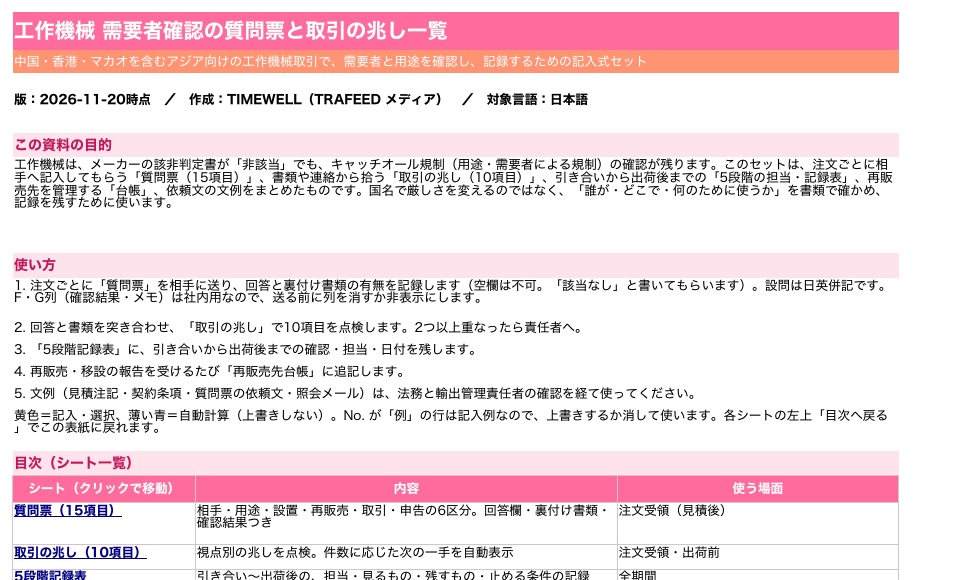
A 15-item end-user questionnaire, a 10-item red-flag list, a five-stage record sheet and a resale ledger for machine-tool deals in Asia (Japanese only).
Get the fileYou can download it after a short form (Japanese).
Hello, this is Ryuta Hamamoto from TIMEWELL.
(21 November 2026) We corrected the structure of the akiraka guideline (its 20 items sit under eight headings, not seven) and which law has an amendment taking effect on 4 January 2027 registered on e-Gov (the Foreign Exchange Order, not the Export Trade Control Order).
Imagine you handle exports at a mid-sized machinery trading company. A deal is moving forward to sell a machining center, bought from a Japanese maker, to a customer in China. The maker's classification record (該非判定書) says "not controlled." The purchase order has arrived. Can you assume that, since it is not controlled, it can ship as it is?
The short answer is that you cannot say so for certain. "Not controlled" on a classification record is the result for list controls. Machine tools also need a catch-all check, separate from list controls. This article focuses on machine tool transactions with China, Hong Kong, Macao and the rest of Asia, and covers in what order to check end users and end uses, what to look at, and how to record it. The wider picture of export control at a trading company is in our article on export control for trading companies. Read the two together and you can skip the parts that overlap.
The conclusion first
- Even when they are not list-controlled, machine tools bound for anywhere other than the 27 countries in Appended Table 3 need end-user and end-use checks. Decide from the documents and communications, not the country name.
- The checks run in five stages, from inquiry to after shipment. Keep the questionnaire answers and supporting documents for each order.
- Holding a bulk license does not let you skip the checks. Record, case by case, the scope and conditions under which you can use it.
Why checks are needed even when "not controlled": machine tools have two layers
Layer one is list controls, layer two is catch-all controls
Export control for machine tools works in two layers.
The first layer is list controls. You check whether the machine is a controlled item defined by performance figures, such as row 2(12) of Appended Table 1 of the Export Trade Control Order. Figures such as positioning accuracy and the number of axes that can be controlled are set out in the Goods Ordinance (貨物等省令). Here, the maker's classification record is your raw material. How to read one is covered in 10 points to check in a maker's classification record.
The second layer is catch-all controls: a supplementary net under which even goods that are not list-controlled need a license if there are concerns about the end use or the end user. Machine tools are named explicitly in row 16(1), the way into this net. Items 1 to 6 of row 16(1) of Appended Table 1 of the Export Trade Control Order are the following goods1.
- Machines that work materials by removing them with lasers, electrical discharge and similar methods, and water-jet cutting machines
- Machining centers, unit construction machines and multi-station transfer machines for working metal
- Lathes
- Drilling, boring, milling, threading and tapping machines for metal
- Grinding, honing, lapping, polishing and other finishing machines
- Planing, shaping, slotting, broaching, gear cutting, sawing, cutting-off and other machines
The line is drawn by HS code. Article 14-2(i) of the Goods Ordinance lists goods falling under headings 84.56 to 84.61 of the Customs Tariff Schedule2. Check first, model by model, whether the models you handle fall under these six headings. Industrial machinery that does not is looked at under other rows. In principle, the exporter decides the HS code3.
Four conditions that make a license necessary
When goods in row 16(1) are exported to a country not in Appended Table 3, no license is needed only if none of the following applies (Article 4(1)(iii) of the Export Trade Control Order)1.
| Condition | What it means |
|---|---|
| WMD end-use and end-user requirements | The contract, a document you obtained, or a message from the importer or others says the goods will be used to develop nuclear weapons and the like, or that the end user develops (or has developed) them |
| WMD inform requirement | The Minister of Economy, Trade and Industry has notified you to apply for a license |
| Conventional weapons end-use and end-user requirements | Documents or messages say the goods will be used to develop conventional weapons, or that the end user develops (or has developed) them |
| Conventional weapons inform requirement | You have received a notice to the same effect as above |
The detail on the conventional weapons side is set by an ordinance of the Ministry of Economy, Trade and Industry (METI), METI Ordinance No. 57 of 2008. It is built in three parts4.
- Where the contract, a document the exporter has obtained, or a message from the importer or others indicates that the goods will be used to develop weapons and the like (the end-use requirement)
- Where the contract or a document specified by public notice indicates that the end user develops weapons and the like (the end-user requirement)
- Likewise, where it indicates that the end user has developed them (the end-user requirement)
Parts 2 and 3 carry a parenthetical: where it is clear from the end use of the goods and the terms and conditions of the transaction that they will be used for something other than development and the like, the requirement does not apply. The tool an exporter uses to explain that something is "clear" in this sense is the "clearly" (akiraka) guideline. The ordinance for weapons of mass destruction (METI Ordinance No. 249 of 2001) is built the same way5.
Three points here are easy to misread.
First, the test is whether something is written in documents or said in communications. METI's Q&A answers that merely learning from news reports that a destination is developing weapons does not trigger the end-user requirement. Voluntary control that carefully checks information of concern is still recommended6.
Second, if the sales department knows before export, the company is treated as knowing. Even if the export control department did not know, the export can be illegal. Conversely, if the requirements did not apply at the time of export, information learned afterwards does not turn it into an illegal export. That information does, however, become part of what you have obtained by the time of your next export to the same counterparty, so it feeds into that judgment (our reading of the approach in Q4 of the Q&A)6.
Third, the material for the checks is documents actually obtained in the ordinary course of business. You are not obliged to gather every document you could have found if you had gone looking. However, where the end user is in the conventional weapons category of the End User List and concerns remain after you have looked at the other items, you check using all the information available (item 17(ro) of the akiraka guideline)67.
The destination's country name does not make the rules stricter
Appended Table 3 lists 27 countries, including the Republic of Korea. Appended Table 3-2 lists a different set of 10 countries and regions. China, Hong Kong, Macao and many other countries and regions in Asia appear in neither table. In practice, they are all treated as "general countries" (一般国), a working term rather than a term in the law1.
Separately from catch-all controls, Article 2(1)(i)-8 of the Export Trade Control Order requires export approval when goods listed in Appended Table 2-3 (other than item 3, and excluding goods in certain rows of Appended Table 2; machine tools and their parts, and numerical control units for machine tools, appear in item 2(43) as "those specified by Ministerial Order") are exported to a region listed in Appended Table 2-4 (ten countries including the People's Republic of China, India, Thailand and Turkey) in a direct or indirect transaction with a person designated by the Minister of Economy, Trade and Industry in a public notice1. The designated persons are set out in METI Notice No. 162 of 2023 (persons designated by the Minister by public notice under Article 2(1)(i)-6, (i)-7 and (i)-8 of the Export Trade Control Order). We confirmed this title from the citation in METI's Bulk License Handling Guidelines (we have not checked the text of the notice or the latest list of designated persons; when screening, look up the counterparty and its parent and other direct or indirect parties in the latest notice and the lists of entities subject to the export bans on METI's page "Sanctions against Russia and others"8). This, too, is a regulatory category, not an assessment of any destination country or company.
Item (i)-8 is part of Japan's measures concerning Russia in light of the situation over Ukraine. On October 16, 2026, the goods in Appended Table 2-3 were also widened as part of the ban on exports to Russia and to specified entities in third countries (Customs notice Zaikan No. 1185)9. To check Russia-bound approvals and dealings with designated persons in the ten Appended Table 2-4 countries together, see "Export control for trading companies: Russia, Belarus and designated entities in third countries" and "Export approval under Appended Table 2"; for transit-country deals, see "How to spot circumvention and transshipment."
This category is not an assessment of those countries. It sorts countries by whether they have export control systems in place. Being bound for China is not, in itself, a reason to check more heavily. What you look at is who will use the goods, where, and for what. Being on the End User List is also a regulatory classification, not a judgment on whether a company is good or bad. Not being on it is no proof that a transaction is safe either.
Be clear about how serious a violation is, too. Exporting goods that need a license without one is punishable by imprisonment of up to seven years or a fine of up to ¥20 million, or both. Where five times the value of the goods exceeds ¥20 million, the fine can be up to five times the value (Article 69-7(1)(ii) of the Foreign Exchange and Foreign Trade Act (FEFTA, 外為法)). Attempts are also punishable (paragraph (3) of the same Article). Fines on companies are set separately in Article 72 of the Act10.
The five stages of checks: who looks at what, and what to keep
The table below is our own arrangement; the law does not set stages. We split the process from inquiry to after shipment into five so that it is easy to run within a trading company's organization.
| Stage | Main owner | What to look at | What to keep | When to stop |
|---|---|---|---|---|
| 1 Inquiry | Sales | The counterparty's corporate information, the end user, an outline of the end use, whether your company is the exporter | The inquiry emails, a record of how the company information was obtained | The counterparty will not explain the end user or end use, even when asked |
| 2 Quotation | Sales, export control | The HS code of the model, the classification record, screening against the End User List | The date of screening and the list version, the classification record | The model does not match the classification record, or there is a list hit |
| 3 Order receipt | Export control | Questionnaire answers, reconciling the purchase order, payer and installation site, checking for red flags | The questionnaire, supporting documents, check results, reasons for the decision | Documents contradict each other, or red flags pile up |
| 4 Pre-shipment | Accounting and logistics, export control | Whether the consignee, shipping route, packaging and payer match the questionnaire. Whether an inform notice has arrived | Shipping instructions, a record of rescreening | A last-minute change, or a notice received |
| 5 Post-shipment | Sales, export control | Installation status, resale reports, plant relocations or new plants | Installation reports, an annual reconfirmation | Use at a place or by a party different from what was declared |
1 Inquiry: ask about the end user first
Sales, as the first point of contact, settles the type of transaction. Will your company be the exporter, will the maker ship directly overseas, or will it be a transaction between foreign countries (brokerage trade)? The type changes both who does the checks and which licensing rules apply. A transaction between foreign countries works differently, even if the destination is China. Settle that first, using our article on brokerage trade (in Japanese).
Keep what you ask to three things: the end user's name and address; what will be machined, and what finished product the parts go into; and the address where the machine will be installed. If the local distributor or trading company acting as your contact will not say who the end user is, stop there for the time being. Where a domestic distributor is the exporter, it is that exporter that carries out the checks. The maker's role is to cooperate by providing information on specifications and end use6.
2 Quotation: classification record, HS code and list screening
Before issuing a quotation, check the classification and HS code of each model. The maker's classification record is material for your decision, and the exporter's responsibility remains. Even for goods procured in Japan, the exporter checks for itself whether they fall under row 16(1). METI answers that there is no need to ask the maker for a classification record3.
Screening against the End User List (外国ユーザーリスト) happens at this stage. Use the latest version, and record the date of screening and the version. METI's notice "On the End User List" (dated 29 September 2025) has applied since 9 October 2025. In the table in METI's "Security Export Control Guidance [Introductory Edition]" (version 3.0; the Introductory Guidance), the list as amended on 9 October 2025 contains 835 entities in total. We have not been able to obtain the list file itself, so check individual entries, and whether there has been a revision in 2026, on METI's website11.
Here is where the notice stands. Where the name of the end user of the goods to be exported, or of the person who will use the technology provided, is on this list, a license from the Minister of Economy, Trade and Industry is required unless it is clear from the end use and the terms and conditions of the transaction that it will not be used to develop weapons of mass destruction or conventional weapons and the like. Exporters must check whether a party is on the list. It is not "something to look at for reference" but a document used in judging the objective requirements. Being listed is a regulatory classification, not a judgment on whether a company is good or bad.
3 Order receipt: reconcile the questionnaire with the documents
This is the crux. The questionnaire is in the next section. Once you have the answers, reconcile the documents with each other. Can the buyer on the purchase order, the payer, the consignee, the installation site and the end user be explained as one consistent flow? If a different name turns up, ask why and record the answer.
At the same time, check for the red flags listed later. Do not reach a conclusion on a single one; deepen the checks when they pile up. If something in the documents or communications indicates the development of weapons and the like, check it in line with the akiraka guideline. METI's Q&A says it does not require the guideline to be applied to transactions where nothing of the kind is written7.
Here are the decision branches, written out. If the end user is on the End User List, a license is required unless you can explain that it is clear from the end use and the terms of the transaction that the goods will not be used for development and the like. If nothing is written, there are no red flags and the questionnaire answers are supported, judge that the objective requirements do not apply, record it, and proceed.
If something is written or there are red flags, but checking against the akiraka guideline lets you explain that it is clear the goods will be used for something other than developing weapons and the like, keep a record of the check and proceed. If you cannot say for certain that it is clear, consider applying for a license, and if in doubt, consult METI's Security Export Licensing Division. And if METI has notified you to apply for a license, the goods covered by the notice cannot go without one.
4 Pre-shipment: catch last-minute changes
If there is a long gap between order and shipment, things can change in between. Before shipment, staff in accounting and logistics check that the consignee, shipping route, packaging and payer match what the questionnaire says. Make it explicit that staff at this stage have the authority to stop a shipment. Without that authority, people who notice something will not feel able to say so. Also rescreen to see whether the list version has changed.
5 Post-shipment: through to installation and resale
The job does not end with the sale. Confirm, by attending the installation or through an installation completion report, that the machine was placed at the declared installation site. If it is resold or moved, have that reported to you. METI's Q&A indicates that even with a counterparty you have dealt with for some time, you should also check business plans and the like if a plant is relocated or newly built12. Once a year, reconfirm the main items of the questionnaire with the counterparty.
Replace siloed classification work with AI.
METI's FY2024 data shows 52% of foreign exchange law violations stem from classification errors. Download the TRAFEED product catalog covering features and rollout.
The end-user questionnaire, reading the end use, and red flags
Questionnaire (for the counterparty to fill in)
The table below is an example questionnaire for the counterparty to fill in for each order. We created it; it is not a METI form. It is used for your own checks, separately from the end-use pledges (Form 2 and Form 3) submitted when a license application is needed.
| Category | Question | Answer | Supporting documents |
|---|---|---|---|
| A Counterparty | 1 Legal name, address, year founded | ( ) | Documents equivalent to registered company details, company brochure |
| A Counterparty | 2 Business, main products, industries of main customers | ( ) | Company brochure, official website |
| A Counterparty | 3 Is the buyer the same as the end user? If not, the end user's name and address | ( ) | Documents showing the relationship between the buyer and the end user |
| B End use | 4 What will be machined (part name, material, approximate dimensions, approximate tolerances) | ( ) | Drawings, samples, catalogs |
| B End use | 5 What is the finished product? What will the parts be used in? | ( ) | Product catalog, product pages on the official website |
| B End use | 6 Expected monthly production volume | ( ) | Outline of the production plan |
| B End use | 7 Why this machine was chosen (the accuracy, size and number of axes needed) | ( ) | Request for quotation, specifications |
| C Installation | 8 Address, building and floor of the installation site | ( ) | Plant layout, photos |
| C Installation | 9 Does any other company occupy the same premises or building? If so, will that company use the machine? | ( ) | Confirmation form |
| C Installation | 10 Is it a new plant or an existing one? Are there plans to relocate? | ( ) | Outline of the business plan |
| D Resale | 11 Are there plans to transfer, lend or resell the machine to a third party? | ( ) | Agreement to the contract clauses |
| D Resale | 12 Are there plans to move it to another country or region? | ( ) | Agreement to the contract clauses |
| E Transaction | 13 Is the payer the buyer? If not, the payer's name and the reason | ( ) | Confirmation of the remitter |
| E Transaction | 14 Is the consignee the buyer? If not, the consignee's name and the reason | ( ) | Consignee information |
| F Declaration | 15 We will notify you in writing in advance of any change to the above | (Agreed) | Signature and date |
Three tips for using it. First, allow no blanks; ask for "not applicable" to be written in. Second, check against public information, such as the official website, whether answers 4 and 5 fit the counterparty's business. Third, keep the answers and supporting documents with the order record.
In license reviews for machine tools, METI asks as needed for materials showing what the workpieces are, materials on the final products, the layout of the installation floor, and confirmation that companies sharing the premises will not use the goods12. Questions 4 to 9 also serve to gather these materials in advance, so if you do end up applying for a license, there is less rework. The questionnaire comes as a fill-in sheet in our machine tool end-user questionnaire and red-flag list (Excel, in Japanese), together with the ten red flags below, a five-stage record sheet and a resale register.
Reading the end use: do the machine's specifications and the explanation fit together?
In checking the end use, you are looking at whether the class of machine and the counterparty's explanation fit together. From here on, this is our own approach.
A machine tool's specifications can be expressed in numbers: the number of controllable axes, positioning accuracy, the size of work it can take, spindle power. Sales and engineering staff look at whether the workpieces the counterparty described actually need those specifications. Say the counterparty wants very high accuracy or a multi-axis model to machine small general-purpose parts, or the model is large but the workpieces described are small. I want to be clear that mismatches like these are not evidence of bad intent. They often come from sales not explaining enough, or from leaving headroom for future uses. Record them as points that do not quite fit, ask the reason, and keep the answer.
Civilian businesses also include machining parts for aerospace, energy, shipbuilding, precision instruments and the like. What METI calls "businesses requiring attention" (要注意事業) are businesses such as carrying out military, nuclear or aerospace-related work, or dealing with companies that do. Having such a business does not by itself mean there is a problem with the counterparty12. Legitimate civilian manufacturers sometimes touch these categories in some of their transactions. The aim of the check is to confirm from documents how that business relates to the plant or line where the exported machine will be used.
Red flags in the transaction (our own list)
METI's akiraka guideline sets out 20 items, numbered ① to ⑳, under eight headings (end use and specifications; installation site and installation conditions; related equipment; labeling, shipping, transport route and packaging; payment and warranty; declining installation and confidentiality; companies on the End User List; and other)7. The table below applies those headings to machine tool deals, with the End User List and "other" combined in one row. It is not a list published by METI.
| Viewpoint | Example | Why look at it | Next step |
|---|---|---|---|
| End use | Will not describe the workpieces, or the description changes every time | The end use cannot be confirmed | Ask for drawings or samples |
| Specifications | The machine's specifications look excessive for the declared workpieces | The explanation and the machine do not fit | Ask why. Record the engineering staff's view |
| Installation site | The installation address is vague. A place that is not a plant, or that is close to housing | The place of use cannot be pinned down | Ask for a layout and photos |
| Installation site | Another company occupies the same building | Another company might use the machine | A confirmation form stating that the other occupant will not use it |
| Related equipment | Orders for peripheral equipment or consumables do not fit the end use | The overall picture differs from the explanation | Ask about the overall setup |
| Transport and packaging | The consignee differs from the buyer. The shipping route or packaging instructions are unusual | The final destination is not visible | Ask for the reason and for consignee information |
| Payment | The payer differs from the buyer. Terms far from the market norm | The substance of the transaction is not visible | Ask about the relationship with the payer |
| Installation and warranty | Declines installation or the presence of engineers. Does not ask for the usual warranty | Differs from a normal deal | Record the reason for declining |
| Confidentiality | Unusually keen to keep the final installation site secret | The place of use cannot be confirmed | Ask for an explanation and confirm in writing |
| Lists | A party on the End User List, or a party related to one | Further checks are needed | Check the type of concern, the end use and the terms, and record them |
Three principles for reading them. Do not reach a conclusion on a single one. Deepen the checks when they pile up. And whether the deeper check ends with "the concern was resolved" or "it was not," write down the reasons and keep them.
Document templates, and checking resale destinations
What you gather through the questionnaire and the red-flag check is easier to rely on later if it is also written into your quotations and contracts, for example when you need to ask for more information or hold a shipment. Resale is managed the same way, through contract clauses and a register.
How to use the templates
The templates below are examples we created for the Japanese system. They are not METI forms, and they have not been adapted to your contract formats, the laws of the counterparty's country, or your negotiating position with the counterparty. Do not use them as they stand; have them reviewed by your legal team and your export control officer. Templates for the basic clauses of a sales contract (an end-use representation, restrictions on resale and so on) are in our article on export control for trading companies. What follows is in addition to those.
In transactions that need a license application, use the forms METI has set (the end-use pledges, Form 2 and Form 3). In some situations, documents you draft yourself cannot take their place. How to choose the form is covered in our guide to pledges and end-user certificates.
Template A: note on the quotation
This quotation is subject to completion of our export control checks
(end user, end use, installation site and any other matters we consider
necessary). Depending on the results of those checks, delivery dates or
terms of the transaction may change, or we may be unable to accept the
transaction.
Putting this in at the quotation stage means the counterparty pushes back less when you later ask for checks.
Template B: additional clauses for the sales contract (transfer, reporting, suspension of shipment)
Article [X] (Control of transfer and changes)
1. If there is to be any change in the installation site, end user or
   end use of the Goods, the Buyer shall notify the Seller in writing in
   advance.
2. The Buyer shall not lend, assign or resell the Goods, or move them to
   another place, country or region, without the Seller's prior written
   consent.
3. At the Seller's request, the Buyer shall cooperate in confirming the
   installation status (including photographs, reports and on-site
   checks). Once a year, the Buyer shall report in writing on the
   installation site and the status of use.
Article [X] (Suspension of shipment and termination)
The Seller may suspend shipment or terminate this contract if it judges
this necessary for export control reasons. In that case, the Seller shall
not bear any damage suffered by the Buyer.
The "shall not bear any damage" part needs negotiation with the counterparty and a judgment from your own legal team. Discuss with them whether to include it or to soften it.
Template C: additional clauses for distributor (agent) agreements
Article [X] (Control of resale destinations)
1. When reselling the Products, the Distributor shall report to the
   Company in writing, in advance, the name, address, end use and
   installation site of the resale destination.
2. The Distributor shall not sell the Products to any party to which the
   Company has refused to permit resale for export control reasons.
3. The Distributor shall keep documents obtained from resale destinations
   (such as end-use declarations) for five years (align with the period in
   your internal rules; seven years is the guide for list-controlled items) and shall present them at the Company's request.
The retention period is an example. Set the actual period to match your own rules.
Template D: covering note when sending the questionnaire
The Japanese edition of this article gives this note in both Japanese and English. Here is the English version.
Thank you for your continued business.
For the export of this order, we are required under Japanese export
control laws and regulations to confirm the end user, end use and
installation site of the equipment, among other matters.
Please complete the attached questionnaire and return it to us together
with supporting documents.
So that it does not read as though you suspect the counterparty, say first that this is a procedure your company follows because the law requires it.
Template E: inquiry email when red flags appear
Thank you for your message.
For our export control checks, could you please let us know the following?
1. The name and end use of the parts to be machined, and an outline of the
   finished product
2. The address of the plant where the machine will be installed, and
   whether any other company occupies the same premises or building
3. The reason the consignee for these goods is a company other than yours
Once we have reviewed your answers, we will confirm the delivery date and
terms of the transaction.
Keep the questions to confirming facts. Leave out any words that assess the counterparty's business or country.
Checking resale destinations: three situations
Resale comes up in three situations.
| Situation | How to approach the checks | What to keep |
|---|---|---|
| Orders where the end user is decided | Check through the questionnaire and pledge. Ask about any plans to resell | The questionnaire, agreement to the clauses |
| Selling into stock (end user not yet decided) | Checking against the end-user requirement is in principle not necessary. Checking the expected end users and the importer (distributor) is still desirable. Even for general-purpose goods, if the machine is dedicated to a specific use, check the end-use requirement | Checks on expected end users, the importer's business and the range of its customers |
| Transactions through a distributor | If a domestic distributor is the exporter, that distributor does the checks. The maker cooperates by providing information | Clauses with the distributor, a register of resale destinations |
The thinking on stock transactions is set out in our article on inform requirements and stock sales (in Japanese)6. Stock sales of machine tools (row 2(12)1) carry a separate set of seven conditions, covered in our article on export control for trading companies.
A register of resale destinations needs only the columns below. Update it each time a resale is reported to you. A fill-in version is on the resale register sheet of the questionnaire file mentioned above (Excel, in Japanese).
| Column | Content |
|---|---|
| Original order | Order number, model, serial number |
| Resale destination | Name, address, end use |
| Check | Date screened, list version, reasons for the decision |
| Approval | Approver, date |
When bulk licenses can and cannot be used
A bulk license (包括許可) lets you obtain in one go what would otherwise be individual licenses. Here is when one can and cannot be used for machine tools.
| Situation | Bulk license | Conditions and notes |
|---|---|---|
| Machine tools in row 2(12)1 fitted with a relocation detection device | For destinations that have a "Special General" cell in Appended Table A (Region i (1), Region i (2) and Region ri), the Special General Bulk License (toku-ippan) can be used, with conditions. Where the destination is in "Region ri," the original text of the handling guidelines requires that the end user be decided, that prior notification be made and that a pledge be obtained. The "Region ro (excluding Regions chi and ri)" column, which covers China, Hong Kong and Macao, shows only "Specific" | For Region ri, prior notification (Form 14) is required, and you cannot export for 14 days after it is accepted. Obtain an end-use pledge (Form 2) from the end user or others. Prior notification is made contract by contract. Customs declarations are made as before. Details (in Japanese) |
| Machine tools that fall only under row 6(2) (Article 5(ii) of the Goods Ordinance, not Article 1(xiv)) | In Appended Table A, the row for items 6(1) to (10) has "Special General" in the Region to (2) column. China, Hong Kong and Macao have circles in Region to (2) | Check the applicant requirements (II-2) and that the export does not fall under the proviso below (II-4(1)). Our conclusion is at the end of this section |
| The counterparty and goods in continuing transactions are fixed | Specific Bulk License (combinations in "Specific" cells of Appended Table A) | Exports, to a counterparty with a continuing transaction relationship under III-5(5) of the guidelines (for example, six or more export licenses for the same importer in a year, or where this is expected), of the goods stated on the license. Requirements include that the end user be decided and that the end user submit a pledge (III-3(1)). Details (in Japanese) |
| Row 16(1), where neither the objective requirements nor the inform requirement applies | Not needed | No license is needed at all. Still keep a record of the checks |
| Row 16(1), where a license is needed | In principle an individual license | As an exception, the Special General Bulk License may be usable. Its scope needs checking6 |
| Transactions between foreign countries (brokerage trade) | None | There is no bulk license and no small-value exception. Decide using our article on brokerage trade (in Japanese) |
You can hold both a Special General Bulk License and a Specific Bulk License, but only one of them can be used on a single export declaration. Record, case by case, the conditions of whichever license you used13.
Even with a bulk license, end-user and end-use checks remain. There are three reasons.
- Conditions are attached. The Special General Bulk License for machine tools fitted with a relocation detection device bound for "Region ri" comes with conditions such as prior notification and obtaining an end-use pledge, and the Specific Bulk License requires, among other things, that the end user be decided and that the end user submit a pledge13.
- You cannot use the bulk license for 14 days after the prior notification is accepted. And if the Minister notifies you that an export risks hindering the maintenance of international peace and security, the bulk license no longer applies to that export. The guidelines set no time limit on when such a notice can come13.
- Go beyond the scope and you need an individual license. When the name of the notified end user or of the place where the equipment is delivered changes, you need to notify again or file a correction report. A change of company name needs a fresh prior notification; a correction to how the company's legal form is written needs a correction report13.
At regular intervals, reconcile the parties named in your notifications with the latest counterparty information held by sales.
On the Special General Bulk License in this table (machine tools fitted with a relocation detection device), the original text of the Bulk License Handling Guidelines (the version promulgated on 14 November 2025 and in force from 14 February 2026) has provisions for destinations in "Region ri" (り地域). There are four: it is limited to cases where the end user is decided; prior notification (Form 14) is needed; the license cannot be used for 14 days after acceptance; and an end-use pledge (Form 2) must be obtained from the end user or others. In the table annexed to the operational circular, "Region ri" has circles against India, Singapore, the Philippines and Malaysia (we confirmed this by machine parsing and could not check the table visually). This is a regional category in the export control system, not an assessment of those countries. China, Hong Kong and Macao are not among these four. Which bulk license can be used for which combination of goods and destination is set by Appended Table A of the guidelines. In Appended Table A, "Special General" in the row for item 2(12)1 machines with a relocation detection device appears in the Region i (1), Region i (2) and Region ri columns; the "Region ro (excluding Regions chi and ri)" column shows only "Specific"14. Our conclusion for China, Hong Kong and Macao is at the end of this section.
Exports where the Special General Bulk License cannot be used (proviso to Section II-4(1))
Right at the start of the paragraph that sets the scope of the Special General Bulk License (Section II-4(1)), the guidelines list, in a proviso, exports to which it cannot be applied13:
“However, [this license] may not be applied to exports via a region listed in Appended Table 3-2 or Appended Table 4 of the Export Trade Control Order, to exports destined for a region listed in Appended Table 2-4 of the Order (limited to those made through direct or indirect transactions with persons specified in item 3 of METI Notice No. 162 of 2023, which designates persons under Article 2(1)(i)-6, (i)-7 and (i)-8 of the Order), or to the provision of services for the purpose of providing to persons specified in item 3 of METI Notice No. 162 of 2023.” (our translation)
In trading-company terms, the license cannot be used for:
- Exports routed via a region in Appended Table 3-2 or Appended Table 4 of the Export Trade Control Order
- Exports to a region in Appended Table 2-4 that are made through direct or indirect transactions with persons specified in item 3 of Notice No. 162
- Provision of services intended for persons specified in item 3 of Notice No. 162
Appended Table 2-4 lists ten countries: the United Arab Emirates, Armenia, China, India, Kazakhstan, Kyrgyzstan, Syria, Thailand, Turkey and Uzbekistan1. India, which is in Region ri, is among them. We have not checked the text of Notice No. 162 or its latest list of designated persons; when screening, check the latest notice and entity lists on METI's page "Sanctions against Russia and others"8. This is a category in the control system, not an assessment of any country or company.
Our conclusion on machine tools bound for China (as of 22 November 2026, within what we could confirm in the original texts)
The guidelines define the scope of the Special General Bulk License as exports of "combinations of goods and destinations falling in cells marked 'Special General' in Appended Table A" (Section II-4(1)①), and the scope of the Specific Bulk License as "combinations of goods and destinations falling in cells marked 'Specific' in Appended Table A, as stated on the license" (Section III-4(1)) (our translation)13. The machine tool rows of Appended Table A read as follows14.
| Row of Appended Table A (goods) | Destination columns and the licenses marked |
|---|---|
| Item 2(12)1 goods falling under Article 1(xiv) of the Goods Ordinance (limited to machines fitted with a relocation detection device) | Region i (1): Special General, General / Region i (2): Special General / Region ro (excluding Regions chi and ri): Specific / Region chi: – / Region ri: Special General, Specific |
| Item 2(12) goods falling under Article 1(xiv) or (xvii) (other than the row above) | Region i (1): Special General, General / Region i (2): Special General / Region ro (excluding Regions chi and ri): Specific / Region chi: – / Region ri: – |
| Items 6(1) to (10) goods falling under Article 5(i) to (xii) of the Goods Ordinance (including machine tools under Article 5(ii)) | Region i (1): Special General, General / Region to (2): Special General / Region chi: – |
In the table annexed to the operational circular, China, Hong Kong and Macao have circles in "Region ro" and "Region to (2)", and none in "Region chi" or "Region ri" (we read a version converted to text, matching each circle's position to the column headings)13. From this we read the following (our reading).
- When selling a machine tool that falls under Article 1(xiv) (item 2(12)) to China, the only cell in Appended Table A is "Specific," whether or not it has a relocation detection device. It is outside the scope of the Special General Bulk License (Section II-4(1)①). If you want a bulk license, the candidate is the Specific Bulk License. Exports such as returning goods that were imported for repair fall under a separate slot, Section II-4(1)②.
- A machine tool that does not fall under Article 1(xiv) but falls only under item 6(2) (Article 5(ii)) has "Special General" in the Region to (2) column. Exports to China can fall within the scope of the Special General Bulk License.
- Neither bulk license can be used for exports to a region in Appended Table 2-4 (which includes China) made through direct or indirect transactions with persons specified in item 3 of Notice No. 162 (the provisos to Section II-4(1) for Special General and Section III-4(1) for Specific)13.
Section II-4(1)①(ro) of the guidelines limits the Special General Bulk License for item 2(12)1 machines with a relocation detection device bound for Region ri to cases where the end user is decided. China is not in Region ri, so this provision does not apply.
To use a Specific Bulk License, your company must meet the applicant requirements in Section III-2 (CP and checklist acknowledgement slips, a compliance inspection, a continuing transaction relationship with the importer and end user, and a record of exporting after an internal review under accepted internal regulations), and the counterparty must meet Section III-3(1) (the end user is decided; the existence and business of the importer and end user are clear; the end user has submitted a pledge; and where the importer and end user differ, documents show the goods are likely to reach the end user)13. A table of these steps is in "The path to a Specific Bulk License" in our article on export control at trading companies.
Whether an ordinary trading company can use the Special General Bulk License depends on the applicant requirements in the handling guidelines. According to II-2 of the guidelines, an applicant must meet all of the following: it has been issued an acknowledgement slip for its internal export control regulations and an acknowledgement slip for its checklist; it has undergone a compliance inspection by the Security Export Inspection Office on compliance with FEFTA and related laws; and it has a track record of exporting or providing technology after an internal review under those internal regulations. However, specified exporters (特定輸出者) applying for an export license or a license for a technology transaction (programs for use) do not need to meet the compliance inspection requirement. An ordinary trading company can also qualify if it has filed its internal regulations and undergone a compliance inspection.
Common mistakes
To finish, here are ten common mistakes, in the words people tend to use. Each of them can be caught somewhere in the procedure above.
The first is "The classification record says not controlled, so no checks are needed." List controls and catch-all controls are separate layers, and machine tools are named in row 16(1). The second is "We check China more heavily than anywhere else." The categories are not a system in which the destination country's name decides how strict things are. Outside Appended Table 3, the procedure is the same. Look at the business, end use and installation site, not the country name.
The third and fourth are about who you rely on. Do not assume that "the local distributor is our contact, so checking the distributor is enough"; confirm who the end user is beyond the distributor. "What sales heard was dealt with inside sales" is just as risky. Information sales held before export is information the company held, so pass any document that mentions end use or end users to the export control department.
The fifth to seventh are about how deep the checks go. If you "took an online article as the basis for the check," remember that learning something from the news does not trigger the end-user requirement, but information of concern should still be verified through documents or by asking the party directly, and recorded. If you "stopped at the questionnaire answers," check against public information whether the answers fit the counterparty's business, and look for contradictions between documents. "We've dealt with them for years, so we skipped the checks each time" fails for a similar reason: relocating or building a plant changes the situation, so set an annual reconfirmation.
The last three are misreadings of licenses and lists. "We have a bulk license, so no pledge is needed" is wrong, because obtaining an end-use pledge is one of the conditions for "Region ri". Nor can you say "they're not on the list, so it's safe." Not being on the list is no proof of safety, and if documents or communications mention a concern, a license can be needed even for a party that is not on the list. The reverse, "they're on the list, so we can't deal with them," jumps too far as well. It is not an outright prohibition. METI's notice says a license is required unless it is clear from the end use and the terms and conditions of the transaction that the goods will not be used to develop weapons and the like. Decide, with a record of your checks, whether you can explain that it is clear11.
What we have not confirmed, and the limits of this article
We confirmed the End User List from the original of METI's notice (dated 29 September 2025, applying from 9 October) and from the table in the Introductory Guidance (835 entities in total). We could not obtain the list file itself, so individual entries, and whether there has been a revision in 2026, are unconfirmed. We checked the content of METI's Q&A and the 20 items of the akiraka guideline (under eight headings) against the original pages and PDF on 21 November 2026. We have not checked directly the text of the public notice that specifies the "documents" (such as METI Notice No. 760 of 2001).
We checked Appended Table A of the handling guidelines (the table of combinations of goods and destinations) by viewing page images, on 22 November 2026, of the PDF (created 10 February 2026) that we saved from METI's site on 21 November 2026. Appended Table B (combinations of technology and places of provision) is not covered in this article.
We confirmed by machine parsing that, in the table annexed to the operational circular (the version promulgated on 14 November 2025 and in force from 14 February 2026), "Region ri" has circles against India, Singapore, the Philippines and Malaysia. That China, Hong Kong and Macao fall in "Region ro" and "Region to (2)" and not in "Region chi" or "Region ri" we also read from a text version of the same table, matching each circle's position to the column headings (22 November 2026). We could not make a final visual check of the table. METI's Q&A on bulk licenses after they are granted (Q5-12) also names India, Singapore, Malaysia and the Philippines as the destinations for Region ri. Please check the latest annex to the operational circular yourself.
Keeping documents is one of the items the Export Compliance Standards say exporters "shall endeavor" to do. The Introductory Guidance (version 3.0) gives as a guide, counted from the date the goods are exported or the technology is provided, at least five years for items related to rows 5 to 16 and at least seven years for items related to rows 1 to 4. List-controlled machine tools (row 2(12)) are in row 2, so at least seven years; catch-all row 16(1) is at least five years. Since it is not realistic to keep the documents for one transaction separately, aligning on the longer period is the safer choice (our suggestion). The law does not set a number of years. Decide it in your own rules.
The questionnaire, the red flag list, the contract clauses and the covering notes are our own arrangement and examples, not standards or forms published by METI. Documents attached to license applications follow METI's forms. The provisions of the Export Trade Control Order are the current version, checked on e-Gov on 20 November 2026. The amendment taking effect on 4 January 2027 that is registered on e-Gov is to the Foreign Exchange Order; as of 21 November 2026, no amendment to the Export Trade Control Order awaiting entry into force is registered (checked in e-Gov's revision history). We have not checked the content of the Foreign Exchange Order amendment.
This article does not assess counterparties' nationality or any particular country or company. Nor is it meant to treat foreign employees or counterparties' staff as risks. Whether a particular transaction needs a license is for your export control officer to decide; if in doubt, consult METI.
Further reading
- Export control for trading companies: brokerage, stock sales, used machines and maker classification records
- The Special General Bulk License for machine tools fitted with a relocation detection device (in Japanese)
- The objective requirements: do you need a license because of something in the news? (in Japanese)
- The akiraka guideline and what "military end use" means (in Japanese)
- Where the End User List fits (in Japanese)
- Counterparty checks (end-user screening) in practice
- Pledges and end-user certificates explained
- The three requirements of catch-all controls
- 12 questions on the Specific Bulk License (in Japanese)
If you want to bring questionnaires and check records together into a register for each transaction, talk to us about TRAFEED.
Footnotes
-
e-Gov Laws, "Export Trade Control Order" (Cabinet Order No. 378 of 1949), Article 2(1)(i)-8, row 16(1) of Appended Table 1, Article 4(1)(iii), Appended Tables 2-3, 2-4, 3 and 3-2 (in Japanese). The current version, reflecting the amendment by Cabinet Order No. 325 of 2026 (in force 16 October 2026). Checked 20 November 2026. https://laws.e-gov.go.jp/law/324CO0000000378 ↩ ↩2 ↩3 ↩4 ↩5
-
e-Gov Laws, "Ministerial Ordinance Specifying Goods or Technology Pursuant to the Provisions of Appended Table 1 of the Export Trade Control Order and the Appended Table of the Foreign Exchange Order" (the Goods Ordinance; MITI Ordinance No. 49 of 1991), Article 14-2(i) (the version reflecting the amendment in force from 14 February 2026) (in Japanese). Checked 20 November 2026. https://laws.e-gov.go.jp/law/403M50000400049 ↩
-
METI, catch-all Q&A "9. Questions on the new conventional weapons catch-all system," Q12 (the exporter in principle decides the HS code) and Q13 (there is no need to ask the maker for a classification record under row 16(1) even for goods procured in Japan) (in Japanese) (last updated 15 October 2025), https://www.meti.go.jp/policy/anpo/qanda/qanda20.html . Checked against the original page on METI's site on 21 November 2026. Our explainer (meti-qa-conventional-catchall-specified-items) also covers these points. ↩ ↩2
-
e-Gov Laws, "Ministerial Ordinance Specifying Cases Where Exported Goods Are Likely to Be Used for the Development, Manufacture or Use of Goods Listed in the Middle Column of Row 1 of Appended Table 1 of the Export Trade Control Order (Excluding Those Falling Under Nuclear Weapons, etc.)" (METI Ordinance No. 57 of 2008) (the version reflecting the amendment in force from 9 October 2025) (in Japanese). Checked 20 November 2026. https://laws.e-gov.go.jp/law/420M60000400057 ↩
-
e-Gov Laws, "Ministerial Ordinance Specifying Cases Where Exported Goods Are Likely to Be Used for the Development, etc. of Nuclear Weapons, etc." (METI Ordinance No. 249 of 2001) (the version reflecting the amendment in force from 9 October 2025) (in Japanese). Checked 20 November 2026. https://laws.e-gov.go.jp/law/413M60000400249 ↩
-
METI, catch-all Q&A "4. Questions on customer requirements in general" (Q1 to Q4 and Q6), "6. Questions on the public notice on documents," "7. Questions on stock sales" (Q1, Q2, Q4 and Q5) and "8. Q&A on the End User List, examples of goods of high concern and the akiraka guideline" (Q2, Q3, Q12 and Q13) (in Japanese) (all last updated 15 October 2025), https://www.meti.go.jp/policy/anpo/qanda/qanda15.html and related pages. Checked against the original pages on METI's site on 21 November 2026. Our explainers (meti-qa-catchall-objective-requirement, meti-qa-akiraka-guideline-military-use, meti-qa-foreign-user-list-explained, meti-qa-catchall-inform-stock-sales) also cover these points. ↩ ↩2 ↩3 ↩4 ↩5 ↩6
-
METI, "Guidelines for exporters to judge cases where it is 'clear'" (content in force from 9 October 2025) (in Japanese), https://www.meti.go.jp/policy/anpo/catch-all/20251009_akirakaguide.pdf . Checked against the original on 21 November 2026: the 20 items ① to ⑳ sit under eight headings, and item ⑰(b) requires a check based on all available documents and other information where the end user's listed concern is "conventional weapons" and the goods fall under row 16(1). Our explainer (akiraka-guideline-catchall) also covers this. ↩ ↩2 ↩3
-
METI, "Sanctions against Russia and others" (in Japanese), https://www.meti.go.jp/policy/external_economy/trade_control/01_seido/04_seisai/crimea.html . We opened the page on 22 November 2026 and checked the links to the document "Persons designated by the Minister of Economy, Trade and Industry by public notice under Article 2(1)(i)-6, (i)-7 and (i)-8 of the Export Trade Control Order" and to the lists of entities subject to the export bans in the Russian Federation, the Republic of Belarus and other countries. We have not checked the contents of the linked documents. ↩ ↩2
-
Customs and Tariff Bureau, Ministry of Finance, notice on customs procedures for the ban on exports of goods that strengthen Russia's industrial base and exports to specified entities in countries other than Russia and Belarus (Zaikan No. 1185, October 9, 2026). Checked November 21, 2026. https://www.customs.go.jp/kaisei/zeikantsutatsu/kobetsu/TU-R08z1185.pdf (in Japanese) ↩
-
e-Gov Laws, "Foreign Exchange and Foreign Trade Act" (Act No. 228 of 1949), Article 48(1), Article 69-7(1)(ii) and (3), and Article 72(1)(ii) (the current version, reflecting the amendment in force from 12 August 2026) (in Japanese). Checked 20 November 2026. https://laws.e-gov.go.jp/law/324AC0000000228 ↩
-
The original of METI's notice "On the 'End User List'" (20250922 Bōkyoku No. 1, dated 29 September 2025, applying from 9 October 2025), and the End User List table in Chapter 2, III of METI's "Security Export Control Guidance [Introductory Edition]," version 3.0 (March 2026) (amended 9 October 2025, 835 entities in total) (both in Japanese). https://www.meti.go.jp/policy/anpo/20250929_2.pdf , https://www.meti.go.jp/policy/anpo/guidance/guidance.pdf . Checked 20 November 2026. The Introductory Guidance's table lists 15 countries and regions. How the list is applied in practice was checked against Q2 and Q3 of METI's catch-all Q&A 8 (last updated 15 October 2025) on METI's site on 21 November 2026. ↩ ↩2
-
METI Q&A "Machine tools (Appended Table 1, row 2(12)1, row 6(2), etc.)" (Q4-11 to Q4-14; last updated 9 June 2026) and "[Before applying for a license] Applications in general" (Q2-3 and Q2-5; last updated 23 April 2026) (in Japanese). Checked against the original pages on METI's site on 21 November 2026. Our explainers (meti-qa-list-machine-tools-stock-exhibition-documents, meti-qa-classification-application-basics) also cover these points. ↩ ↩2 ↩3
-
METI Q&A "[After obtaining a license] Bulk licenses" (in Japanese) (last updated 23 April 2026), https://www.meti.go.jp/policy/anpo/qanda40.html , Q5-2 to Q5-4, Q5-7 and Q5-12. Checked against the original page on METI's site on 21 November 2026. Our explainers (meti-qa-post-blanket-machine-tools, meti-qa-blanket-license-specific) also cover these points. We checked in the original the Bulk License Handling Guidelines (Export Notice 17 No. 7; the version promulgated on 14 November 2025 and in force from 14 February 2026), II (Special General Bulk License) 2, 3 and 4, and the provisions on prior notification (14 days) and pledges. The annex to the operational circular (regional categories) was checked by machine extraction of the table. Checked 20 November 2026. Section III (Specific Bulk License) 2, 3, 4 and 5(5) of the guidelines were checked in the same version on 22 November 2026. The circles for China, Hong Kong and Macao in "Region ro" and "Region to (2)" were read on 22 November 2026 from a text version of the annex table, matching each circle's position to the column headings. ↩ ↩2 ↩3 ↩4 ↩5 ↩6 ↩7 ↩8 ↩9
-
METI, Bulk License Handling Guidelines, Appended Table A, "Matrix for the Special General, General, Specific and Specific Subsidiary Bulk Export Licenses" (in Japanese) (10-page PDF created 10 February 2026), the tables for item 2 (pp. 1 to 2) and item 6 (p. 6). We viewed page images of the PDF saved from METI's site on 21 November 2026, on 22 November 2026. https://www.meti.go.jp/policy/anpo/law_document/tutatu/tutatu24fy/matrix_kamotsu.pdf ↩ ↩2