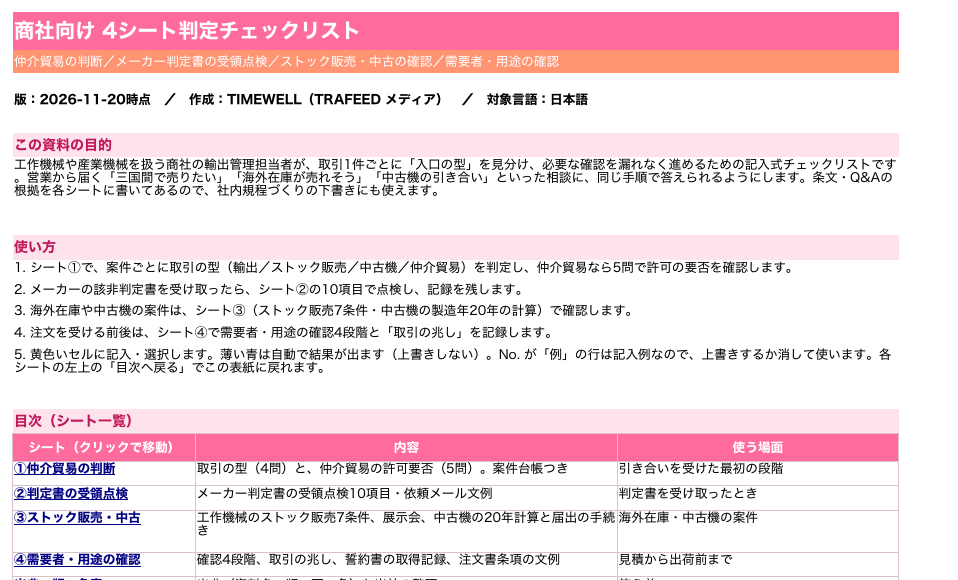
Four-Sheet Judgment Checklist for Trading Companies (editable Excel)
An editable checklist for trading-company staff: intermediary trade, review of maker classification sheets, stock sales and used machines, and end-user checks (Japanese only).
Get the fileYou can download it after a short form (Japanese).
Hello, this is Ryuta Hamamoto from TIMEWELL.
(November 21, 2026) We corrected the explanation of overseas branches: under FEFTA a branch itself is treated as a non-resident, but the contracts it concludes are those of the Japanese head office. In the division-of-roles table, we now separate the statutory chief export control officer from the in-house officer who handles day-to-day decisions. We also corrected our statement that the Q&A itself does not define "CP holder" (CP等保有者): the machine tool Q&A defines it in condition (2) of Q4-6.
(November 22, 2026) Below the division-of-roles table we had said flatly that the chief export control officer cannot be a director without representative authority or a division head. We have revised this: the officer is normally the representative director, but METI's CP Q&A (Q13) says that where choosing from the representative directors is difficult, as in a company with committees, a representative executive officer, director or executive officer may be chosen as an exception.
Picture someone who has just been put in charge of export control at a machinery trading company. First thing in the morning, three emails arrive from sales. The first says, "We want to send a machine we bought from a supplier in Thailand straight on to a customer in Vietnam." The second, "The stock we keep overseas for trade shows looks like it might sell." The third, "We've had an inquiry about a ten-year-old used machine."
In all three cases, where you start on the question of whether an export license is needed depends on the type of transaction. Is it brokerage trade, an export, a stock sale, or a used machine? Get that wrong and every step after it goes off course. This article puts in one place how to tell those entry points apart and the practical steps that follow from each. I have narrowed the readership to export control staff at trading companies that handle machine tools and industrial machinery.
The conclusion first
- Transactions can be sorted with four questions: "Do the goods leave Japan?", "Is a Japanese company party to both the purchase and the sale?", "Is it stock?" and "Is it used?"
- A manufacturer's classification record can be used, but the trading company, as the exporter, stays responsible. Check 10 points when you receive one.
- Brokerage trade has no bulk license and no small-value exception. Check three things every time: region, goods and end use.
Sorting transactions into four types: a decision flow and an entry table
The first job is to put a transaction into one of four types. Once the type is set, you know which section to read next.
Four questions
Answer them in order.
- Do the goods leave Japan for a foreign country (shipped from a Japanese port, airport or warehouse)?
- Is a Japanese company (a resident) party to both a contract to buy from a foreign company and a contract to sell to a foreign company?
- Is the buyer (the final end user) decided? Or is this an export of stock with no buyer yet?
- Are the goods used, and were they manufactured within the past 20 years?
Roughly speaking, a resident is an individual or a corporation with an address or head office in Japan. A Japanese company's overseas branch is itself treated as a non-resident under FEFTA. But it has the same legal personality as the head office, so the purchase and sale contracts it concludes are contracts of the Japanese head office, a resident (METI brokering trade Q&A Q46, Q57 and Q58). An independent overseas subsidiary is a separate corporation.
Classification table
| What the transaction looks like | Type | Entry check | Section to read |
|---|---|---|---|
| Shipped from Japan. Buyer decided | Export | Classification, end-user and end-use checks | Classification record section, end-user section |
| Shipped from Japan. Buyer not decided (stock placed overseas) | Stock sales | Seven conditions (for machine tools), or end-user and resale checks | Stock sales section |
| Shipped from Japan. Used, manufactured within 20 years | Used machine export | Pinning down the manufacturing year, basis for measured values, notification form | Used machine section |
| Goods move from one foreign country to another. A Japanese company is party to both purchase and sale | Brokerage trade | Item number of the goods, shipping region and destination, whether there is a "risk" | Brokerage trade section |
| Goods move between foreign countries, but a Japanese company is on only one side | May fall outside brokerage trade | The form of the contracts (deliberately arranging that form is another matter) | Brokerage trade section |
| Only transshipped in Japan | Goods from abroad are temporarily landed in Japan and sent on under a bill of lading to a destination outside Japan | Weapons always need a license; for destinations outside Appended Table 3, a license is needed when the WMD concern or an inform applies (Export Trade Control Order Article 4(1)(i)) | Transshipment section |
A transaction may be more than one type. "Used stock machines shipped from Japan," for example, means looking at both row 2 (stock sales) and row 3 (used machines) of the table. A sale of stock held in an overseas warehouse to a customer in another foreign country can take the form of brokerage trade if a Japanese company is involved in both the purchase and the sale. The Q&A published by METI (the Ministry of Economy, Trade and Industry) answers that this applies even if the goods have not yet been manufactured (Q3) or are held by someone other than the seller (Q4). Whether you have the goods in hand is not the deciding factor1.
Matching everyday terms to the legal terms
The words used on the ground and the words used in the law do not match.
| What people on the ground say | What the law and the Q&A say |
|---|---|
| Triangular trade (三国間取引), trade between foreign countries | Brokerage trade (仲介貿易; transactions involving the movement of goods between foreign countries) |
| Selling from inventory, overseas inventory, placing demo machines | Stock sales (ストック販売; exports where the end user has not been determined) |
| Used machinery, second-hand goods | Used machine tools (classification by someone other than the manufacturer) |
| The maker's classification paperwork, a "non-applicability" letter | Classification record (該非判定書), certificate of non-applicability (非該当証明書) |
Share this mapping with sales too. Sales say "triangular," export control says "brokerage trade," and that gap in naming is exactly what delays consultations.
Brokerage trade: five questions decide whether a license is needed
A transaction that the classification table puts under brokerage trade goes through the five questions in this section. Before that, it helps to have the legal basis and the structure of the license requirement clear. The export approval and transshipment rules, which you also need to check for deals involving other countries, are in the second half of this section.
The legal basis, and a caution on article numbers
The license requirement for brokerage trade transactions is based on Article 25(4) of the Foreign Exchange and Foreign Trade Act (FEFTA, 外為法). The specific scope is set by Article 17(5) of the Foreign Exchange Order (外為令). Before the amendment that took effect on 9 October 2025, the same content was in Article 17(3). The current Article 17(3) is a different provision, dealing with the provision of technology. We confirmed this on 20 November 2026 by comparing the current text on e-Gov with the versions in force from 28 May 2025 and from 9 October 202523.
Some older explanations, internal rules and articles still say "Article 17(3)." When you cite the article, change it to the current paragraph (5). If you find a document that cites the old paragraph (3), it is worth checking whether it was copied from the pre-amendment version.
When a license is needed: arms, and "risk"
Article 17(5) of the Foreign Exchange Order divides the transactions that need a license into two groups2.
| Goods | Conditions | License |
|---|---|---|
| Item 1 of Appended Table 1 of the Export Trade Control Order (輸出令別表第1) (arms) | Any region | Required |
| Items 2 to 16 of Appended Table 1 | Excluding cases where the shipping region or the destination is a region in Appended Table 3. Beyond that, where there is a risk of use in developing nuclear weapons and the like, in cases specified by METI ordinance, or where the Minister of Economy, Trade and Industry has notified you that you must apply for a license (an inform notice) | Required |
Appended Table 3 is the list of regions commonly called Group A. If either the shipping region or the destination is in Appended Table 3, everything other than arms falls outside this control.
"Nuclear weapons and the like" here covers not only nuclear weapons but also military chemical and biological agents, devices for dispersing them, and rockets and unmanned aerial vehicles with a range of 300 km or more2.
"Risk" is decided by documents and communications
What counts as a "risk" is set out in the brokerage risk ordinance (仲介おそれ省令, METI Ordinance No. 101 of 2006). In the ordinance's wording, one case is where the contract, or documents or electronic records the resident has obtained, state that the goods will be used for such purposes. The other is where the resident is told by the non-resident counterparty to the transaction, the end user or their agent that the goods will be used for such purposes4.
In other words, it is not decided by your impression of the counterparty or by the name of a country. It is decided by what the documents and communications in front of you say. Emails, specifications and requests for quotation received by a trading company's sales staff can all be "documents obtained." METI's Q&A answers that this broadly covers what the resident obtains in that transaction, public information included. It also says this means what is obtained in the course of normal business practice and does not oblige anyone to obtain particular documents1.
Five situations trading companies tend to overlook
The first is transactions by overseas branches. A branch has the same legal personality as the head office, so purchases and sales concluded by the branch are the Japanese head office's transactions (Q&A Q46, Q57 and Q58). Deals in which branch staff stand between a local supplier and a customer can also be covered. An independent overseas subsidiary is not subject to this control1.
The second is transactions without a written contract. A contract is formed simply by a notice accepting an offer, so a single email can form the purchase and sale contracts. The third is leases and transactions with transfer of ownership. A lease under which ownership transfers at the end of the term is treated as a sale, and changing the name makes no difference if it is a sale in substance.
The fourth and fifth are about timing. Where there is a master agreement and individual orders, the license is needed at the stage that makes the transfer of goods concretely possible, such as an individual order. Do not look only at the point when the master agreement was signed. And if goods are moved before the deal closes, the license is needed before that movement.
When the license is needed, and the absence of bulk licenses
The license is needed before whichever of the purchase and sale contracts is concluded later. If that contract is formed by dispatching or providing the goods, it is needed before that happens. METI's Q&A answers that every brokerage trade license is an individual license, that there is no bulk license (包括許可) system, and that the small-value exception (少額特例) cannot be used either1.
Sales often ask, "It's the same supplier and the same customer every time, so can't we get one license to cover them all?" Under this control, there is no way to do that. Build your internal flow on the assumption that you check every time.
Penalties
The penalty for conducting brokerage trade transactions without a license is in Article 69-7(1)(i) of FEFTA: imprisonment of up to seven years or a fine of up to ¥20 million, or both. If five times the value of the goods exceeds ¥20 million, the fine can be up to five times the value. For goods specified by Cabinet Order as posing a particularly high risk of use in developing nuclear weapons and the like, Article 69-7(2)(ii) provides for imprisonment of up to ten years, a fine of up to ¥30 million, or both (again with the five-times-value ceiling)3.
Older materials sometimes cite "Article 69-6." The current Article 69-6 is a transitional provision, not a penalty provision. We checked this on 20 November 20263.
Decision steps (five questions)
- Do the goods move from one foreign country to another? If so, go on.
- Is a Japanese resident, such as a Japanese corporation, party to both the purchase and the sale? Contracts concluded by an overseas branch count, because the party is the Japanese head office (Q&A Q46, Q57 and Q58).
- Are the goods arms (Item 1)? If so, a license is needed regardless of region.
- If they are not arms, is either the shipping region or the destination a region in Appended Table 3? If so, no license is needed under this control.
- If neither is in Appended Table 3, is there anything in the contract, the documents obtained, or messages from the counterparty and others saying the goods will be used to develop nuclear weapons and the like? Or have you received a notice from the Minister of Economy, Trade and Industry?
If the goods are arms under question 3, or if question 5 turns up a statement, a communication or a notice, apply for a license before the transaction. The applicant is the resident who intends to carry out the transaction. For an overseas branch's transaction, the head office is the applicant (Q&A Q53 to Q55). If in doubt, consult METI in advance, before the contract is concluded.
Detailed explanations are in the basics of brokerage trade (in Japanese), license timing and overseas branches (in Japanese) and an overview of brokerage trade regulation.
Question 6: check the laws of other countries too
The five questions decide Japan's brokerage-trade control under FEFTA. Goods that move from one foreign country to another are also subject to other countries' laws. These three are the ones trading companies tend to miss.
| Law to check | What to look at | Our related articles |
|---|---|---|
| Export controls of the shipping country | Whether the export control law of the country the goods actually leave requires a license. Check under that country's law, with the local exporter or agent | — |
| U.S. EAR | U.S.-origin items are subject to the EAR wherever located (15 CFR 734.3(a)(2)). Foreign-made items incorporating more than a certain share of U.S.-origin content (de minimis, 734.4) and foreign-made items produced from U.S. technology (foreign direct product rules, 734.9) can also be subject | Telling when extraterritorial rules apply, FDPR and de minimis |
| Shipping from China | Whether China's Export Control Law and dual-use item controls apply; some items are subject to measures aimed at Japan | China's dual-use export measures against Japan |
Do not stop when you find that no Japanese license is needed. Record the result of checking each of the three for a three-country transaction.
Russia, Belarus and designated entities in third countries (export approval)
Beyond the five brokering questions, two more regimes need checking when a deal involves other countries: export approvals for Russia, Belarus and related destinations, and transshipment in Japan. Separately from the "licenses" of list controls and catch-all controls, exports involving Russia and Belarus can require an "approval" from the Minister of Economy, Trade and Industry under Article 48(3) of FEFTA. The basis is Article 2(1) of the Export Trade Control Order, which uses tables different from Appended Table 1 of the list controls (Appended Tables 2-3 and 2-4)5.
| Export Trade Control Order Art. 2(1) | Destination or counterparty | Goods covered |
|---|---|---|
| Item (i)-3 | Belarus | Goods in Appended Table 2-3 (excluding item 1-2, items 2(32)–(85), item 2-2 and item 3) |
| Item (i)-4 | Russia | Goods in Appended Table 2-3 |
| Items (i)-6 and (i)-7 | Persons in Belarus or Russia designated by METI notice | Even goods not covered by the two rows above, when exported through direct or indirect dealings with a designated person |
| Item (i)-8 | Persons designated by METI notice in the ten countries of Appended Table 2-4 (the UAE, Armenia, China, India, Kazakhstan, Kyrgyzstan, Syria, Thailand, Turkey and Uzbekistan) | Goods in Appended Table 2-3 (excluding item 3), when exported through direct or indirect dealings with a designated person |
Each item also excludes certain entries of Appended Table 2. Confirm the final answer against the text.
For a trading company handling machine tools, three points matter.
First, machine tools are in Appended Table 2-3. Item 2(43) reads "machine tools and their parts and numerical control units for machine tools." Even if a machine is not listed under the list controls, it needs approval when bound for Russia (item (i)-4).
Second, counterparties in third countries are covered too. If a counterparty in China, Turkey, the UAE, Central Asia or the other listed countries is a person designated by the notice, exporting goods in Appended Table 2-3, including machine tools, needs approval (item (i)-8). Add the notice's list to your counterparty screening. Indirect dealings count as well as direct ones.
Third, the list of goods widened on October 16, 2026. An amendment to the Order (Cabinet Order No. 325) added goods to item 2-2 of Appended Table 2-3 (plaster, ores such as chromium ore, chlorine and sulfur, plastic monofilament, steel barbed wire and chains, copper and aluminium and their products, machine parts and more). The Customs notice describes this as "the ban on exports of goods that strengthen Russia's industrial base and on exports to specified entities in countries other than Russia and Belarus"6. The widened item 2-2 does not apply to Belarus (item (i)-3).
Know the likely outcome of an approval application, too. Section 2-1-1-3 of METI's operational circular (the version in force from 14 February 2026) says that, for exports under items (i)-3 to (i)-8 of Article 2(1) destined for Belarus, Russia, Ukraine or a region in Appended Table 2-4 (for item (i)-4, limited to goods in items 1 to 2-2 of Appended Table 2-3), approval is "in principle not granted," although "approval may be granted where the export meets separately established export approval criteria." For goods in item 3 of Appended Table 2-3 bound for Russia, approval is "not granted" (our translation)7. Machine tools bound for Russia (item 2(43)) fall under "in principle not granted" in that version. METI's page also lists a partial amendment to the operational circular dated 9 October 2026; we have not read the text of that amendment.
The lists of designated persons are on METI's page "Sanctions against Russia and others" (対ロシア等制裁関連). The page links to a document titled "Persons designated by the Minister of Economy, Trade and Industry by public notice under Article 2(1)(i)-6, (i)-7 and (i)-8 of the Export Trade Control Order" (the same wording the Bulk License Handling Guidelines use as the name of METI Notice No. 162 of 2023), and to lists of the entities subject to the export bans in the Russian Federation, in the Republic of Belarus, and in countries other than those two (checked on 22 November 2026)8. We have not checked the contents of the notice or the lists, or how many persons are designated. Screen counterparties against the latest versions on that page. A designation is a category in the control system, not an assessment of any country or company.
For spotting deals that reach Russia through a transit country, see "How to spot circumvention and transshipment". The approval system under Appended Table 2 is covered in "Export approval under Appended Table 2."
Goods transshipped in Japan (goods temporarily landed for a foreign destination)
The Export Trade Control Order calls goods that are temporarily landed at a Japanese port or airport and carried under a bill of lading (including an air waybill) to a destination outside Japan "goods temporarily landed for a foreign destination" (Article 4(1)(i))5.
| Situation | License under FEFTA Article 48(1) | Basis |
|---|---|---|
| Goods in item 1 of Appended Table 1 (weapons) | Always required | Article 4(1), proviso |
| Destination is one of the 27 countries in Appended Table 3 (including the U.S., the UK, Germany, France, Korea and Australia) | Not required | Article 4(1)(i) |
| Destination is outside Appended Table 3 | Required when the goods may be used for developing weapons of mass destruction (as set by ministerial ordinance) or when METI has notified you to apply (an inform). Otherwise not required | Article 4(1)(i)(a) and (b) |
Export approvals (Article 2, including the Russia-related approvals above) generally do not apply to exports of temporarily landed goods (Article 4(3)(i)). Goods in items 1, 35, 35-2, 37 to 41 and 43 to 45 of Appended Table 2 are excluded from this exemption. Goods carried to Japan under a bill of lading naming Japan as the destination do not fall within this definition. If you send such goods abroad, treat it as an ordinary export.
As with brokering, the WMD concern is determined by documents and communications from the other party. For transshipments to destinations outside Appended Table 3 where the end user or end use is unclear, go through the same five questions used for brokering. Brokering controls can also apply at the same time. METI's brokerage trade Q&A (Q23) answers that a transaction in which the goods are only to be transshipped in Japan during their movement "is treated as a movement between foreign countries. In this case, transshipment controls may also apply at the same time" (our translation)1. If a Japanese company is a party to both the sale and the purchase, check both the five brokering questions and this table.
Watch the timing of payments as well, in particular payments made or received before a license or approval is granted. Article 16(5) of FEFTA provides that, where a license or approval is required for a transaction or act, payments relating to it must not be made without that license or approval, except in cases set by Cabinet Order3. The Cabinet Order exception (Article 6(5) of the Foreign Exchange Order) is limited to payments for exports or imports of goods that need a license under FEFTA Article 48(1) or an approval under Article 2(1) of the Export Trade Control Order and that the Minister has designated by public notice. Brokering licenses (FEFTA Article 25(4)) are not among them2.
A revision of the definition has also been proposed. The draft Cabinet Order put out for public comment on 19 October 2026 would delete Article 4(2)(iii) from the definition of "goods temporarily landed for a foreign destination" in Article 4(1)(i) of the Export Trade Control Order. The same draft would also add exports under Article 1(3) of the Order to what is excluded from the ban on settling payments before a license or approval (Article 6(5) of the Foreign Exchange Order)9. As of 22 November 2026, e-Gov lists no amendment to the Export Trade Control Order awaiting entry into force5. The draft is covered in "Japan's FEFTA Revisions Explained: From the February 2026 Changes to the October Draft."
Replace siloed classification work with AI.
METI's FY2024 data shows 52% of foreign exchange law violations stem from classification errors. Download the TRAFEED product catalog covering features and rollout.
Goods leaving Japan: classification records, stock and used machines
From here on, the goods leave Japan. In the classification table, that covers three types: exports, stock sales and exports of used machines. Whatever the type, you first confirm where the goods sit under the controls, and then look at the conditions for that type. Classification records come into play for stock placed abroad in advance and for used machines you bought in, too, so that is where to start.
Receiving a manufacturer's classification record: a 10-point check and a request template
For an export, the first document that lands on a trading company's desk is usually the manufacturer's classification record.
Responsibility stays with the trading company
METI's Q&A answers that METI does not carry out classification (該非判定, determining whether an item or technology falls under the control lists) and that the exporter should do it on its own responsibility. If you cannot judge for yourself, you may obtain and use a classification record from the manufacturer or others. The Q&A adds, however, that the exporter should check the result and treat it as a result the exporter has determined on its own responsibility10.
A classification record is input to your judgment. It does not take the responsibility off your hands. METI's introductory guidance (version 3.0) also says that when a trading company exports goods made by a manufacturer, the exporter in law is the trading company, and it is the trading company that will be held legally responsible. For purchased items, it asks companies to check again for themselves whether the name and model on the classification record match the goods being exported, whether the reasons for the classification are clear and sound, and whether it was checked against the latest regulations11. A trading company can be the exporter even of goods it did not make. So when a record arrives, read it, and keep a record that you read it. Those two things are the basic moves of export control at a trading company. The background and the thinking on responsibility are also covered in METI Q&A: classification and the steps before applying for a license (in Japanese) and how to write and receive a certificate of non-applicability.
A 10-point check on receipt
Check every classification record that arrives against the following 10 points. If even one is missing, send it back to the manufacturer.
| No. | Check point | What to look at | What to do if it is missing |
|---|---|---|---|
| 1 | Product name, model number | Is it identical, character for character, to the model you are selling? Do not miss suffix codes or a different series | Identify the model and ask again |
| 2 | Configuration, options | Does the classification cover the control unit, number of axes, add-on units and installed software? | Ask for a classification for each configuration |
| 3 | Classification date | Is it dated? Is the date too old? | Ask for a reissue with the classification date |
| 4 | Version of the regulations | Which point in time's regulations were used? Is it on or after the effective date of the latest amendment? | Ask them to state the effective date of the regulations they referred to |
| 5 | Coverage of item numbers | Does it state controlled or not controlled for each item number of the Goods Ordinance (貨物等省令)? Does it classify only some item numbers? | Ask for a classification of all item numbers |
| 6 | Reasons for "not controlled" | Does it distinguish "not applicable" (非該当) from "outside the scope" (対象外)? Is there a basis for the reason? | Ask for a parameter sheet or similar to be attached |
| 7 | Supporting material | Can you tell the basis for the specification values (measured, catalog or declared values)? | Ask for an item-by-item comparison sheet or a parameter sheet |
| 8 | Wording on Item 16 | Do you understand for yourself what "not applicable under Items 1 to 15; falls under Item 16" means? | Move on to catch-all checks |
| 9 | Issuer, signature | Are the issuing department, company name, person in charge, and name and seal there? | Ask for a reissue stating the issuer |
| 10 | Validity, reclassification | Is reclassification needed because of the manufacturing year, specification changes or amendments to the regulations? | Decide when to reclassify |
The "latest amendment" in point 4 comes around more often than you might think. The e-Gov history shows effective dates for amendments to the Export Trade Control Order of 19 January, 14 February, 5 June and 16 October in 2026 alone (and in 2025, amendments also took effect on 15 November and 1 December)12. If the classification date on the record is earlier than the most recent effective date, check with the manufacturer whether the amendment changed the classification.
Point 8 is the one most often misunderstood in practice. Even if the record says "not applicable under Items 1 to 15," goods that fall under Item 16 still carry the obligation to check end use and end users. A record that says "not controlled" does not let you skip checking the counterparty. For details, see our article on certificates of non-applicability and the three requirements of catch-all controls.
Keep the results of the check as a single record together with a copy of the classification record: who checked which points, and when. It is the record that protects you from being told later that "you used the manufacturer's classification record without reading it." The ten points are on the "②判定書の受領点検" (receipt check of classification records) sheet of our trading company judgment checklist (Excel, in Japanese), with one entry per classification record.
Classification records also arrive through other trading companies
At a trading company, classification records sometimes come not from the supplying manufacturer but through another trading company or a distributor. The same 10 points apply. But when the issuer is one step removed from your own supplier, points 9 and 7 tend to break down. Check whether you can trace back to a copy of the manufacturer's own classification record.
Request email to the manufacturer (template)
Below is a template in a form you can use as it is. It follows the same thinking as the request template in our other article (on certificates of non-applicability), with the manufacturing year and serial number added for trading companies. It is based on the Japanese system. Use it after review by your legal team and your export control officer.
Subject: Request for classification documents (your product "[product name / model]")

[Manufacturer name]
Sales Department, [Name]

Thank you for your continued support. This is [Name], export control,
[Your company name].

We plan to supply your product to a customer overseas and are carrying out
classification under the Foreign Exchange and Foreign Trade Act. Could you
kindly provide the following?

1. Classification record (controlled / not controlled for each item number
   of the Goods Ordinance, and the classification date)
2. Material showing the basis for the classification, such as a parameter
   sheet or an item-by-item comparison sheet
3. The effective date of the regulations used for the classification
   (we would ask for a classification under the latest amended version)

[Product]
- Product name / model:
- Configuration (control unit, options, installed software):
- Serial number (for used goods):
- Year and month of manufacture (as far as known):

[Delivery region] (the country name is enough):
[Requested by] [date] (worked back from the planned shipping date)

We will use your classification record as our classification result on our
own responsibility, after checking its content as the exporter. If anything
is unclear, please feel free to contact us, by phone if you prefer.
Thank you very much for your help.
Some manufacturers reply that they "don't issue anything in the form of a classification record." Even then, the exporter's duty to classify does not go away. Work out the specifications from catalogs and data sheets, and narrow down candidate item numbers with an item-by-item comparison sheet. For specifications that remain unclear, you will often get an answer if you ask not for a classification record but a technical question: "Could you tell us the [X] specification of this product?" This approach is the same as the one in our article on certificates of non-applicability. If gaps still remain, treat the item as one you cannot classify and move on to considering a license application or consulting a specialist.
Stock sales: seven conditions for machine tools, and other stock
Stock sales means placing machines locally in advance, before the end user is decided. It is the form trading companies most want to use, but the conditions are heavy and different rules apply depending on the type. I will take it in two parts.
Stock sales of machine tools (Item 2(12)1): seven conditions
METI's Q&A on machine tools answers that stock sales of numerically controlled machine tools falling under Item 2(12)1 can be carried out if all seven conditions below are met and a license is granted after review13. Restated for trading companies, they look like this.
| No. | Condition (gist of the Q&A) | What the trading company prepares |
|---|---|---|
| 1 | The destination is in Region ro (excluding Appended Table 3-2 and Appended Table 4) | Confirmation that the destination is in Region ro as defined in the circular (see below) |
| 2 | The importer (the holder of the stock) is a subsidiary or similar of a CP holder, or its agent | Materials showing the capital relationship. For an agent, the agency agreement covering stock sales |
| 3 | The stock status is reported every six months | A person responsible for reporting, and a register of reporting dates |
| 4 | Applications for prior consent are made for resale and re-export | A flow for running the prior consent procedure for each sale |
| 5 | The stock quantity is appropriate | A sales plan (market area, target industries and so on) and the quantity of existing stock |
| 6 | A relocation detection device is installed, and its unlock password is properly managed and operated by the manufacturer | The manufacturer's management documents (with the name and seal of a representative with signing authority) |
| 7 | The importer manages the stock machines strictly | Floor plans and photos of the installation and storage site, and the locking and security arrangements |
The Q&A itself defines "CP holder" (CP等保有者), in condition (2): a company that has received both a CP acknowledgement slip and a checklist acknowledgement slip from the Security Export Inspection Office for putting internal export control regulations (a compliance program, or CP) in place and reliably implementing the FEFTA compliance requirements (Q4-6)13. The Bulk License Handling Guidelines (包括許可取扱要領) list the same two acknowledgement slips as a requirement for applicants for licenses such as the Special General Bulk License14. Condition 2 requires that the customer's local subsidiary or agent be linked to a company in that position by a capital relationship or an agency agreement.
The following are treated in the same way as a "resale" and are subject to prior consultation: lending a stock machine in advance to a company you plan to sell it to, and being forced to move it under local law or the like. Moving a machine from its stock installation or storage site without prior consultation can breach the license conditions.
Stock machines placed under a consignment sales contract must, when the contract term ends, either be shipped back within the deadline in line with the license conditions, or have ownership transferred to the consignee after going through the prior consultation procedure for resale. If the installation or storage site does not change, an extension of the contract term may be allowed.
"Region ro" and "Region ri" are set by a table annexed to the operational circular
The Q&A refers to destinations by the names used in the circular, "Region ro" (ろ地域) and "Region ri" (り地域). These categories are set by a table in an annex to the operational circular for the Export Trade Control Order ("On the Operation of the Export Trade Control Order," last amended by an amendment promulgated on 14 November 2025 that took effect on 14 February 2026). The table lists countries and regions in the left column and puts a circle in whichever of its 15 columns, from "Region i (1)" (い地域①) to "Region nu" (ぬ地域), apply15. Here is what we found when we re-read the circles in the table.
| Category | What we read |
|---|---|
| Region ri | Four countries: India, Singapore, the Philippines and Malaysia |
| Region ro | Many countries and regions in the table have a circle. In Asia, it includes China, Hong Kong, Macao, Taiwan, Thailand, Vietnam, Indonesia, Cambodia, Laos, Brunei, Myanmar and Mongolia, plus the four Region ri countries |
| Examples not in Region ro | The countries and regions in Region i (1) (the United States, the United Kingdom, Germany, France, Canada, Australia, South Korea and others) have no Region ro circle |
The Bulk License Handling Guidelines contain the wording "Region ro (excluding Region chi)." Region chi (ち地域) is shown in a separate column of the table, and places can be excluded here even if they have a Region ro circle14.
From the Q&A and the guidelines, we confirmed two conditions that relate to these categories. Condition 1 for stock sales excludes Appended Table 3-2 and Appended Table 4 from Region ro13. And when exporting machine tools fitted with a relocation detection device to Region ri under a Special General Bulk License, prior notification is required, and you cannot export for 14 days after it is accepted. The guidelines contain the same condition14.
Always look up the list of countries in the latest annex to the operational circular. The categories can change with amendments. Do not copy the country names in this table from old materials into your internal tables.
Exhibiting at trade shows
Machines can be exhibited at trade shows without a relocation detection device. You submit documents committing to two things: not transferring ownership from Japan, and always shipping the machine back to Japan after the show ends. A trade show here means one that meets all three of the following at once: it is run by a third party, it is held at a public facility, and there are many exhibitors. Private showings hosted by your own company or group are not included. The principle is "one show, one application"13.
Stock sales outside machine tools, and under other schemes
Catch-all controls and the Special General Bulk License also have rules on stock sales. For stock sales in regions other than those in Appended Table 3, METI's Q&A says it is desirable to run checks similar to those required under the Special General Bulk License even when you hold an individual license. There are two points to check: that the stock sales customer and the end user are not the military, a military-related body or a similar body, and that the goods will not be resold to countries or regions in Appended Table 3-2 or Appended Table 4 of the Export Trade Control Order. Ideally, the importer confirms this in a document or by email10. The license conditions of the Special General Bulk License (in the Bulk License Handling Guidelines) contain a provision to the same effect: when carrying out stock sales in regions other than those in Appended Table 3 of the Export Trade Control Order, you check the expected end users and so on, and confirm that there are no plans to resell to third countries for which this license cannot be used14.
If the end user is not yet decided, checking against the end-user requirement of catch-all controls is in principle not necessary. Checking the expected end users and importers is still considered desirable. The differences between the two schemes are covered in Special General Bulk License returns and stock sales (in Japanese) and inform notices and stock sales (in Japanese).
Document list (stock sales)
- Materials showing the relationship between the importer and your company (capital relationship, agency agreement)
- Sales plan and quantity of existing stock
- The manufacturer's management documents for the relocation detection device
- Overview of the stock installation and storage site (floor plan, photos, locking and security)
- Register of six-monthly status reports
- Records of prior consent for resale and re-export
These are set out in more detail in 15 questions on stock sales, trade shows and attached documents for machine tools (in Japanese). The "③ストック販売・中古" (stock sales and used machines) sheet of the same checklist (Excel, in Japanese) lets you record the seven conditions and the documents for each stock location.
Used machines: the notification for machines within 20 years of manufacture
After stock comes used machinery. When a trading company handles a used machine, the procedure depends on whether it is within 20 years of manufacture.
First, pin down the manufacturing year
With used machine exports, the first thing to settle is the manufacturing year. The procedure splits on whether the machine is within 20 years of manufacture. The Q&A sets out the end of the 20-year window for each of the date, the year and month, and the year of manufacture, as follows. The rightmost column gives examples we calculated by the same method for years that tend to come up now13.
| Manufacturing information | End of the 20-year window (Q&A example) | Our calculation (same method) |
|---|---|---|
| Year and month of manufacture: December 2004 | Until the last day of November 2024 | December 2007: until the last day of November 2027 |
| Date of manufacture: 17 December 2004 | Until 16 December 2024 | 17 December 2007: until 16 December 2027 |
| Year of manufacture: 2004 | Until the last day of December 2024 | 2006: until the last day of December 2026. 2007: until the last day of December 2027 |
For a machine where only the year is known, it counts as within 20 years until the end of that year. A machine made in 2006 passes the 20-year mark about 40 days after this article's publication date. For how a particular transaction is treated, including which date to count the 20 years from, check with METI.
If you cannot pin down the manufacturing year, try to obtain catalogs, brochures and specifications, and ask the manufacturer directly as well. If you still cannot get them, put in writing the steps you took to identify it, so that you can give a reasonable explanation.
When someone other than the manufacturer exports a machine within 20 years
Trading companies are usually not the manufacturer. The Q&A sets things out as follows13.
| Situation | Procedure |
|---|---|
| A machine that was controlled when manufactured is judged not controlled on the basis of measurements by someone other than the manufacturer | Obtain the manufacturer's confirmation and file a PDF of the notification form (Attachment 6) with the Security Export Licensing Division. A notification acknowledgement slip is issued by email. You can clear customs with the slip, and no export license is needed |
| Judged controlled by someone other than the manufacturer | No need to check with the manufacturer. Apply for an export license according to the relevant item number and destination |
| Catalog, specification or declared values are stated to be based on positioning accuracy or similar, and they showed the machine as controlled | You can apply for a license without measuring |
| The validity of the accuracy figures cannot be confirmed | An export license application is required |
| The manufacturer does not respond to the request for confirmation | If the machine was controlled when manufactured (including when new), apply for an export license. If the manufacturer will not respond even on the machine's status at the time of manufacture, file the notification, stating clearly that the manufacturer refused to confirm the measurement results |
| The manufacturer has been dissolved | State this in the notification form. One example of supporting evidence is the Official Gazette |
| Non-controlled since manufacture, with a non-applicability certificate based on the manufacturer's measured values | That certificate can be used (Q2-18) |
| More than 20 years since manufacture | No change from the previous procedure, for parties other than the manufacturer as well |
On how long it takes for the notification acknowledgement slip to be issued, the Q&A answers that "we cannot give an approximate period." Build delivery schedules with plenty of slack.
Keep records when you buy
When you buy a used machine, record the following six things. All of them are hard to obtain later.
- Manufacturer name and model
- Year of manufacture (ideally the date of manufacture)
- Serial number and a photo of the nameplate
- Where the catalog and specification values came from
- Whether you can expect to ask the manufacturer for confirmation (contact details)
- Whether a controlled program is installed
If the program is controlled and the machine is not, the machine's classification is also checked in the review of the license to provide technology (役務取引許可) for the program, so you do not need to obtain a separate notification acknowledgement slip. Submit a copy of that license to customs13. Details are in 14 questions on used machines and the 20-year rule (in Japanese).
End-user and end-use checks: the documents to secure for deals in Asia
Look at business, end use and installation site, not country names
The procedure for checks is the same whether the customer is elsewhere in Asia or in China. Do not screen counterparties by nationality or by the name of the destination country alone. What the system looks at is where, for what and by whom the goods will be used. Listing on the End User List (外国ユーザーリスト) is a regulatory classification, not a judgment on whether a company is good or bad. A METI notice (29 September 2025, applying from 9 October 2025) provides that where the end user of exported goods is on the list, a license from the Minister of Economy, Trade and Industry is required unless it is clear from the end use and the terms and conditions of the transaction that the goods will not be used to develop weapons of mass destruction, conventional weapons and the like16. Not being on the list is not proof that a transaction is safe.
Note also that, for "between foreign countries" in brokerage trade, China, Hong Kong and Macao are each treated as different foreign countries (METI Q&A Q22)1. Record transactions via Hong Kong or Macao as involving separate countries too.
Four stages of checks for trading companies
| Stage | What to check | What to keep |
|---|---|---|
| Inquiry | The counterparty's legal name, address and business, and an outline of the end use. Who the final user is | Inquiry emails, records of how company information was obtained |
| Quotation | Matching the goods' specifications against the classification record. List screening | Classification records, results and date of list screening |
| Order receipt | End use, installation site and any resale stated in the purchase order. Obtaining a pledge | Purchase order, the end user's pledge |
| Before shipment | Does the ship-to party match the addressee on the purchase order? Has the commercial flow changed? | Shipping instructions, records of changes |
In license reviews for machine tools, METI asks as needed for materials showing what the workpieces are, materials on the final products the workpieces go into, the floor layout of the installation site, confirmation that other companies sharing the premises will not use the goods, and so on13. Whether or not you end up applying for a license, building relationships in which you can ask for these at the order stage cuts down on rework later.
Decide in advance how you will ask. For example, five points: what will be machined, what the finished product is a part of, the address of the factory where the machine will be installed, whether any other company is in the same building, and whether there are plans to resell the goods to another company. The record for each deal can go on the "④需要者・用途の確認" (end-user and end-use checks) sheet of the trading company judgment checklist (Excel, in Japanese). For machine tools going to Asia, our machine tool end-user questionnaire and red-flag list (Excel, in Japanese) adds a 15-item questionnaire for the counterparty and a list of ten red flags.
Signs in a transaction that trading companies watch for (our framing)
The signs below apply to any transaction, regardless of the counterparty's nationality. Do not draw a conclusion from one sign alone. When several overlap, increase the depth of your checks.
- Explanations of end use or workpieces are not given even when asked for
- The names or addresses of the orderer, the delivery destination, the payer and the installation site are all different
- The specifications look excessive for the stated end use
- Delivery dates are brought forward, or the installation site changes at the last minute
- Answers to export control questions are vague and change every time
When several overlap, escalate to the responsible officer in your company and keep a record. METI's Q&A indicates that even for counterparties you have dealt with for some time, if a factory is relocated or a new one is built, you should additionally check business plans and the like10. The more familiar the counterparty, the harder it is to notice change.
Sample wording for purchase orders (template)
Below is sample clause wording for purchase orders or terms of sale. It is based on the Japanese system and assumes review by your legal team and your export control officer. Adapt it to your own contract format.
(Clause on end use and export control)
Article [X] The Buyer represents and warrants the following with respect to
the goods purchased from the Seller (the "Goods"):
1. The end user of the Goods is the party stated in the Annex, and the
   installation site is as stated in the Annex.
2. The Buyer will not use, or allow any third party to use, the Goods for
   the development, manufacture, use or storage of nuclear weapons,
   military chemical or biological agents, devices for dispersing them,
   rockets or unmanned aerial vehicles capable of delivering them,
   or any other military end use, including conventional weapons.
3. If the end use, end user, installation site or resale destination of
   the Goods is to change, the Buyer will notify the Seller in writing
   in advance.
4. The Buyer will not transfer or resell the Goods to any third party,
   or move them to another country or region, without the Seller's prior
   written consent.
5. If the Seller requests checks it considers necessary for export control
   (including checks of end use, end user and installation status),
   the Buyer will cooperate.
Article [X] If the Buyer breaches the preceding Article, or is likely to
do so, the Seller may suspend shipment and terminate the contract.
Sample wording for an end-user certificate (pledge) (template)
In Japanese export control, the pledge forms are prescribed in METI's circular on the documents to be submitted with license applications (提出書類通達, the Submission Documents Circular), and the Bulk License Handling Guidelines refer to pledges by those form numbers. Form 2 is written by the final end user. Form 3 is used where the importer or the counterparty to the transaction is not the final end user (in stock sales, for example). Form 4 covers goods and technology controlled under the Chemical Weapons Convention. Where a METI form is prescribed, use it. The template below shows the gist of what to ask the counterparty to write in transactions that do not require a form, or for your own internal checks. How to choose the form is covered in our guide to end-user certificates and pledges17.
Confirmation of End Use and End User

To: [Your company name]
Issued by: (company name, address, name of representative, date)

1. Goods: (product name, model, quantity, serial number)
2. End user: (legal name, address)
3. Installation site: (address, building, floor)
4. End use: (what will be machined, outline of the finished product)

We pledge that we will:
(a) use the above goods only at the above installation site and for the
    above end use;
(b) not use them for the development, manufacture, use or storage of
    weapons of mass destruction or conventional weapons; and
(c) not resell or transfer them, move them to another location, or
    re-export them to another country or region, without your prior
    written consent.

Name and seal (or signature):
The pledge is written by the buyer or the final end user. It is not something the exporter fills in on their behalf. For details of handling, such as keeping the original and prior consent for re-export, check the instructions for completing the forms.
Where bulk licenses fit
As noted earlier, brokerage trade has no bulk license. On the export side, there are schemes such as the Special General Bulk License (特別一般包括許可, often shortened to toku-ippan) and the Specific Bulk License (特定包括許可).
Machine tools in Item 2(12)1 fitted with a relocation detection device can use the Special General Bulk License for some destinations, subject to conditions (our conclusion for China is later in this section). The conditions for Region ri that we confirmed in the Bulk License Handling Guidelines are as follows14.
| Condition | Content |
|---|---|
| End user | Limited to cases where the end user is decided. The guidelines limit exports to Region ri to cases that do not involve stock sales |
| Prior notification | Notify using Form 14 before exporting. You cannot export under this license for 14 days from the date of acceptance |
| Exporting again to the same parties | After the 14 days, no new notification is needed when exporting again to the same importer (buyer and consignee), end user and delivery site for the equipment |
| Pledge | Obtain a Form 2 pledge from the end user before exporting |
| Performance reports | Report January to June results by the end of July, and July to December results by the end of the following January, using Form 18 |
| Record keeping | Keep export documents under your internal export control regulations for at least seven years for Items 2 to 4 and at least five years for Items 5 to 16 |
| Checklist | Throughout the license's validity, submit the Exporter Profile and Self-Management Checklist every year between 1 and 31 July |
Exports where the Special General Bulk License cannot be used (proviso to Section II-4(1))
Right at the start of the paragraph that sets the scope of the Special General Bulk License (Section II-4(1)), the guidelines list, in a proviso, exports to which it cannot be applied14:
“However, [this license] may not be applied to exports via a region listed in Appended Table 3-2 or Appended Table 4 of the Export Trade Control Order, to exports destined for a region listed in Appended Table 2-4 of the Order (limited to those made through direct or indirect transactions with persons specified in item 3 of METI Notice No. 162 of 2023, which designates persons under Article 2(1)(i)-6, (i)-7 and (i)-8 of the Order), or to the provision of services for the purpose of providing to persons specified in item 3 of METI Notice No. 162 of 2023.” (our translation)
In trading-company terms, the license cannot be used for:
- Exports routed via a region in Appended Table 3-2 or Appended Table 4 of the Export Trade Control Order
- Exports to a region in Appended Table 2-4 that are made through direct or indirect transactions with persons specified in item 3 of Notice No. 162
- Provision of services intended for persons specified in item 3 of Notice No. 162
Appended Table 2-4 lists ten countries: the United Arab Emirates, Armenia, China, India, Kazakhstan, Kyrgyzstan, Syria, Thailand, Turkey and Uzbekistan12. India, which is in Region ri, is among them. We have not checked the text of Notice No. 162 or its latest list of designated persons; when screening, check the latest notice and lists on the METI page given in the Russia and Belarus section above8. This is a category in the control system, not an assessment of any country or company.
Our conclusion on machine tools bound for China (as of 22 November 2026, within what we could confirm in the original texts)
Which bulk license can be used for which goods and destination is set by Appended Table A of the guidelines (the bulk license matrix for goods). The guidelines define the scope of the Special General Bulk License as exports of "combinations of goods and destinations falling in cells marked 'Special General' in Appended Table A" (Section II-4(1)①), and the scope of the Specific Bulk License as "combinations of goods and destinations falling in cells marked 'Specific' in Appended Table A, as stated on the license" (Section III-4(1)) (our translation)14. The machine tool rows of Appended Table A read as follows18.
| Row of Appended Table A (goods) | Destination columns and the licenses marked |
|---|---|
| Item 2(12)1 goods falling under Article 1(xiv) of the Goods Ordinance (limited to machines fitted with a relocation detection device) | Region i (1): Special General, General / Region i (2): Special General / Region ro (excluding Regions chi and ri): Specific / Region chi: – / Region ri: Special General, Specific |
| Item 2(12) goods falling under Article 1(xiv) or (xvii) (other than the row above) | Region i (1): Special General, General / Region i (2): Special General / Region ro (excluding Regions chi and ri): Specific / Region chi: – / Region ri: – |
| Items 6(1) to (10) goods falling under Article 5(i) to (xii) of the Goods Ordinance (including machine tools under Article 5(ii)) | Region i (1): Special General, General / Region to (2): Special General / Region chi: – |
In the table annexed to the operational circular, China, Hong Kong and Macao have circles in "Region ro" and "Region to (2)", and none in "Region chi" or "Region ri" (we read a version converted to text, matching each circle's position to the column headings)15. From this we read the following (our reading).
- When selling a machine tool that falls under Article 1(xiv) (item 2(12)) to China, the only cell in Appended Table A is "Specific," whether or not it has a relocation detection device. It is outside the scope of the Special General Bulk License (Section II-4(1)①). If you want a bulk license, the candidate is the Specific Bulk License. Exports such as returning goods that were imported for repair fall under a separate slot, Section II-4(1)②.
- A machine tool that does not fall under Article 1(xiv) but falls only under item 6(2) (Article 5(ii)) has "Special General" in the Region to (2) column. Exports to China can fall within the scope of the Special General Bulk License.
- Neither bulk license can be used for exports to a region in Appended Table 2-4 (which includes China) made through direct or indirect transactions with persons specified in item 3 of Notice No. 162 (the provisos to Section II-4(1) for Special General and Section III-4(1) for Specific)14.
Section II-4(1)①(ro) of the guidelines limits the Special General Bulk License for item 2(12)1 machines with a relocation detection device bound for Region ri to cases where the end user is decided. China is not in Region ri, so this provision does not apply.
The path to a Specific Bulk License
The Specific Bulk License is for exporting particular goods in bulk to the same counterparty with whom you have a continuing transaction relationship (Section III-3(1) of the guidelines)14.
| What to check | What the guidelines provide |
|---|---|
| Applicant (your company) requirements (Section III-2; all of them) | (1) You apply as set out in the circular on special procedures. (2) You have been issued a CP acknowledgement slip and a checklist acknowledgement slip by the Security Export Inspection Office. (3) You have undergone a compliance inspection (not required when a specified exporter applies for a Specific Bulk Export License). (4) You have a continuing transaction relationship under Section III-5(5) with the importer and the end user. (5) You have exported after an internal review under internal regulations for which an acknowledgement slip was issued |
| Continuing transaction relationship (Section III-5(5); any one) | For the importer, for example: six or more export licenses for the same importer in a one-year period beginning on the first day of any month within one year before the application (including where this is expected), or two or more in each of the three one-year periods before the application. There are also provisions for exports for a single plant and for exports to maintain, repair or replace certain goods. Where the importer and end user differ, there are provisions for the end user too (Section III-5(5)②) |
| Counterparty (importer and end user) requirements (Section III-3(1)) | (a) The end user is decided. (b) The existence and business of the importer and end user are recognized as clear. (c) The end user has submitted a pledge to manage the exported goods properly. (d) Where the importer and end user differ, contracts or other documents show that the goods are likely to reach the end user |
| Scope (Section III-4(1)) | Combinations in "Specific" cells of Appended Table A, as stated on the license. It cannot be used for exports routed via regions in Appended Tables 3-2 or 4, or for exports to a region in Appended Table 2-4 made through direct or indirect transactions with persons specified in item 3 of Notice No. 162 |
If your company ships the same model repeatedly to the same importer and end user in China, start by counting whether your recent individual licenses reach a "continuing transaction relationship." If they do not, you will proceed with individual licenses for the time being (our judgment). For more, see 12 questions on the Specific Bulk License (in Japanese).
The Special General Bulk License is valid for a period not exceeding three years from the date it takes effect. The applicant requirements are not light either. You need to have received a CP acknowledgement slip and a checklist acknowledgement slip, to have undergone a compliance inspection (実施状況調査) by the Security Export Inspection Office, and to have a track record of exporting after internal review under the accepted internal regulations. For specified exporters (特定輸出者), the compliance inspection requirement is dropped from those last two. It is not a scheme you can start using the moment you obtain it.
You can hold both the Special General Bulk License and the Specific Bulk License, but only one of them can be used in a single export declaration. This point comes from METI's Q&A on bulk licenses after they are granted (Q5-3)13.
Trading companies using them should watch three things. The license is held by the exporter, and responsibility for keeping to its conditions lies with the exporter. Record which bulk license was used for each case, so that the conditions do not get mixed up. And check the details of the conditions against the license itself and METI's latest information. More detail is in bulk licenses for machine tools with relocation detection devices (in Japanese).
The practice of checking counterparties, down to how to use the screening sources, is explained in end-user screening in practice.
Running it in-house: roles, the first 90 days, and common misunderstandings
None of these checks can be run by one person. Sales need to tell the transaction types apart, the export control staff check the classification records, and accounting and logistics can stop a shipment at the last moment. Once the roles are set, decide what to do in the first 30 days and in days 31 to 90, and get moving. The common misunderstandings and the cases from METI's analysis of violations below are also useful material when you explain all this internally.
Division of roles in the company, and the first 30 and 90 days
Put the roles on one table, with who does what.
Division of roles
| Role | Who | Main tasks |
|---|---|---|
| Sales | The person handling the deal | First-pass judgment of the transaction type (the four questions), asking about end use at the inquiry stage, requesting classification records |
| Export control staff | Appointed by the in-house export control officer | 10-point check of classification records, list screening, deciding whether licenses or notifications are needed, keeping records |
| Procurement and purchasing | Contact point for suppliers | Exchanging classification records with manufacturers, recording the manufacturing year and nameplate of used machines |
| Accounting and logistics | Staff handling payments and shipping | Spotting mismatches between orderer, payer and ship-to party; authority to hold a shipment pending checks |
| In-house export control officer | A division head or similar, appointed under internal rules | Final decisions on individual cases, consulting METI, approving exceptions |
| Chief export control officer (統括責任者) | Chosen from among those who represent the company (usually the representative director) | Overall management of export operations; required for companies that export listed items as a business (Exporter Compliance Standards Ordinance, Article 1(2)(a)) |
The chief export control officer is a statutory role and is normally the representative director. METI's CP Q&A, which notes that the CP's chief officer corresponds to this statutory role, says that where choosing from the representative directors is difficult, as in a company with committees under the Companies Act, a representative executive officer, director or executive officer may be chosen as an exception, with the reasons and their appropriateness made clear through a board resolution or other appropriate procedure19. A division head is not among those exceptions. The in-house officer is an internal role that makes day-to-day decisions under authority delegated by the chief officer. In a small company, the chief officer may make those decisions directly.
The first 30 days
- Take stock of your transactions by the four types. Color-code the past year's deals as brokerage, export, stock or used.
- Give sales a one-page summary of the four questions. Include the mapping between "triangular trade" and "brokerage trade."
- Turn the 10-point check of classification records into a form.
- Check that your internal rules cite "Article 17(5) of the Foreign Exchange Order" as the basis for brokerage trade. If they still say paragraph (3), fix them.
Days 31 to 90
- For each stock sales location, set up a register showing whether the documents for the seven conditions are in place. Put the six-monthly reporting dates in the calendar.
- Turn the purchase records for used machines (manufacturing year, nameplate, where the values came from) into a standard form.
- After review by your legal team, build the purchase order clause and the confirmation template into your standard contract forms.
- Go through past transactions that took the form of brokerage trade and check whether records of the decision on whether a license was needed still exist.
Common misunderstandings and failures
Here are ten misunderstandings you hear at trading companies, in the words people use.
The first is "We're not shipping from Japan, so export control doesn't apply." Even if the goods never pass through Japan, it can be brokerage trade if a Japanese resident is party to both the purchase and the sale. The second is "We have the manufacturer's classification record, so we're fine." The record is material for your judgment, and responsibility stays with the exporter. Using a record for a different model or configuration as it is happens a lot.
The third and fourth mix up what a deal is called with who is doing it. On "We call it acting as an agent (取次ぎ), so it doesn't apply," METI's Q&A says that acting as an agent for a sale is not itself covered (Q11). But transactions are judged on substance, not on the name or form of the contract (Q31). If you are in fact party to both the purchase and the sale contracts, it can apply even if you call it acting as an agent1. "Our overseas subsidiary handles it, so it's nothing to do with us" is only half right. An overseas subsidiary is a separate corporation and is outside this control. An overseas branch, on the other hand, is part of the Japanese company and is covered. Do not confuse branches with subsidiaries.
The fifth to seventh are assumptions about timing and procedure. Even if "we checked when we signed the master agreement," the individual order can be the point that counts, so review each order. "A private showing is a kind of trade show" is wrong too: the trade show treatment for stock sales does not include private showings hosted by your own company. Nor can you say "it's used, so we can call it not controlled based on old figures." For someone other than the manufacturer to treat a machine that was controlled when manufactured as not controlled, the notification procedure is required. Do not handle a machine whose manufacturing year cannot be identified by guesswork.
The last three are misreadings of the rules and the paperwork. "It's a small amount, so there's an exception" does not work, because there is no small-value exception for brokerage trade. "The end use stated on the purchase order is enough" falls short: the stated end use matters, but look at it together with the pledge, confirmation of the installation site and confirmation of resale destinations. And if "we copied the article numbers from old materials," check again that the basis for brokerage trade is the current Article 17(5) of the Foreign Exchange Order and that the penalties are in Article 69-7 of FEFTA.
From METI's analysis of violation cases: those closest to trading company failures
METI's Security Export Inspection Office analyzed the cases in which administrative action was decided between April 2024 and March 2025, and published the results in December 2025. Here are examples from the original that are close to trading company practice20.
The first is taking another company's classification record at face value. In one case, a company exported without checking for itself because the classification record from the manufacturer said "not controlled," and the item turned out to be controlled because of the manufacturer's error. METI's commentary says companies should try to check classification records obtained from other companies again for themselves. In the breakdown of causes, "taking another party's misclassification at face value" accounted for 5%. Another case involved a substitute with a different model number. A product that had been classified as not controlled was discontinued, and a substitute with a different model number was exported without classification, on the assumption that its performance was equivalent. Classification is done for each export. "Classification not carried out / assumed not controlled" accounted for 32%, the largest single cause.
In a case of failing to keep up with amendments, a product classified as not controlled became controlled through an amendment, but the company did not notice and kept exporting it without a license. In a case of misapplying the small-value exception, a single contract exceeded the limit, but the goods were exported in several shipments on the grounds that each declaration was within the limit. The small-value exception is judged on the value of the whole contract, not on individual declarations. And in an error in customs declarations, a company held a bulk license but declared the goods as not controlled. You need to tell your customs broker in advance that you are using a license or an exception. Even when you use a customs broker, the exporter is responsible for errors in the declaration.
In the same analysis, 59% of violations came to light through post-clearance audits by customs and 30% were discovered by the companies themselves. Of the companies that committed violations, 71% had not filed internal export control regulations (a CP), and companies with 300 or fewer employees made up 64%. These figures do not mean that smaller companies are to blame. They can be read as saying that the smaller the company, the more room there is to put systems in place.
What we could not confirm, and the limits of this article
Whether China and others fall in Region ro, Region ri or Region to (2), we read from the table in the annex to the operational circular, using a version converted to text. Because this means matching the positions of the circles to the column headings, check the country names visually against the original PDF (the annex, around pp. 66 to 70) before copying them into internal tables. We checked Appended Table A of the Bulk License Handling Guidelines by viewing page images of the PDF we saved from METI's site on 21 November 2026. For Region ro, we have limited the country names to the examples in the text. We checked the Bulk License Handling Guidelines and the operational circular directly in METI's PDFs. METI's Q&A pages (brokerage trade, machine tools, classification and applications in general before applying, bulk licenses after they are granted, and catch-all stock sales) were checked against the original pages on METI's site on 21 November 2026. The seven conditions for stock sales, the notification form for used machines (Attachment 6) and how the 20 years are counted, and the Q numbers for brokerage trade come from the Q&A. We could not find them in the text of the operational circular or the guidelines.
The counts were confirmed in the table in METI's Introductory Guidance, version 3.0 (amended 9 October 2025: 15 countries and regions, 835 entities in total); we could not obtain the list file itself. Check individual listings against METI's latest list.
The original METI Q&A and the details of current circulars and ordinances can change. This article is as of 20 November 2026 (the parts added on 22 November 2026 are as of that date). e-Gov lists an amendment to the Foreign Exchange Order taking effect on 4 January 2027 as not yet in force. In that version, Article 17(5) has the same wording as the current version in force from 16 September 2026 (we retrieved both versions through e-Gov's Law API v2 and compared them on 22 November 2026). We have not checked the other amended provisions. We checked the treatment of approvals for Russia and others (Section 2-1-1-3 of the operational circular) in the version in force from 14 February 2026. We have not read the text of the partial amendment to the operational circular dated 9 October 2026, or the contents of Notice No. 162 and the entity lists.
Article 17(8) of the Foreign Exchange Order provides that transactions designated by the Minister of Economy, Trade and Industry do not require a license. We have not checked what has been designated. That brokerage trade has no bulk license and no small-value exception is based on METI's Q&A answers.
The purchase order and confirmation templates are examples we wrote. They have not been aligned with METI's forms, your contract format or the laws of the counterparty's country. Do not use them as they are; have them reviewed by your legal team and your export control officer. The list of signs in a transaction is our framing, not criteria set by METI. Whether a particular transaction needs a license is for your company's export control officer to decide. If in doubt, consult METI.
This article does not evaluate the nationality of counterparties or any particular country or company. Nor is it meant to treat foreign employees or counterparty staff as risks. If you are unsure, go back to the classification table at the start and check again which type the transaction is.
What to read next
- The basics of brokerage trade, read through METI's Q&A (in Japanese)
- Brokerage trade contracts and license timing (in Japanese)
- An overview of brokerage trade regulation and penalties
- Used machine tools and the 20-year notification (in Japanese)
- 15 questions on stock sales, trade shows and attached documents (in Japanese)
- Q&A on classification and the steps before applying for a license (in Japanese)
- How to write and receive a certificate of non-applicability
- Counterparty screening (end-user checks) in practice
- The entry point to our METI Q&A series (in Japanese)
If you want to bring your transaction records and classification record checks together in one register, talk to us about TRAFEED.
Footnotes
-
METI, Q&A on "Brokerage trade controls" (in Japanese) (last updated 23 April 2026), https://www.meti.go.jp/policy/anpo/qanda10.html . Checked against the original page on METI's site on 21 November 2026 (Q3, Q4, Q11, Q19, Q20, Q22, Q23, Q26, Q31, Q32, Q36, Q37, Q39, Q42, Q45 to Q47, Q50 to Q55, Q57 and Q58). Our explainers (meti-qa-brokering-trade-basics, meti-qa-brokering-trade-contracts-timing) also cover these points. ↩ ↩2 ↩3 ↩4 ↩5 ↩6 ↩7
-
e-Gov Law Search, "Foreign Exchange Order (Cabinet Order No. 260 of 1980)" (in Japanese), Article 17(5) (the current version, in force from 16 September 2026). In the version in force from 28 May 2025 the same content was in Article 17(3); from the version in force from 9 October 2025 it is in Article 17(5). Checked 20 November 2026. Article 6(5), and Article 17(5) in the version taking effect on 4 January 2027 (amended by Cabinet Order No. 296 of 2026 and registered on e-Gov as not yet in force), were retrieved through the Law API v2 and checked on 22 November 2026. https://laws.e-gov.go.jp/law/355CO0000000260 ↩ ↩2 ↩3 ↩4
-
e-Gov Law Search, "Foreign Exchange and Foreign Trade Act (Act No. 228 of 1949)" (in Japanese), Article 16(5), Article 25(4), Article 69-6 (transitional measures) and Article 69-7 (current version in force). Checked 20 November 2026 (Article 16(5) was checked on 22 November 2026 in the version in force from 12 August 2026, retrieved through the Law API v2 on 20 November). https://laws.e-gov.go.jp/law/324AC0000000228 ↩ ↩2 ↩3 ↩4
-
e-Gov Law Search, "Ministerial Ordinance Specifying Cases Where Goods Involved in Transactions for the Sale, Lease or Gift of Goods Involving the Movement of Goods Between Foreign Countries May Be Used for the Development of Nuclear Weapons, etc. (METI Ordinance No. 101 of 2006)" (in Japanese) (version reflecting the amendment in force from 9 October 2025). Checked 20 November 2026. https://laws.e-gov.go.jp/law/418M60000400101 ↩
-
e-Gov Law Search, "Export Trade Control Order (Cabinet Order No. 378 of 1949)," Article 2(1)(i)-3 to (i)-8, Article 4(1)(i) and 4(3)(i), Appended Tables 2, 2-3, 2-4 and 3 (version in force from October 16, 2026, retrieved through the Laws API v2; checked November 21, 2026. That no amendment awaiting entry into force is registered in the revision history was checked on November 22, 2026). https://laws.e-gov.go.jp/law/324CO0000000378 (in Japanese) ↩ ↩2 ↩3
-
Customs and Tariff Bureau, Ministry of Finance, notice on customs procedures for the ban on exports of goods that strengthen Russia's industrial base and exports to specified entities in countries other than Russia and Belarus (Zaikan No. 1185, October 9, 2026; the attachment includes METI's notice and Cabinet Order No. 325). Checked November 21, 2026. https://www.customs.go.jp/kaisei/zeikantsutatsu/kobetsu/TU-R08z1185.pdf (in Japanese) ↩
-
METI, "On the Operation of the Export Trade Control Order" (in Japanese) (the version last amended by Export Notice 2025 No. 27, promulgated 14 November 2025, in force 14 February 2026), Section 2-1-1-3 (1) and (2). Checked on 22 November 2026 in the copy retrieved from METI's site on 20 November 2026. https://www.meti.go.jp/policy/anpo/law_document/tutatu/26fy/unyou_tsutatsu.pdf ↩
-
METI, "Sanctions against Russia and others" (対ロシア等制裁関連) (in Japanese), https://www.meti.go.jp/policy/external_economy/trade_control/01_seido/04_seisai/crimea.html . We opened the page on 22 November 2026 and checked the links to the notice and the entity lists, and the listing of the partial amendment to the operational circular dated 9 October 2026. We have not checked the contents of the linked documents. ↩ ↩2
-
METI, "Call for public comments on the draft Cabinet Order partially amending the Foreign Exchange Order and the Export Trade Control Order, etc." (in Japanese) (19 October 2026), 1.(2) and (3), and the draft's comparison table of old and new provisions for Article 4(1)(i) of the Export Trade Control Order. The e-Gov public comment attachments (seqNo=0000322500 and 0000322501) were checked on 22 November 2026. https://public-comment.e-gov.go.jp/pcm/download?seqNo=0000322500 ↩
-
METI, Q&A on "[Before applying for a license] Classification" (Q1-1) and "[Before applying for a license] Applications in general" (Q2-5 and Q3-3) (in Japanese) (both last updated 23 April 2026), and "Catch-all controls 7: Questions on stock sales" (Q1) (in Japanese) (last updated 15 October 2025). All were checked against the original pages on METI's site on 21 November 2026. Our explainers (meti-qa-classification-application-basics, meti-qa-post-blanket-return-stock-sales, meti-qa-catchall-inform-stock-sales) also cover these points. ↩ ↩2 ↩3
-
METI, "Security Export Control Guidance [Introductory Edition]" (in Japanese), version 3.0 (March 2026); the text was checked directly. Chapter 2 (p. 31, responsibility in indirect exports) and Chapter 3, "Note 5" (p. 37, classification of purchased items). Checked 20 November 2026. https://www.meti.go.jp/policy/anpo/guidance/guidance.pdf ↩
-
e-Gov Law Search, amendment history of the "Export Trade Control Order" (in Japanese) (effective dates: 15 November and 1 December 2025; 19 January, 14 February, 5 June and 16 October 2026). Checked 20 November 2026. https://laws.e-gov.go.jp/law/324CO0000000378 ↩ ↩2
-
METI, Q&A on "Machine tools (Appended Table 1, Item 2(12)1, Item 6(2), etc.)" (in Japanese) (last updated 9 June 2026), https://www.meti.go.jp/policy/anpo/qanda03.html (the seven conditions for stock sales and the definition of "CP holder" are in Q4-6, the supporting materials in Q4-7, exhibitions in Q4-8 and Q4-9 and the questions that follow, used machines in Q2-18 to Q2-30, and the materials requested in review in Q4-11 to Q4-14), and METI's Q&A on "[After obtaining a license] Bulk licenses" (in Japanese) (last updated 23 April 2026), https://www.meti.go.jp/policy/anpo/qanda40.html , Q5-3 and Q5-4 (using the Special General and Specific Bulk Licenses, prior notification and the 14 days). Both were checked against the original pages on METI's site on 21 November 2026. Our explainers (meti-qa-list-machine-tools-stock-exhibition-documents, meti-qa-list-machine-tools-used-machines-20years, meti-qa-post-blanket-machine-tools) also cover these points. The "our calculation" column for the end of the 20-year window was calculated by us using the same method as the Q&A examples. ↩ ↩2 ↩3 ↩4 ↩5 ↩6 ↩7 ↩8 ↩9
-
METI, "Bulk License Handling Guidelines" (in Japanese) (last amended by an amendment promulgated on 14 November 2025, in force from 14 February 2026); the text was checked directly. Applicant requirements (II-2), scope of the Special General Bulk License (II-4), performance reports ("Reporting of performance, etc.", item 2), license conditions (Appended Table), validity period (II-9). Checked 20 November 2026. The applicant requirements (III-2), requirements (III-3) and scope (III-4) of the Specific Bulk License, and continuing transaction relationships (III-5(5)), were checked in the same version on 22 November 2026. https://www.meti.go.jp/policy/anpo/law_document/tutatu/tutatu24fy/houkatu_toriatukaiyouryou.pdf ↩ ↩2 ↩3 ↩4 ↩5 ↩6 ↩7 ↩8 ↩9
-
METI, "On the Operation of the Export Trade Control Order" (in Japanese) (last amended by Export Notice 2025 No. 27, promulgated 14 November 2025, in force 14 February 2026); the annex table of regions from "Region i (1)" to "Region nu" (around pp. 66 to 70 of the PDF) was checked directly. Checked 20 November 2026. https://www.meti.go.jp/policy/anpo/law_document/tutatu/26fy/unyou_tsutatsu.pdf ↩ ↩2
-
METI Trade and Economic Security Bureau, "On the End User List" (in Japanese) (20250922 Bōkyoku No. 1, 29 September 2025, applying from 9 October 2025); the body text was checked directly. We could not obtain the list itself. The counts were confirmed in the table in METI's Introductory Guidance, version 3.0 (amended 9 October 2025: 15 countries and regions, 835 entities in total); we could not obtain the list file itself. Check the latest list on METI's page. ↩
-
How Forms 2, 3 and 4 of the pledge are used was confirmed in the sections of METI's "Bulk License Handling Guidelines" (in Japanese) on end users' pledges and specified subsidiaries' pledges (Form 2 = final end user; Form 3 = an importer or counterparty to the transaction that is not the final end user; Form 4 = goods and technology controlled under the Chemical Weapons Convention). We have not checked the text of the completion instructions (Annex 1 (ka) and Annex 2 of the Submission Documents Circular). See also our article "What are end-user certificates and pledges?" ↩
-
METI, Bulk License Handling Guidelines, Appended Table A, "Matrix for the Special General, General, Specific and Specific Subsidiary Bulk Export Licenses" (in Japanese) (10-page PDF created 10 February 2026), the tables for item 2 (pp. 1 to 2) and item 6 (p. 6). We viewed page images of the PDF saved from METI's site on 21 November 2026, on 22 November 2026. https://www.meti.go.jp/policy/anpo/law_document/tutatu/tutatu24fy/matrix_kamotsu.pdf ↩
-
METI, Q&A on "The Filing of Internal Compliance Programmes" (in Japanese) (prepared 2 May 2025), Q13. It says the chief officer "is to be chosen from among the representative directors" and that, "as an exceptional measure" where this is difficult, as in a company with committees, a representative executive officer, director or executive officer may be chosen, with the reasons and their appropriateness made clear through a board resolution or other appropriate procedure. A note says the CP's chief officer corresponds to the chief export control officer under the Exporter Compliance Standards (Ordinance, Article 1(2)(a)). Original checked on 21 November 2026. https://www.meti.go.jp/policy/anpo/compliance_programs_pdf/20250502_CPtutatsuQA.pdf ↩
-
METI Trade and Economic Security Bureau, Security Export Inspection Office, "Results of the Analysis of FEFTA Violation Cases (Security Export Control) (FY2024)" (in Japanese) (December 2025, covering cases in which administrative action was decided between April 2024 and March 2025); the original was checked directly. Checked 20 November 2026. https://www.meti.go.jp/policy/anpo/gaitameho_document/ihanjireigaitamehou6.pdf ↩