Hello, this is Ryuta Hamamoto from TIMEWELL.
This one is for companies that make semiconductor manufacturing equipment, materials and parts, and for the trading companies that handle them. I am writing for the person who covers export control alongside sales or quality assurance, and for the manager whose team has just reported that "the US is tightening the rules again." My starting point is Japan, but the same questions land on suppliers across Asia.
Put simply, noise in the US Congress does not change tomorrow's shipping rules by itself. Shipping rules change when a bill in Congress becomes law, or when the executive branch issues a rule. Those two move on separate tracks.
Why now? On November 23, 2026, a major US chipmaker announced the return of its CEO, and that week brought a run of headlines along the lines of "Congress demands tougher China export controls" and "chip curbs likely to tighten." Read on their own, the headlines suggest a new restriction is days away. So I went to the congressional record and the Federal Register, the US government's official gazette, to see what had moved by November 29 and what had not. The leadership story itself is in my piece on the resignation and reinstatement, so I leave it out here.
The conclusion first
- There are three main bills on semiconductors and AI chips for China. None has been enacted, and I could not find any procedural progress in November in Congress's official data.
- What moved in late November was statements and letters from members, scheduled hearings and interviews, and a release of license information. None of these changes a company's obligations directly.
- In the same month the executive branch published three export control rules. Those are what changed whether a license is needed.
- Split the jobs: check license requirements against the rules in the Federal Register, and read the bills to learn what would follow, and how many days after enactment.
A few terms first.
| Term | In a sentence |
|---|---|
| Bill | A draft law written by Congress. It becomes law when both chambers pass identical text and the President signs it |
| Rule | A requirement the executive branch issues under authority granted by statute. For export controls, the Commerce Department issues it |
| BIS | The Bureau of Industry and Security at the Commerce Department, the agency in charge of US export controls |
| EAR | The Export Administration Regulations, the body of rules BIS administers. Amendments appear in the Federal Register |
| ECRA | The Export Control Reform Act, the 2018 statute that the EAR rests on |
| NDAA | The National Defense Authorization Act, the annual defense policy law. Other bills sometimes ride on it |
| Reexport | Sending an item that left the United States onward from a non-US country, such as Japan, to another country |
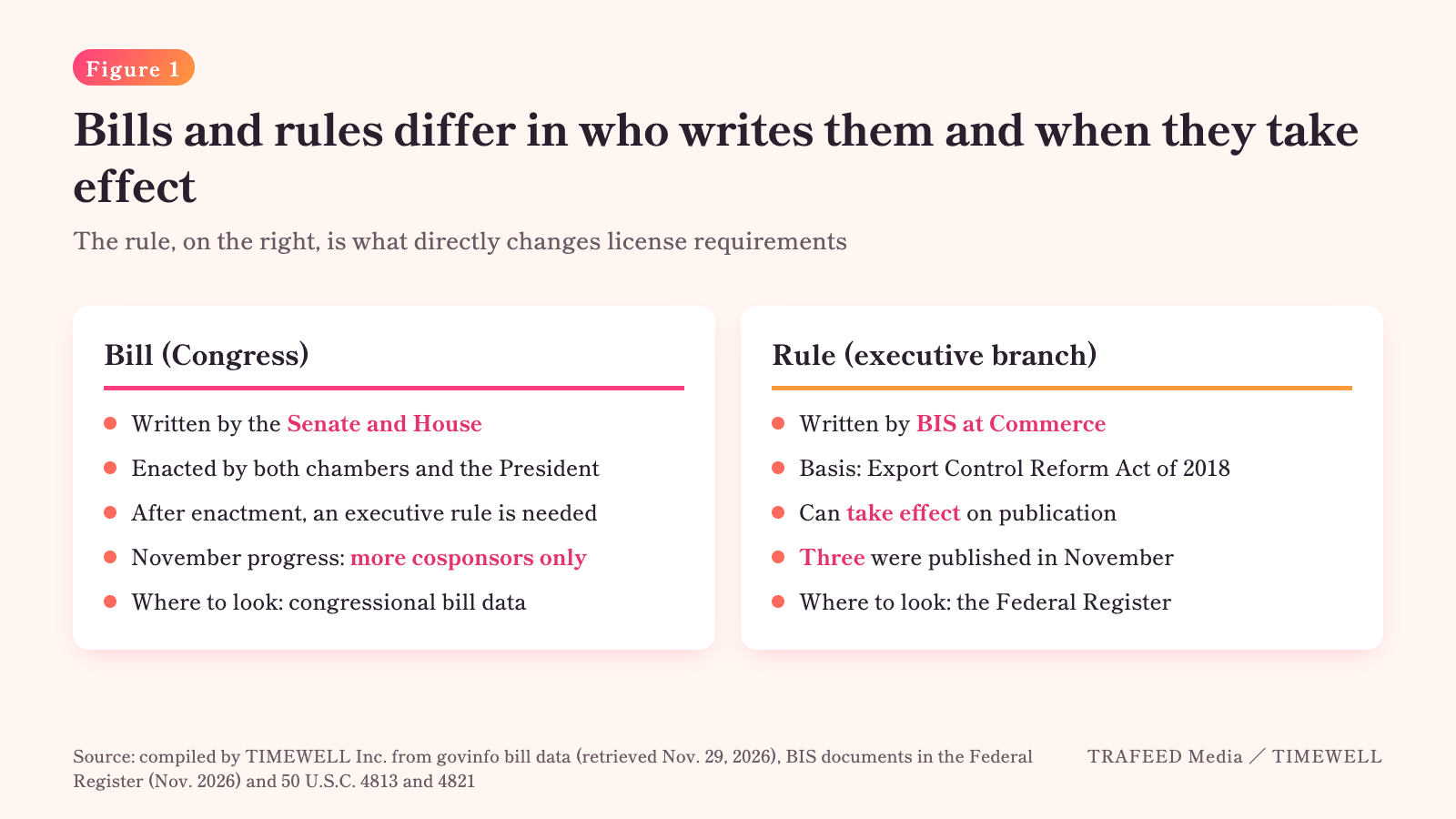 Figure 1. Bills versus rules. Congress's bills are on the left, executive rules on the right. Compare, from the top, who writes them, when they take effect and what happened in November. Source: compiled by TIMEWELL Inc. from govinfo bill data, the Federal Register and 50 U.S.C. 4813 and 4821
What actually moved in Congress in the week after the reinstatement
Congress in November produced messaging and oversight. It did not produce legislation. That distinction is where I start.
The clearest piece of messaging came on the Senate floor on November 16. The Senate Democratic leader said the rule the Commerce Department announced that day could be a meaningful step, then said the only way to close the loopholes was for Congress to pass the AI OVERWATCH Act, the MATCH Act and the Chip Security Act1. That is where the three bill names appear side by side. On November 23, the chairmen of the House Foreign Affairs Committee, the Select Committee on China and the Permanent Select Committee on Intelligence issued a joint statement saying the transcribed interviews set for December 1 and 2, a form of questioning that leaves a record for a congressional inquiry, would go ahead as planned2.
There was oversight activity too. On November 17, the chairman of the House Foreign Affairs Committee sent a letter to a Commerce under secretary asking for information on an investigation involving a Southeast Asian data center operator and on export licenses3. On November 19, citing authority under the Export Control Reform Act, he released information on license applications for AI chips bound for China. According to his announcement, applications covered about 3.4 million chips and BIS approved more than 879,0004. Those figures come from the chairman's announcement. I have not been able to read the released application documents themselves.
According to press reports, six Senate Democrats issued a statement on November 24 asking the administration for an explanation, and four House Democrats published a letter to the President. A hearing at the Senate Committee on Banking, Housing, and Urban Affairs is also reported for December 35. I could not confirm these three points in the original documents, because the members' and committee's official sites did not accept automated retrieval.
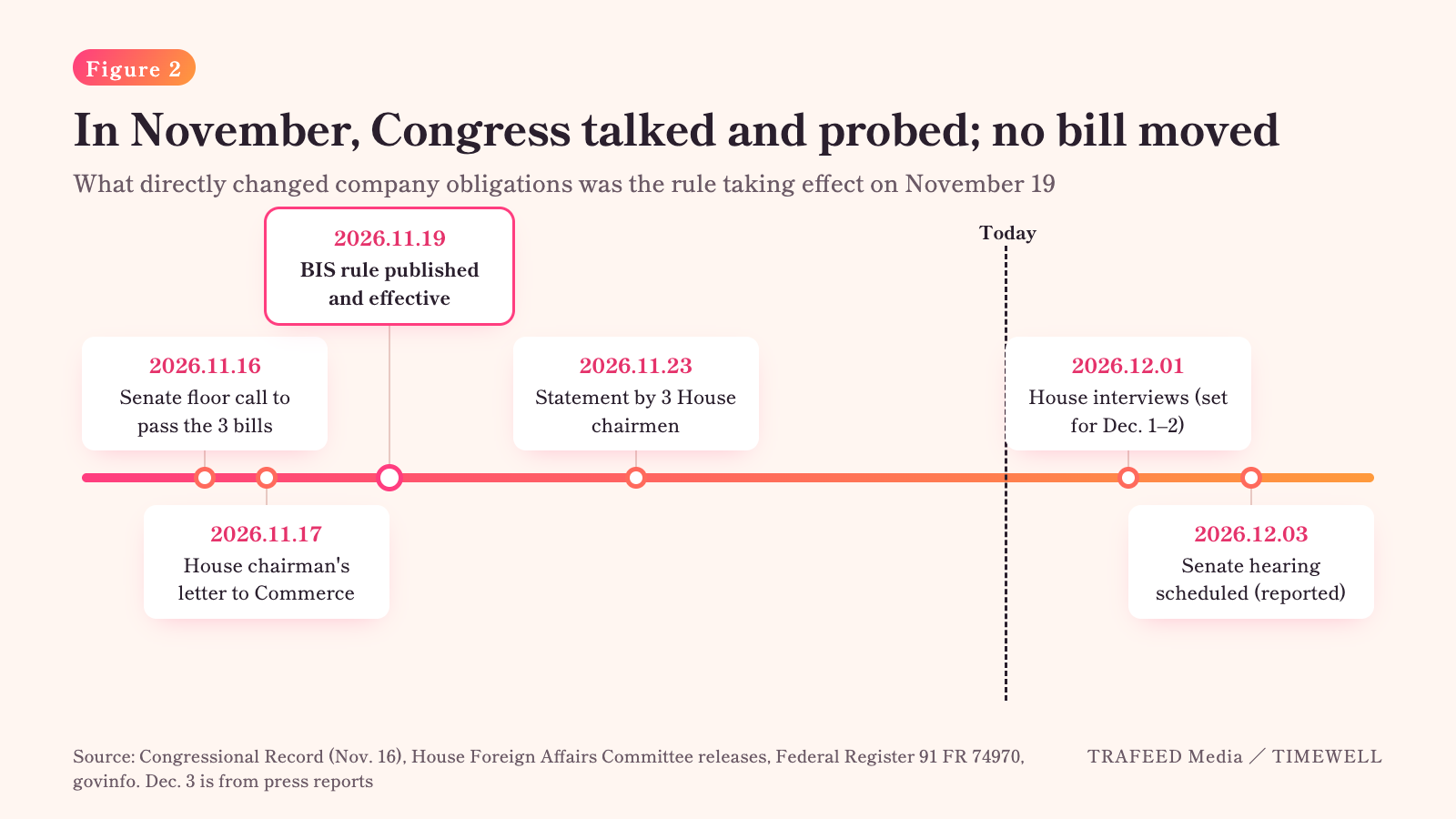 Figure 2. Events from November 16 to December 3. The colored dot is the one event that directly changed company obligations, a rule taking effect. The other dots are messaging and oversight, which change no obligations. Source: Congressional Record (November 16, 2026), House Foreign Affairs Committee releases (November 17 and 23), Federal Register 91 FR 74970, govinfo bill data. The December 3 hearing is from press reports
And legislation? Using the bill data from the US Government Publishing Office (govinfo), I went through the titles of 567 bills: those introduced in the Senate from September 29 to November 20 and in the House from October 15 to November 27. I found no new bill on exports of advanced semiconductors to China6. It was a title search, so I may have missed something, and Senate bills introduced on or after November 21 may not be in the data yet. Even so, I can say this is not a situation where "new bills poured in after the reinstatement."
One semiconductor bill did clear a committee that week. The Senate Committee on Commerce, Science, and Transportation ordered the Chip EQUIP Act (S.3301) reported on November 18, and it was placed on the Senate calendar on the 20th7. Its subject is not export control, though. It is a funding condition: companies that receive US semiconductor incentives could not install completed manufacturing equipment made by foreign entities of concern for ten years, and components are carved out. Say you see a one-line alert that "a chip bill has cleared committee." Whether it is an export restriction or a subsidy condition makes all the difference to how it touches your company.
In other words, "Congress demands" in a headline usually means remarks, letters and interviews. Whether a bill has moved to the next stage has to be checked separately.
Replace siloed classification work with AI.
METI's FY2024 data shows 52% of foreign exchange law violations stem from classification errors. Download the TRAFEED product catalog covering features and rollout.
The three bills and where each one stands
All three bills are at the committee stage in both the Senate and the House. None has had a floor vote.
| Bill | In a sentence | Senate | House |
|---|---|---|---|
| Chip Security Act | Requires a mechanism on advanced AI chips to check for diversion | S.1705. Introduced May 8, 2025; referred to the Committee on Banking, Housing, and Urban Affairs | H.R.3447. Introduced May 15, 2025; ordered reported by the Foreign Affairs Committee 42 to 0 on March 26, 2026 |
| MATCH Act | Aligns controls on semiconductor manufacturing equipment with those of allies | S.4281. Introduced April 13, 2026; referred to the same committee | H.R.8170. Introduced April 2, 2026; ordered reported, as amended, by the Foreign Affairs Committee 36 to 8 on April 22 |
| AI OVERWATCH Act | Requires advance submission to Congress for AI chip licenses to parties tied to countries of concern | S.4456. Introduced April 30, 2026; referred to the same committee | H.R.6875. Introduced December 18, 2025; ordered reported by the Foreign Affairs Committee 42 to 2 on January 21, 2026 |
The table comes from govinfo bill data retrieved on November 29689. The three House bills have gone as far as the committee deciding to report them to the floor, and there is no record of a floor vote. The three Senate bills were referred to committee on the day they were introduced and have not had a committee vote since.
What did change in November was the number of cosponsors. In the Senate, two joined the MATCH Act on November 10, one joined the Chip Security Act on November 16, and two joined the AI OVERWATCH Act on November 19689. Figure 3 shows sponsors plus cosponsors for each bill.
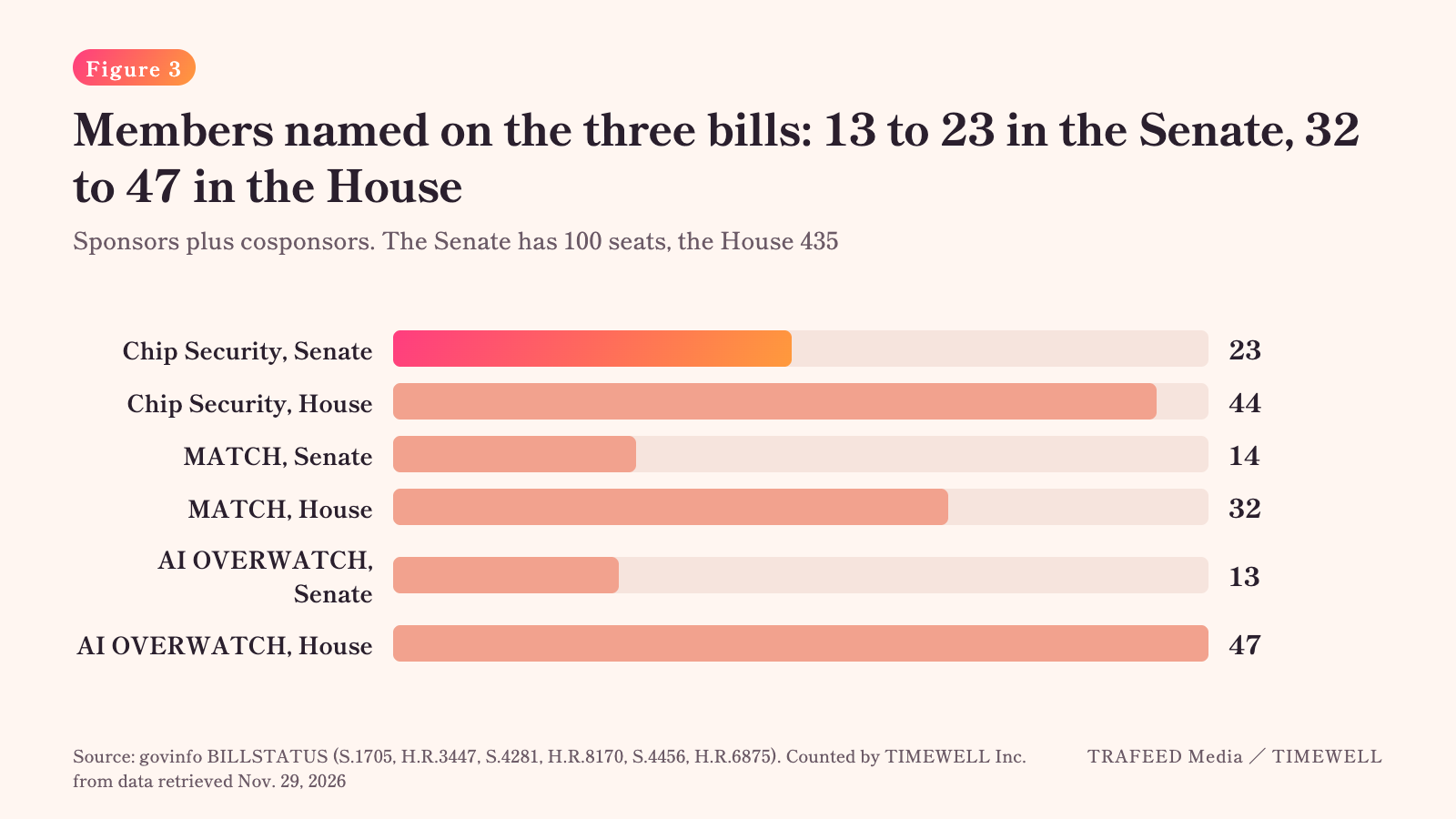 Figure 3. Sponsors and cosponsors by bill (data retrieved November 29, 2026). A longer bar means more members have put their names on the bill. The Senate has 100 seats and the House 435. Source: govinfo BILLSTATUS (S.1705, H.R.3447, S.4281, H.R.8170, S.4456, H.R.6875)
The counts are a rough gauge of how wide support runs. They do not promise passage. The Senate Chip Security Act has 23 names, short of a quarter of the chamber. The bipartisan part is real: all three Senate bills were introduced by Republicans, and the cosponsors split about evenly between the parties.
Some reports say "the three bills are in the Senate version of the defense authorization bill"10. This is a point worth getting exactly right. The congressional record shows that in June and July 2026 the three bills were filed as amendments to the Senate defense authorization bill (S.4784): the Chip Security Act as Amendment 6683, the MATCH Act as 6585 and the AI OVERWATCH Act as 6575, among others111213. Each entry reads "ordered to lie on the table." That notation means the amendment was submitted and printed in the record but has not yet been brought up for consideration. Search the text of the bill as reported by the Senate Armed Services Committee and the three bill names do not appear. They are not in the text of the defense authorization bill the House passed 216 to 212 on July 22 (H.R.8800) either1415.
So if someone at your company reports that "it's already in the Senate bill," ask back: is it in the text, or only filed as an amendment? That one question changes the weight of the news.
For the substance I will point to earlier articles. See my explainer on the location verification bill for the Chip Security Act and my piece on its status and what it means for Japanese companies for the MATCH Act. One note: the July amendment version of the Chip Security Act covers data center products under ECCNs (the US control list numbers) 3A090, 4A090, 5A002.z and others, and the verification mechanism includes on-site audits and attestation by a company headquartered in the United States11. The wording has changed from the bill as introduced, which matters when you read it.
In other words, each of the three bills sits at "committee stage" and "filed as an amendment," and nothing in November changed that position.
The steps from bill to law, and the time left
For a bill to become law, both chambers must pass identical text and the President must sign it. Counting from November 29, this Congress has 35 days left.
Here are the steps, following the House's official guide16. A member introduces a bill and it is referred to the committee of jurisdiction. Once the committee considers it and orders it reported, it goes on the floor calendar. If the chamber passes it, it goes to the other chamber and follows the same steps. If the two texts differ, they are reconciled into one. A bill that has passed both chambers goes to the President, who within ten days, Sundays excepted, either signs it or vetoes it and returns it to Congress. A vetoed bill becomes law if each chamber repasses it by two thirds.
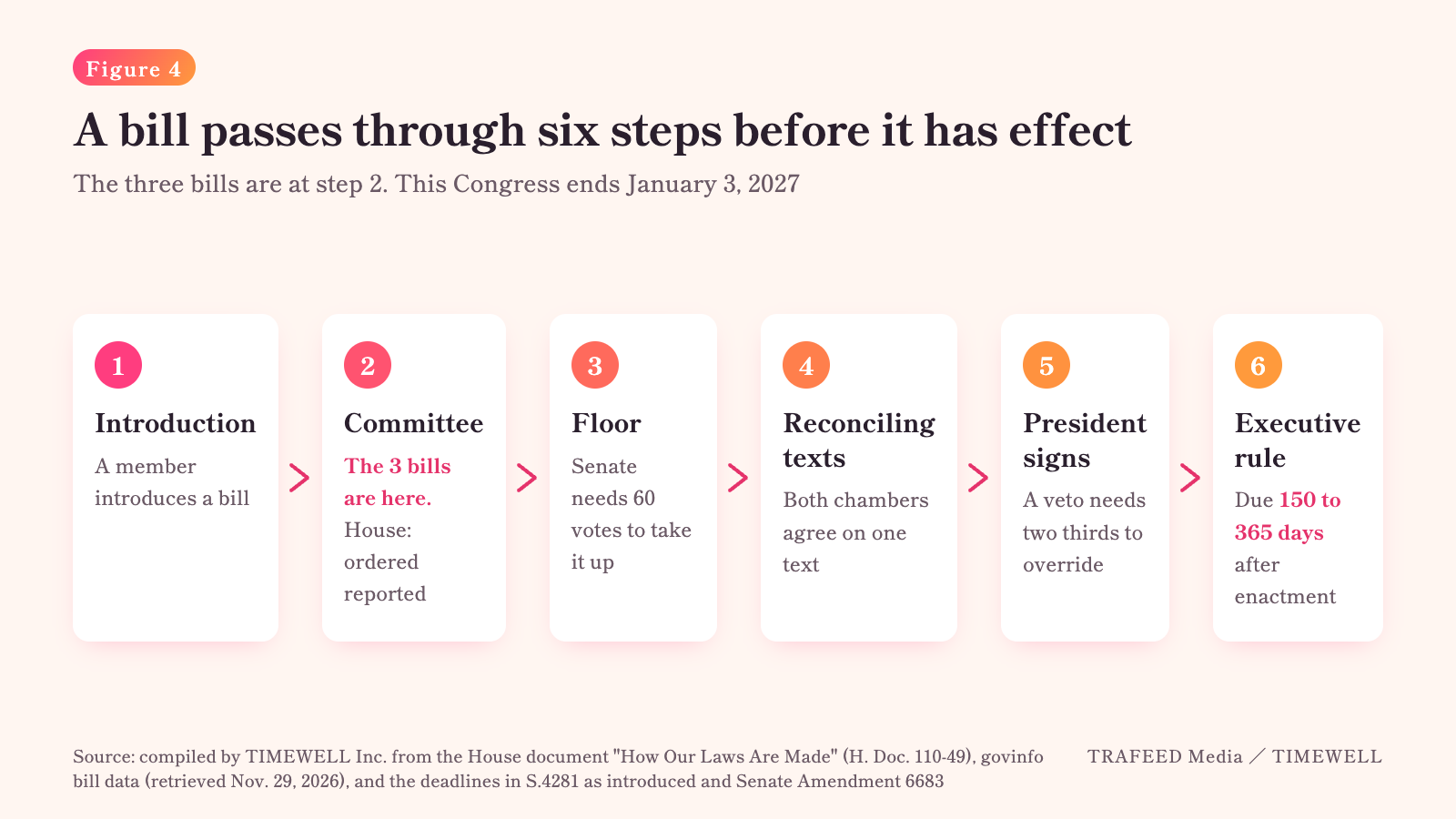 Figure 4. The six steps from introduction to a change in company obligations. The three bills are at the entrance to step 2 in the Senate and at its exit in the House. Read left to right. Source: compiled by TIMEWELL Inc. from the House document "How Our Laws Are Made" (H. Doc. 110-49) and govinfo bill data
The Senate has one more gate. To take up a bill, in most cases a motion to end debate needs three fifths of the full Senate, that is, 60 votes16. On July 14 that motion failed 50 to 46 for the Senate defense authorization bill, and the Senate has not been able to begin considering it. The latest action I can confirm in govinfo data is a motion to proceed on July 2715. Press reports say the final defense authorization act is expected to be taken up in December, that the House Speaker has said agreement is forming in Congress on chip export controls, and that the Senate majority leader has not stated a position10.
There is a deadline as well. A Congress lasts two years, and the current 119th Congress ends at noon on January 3, 202716. Bills not enacted by then have to be reintroduced in the next Congress. The three bills can become law in this Congress either by riding on the defense authorization act or by passing both chambers on their own, and either route is confined to a few weeks in December.
Even if they are enacted, obligations do not start the next day. Counting from the text of the July amendment, the Chip Security Act calls for a report to Congress within 210 days of enactment, a proposed rule within 270 days and a rule within one year11. For the MATCH Act, the rule deadline is 150 days in the Senate bill as introduced and 240 days in the amendment offered in the House committee1718. So even with enactment in December, the content of the obligations would come into view as rules sometime between summer and the end of 2027.
On the outlook, I have stopped trying to call it. A ride on the defense bill in December and a lapse at the end of the term are both still possible. What helps more inside a company is being able to say from the text, on the day enactment is reported, what will follow and in how many days.
In other words, even an enacted bill needs one more step, an executive rule, before it becomes a company obligation. The dates to watch are two: the date of enactment and the rule deadline counted from it.
Without a new law, the executive branch can still act by rule
US export controls can tighten without any new statute. In November, the body that actually changed the controls was the executive branch, not Congress.
The basis is the Export Control Reform Act of 2018 (ECRA). It gives the President authority to control the export, reexport and in-country transfer of items subject to US jurisdiction. It then authorizes the Secretary of Commerce to establish a list of controlled items, to establish lists of parties and end uses that raise national security concerns, to require licenses, and to suspend or revoke them19. The rulemaking procedure is different from other agencies' too. The Act says the prior notice-and-comment provisions of the Administrative Procedure Act do not apply to export control rules20. That is why a BIS rule can take effect the day it appears in the Federal Register.
Look at what happened in November. Checking the Federal Register API, BIS published three rules that month2122.
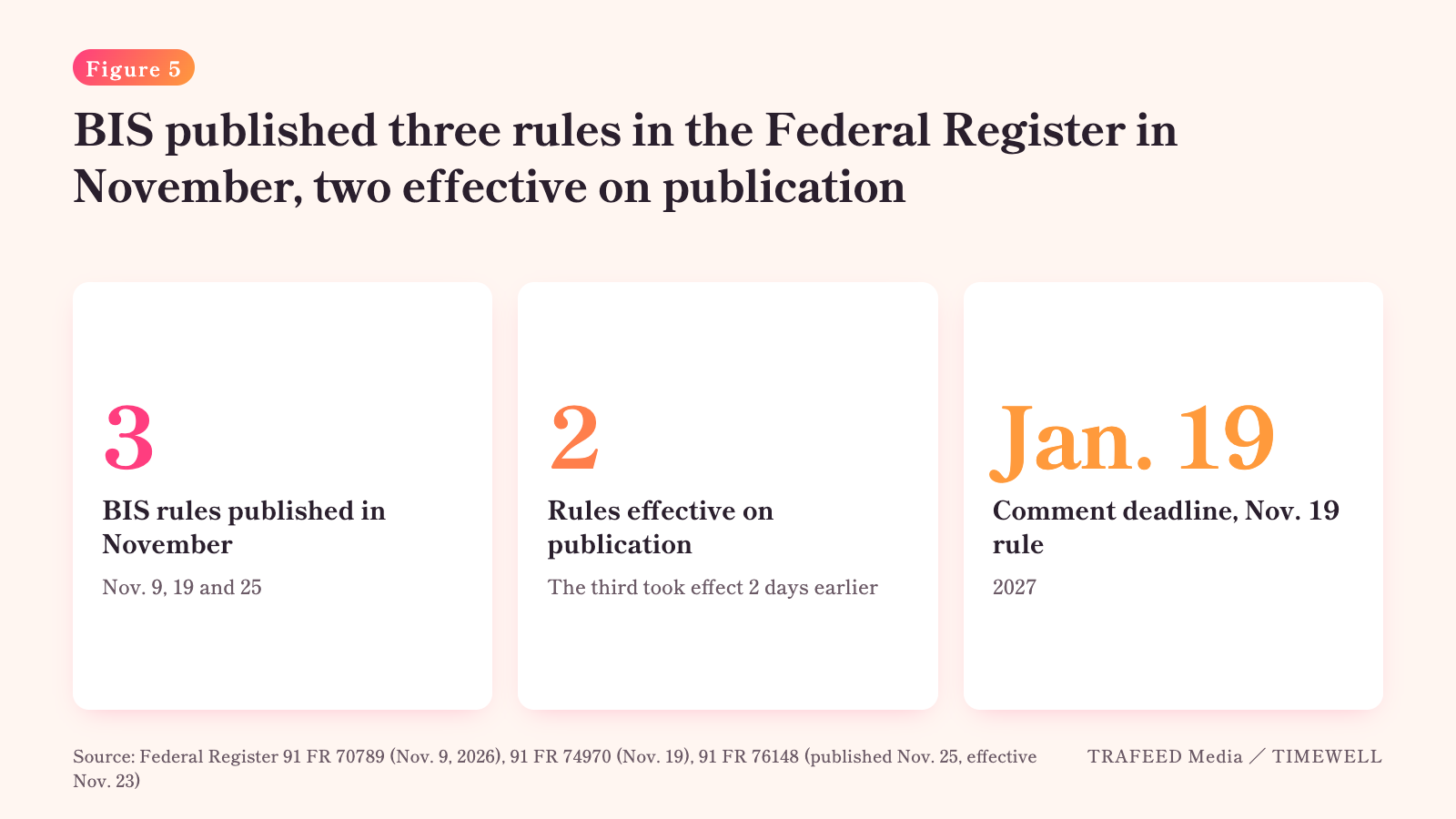 Figure 5. BIS rules in November 2026 in numbers. From left: the number of rules, the number effective on the day of publication, and the comment deadline for the interim final rule. Source: Federal Register 91 FR 70789 (November 9), 91 FR 74970 (November 19), 91 FR 76148 (November 25)
The first, on November 9, extended the suspension of a measure that expands controls to affiliates of parties on the Entity List (the list of parties for which transactions need a license). Rules that loosen controls come out through the same procedure. The second is the interim final rule of November 19. It set requirements for remote access to advanced semiconductors and for licenses to four Southeast Asian countries and Brazil, and it took effect on publication. Comments are open until January 19, 2027. The third, published on November 25, added seven parties located in Malaysia, Singapore and Thailand to the Entity List. Its effective date is November 23, before publication. A listing is a regulatory designation. It is not a judgment on the merits of the company. I covered the second rule in my article on shipments to Southeast Asia and in a plain-language explainer on the remote access rule.
One example shows how bills and rules relate. A bill to bring remote access under export control, the Remote Access Security Act (H.R.2683), passed the House 369 to 22 on January 12, 2026, was sent to a Senate committee the next day and has sat there since23. Ten months later, the executive branch set requirements on the same subject by rule, without waiting for the law. A company that had been tracking only the votes might have read it as "stalled in the Senate, so nothing moves for now." In fact, the requirements changed on the morning of November 19, at the moment of publication.
Congress and the executive branch are not moving in complete isolation from each other. The same Act requires that proposed amendments to the EAR be notified in advance to the Senate Committee on Banking, Housing, and Urban Affairs and the House Foreign Affairs Committee20. Those are the two committees handling the three bills. When Congress gets louder, the executive branch answers first with a rule. The rule announcement on November 16 and the Senate floor remarks on the same day show that relationship well, in my view.
In other words, the place to check every week is the Federal Register, not the news from Congress. I wrote up what to do on the day a rule comes out in my playbook for the day a US rule changes.
What equipment, materials and parts makers and trading companies in Japan and Asia should check
For companies outside the United States, the issue is less direct export from the US than "reexport" from Japan or a third country, and the provisions that reach foreign-made products built with US technology. The same three questions come up under both the bills and the current rules. I write from Japan, but they apply the same way to suppliers elsewhere in Asia.
The first is how much US-origin content is in your product. Even under today's EAR, the de minimis approach, under which an item falls outside the EAR if its US-origin share is small, is not available for some semiconductor manufacturing equipment. Certain lithography equipment used to make advanced integrated circuits is subject to the EAR regardless of percentage unless the country it is first exported from has put that equipment on its own control list. The provision refers by name to the Japanese government's addition of ArF immersion lithography equipment and other items to its control list for all destinations on July 23, 202324. Percentage does not matter either when equipment containing US-origin integrated circuits is headed to destinations such as Macau or China, or to parties under footnote 5 of the Entity List. The MATCH Act as introduced is drafted to widen the items that could be covered to foreign-made items whose US-origin content is anything above zero17. For how this ties to Japan's own controls, see my explainer on Japan's advanced semiconductor control amendments. For the percentage calculation, see my check of reexports from overseas sites.
The second is the provision that reaches foreign-made products built with US technology or software, the foreign direct product rule (FDPR). The current EAR has one category for semiconductor manufacturing equipment and others for specific parties on the Entity List25. A part for equipment made at a factory in Japan, for example, may need an EAR license if its design used US-origin technology and its destination is a party or country the rule specifies. The overall picture is in my FDPR explainer.
The third is where your customer's ultimate parent is headquartered. The AI OVERWATCH Act as introduced is written to require a license for exports, reexports and in-country transfers not only to parties located in a country of concern, but also to parties whose headquarters, or whose ultimate parent's headquarters, is in one26. The November 19 rule likewise required data center customers to be checked by tracing ownership and control21. Take a trading company in Japan selling a covered server domestically to a foreign-affiliated entity in Japan. The direction of travel is that the location of that entity's parent headquarters would be asked about even there. This is my reading of the bill as introduced, and the text can change before enactment.
Equipment makers have one more point. The MATCH Act would require a license for servicing as well as export, and "servicing" in the bill as introduced reaches installation, calibration, repair, software updates, training and remote support17. The amendment offered in the House committee listed electrostatic chucks, deep ultraviolet light sources, radio-frequency power supplies and optical components among the examples of components to be assessed18. Companies that make parts and materials, and no finished tools, are in the frame too.
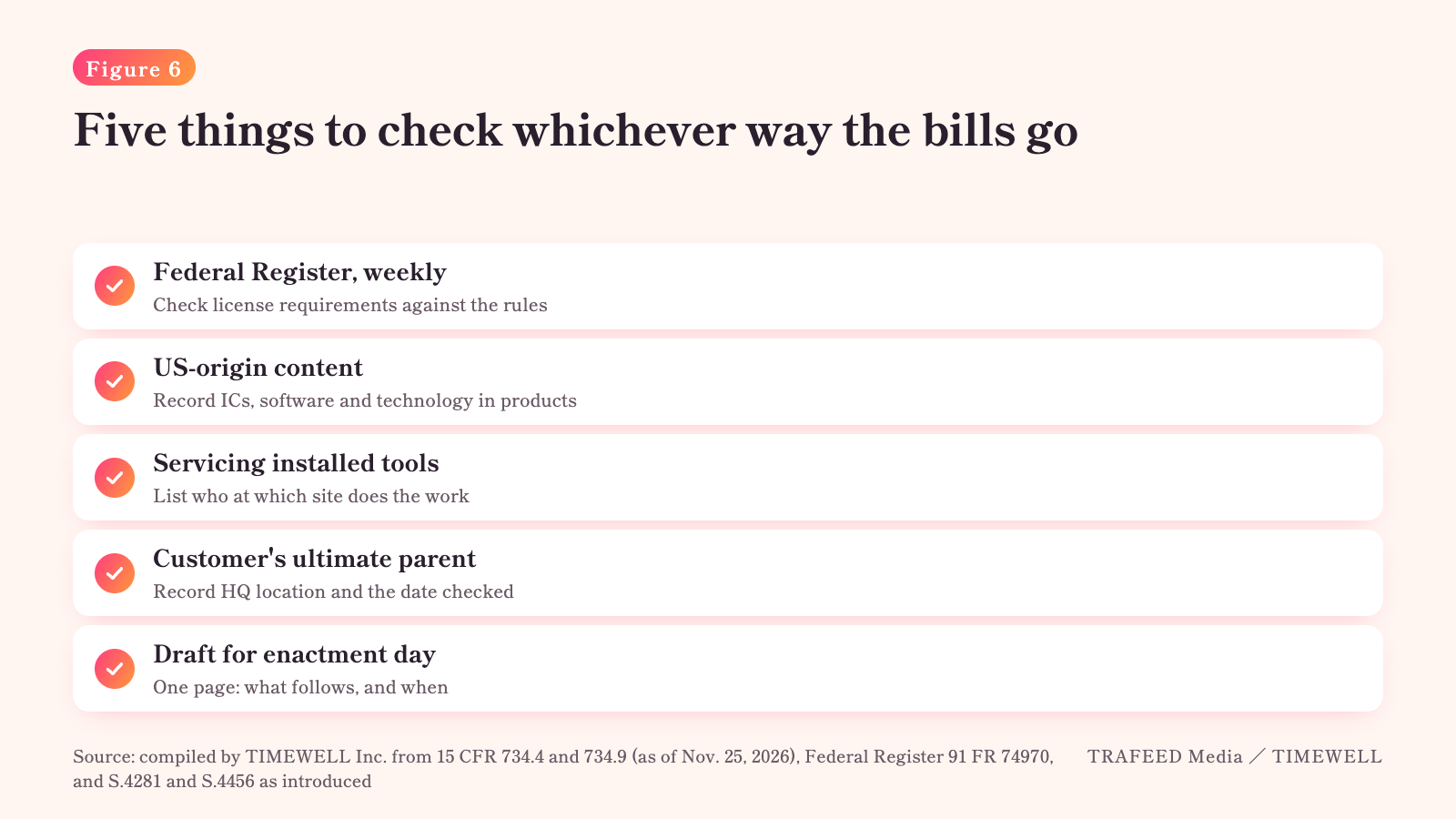 Figure 6. From the top left: how to read the news, products, servicing, counterparties and records. I listed only checks that are useful whether or not the bills are enacted. Source: compiled by TIMEWELL Inc. from 15 CFR 734.4 and 734.9, Federal Register 91 FR 74970, and S.4281 and S.4456 as introduced
If you cover export control part-time and want to do something this week, here is the order. Start a habit of looking at new BIS documents in the Federal Register once a week. Next, for your main products, record in a ledger whether they contain US-origin integrated circuits, software or technology, together with your suppliers' answers. Equipment companies should list who at which site services each installed tool. Trading companies should record where each customer's ultimate parent is headquartered, with the date you confirmed it in a corporate registry or public information. Last, draft now the one-pager you would hand your manager on the day a bill is enacted. Our US rule change impact triage sheet (Excel, in Japanese), which requires registration, also works as is: on the morning a rule comes out you fill in the deadlines, six fit questions, the sorting of cases and a one-page note for executives, in that order.
In other words, more than memorizing bill names, being able to explain your products, your servicing and your counterparties with evidence is the preparation that pays off under every outcome.
Wrapping up
What happened in Congress in late November was remarks, letters and scheduled interviews. The bills did not advance. The three bills have been ordered reported by committee in the House and remain referred to committee in the Senate, and they have not been adopted as amendments to the defense authorization bill. This Congress ends on January 3, 2027. The executive branch, meanwhile, published three rules in the same month, and one of them changed the scope of licensing for advanced semiconductors on the day it was published.
When you see a headline that "Congress is taking a hard line," check three things: the bill number and its current stage, the number of days from enactment to a rule, and what appeared in the Federal Register that same week. If you can explain those three separately to your manager, you will neither panic more than necessary nor miss something. Honestly, the more closely you follow news from Congress, the more anxious you get. Opening the Federal Register once a week does far more for the actual work.
December will bring another wave of headlines, with the interviews, the hearing and the handling of the defense authorization act. If something moves, I will go back to the congressional record and the Federal Register and update this article. I also report each week's rule changes in the weekly regulatory update.
TRAFEED, which supports export control decisions with AI, helps track changes to each country's rules and lists and helps with counterparty checks. The final classification decision rests with the person responsible for export control at your company.
Footnotes
-
Congressional Record, Volume 172, Number 173 (November 16, 2026), Senate, page S5674, "AI Chips." Remarks naming the three bills. Retrieved November 29, 2026. https://www.govinfo.gov/content/pkg/CREC-2026-11-16/html/CREC-2026-11-16-pt1-PgS5674-2.htm ↩
-
House Foreign Affairs Committee (Republicans), "Chairmen Mast, Moolenaar, and Crawford Release Statement on Jensen Huang's Reinstatement" (November 23, 2026). States that the interviews will proceed as scheduled on December 1 and 2. Retrieved November 29, 2026. https://foreignaffairs.house.gov/news/press-releases/chairmen-mast-moolenaar-and-crawford-release-statement-on-jensen-huang-s-reinstatement ↩
-
House Foreign Affairs Committee (Republicans), "Chairman Mast Sends Letter to Commerce Department on Megaspeed" (November 17, 2026). Retrieved November 29, 2026. https://foreignaffairs.house.gov/news/press-releases/chairman-mast-sends-letter-to-commerce-department-on-megaspeed ↩
-
House Foreign Affairs Committee (Republicans), "Chairman Brian Mast Exercises Legislative Authority to Publicly Release AI Chip License Information for China" (November 19, 2026). The application and approval counts are from the chairman's announcement. Retrieved November 29, 2026. https://foreignaffairs.house.gov/news/press-releases/chairman-brian-mast-exercises-legislative-authority-to-publicly-release-ai-chip-license-information-for-china ↩
-
Export Compliance Daily, "Lawmakers Ask What the Administration Knew About Nvidia's Export Control Compliance" (November 27, 2026). Press report. The November 24 statement and letter and the hearing scheduled for December 3. The members' and committee's original documents are unconfirmed. Checked November 29, 2026. https://exportcompliancedaily.com/article/2026/11/27/lawmakers-ask-what-the-administration-knew-about-nvidias-export-control-compliance-2611250006 ↩
-
US Government Publishing Office, govinfo "Bill Status," S.1705 and H.R.3447 (Chip Security Act). Introduction dates, referrals, committee votes and cosponsors. For new bills, we searched the titles of 567 bills in the same data, S.5590 to S.5820 and H.R.10830 to H.R.11165. Retrieved November 29, 2026. https://www.govinfo.gov/bulkdata/BILLSTATUS/119/s/BILLSTATUS-119s1705.xml , https://www.govinfo.gov/bulkdata/BILLSTATUS/119/hr/BILLSTATUS-119hr3447.xml ↩ ↩2 ↩3
-
govinfo "Bill Status," S.3301 (Chip EQUIP Act), and the text reported to the Senate on November 20, 2026 (Calendar No. 727). Retrieved November 29, 2026. https://www.govinfo.gov/bulkdata/BILLSTATUS/119/s/BILLSTATUS-119s3301.xml , https://www.govinfo.gov/content/pkg/BILLS-119s3301rs/html/BILLS-119s3301rs.htm ↩
-
govinfo "Bill Status," S.4281 and H.R.8170 (MATCH Act). Retrieved November 29, 2026. https://www.govinfo.gov/bulkdata/BILLSTATUS/119/s/BILLSTATUS-119s4281.xml , https://www.govinfo.gov/bulkdata/BILLSTATUS/119/hr/BILLSTATUS-119hr8170.xml ↩ ↩2
-
govinfo "Bill Status," S.4456 and H.R.6875 (AI OVERWATCH Act). Retrieved November 29, 2026. https://www.govinfo.gov/bulkdata/BILLSTATUS/119/s/BILLSTATUS-119s4456.xml , https://www.govinfo.gov/bulkdata/BILLSTATUS/119/hr/BILLSTATUS-119hr6875.xml ↩ ↩2
-
CNBC, "Jensen Huang scandal fuels bipartisan push to block AI chip sales to China" (November 17, 2026, updated November 18). Press report. That the three bills are amendments to the Senate version of the defense authorization bill, that they are not in the House version, the expected December consideration, and the House Speaker's remark. Checked November 29, 2026. https://www.cnbc.com/2026/11/17/congress-ai-china-jensen-huang-chips.html ↩ ↩2
-
Congressional Record (July 14, 2026), pages S3953 to S3956, "Text of Senate Amendment 6683." The Chip Security Act as an amendment to S.4784 (sections 1094 to 1099). "Ordered to lie on the table." Amendment 6105, with the same title, is dated June 24. Retrieved November 29, 2026. https://www.govinfo.gov/content/pkg/CREC-2026-07-14/html/CREC-2026-07-14-pt1-PgS3953-4.htm ↩ ↩2 ↩3
-
Congressional Record (July 13, 2026), page S3782, "Text of Senate Amendment 6585." The MATCH Act as an amendment to S.4784. "Ordered to lie on the table." Amendments 6398 and 6400 of June 24 carry the same title. Retrieved November 29, 2026. https://www.govinfo.gov/content/pkg/CREC-2026-07-13/html/CREC-2026-07-13-pt1-PgS3782.htm ↩
-
Congressional Record (July 13, 2026), page S3772, "Text of Senate Amendment 6575." The AI OVERWATCH Act as an amendment to S.4784. "Ordered to lie on the table." Amendment 6451 of June 24 has the same content. Retrieved November 29, 2026. https://www.govinfo.gov/content/pkg/CREC-2026-07-13/html/CREC-2026-07-13-pt1-PgS3772.htm ↩
-
govinfo "Bill Status," H.R.8800 (National Defense Authorization Act for Fiscal Year 2027, House). Passed 216 to 212 on July 22, 2026 (Roll no. 278). We searched the House-passed text and confirmed the three bill names are absent. Retrieved November 29, 2026. https://www.govinfo.gov/bulkdata/BILLSTATUS/119/hr/BILLSTATUS-119hr8800.xml , https://www.govinfo.gov/content/pkg/BILLS-119hr8800eh/html/BILLS-119hr8800eh.htm ↩
-
govinfo "Bill Status," S.4784 (National Defense Authorization Act for Fiscal Year 2027, Senate). Reported by the Armed Services Committee on June 15, 2026; cloture on the motion to proceed failed 50 to 46 on July 14 (Record Vote No. 195); latest action July 27. We searched the committee-reported text and confirmed the three bill names are absent. Retrieved November 29, 2026. https://www.govinfo.gov/bulkdata/BILLSTATUS/119/s/BILLSTATUS-119s4784.xml , https://www.govinfo.gov/content/pkg/BILLS-119s4784rs/html/BILLS-119s4784rs.htm ↩ ↩2
-
US House document "How Our Laws Are Made" (H. Doc. 110-49). Term of a Congress, committees, floor consideration, cloture in the Senate, presidential signature and veto, and override. Retrieved November 29, 2026. https://www.govinfo.gov/content/pkg/CDOC-110hdoc49/html/CDOC-110hdoc49.htm ↩ ↩2 ↩3
-
S.4281, "Multilateral Alignment of Technology Controls on Hardware (MATCH) Act," as introduced (April 13, 2026). The 150 days in section 3(c), "applicable item" in (g)(3) and "servicing" in (g)(13). Retrieved November 29, 2026. https://www.govinfo.gov/content/pkg/BILLS-119s4281is/html/BILLS-119s4281is.htm ↩ ↩2 ↩3
-
House Foreign Affairs Committee markup document of April 22, 2026, "Amendment in the Nature of a Substitute to H.R. 8170 offered by Mr. Baumgartner." The component examples in section 3(b)(2) and the 240 days in (f). The committee amended this text further before approving it, and the final text as approved is unconfirmed. Retrieved November 29, 2026. https://docs.house.gov/meetings/FA/FA00/20260422/119191/BILLS-1198170ANSih-U1.pdf ↩ ↩2
-
50 U.S.C. 4812 (authority of the President) and 4813 (additional authorities of the Secretary of Commerce; (a)(1), (2) and (5)). 2024 edition. Retrieved November 29, 2026. https://www.govinfo.gov/link/uscode/50/4813?type=usc&year=mostrecent&link-type=html ↩
-
50 U.S.C. 4821 (administrative procedure). (a) is the exemption from the Administrative Procedure Act and (c) the advance notice to Congress of proposed EAR amendments. 2024 edition. Retrieved November 29, 2026. https://www.govinfo.gov/link/uscode/50/4821?type=usc&year=mostrecent&link-type=html ↩ ↩2
-
Federal Register, "Addressing Remote Access to Advanced Semiconductors" (91 FR 74970, published and effective November 19, 2026; interim final rule; comments due January 19, 2027). Retrieved via the Federal Register API on November 29, 2026. https://www.federalregister.gov/documents/2026/11/19/2026-23529/addressing-remote-access-to-advanced-semiconductors ↩ ↩2
-
Federal Register, "Extension of the Suspension of Expansion of End-User Controls for Affiliates of Certain Listed Entities" (91 FR 70789, published and effective November 9, 2026) and "Additions to the Entity List" (91 FR 76148, published November 25, 2026, effective November 23). Retrieved via the Federal Register API on November 29, 2026. https://www.federalregister.gov/documents/2026/11/25/2026-23999/additions-to-the-entity-list ↩
-
govinfo "Bill Status," H.R.2683 (Remote Access Security Act). Passed the House 369 to 22 on January 12, 2026 (Roll no. 13); referred to the Senate Committee on Banking, Housing, and Urban Affairs on January 13. Retrieved November 29, 2026. https://www.govinfo.gov/bulkdata/BILLSTATUS/119/hr/BILLSTATUS-119hr2683.xml ↩
-
eCFR, 15 CFR 734.4(a)(3), (8) and (9), "De minimis U.S. content." Version current as of November 25, 2026, retrieved November 29. https://www.ecfr.gov/current/title-15/subtitle-B/chapter-VII/subchapter-C/part-734/section-734.4 ↩
-
eCFR, 15 CFR 734.9(e), "Entity List FDP rules," and (k), "Semiconductor Manufacturing Equipment (SME) FDP rule." Version current as of November 25, 2026, retrieved November 29. https://www.ecfr.gov/current/title-15/subtitle-B/chapter-VII/subchapter-C/part-734/section-734.9 ↩
-
S.4456, "AI OVERWATCH Act," as introduced (April 30, 2026). Would add section 1758A to the Export Control Reform Act; (b) is the license requirement and (c) the submission to Congress. Retrieved November 29, 2026. https://www.govinfo.gov/content/pkg/BILLS-119s4456is/html/BILLS-119s4456is.htm ↩