This is Hamamoto from TIMEWELL.
(21 November 2026) We had attributed the point that checking only the entities on the Foreign User List is not enough to "METI's Q&A on the conventional-weapons catch-all." It comes from Q2 of METI's Q&A "Catch-all, 8: questions on the Foreign User List, examples of goods of concern and the 'clear' guidelines," and we have corrected the attribution.
"Can we really trust this counterparty?"
What export control obliges you to check about a counterparty depends on what you ship. A company that exports listed items (specified important goods) as a business must set procedures for confirming end use and end users and confirm them under those procedures (Ministerial Order on exporter compliance standards, Article 1(ii)(d))1. For goods and technology under item 16 (the catch-all), you are required to check whether the end user appears on the End User List2.
The catch-all requirements turn on the documents and communications you hold, so skipping these checks exposes you to the risk of violating Japan's Foreign Exchange Act.
This article explains the specific methods for customer due diligence (end-user screening / customer screening) in practical terms, including how to use Japan's Foreign User List and the U.S. Entity List.
The short version: the starting point for a Japanese exporter is the catch-all control's check on end-use and end-user, together with METI's Foreign User List. Since 9 October 2025, concern about conventional weapons development is part of that check, and the Foreign User List has grown to 835 entities (per the table in METI's introductory guidance). Not appearing on a list, however, is not proof that a counterparty is safe. After list cross-referencing come web research, direct confirmation where needed, and record-keeping. This article covers the screening and verification routine; it does not decide whether a particular item needs a license. That judgment stays with your own export control officer.
Put your list-checking routine into a written, fill-in procedure: The lists discussed here — Japan's Foreign End User List, the US Entity List, the SDN and the rest — organized as five systems (US OFAC, US BIS, the EU, the UK, the UN) plus Japan's list, with fields for which official source to check, how often, and against what. The 50% / ownership-control tests and Red Flags are included, so you can fix a routine that currently varies by person into an internal standard. → Download the Five Sanctions-List Systems Screening Procedure (2026) (Free. Registration with your company name and work email address is required.)
Summary (What You'll Learn from This Article)
- What is required: A company exporting listed items as a business must set end-use and end-user confirmation procedures and follow them (compliance standards, Article 1(ii)(d)); for item 16 transactions, you must check whether the end user is on the End User List
- Foreign User List: METI's list of organizations of concern (835 entities, applied from 9 October 2025)
- Entity List: A list kept by the U.S. BIS. Exports, reexports and transfers of items subject to the EAR to listed parties require a license (§744.11)
- How to conduct investigations: Combining list cross-referencing, web research, and direct verification
- When volumes are large: Stage the checks by level of concern: list screening, then further research, then direct confirmation
How to Check the Entity List Right Now (the Short Answer First)
If you came to this article looking for where to find the latest version of the Entity List, here is the answer up front. The current Entity List can be checked free of charge on official U.S. government sites (on 22 November 2026 we confirmed that Supplement No. 4 to Part 744 on eCFR and the Consolidated Screening List search page were available).
| Where to check | Location | When to use it |
|---|---|---|
| Consolidated Screening List (CSL) | trade.gov/consolidated-screening-list | Cross-searches the Entity List and other major U.S. restricted-party lists at once. In practice, start here |
| BIS official site | bis.gov | The agency that administers the Entity List. Amendment notices and guidance can be traced from here |
| Legal source text | eCFR, Supplement No. 4 to Part 744 of the EAR | The authoritative version. Consult it whenever a CSL search result leaves any doubt |
That said, searching counterparties one by one on official sites has real limits. The Entity List is updated on a rolling basis, and you also need to track name variations — abbreviations, local-language names — plus subsidiaries and affiliates. Our estimate of the workload for an in-depth review is in the second half of this article.
Table of Contents
- What Is Customer Due Diligence (End-User Screening)?
- Why Is Customer Due Diligence Necessary?
- How to Use the Foreign User List
- The U.S. Entity List and Consolidated Screening List
- Step-by-Step Customer Due Diligence Process
- How to Identify Suspicious Transactions (Red Flags)
- Workload for an in-depth review (our estimate)
Replace siloed classification work with AI.
METI's FY2024 data shows 52% of foreign exchange law violations stem from classification errors. Download the TRAFEED product catalog covering features and rollout.
What Is Customer Due Diligence (End-User Screening)?
Definition
Customer due diligence (end-user screening) is the process of verifying the intended end-use and end-user of exported goods or provided technology, and reviewing whether any national security concerns exist.
In English this is also called "Customer Due Diligence," "End-User Screening," or "Customer Screening."
Three Elements to Verify
Customer due diligence involves verifying three elements:
| Element | What to verify |
|---|---|
| End-Use | What the exported item will be used for |
| End-User | The organization or individual who will actually use it |
| Intermediary | Trading companies or agents in the transaction chain |
Where Customer Due Diligence Fits in Export Control
Customer due diligence occupies the following position in the export control process:
[Step 1] Export Classification (List Control Check)
    ↓
[Step 2] Customer Due Diligence (End-Use and End-User Verification) ← Here
    ↓
[Step 3] Determining Whether a License Application Is Required
    ↓
[Step 4] Export and Shipment Control
Why Is Customer Due Diligence Necessary?
Legal Obligation
Japan's Foreign Exchange and Foreign Trade Act (FEFTA) asks for a license not only for listed items but also for unlisted goods when the intended use or the end-user raises concern (the catch-all control). The duty to confirm is written differently by item. A company that exports listed items as a business must set procedures for confirming end use and end users and confirm them under those procedures (compliance standards, Article 1(ii)(d))1. For item 16 transactions, METI's notice says you must check whether the end user is on the End User List2. For other catch-all transactions, you cannot tell whether the license requirements apply without checking use and end user, so in practice the check is indispensable.
Under the catch-all control for weapons of mass destruction, a license application is required in two cases:
| Requirement | Content |
|---|---|
| Inform requirement | When notified by the Minister of Economy, Trade and Industry that a license application is required |
| Objective requirement (end-use and end-user requirements) | When export-related documents such as the contract, or a message from the importer, show that the end use or end user raises a concern and the exporter learns of it |
The objective requirement turns on the documents and communications in hand. Saying "I didn't know" without checking the information you already hold is a risky position. Decide in advance how your company checks end use and end user.
A rule change on 9 October 2025 reshaped the conventional-weapons side as well. Even for unlisted general-purpose goods such as machine tools, integrated circuits and parts for unmanned aircraft, a license from the Minister of Economy, Trade and Industry is required where the transaction meets the conditions set by ministerial ordinance (end-use and end-user requirements) for cases where the goods may be used to develop conventional weapons (Export Trade Control Order, Article 4(1)(iii)(c)). It does not turn on the exporter's own sense that the risk is high; it turns on whether the ordinance's objective requirements are met. The 2025 change clarified those requirements, and even for exports to Group A countries, METI can inform the exporter where there is a risk of diversion through procurement by countries of concern3. Because it is the exporter who has to check whether the requirements are met, the record of how you checked a counterparty, and on what basis you decided, now carries more weight than it used to.
Risks if Violated
If insufficient checks lead you to carry out a transaction that needs a license (for example, one that meets the catch-all requirements or follows an inform) without a license, the following penalties and sanctions apply. Failing to screen a counterparty is not itself a criminal offense.
| Risk | Content |
|---|---|
| Criminal penalties (FEFTA Articles 69-7 and 72) | Individuals: up to 7 years' imprisonment or a fine of up to 20 million yen (up to 10 years and 30 million yen for certain categories tied to nuclear weapons and similar). Corporations: a fine of up to 700 million yen (1 billion yen for those categories). Where five times the value of the goods exceeds the cap, the fine can reach five times that value |
| Administrative sanctions (FEFTA Article 53(1)) | A ban on exports and technology transfers for a set period of up to 3 years |
| Business impact (our assessment) | Explanations to counterparties and banks, suspended shipments and similar |
Sanctions are possible even without intent
The administrative sanctions in Article 53 of FEFTA (an export ban of up to three years, among others) target the act of exporting without a license, and the article sets no requirement of intent. According to METI's analysis of violation cases, the actual severity depends on factors such as the harm to protected interests and the likelihood of recurrence. Rather than stopping at "we trusted the counterparty," recording what you checked is what lets you show you took due care (the items to record are in Step 5 below).
How to Use the Foreign User List
What Is the Foreign User List?
The Foreign User List is a list published by Japan's Ministry of Economy, Trade and Industry (METI) identifying overseas entities where concerns about the development of weapons of mass destruction, or of conventional weapons, have not been dispelled. Entities whose dealings need to be checked for conventional weapons development were added from the version applied on 9 October 20253. It is not an embargo list. METI's notice does, however, require an exporter who has obtained the list to check whether the counterparty's name appears on it in transactions under item 162.
| Item | Details |
|---|---|
| Jurisdiction | Ministry of Economy, Trade and Industry (METI) |
| Number of entries | 835 entities (announced 29 September 2025, applied 9 October 2025; up 87 from the previous version)3 |
| Update frequency | METI's introductory guidance (version 3.0, p. 16) says the Foreign User List is revised every year. The latest revision was published on 29 September 2025 and applied from 9 October 2025; METI's revision information page (in Japanese) lists no later revision as of 22 November 2026 |
Countries and Regions on the List
The list includes entities in countries and regions such as China, North Korea and Iran. The breakdown by country and the entity names change with each revision, so check METI's current list rather than relying on a summary.
How to Use the List
Step 1: Download from METI's website
The Foreign User List can be downloaded free of charge from METI's website.
Step 2: Cross-reference counterparty names
Cross-reference the names of your counterparties against the organization names on the list.
Step 3: Watch for name variations
Be alert to name variations such as:
| Pattern | Example |
|---|---|
| Language differences | English name vs. local language name |
| Abbreviations | University → Univ. |
| Old/new names | Organizations that have changed their names |
| Affiliated organizations | Subsidiaries, affiliated institutions |
How to Respond if a Match Is Found
METI's notice (dated 29 September 2025, applied 9 October 2025) says that a person who has obtained the list must check whether the name of the end-user (or the person who will use the technology) appears on it when exporting goods under item 16 of Appended Table 1 of the Export Trade Control Order (the catch-all category) or providing technology under item 16 of the Appended Table to the Foreign Exchange Order. If the name is listed, a METI license is required unless it is clear, from the end-use and the terms and conditions of the transaction, that the goods or technology will not be used for the development of weapons of mass destruction or conventional weapons2. Under METI's introductory guidance (version 3.0), the conventional-weapons concern applies only to items under item 16(1)4. The reverse does not hold: not being listed does not end the check. In Q2 of METI's Q&A "Catch-all, 8: questions on the Foreign User List, examples of goods of concern and the 'clear' guidelines," METI answers "no" to whether exports to companies not on the list need no license application, saying that it is not enough to check only the entities on the Foreign User List and that exporters need to confirm whether the end-user develops (or has developed) weapons of mass destruction or conventional weapons5. Use and end-user still have to be confirmed separately. For the whole October 2025 revision, in order of end-use, end-user and inform requirements, see our summary of the catch-all revision.
The U.S. Entity List and Consolidated Screening List
Why You Also Need to Check U.S. Lists
What Japanese law asks of exporters is the catch-all check on end-use and end-user. The Foreign User List is a METI list whose entries you must check in item-16 transactions (see the notice above). Japanese law, by contrast, does not oblige you to screen against U.S. lists.
Even so, in practice it is safer to check U.S. lists as well, for the following reasons (our assessment):
| Reason | Content |
|---|---|
| Extraterritorial reach of the EAR | Exports, reexports and in-country transfers of items subject to the EAR to Entity List parties need a license, including those made from Japan (§744.11) |
| Re-export of U.S.-origin items | Products that contain U.S.-origin parts above a set share, among others, can be subject to the EAR when reexported from Japan (de minimis rule, §734.4) |
| Counterparty checks | Appearance on a U.S. list is a reason to check the terms of the deal (a listing is a U.S. regulatory designation, not a judgment on the company) |
What Is the Entity List?
The Entity List is a list of export-controlled parties maintained by the U.S. Department of Commerce's Bureau of Industry and Security (BIS).
| Item | Details |
|---|---|
| Jurisdiction | U.S. Department of Commerce (BIS) |
| Number of entries | A large number of organizations (added and removed on a rolling basis) |
| Effect | A license is required to export, reexport or transfer items subject to the EAR (not only U.S.-origin items) to listed parties; the license review policy is set for each entry (§744.11) |
| Update frequency | As needed |
The Consolidated Screening List
The Consolidated Screening List is a "unified screening list" provided by the U.S. government.
It allows cross-search across multiple regulatory lists, enabling efficient verification:
| Lists Included | Administering Agency |
|---|---|
| Entity List | Department of Commerce (BIS) |
| SDN List | Department of the Treasury (OFAC) |
| Denied Persons List | Department of Commerce (BIS) |
| Unverified List | Department of Commerce (BIS) |
| Military End User List | Department of Commerce (BIS) |
| Others | Department of State, etc. |
How to Check
The U.S. government provides an online searchable tool:
- Access the Consolidated Screening List website
- Enter the counterparty name
- If a hit is returned, verify the details
For the full picture across U.S., UN, and Japanese lists, see our guide to the five sanctions list families.
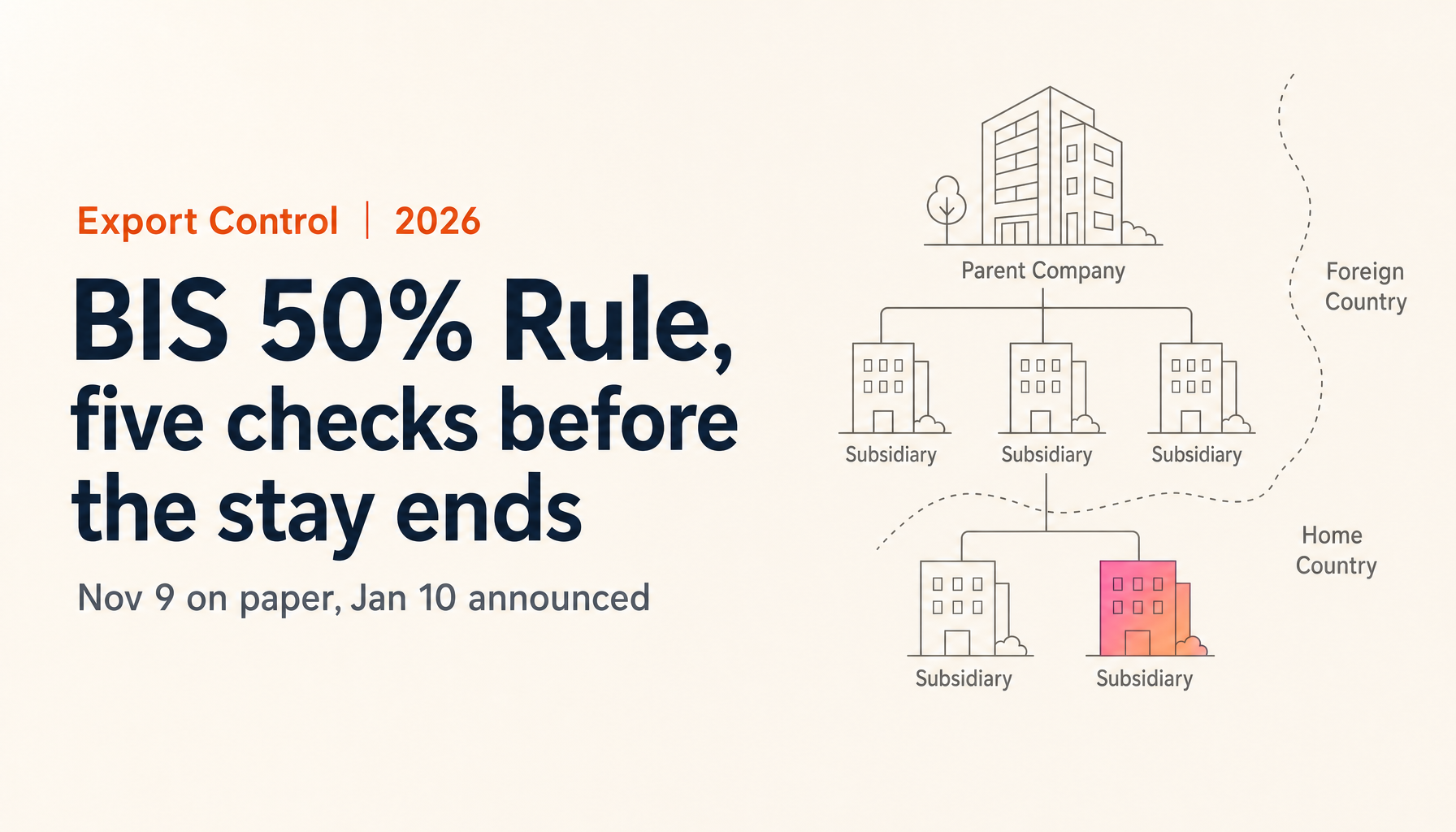
A counterparty that is not on the Entity List can still be caught if a listed organization owns 50 percent or more of it, directly or indirectly. That is the design of BIS's Affiliates Rule (the 50 percent rule), whose application has been suspended since 10 November 2025. The suspension was originally set to end on 9 November 2026, but BIS published a rule that day extending it to 10 January 2027 (91 FR 70789; on 20 November 2026 I corrected the earlier statement that I could not find it in the Federal Register). Absent a further rule, it could return after 10 January 2027, so keep an eye on the date. How to count ownership (exactly 50 percent, aggregation, grandchild companies) is in our guide to counting under the BIS and OFAC 50 percent rules, and finding hidden Chinese subsidiaries is covered in why the BIS 50 percent rule is hard to apply.
Step-by-Step Customer Due Diligence Process
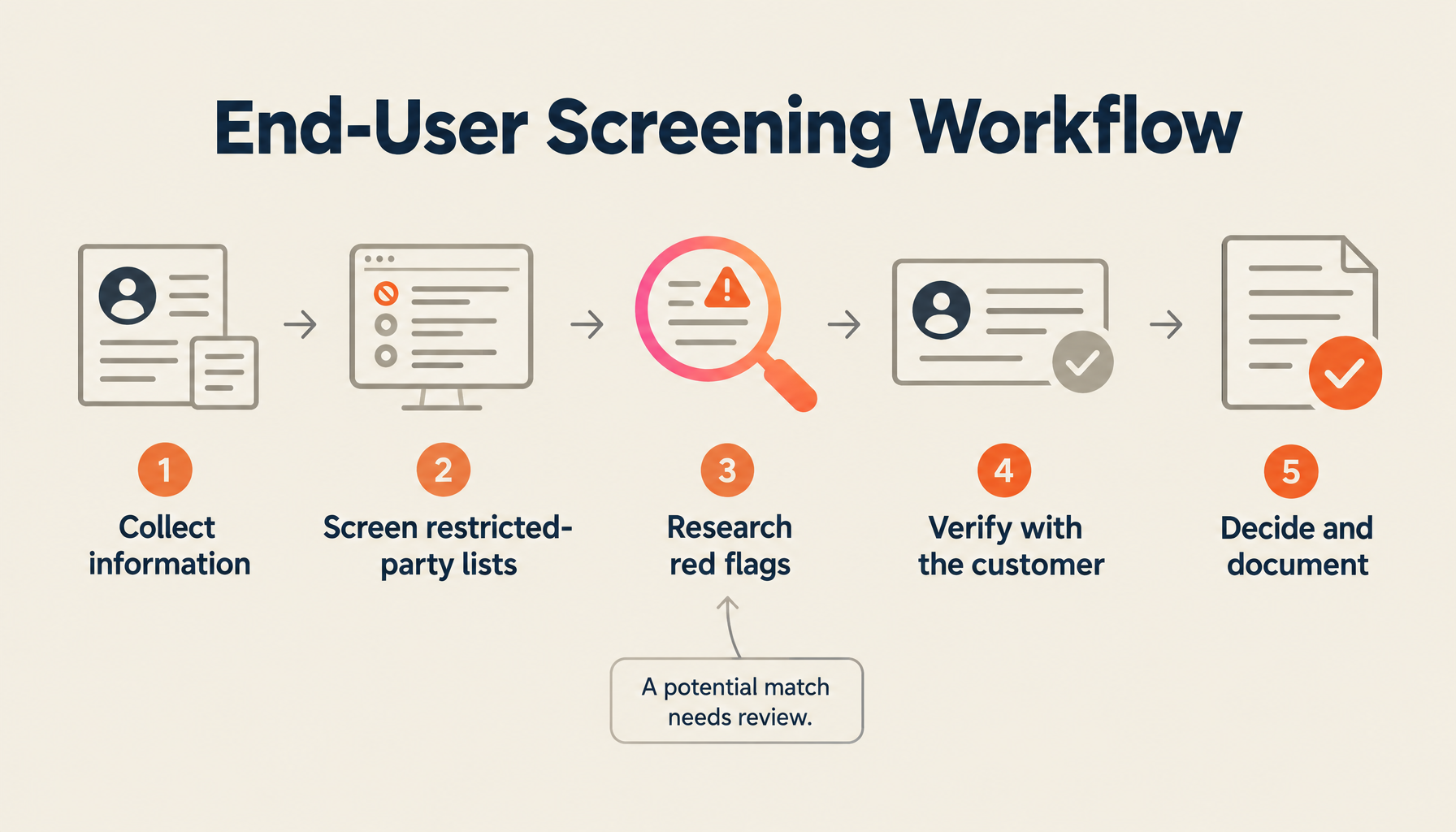
Overview of the Investigation Flow
[Step 1] Collect Basic Information
    ↓
[Step 2] Cross-Reference with Regulatory Lists
    ↓
[Step 3] Additional Research (Web research, etc.)
    ↓
[Step 4] Direct Verification (if needed)
    ↓
[Step 5] Determination and Documentation
Step 1: Collect Basic Information
First, collect the following information about the counterparty:
| Item | Content |
|---|---|
| Legal name | Corporate name (local language and English) |
| Location | Country, city, address |
| Industry | Business activities |
| Representatives | Executives, key persons |
| End-use | Intended purpose of the exported item |
Counterparty shareholders and beneficial owners are best checked at this stage, which makes the later steps easier. Why registration and disclosure regimes differ so much from country to country is explained in what a beneficial owner is.
Step 2: Cross-Reference with Regulatory Lists
Cross-reference against the following lists:
| List | Purpose |
|---|---|
| Foreign User List | Check required by METI's notice in item-16 transactions |
| Entity List | U.S. regulatory risk |
| SDN List | Sanctions target verification |
| UN Sanctions List | International sanctions verification |
Step 3: Additional Research (Web Research, etc.)
Even if not on any list, conduct the following additional research:
| Research method | What to check |
|---|---|
| Official website | Business activities, customers, business partners |
| News search | Presence of negative news |
| Registration information | Verify existence as a legal entity |
| Industry information | Reputation in the industry |
If you want to extend the check beyond the counterparty to its suppliers, UFLPA coverage and what it means for Japanese companies looks at it from the forced-labor angle.
Step 4: Direct Verification (if needed)
If concerns remain, verify directly with the counterparty:
| Item to verify | Specific questions |
|---|---|
| End-use | "What purpose will the product be used for?" |
| Re-export | "Do you plan to re-export to any third countries?" |
| Military connections | "Do you transact with military or military-affiliated institutions?" |
| Declaration | Obtain a declaration regarding end-use and re-export |
When to ask for a pledge or end-user certificate, and how to word it, is covered in our guide to end-user certificates and pledges.
Step 5: Determination and Documentation
Based on the investigation results, determine whether the transaction can proceed and create a record:
| Determination | Action |
|---|---|
| No concerns | Proceed with transaction; retain records |
| Concerns present | Request additional clarification; consider license application |
| Cannot proceed | Halt the transaction |
What to record
Keep enough for each check that you can later answer "when, against which version of which list, and who decided what." This is also what an on-site inspection looks at.
| Item | Example entry |
|---|---|
| Date checked | 2026-11-20 |
| Party checked | Name and address, plus every spelling used in the check (former names, English names) |
| Lists and versions | METI End User List (the version published 29 September 2025 and applied from 9 October 2025); U.S. Consolidated Screening List (date downloaded) |
| Result | No match / similar name / confirmed match |
| Decision and basis | Similar name judged to be a different entity because the address and year of incorporation differ |
| Checked by / approved by | The person in charge and the export control officer |
When a similar name comes up (false positives): do not decide on the name alone. Compare address, representative, year of incorporation and parent company, and record why you concluded it is a different entity. Keeping a list of hits you have already resolved saves you from re-investigating the same party next time.
Retention: keeping records is a best-effort duty under Article 1(ii)(l) of the Ministerial Order on exporter compliance standards ("endeavor to retain for an appropriate period"); the text sets no number of years. The benchmark comes from METI's Security Export Control Guidance [Introductory Edition], version 3.0 (March 2026): from the date of export or technology transfer, at least 7 years for items related to rows 1–4, and at least 5 years for rows 5–16.
After the first check: lists change all the time, so one check at onboarding is not enough. No law sets the frequency, so decide it yourself and write it into your internal rules. Our view is that a practical design combines checking each list update against existing counterparties with a full re-check at least once a year. If you handle export control on top of another job and cannot yet keep up with every update, start with a full re-check every six months, as in our first-30-days article, to cover updates you might miss.
For companies running thousands of checks a year, the matching rules, false-positive criteria and record items are covered in Designing counterparty screening operations; for a part-time officer, the five-item minimum for every check is in If you have been given export control on top of your job.
How to Identify Suspicious Transactions (Red Flags)
What Are Red Flags?
Red flags are warning signs indicating that a transaction may have national security concerns.
If any of the following signs are present, additional investigation is required.
Red Flags Related to the End-User
| Sign | Details |
|---|---|
| Company information unclear | No website; business activities unknown |
| Potential military connection | Relationship with Ministry of Defense, military, or military research institutions |
| Connection to listed organizations | Subsidiary or affiliate of an entity of concern |
| Suspicious location | Possible shell company |
Red Flags Related to End-Use
| Sign | Details |
|---|---|
| Cannot explain intended use | "I can't say what it's for" |
| Use and product do not match | Agricultural company purchasing high-performance measuring instruments |
| Excessive quantities | Orders disproportionately large relative to the scale of operations |
| Declining technical support | "We don't need any support" |
Red Flags Related to Transaction Conditions
| Sign | Details |
|---|---|
| Cash payment | Paying cash for high-value products |
| Unusual pricing | Willing to pay far above market price |
| Urgent ordering | "Please ship immediately" |
| Avoiding documentation | "No contract needed" |
Red Flags Related to Shipping
| Sign | Details |
|---|---|
| Shipping destination mismatch | Ordering entity and shipping destination are in different countries |
| Routing through free zones | Transit through regions with lax regulations |
| Multiple transit points | Unnecessarily complex routing |
| Special packaging requests | "Please package it so it won't stand out" |
Workload for an In-Depth Review (Our Estimate)
Where the effort grows
The effort of checking counterparties grows in the following situations:
| Challenge | Details |
|---|---|
| Multiple list cross-referencing | Foreign User List, Entity List, SDN List, etc. |
| Name variation handling | Multiple languages, abbreviations, old and new names |
| Identifying affiliated organizations | Tracking subsidiaries and affiliated institutions |
| Keeping up with list updates | Following frequent revisions |
| Enormous volume | All new and ongoing transactions must be covered |
Workload benchmarks
This is our own estimate for an in-depth review that goes into public sources; it is not a statistic. A list check plus the five basic points can take only a few minutes per case (see The first 30 days for a part-time export control officer).
| Task | Time required |
|---|---|
| Basic information collection | 15–30 minutes |
| List cross-referencing (multiple) | 30 minutes – 1 hour |
| Web research | 30 minutes – 1 hour |
| Documentation | 15–30 minutes |
| Total | 1.5–3 hours per case |
Reviewing 100 new counterparties a month in that depth could take 150–300 hours per month. Rather than reviewing every case to the same depth, it works better to set tiers in your internal rules: list screening and the five points for every case, and in-depth research only for cases that raise concerns or for large new customers (our view).
Conclusion
Key Points for Customer Due Diligence
- What Japan requires: verifying end-use and end-user, and checking the Foreign User List in item-16 transactions
- Check multiple lists: Foreign User List + U.S. lists
- Additional research: Even if not on lists, verify that no concerns exist
- Red flags: Suspicious transactions require additional investigation
- Retain records: Document and retain all investigation results
What Companies Must Do
- Establish a customer due diligence process
- Conduct list cross-referencing without gaps
- Train employees to recognize red flags
- Retain investigation records appropriately
- Keep a record of the procedure you followed and the basis for each decision
The Reality of Due Diligence Work
- 1.5–3 hours per case for an in-depth review (our estimate)
- Multiple lists, multiple languages, name variation handling
- Keeping up with frequent list updates
- Set tiers of review depth in your internal rules
If you want counterparty checks and their records to run as a routine process, you can contact us about TRAFEED. An overview of its features is in the TRAFEED product catalog (PDF).
Reference Information
- METI notice on the Foreign User List, 29 September 2025 (in Japanese)
- METI, revision of the Foreign User List (29 September 2025; links to the list PDF) (Japanese)
- Foreign User List revision, 29 September 2025 (METI announcement as carried by CISTEC, in Japanese)
- U.S. BIS Entity List
- Consolidated Screening List
- CISTEC Transaction Screening
Update of 20 November 2026: the description of the Foreign User List was revised to match METI's notice of 29 September 2025.
Footnotes
-
e-Gov, "Ministerial Order Establishing Compliance Standards for Exporters" (METI Ordinance No. 60 of 2009), Article 1(ii)(d) (set procedures for confirming the end use and end users of specified important goods and confirm them under those procedures; in Japanese). Checked 21 November 2026. https://laws.e-gov.go.jp/law/421M60000400060 ↩ ↩2
-
METI, Trade and Economic Security Bureau, "Regarding the 'Foreign User List'" (No. 20250922-1, dated 29 September 2025, applied 9 October 2025; in Japanese) https://www.meti.go.jp/policy/anpo/20250929_2.pdf (checked 20 November 2026). ↩ ↩2 ↩3 ↩4
-
METI, "Revision of the 'Foreign User List', which provides information on foreign entities of concern for weapons of mass destruction or requiring confirmation of transactions regarding the development of conventional weapons" (29 September 2025; in Japanese) https://www.meti.go.jp/press/2025/09/20250929006/20250929006.html . It states that the revised list covers "835 (87 more) entities in 15 countries and regions" and applies from 9 October 2025 (original checked 21 November 2026; the copy carried by CISTEC, https://www.cistec.or.jp/export/express/250929/1-20250929_1.pdf , says the same). On the conventional-weapons catch-all revision, METI's page "Review of the catch-all controls (in force 9 October 2025)" says the related cabinet order, ministerial ordinances, notices and circulars were promulgated on 9 April 2025 and took effect on 9 October 2025 (checked 21 November 2026). https://www.meti.go.jp/policy/anpo/apply-01/20251009_catchminaoshi/20251009catchall.html ↩ ↩2 ↩3
-
METI, "Security Trade Control Guidance (Introductory), Version 3.0" (March 2026), Chapter 2, "Content of the Regulations" (in Japanese) https://www.meti.go.jp/policy/anpo/guidance/guidance.pdf . The figure of 835 entries is from the guidance's country/region table (revision of 9 October 2025). ↩
-
METI, "Catch-all, 8: questions on the 'Foreign User List', examples of goods of concern and the 'clear' guidelines" (last updated 15 October 2025; in Japanese), Q2. Original checked 21 November 2026. https://www.meti.go.jp/policy/anpo/qanda/qanda19.html ↩