(November 22, 2026) We had called checking the Foreign End-User List "indispensable in practice." Following METI's notice, anyone who has obtained the list must check whether the end user is on it, and the exception (no license where it is clear the goods will not be used to develop weapons of mass destruction or conventional weapons) now includes conventional weapons. The sanction case now states the goods covered, as in METI's announcement (goods listed in Appended Table 2-3 of the Export Trade Control Order, to all destinations), and the company's location (Osaka), which the announcement does not give, has been removed.
Hello, I'm Ryuta Hamamoto from TIMEWELL.
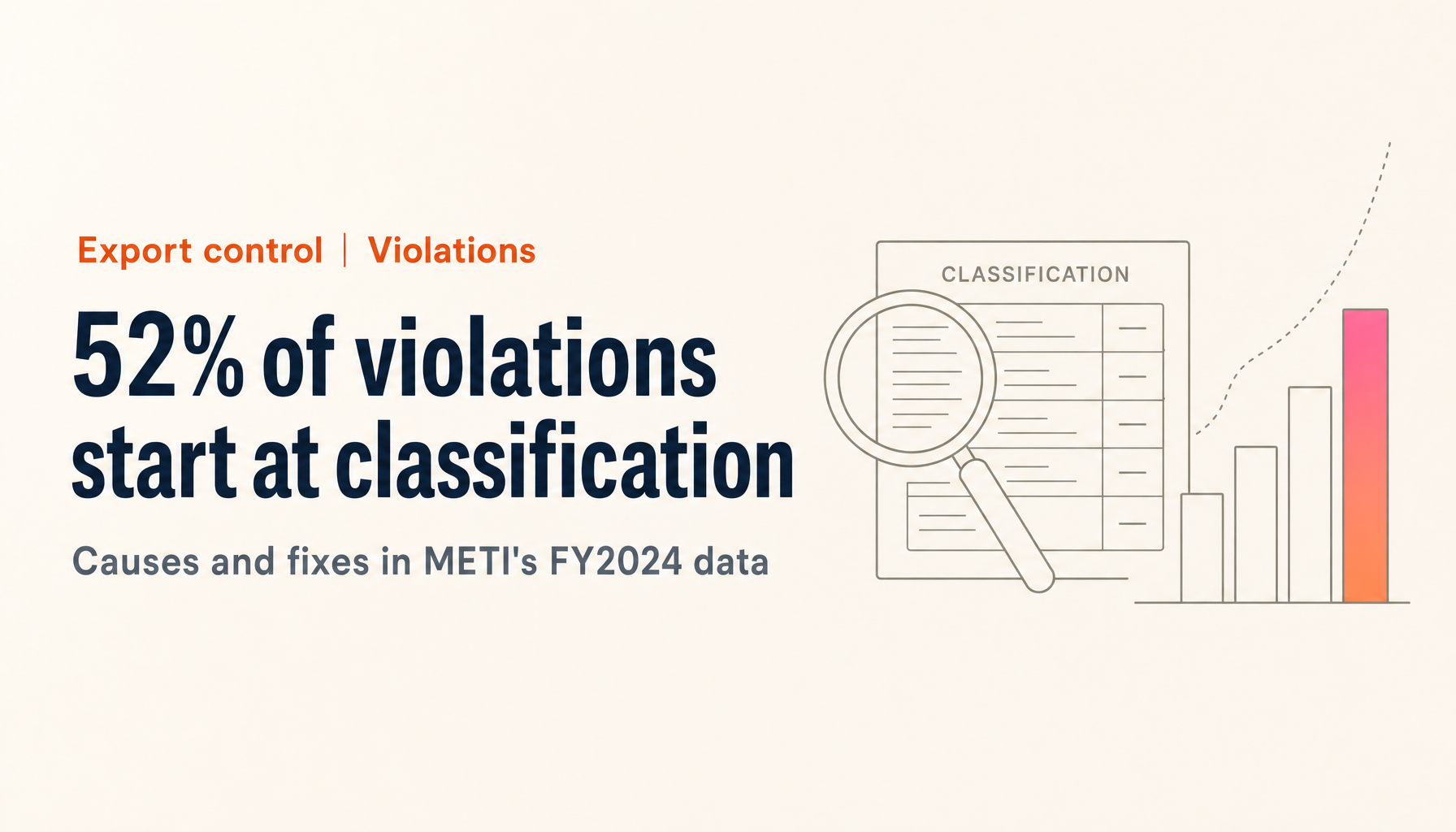
52% of foreign exchange act violations trace back to classification errors. That is the figure published by Japan's Ministry of Economy, Trade and Industry (METI) in December 2025, in its analysis of FY2024 violation cases1. More than half of the incidents start at the same step — classification (該非判定) — and yet, in my conversations with export control teams, I keep running into the same contradiction: the report has been read, but operations on the ground haven't changed.
To help you see which part of your own company the numbers apply to, this article walks through how to read the METI data, the structural causes that the case studies reveal, and a checklist your team can use this week.
Key points of this article
- 52% of FY2024 foreign exchange act violations trace back to classification errors. "Classification not performed / assumed non-controlled" alone accounts for 32%
- The second largest cause is the compliance program at 36%: rules and structure not in place (19%), lack of knowledge (9%), and programs that exist only on paper (8%). 71% of the companies involved had not filed a CP
- The regulatory environment has been moving non-stop: the October 2025 catch-all amendment, the April 2026 amendment of the Three Principles on Defense Equipment Transfer, and China's 40-entity sanctions list against Japan. Violation risk is structurally rising
- The key to prevention is replacing human judgment with a system. Reproducibility of classification rationale and currency of item-specific comparison tables are the load-bearing points
The FY2024 METI Violation Analysis at a Glance
METI's annual analysis of foreign exchange act violations is one of the few primary statistics available in the world of export control. The FY2024 edition was published in December 2025, covering cases sanctioned between April 2024 and March 20251.
The causes of violations cluster into two main buckets.
| Root cause of violation | Share | What's inside |
|---|---|---|
| Classification | 52% | Classification not performed / assumed non-controlled (32%), classification or legal interpretation errors (15%), relying on someone else's wrong classification (5%) |
| Compliance program | 36% | Rules and structure not in place (19%), lack of FEFTA awareness or knowledge (9%), program weaknesses or a program that exists only on paper (8%) |
| Transaction screening | 10% | Misapplying a license exemption (9%), misapplying a license (1%) |
| Shipping control | 0% | Errors at shipment or declaration (0%) |
| Intentional | 2% | Intentional violations |
The categories and shares follow METI's own breakdown. (On 20 November 2026 we corrected an earlier version's "Other, about 12% (false destination, transshipment, etc.)" to match METI's categories.)
Either people stumble at classification, or they stumble at the compliance framework. Roughly nine in ten violations fall into one of these two buckets. Read the underlying cases and the same picture emerges: both buckets are rooted in single-person dependency. When the work depends solely on one or two people's experience and intuition, classifications get skipped, past determinations get reused without review, and amendments to the comparison tables go unnoticed — quietly, over months and years.
The breakdown of outcomes is also disclosed1. 69% of cases were minor ones closed with a report alone, in which the company identifies the cause and pledges to prevent recurrence. Relatively more serious cases, judged by the harm to the protected interest and the risk of recurrence, received a written account plus a verbal caution (26%) or a written account plus a formal written caution (5%). There were no sanctions or warnings. For serious violations, an export ban of up to three years can be imposed. Criminal penalties depend on the category. The heaviest, for WMD-related goods and technology, is up to 10 years' imprisonment and a fine of up to 30 million yen for individuals, and up to 1 billion yen for corporations. Other listed items carry up to 7 years and 20 million yen (700 million yen for corporations), and violations of the Group A inform requirement or export approval carry up to 5 years and 10 million yen (500 million yen for corporations). Fines can rise to five times the value of the goods (FEFTA Articles 69-7, 69-8 and 72). For the prison terms and fines attached to each type of violation, see FEFTA penalties for export violations, provision by provision. As the one-year export ban described below shows, outcomes that can shake a company's existence are not hypothetical2.
The timing is unforgiving. On October 9, 2025, the supplementary catch-all controls were revised3. On September 29, 2025, the Foreign End-User List expanded to 835 entities4. On April 21, 2026, the Three Principles on Defense Equipment Transfer were amended5. China's 40-entity sanctions list against Japan has been moving in parallel. The root causes of violations have not changed, but the regulatory perimeter keeps expanding. That is the operating reality at the start of 2026.
Replace siloed classification work with AI.
METI's FY2024 data shows 52% of foreign exchange law violations stem from classification errors. Download the TRAFEED product catalog covering features and rollout.
Five Causes of Violations, Read One by One
Combining the METI data with CISTEC's published case library6, the most frequent violation patterns on the ground organize into five.
| No. | Violation pattern | Share in METI's analysis | Typical situation |
|---|---|---|---|
| 1 | Classification errors (not performed / assumed non-controlled) | 32% (part of the 52% "classification" category) | "We're not subject to controls" / "No time to classify" |
| 2 | Weak compliance program | 36% ("management system" category: rules and system not in place 19%, lack of awareness or knowledge of FEFTA 9%, system in place but hollow 8%) | No CP filing, no internal procedures, knowledge gaps |
| 3 | Misinterpretation of classification | 15% ("classification error / misreading of law"; relying on another party's wrong classification is a separate 5%) | Using outdated item-specific comparison tables, errors on gray-zone calls |
| 4 | Missed counterparty list checks | No matching category in the analysis (our grouping) | No matching against the Foreign End-User List, weak end-user verification |
| 5 | Destination misidentification / weak response to diversion | No matching category in the analysis (our grouping) | Third-country diversion, gap between documented and actual destination |
The numbers follow the order of this explanation, not the size of the share. METI's main categories are classification 52%, management system 36%, transaction screening 10%, intentional 2% and shipping 0%7.
1. Classification not performed / assumed non-controlled (32%)
The most common pattern is the simplest: no classification was performed at all, or the team assumed "we're not subject to controls" and skipped the work. General-purpose machine tools, measurement equipment, certain chemical substances, software — products that look like "ordinary goods" to the company in question, but when actually matched against the item-specific comparison table turn out to fall under list controls.
When the designated practitioner changes, past classification standards walk out the door with them. The new person skips re-classification on the basis that "it was non-controlled before." That is the textbook example of single-point-of-failure risk.
2. Weak compliance program (36%)
A CP (internal compliance program for export control) is not strictly mandatory to file with METI, but in practice you need one to benefit from special bulk export licenses and similar programs8. CISTEC publishes a model CP, but adoption in many SMEs has not moved forward.
"We have procedures, but they aren't being run," "only the designated person knows the rules," and "there's no audit function" all sit inside this category. Frequently, only after a violation comes to light does the company discover that nobody in-house actually had foundational knowledge of FEFTA. This pattern repeats in report after report.
3. Misinterpretation of classification (15%)
The control criteria are amended at short intervals. The METI Ordinance specifying goods and technologies under the Export Trade Control Order and the Foreign Exchange Order saw amendments take effect on May 28, October 9 and November 15, 2025, and on February 14, 20269. Each round changes the classification result for some items.
Semiconductor manufacturing equipment, AI-related semiconductors, quantum-computing components, unmanned aerial vehicles. These categories saw substantial expansion of controls from 2024 through 2026. Keep using last year's comparison table and you will export something that was non-controlled then but becomes controlled under the new table. This kind of incident occurs several times a year.
4. Missed counterparty list checks
The Foreign End-User List expanded to 835 entities in the September 29, 2025 revision4. METI's notice requires anyone who has obtained the list to check whether the end user appears on it when exporting Item 16 goods to destinations outside Group A, among other cases (under the ministerial ordinances on WMD and conventional-weapons end uses)10. Where the end user is listed, the transaction meets the end-user requirement of the catch-all controls, so a license is required unless it is clear from the end use and the terms and conditions of the transaction that the goods will not be used to develop weapons of mass destruction or conventional weapons10. Exporters who export list-controlled items as a business must also set and follow procedures to confirm end use and end users under the Compliance Standards ordinance (Article 1, item 2 (iv)).
Pulling the latest version of the list into Excel, then cross-checking against trading partners while accounting for company-name changes and transactions routed through subsidiaries — try to do that by hand and the operation breaks. The same is true for China's 40-entity sanctions list against Japan.
5. Destination misidentification / diversion
This is the gap between the documented destination and where goods actually land — diversion routes, in other words. Since 2022, shipments destined for Russia via Central Asia, Turkey, and other third countries have proliferated, and METI keeps issuing notices on the topic.
"Documented as bound for South Korea, in fact bound for Russia." The one-year export ban described next is exactly this pattern.
A Real Case: A One-Year Export Ban
On May 9, 2025, METI imposed administrative sanctions, including a one-year export ban, on a trading company and its representative2. The sanction period ran from May 16, 2025 to May 15, 2026 and has now ended.
The facts from primary sources, in summary:
- Violation period: August 2022 to June 2023, on 18 occasions
- Conduct: a total of 523 items, including motorcycles and personal watercraft whose export to Russia is restricted, were declared as bound for South Korea although the final destination was Russia, and exported without the approval of the Minister of Economy, Trade and Industry
- Provision breached: export approval (FEFTA Article 48(3)); the sanctions were imposed under Article 53(2) and (3)
- Sanction: a one-year ban on exporting goods listed in Appended Table 2-3 of the Export Trade Control Order to all destinations (including exports through third parties), and a one-year ban on the representative serving as an officer in charge of exporting those goods
Since the invasion of Ukraine in February 2022, the goods banned for export to Russia have been widened category by category. What this case illustrates is that even a small company can face a sanction as heavy as a one-year export ban. An administrative sanction is a regulatory enforcement instance and does not represent a judgment on the merits of the company itself. Declaring the destination correctly is a basic confirmation step under FEFTA, and firms need a process that keeps the paperwork consistent with where the goods are actually bound.
There are three takeaways from this case.
- Companies need a framework that recognizes the moment a handled product "becomes regulated." Goods that were not controlled can become controlled when sanctions are added. The moment the regulation changes, if internal awareness does not catch up, the existing business flow drives straight into a violation.
- Verifying the destination cannot stop at the paperwork. Whether the end user really exists in that country, the settlement currency, the logistics route, the history of past transactions — multi-angle verification is required.
- Vigilance about diversion is most important precisely at SMEs. In trades that pass through trading companies or distributors, the final destination can be hard to fully grasp. The assumption that "the trading company will take responsibility" is not enough to prevent a FEFTA violation.
CISTEC's case library6 shows that cases of falsified destinations are not limited to this one. This needs to be treated as a structural issue, not a fluke.
The Structural Causes Behind Violations
Combining the METI data with the case studies makes one thing clear: violations are not simply the result of individual carelessness. They are rooted in structural conditions.
CP filings don't progress in SMEs
METI runs an SME outreach program11 that dispatches advisors free of charge, but many companies don't even know the program exists. CISTEC's model CP is freely downloadable8, but in many SMEs there is no one available to adapt it into the company's own business flow.
Companies that have not filed a CP and received the acknowledgment slips cannot apply for special general bulk licenses or specific bulk licenses (Guidelines for Handling Bulk Licenses, II.2(2) and III.2(2)). A general bulk license, however, is available without a CP filing if the company appoints and registers its classification officer and overall officer (I.2(2)(i)). The more transactions fall outside bulk licenses, the more individual applications pile up; as that administrative burden grows and checks on whether a license is needed slip, violations can follow.
Single-person dependency and turnover risk
Classification requires both the ability to read item-specific comparison tables accurately and a mechanism for inheriting past classification rationale. Yet in many companies, classification lives only in the heads of one or two people.
The moment that person leaves, the rationale for past determinations goes with them. A successor classifying the same item from scratch may or may not arrive at the same answer. If the documents needed to reproduce the rationale are gone, the company cannot explain why it classified an item the way it did when a violation is suspected.
Tracking revisions to item-specific comparison tables
Item-specific comparison tables are revised to follow amendments to the Export Trade Control Order and the goods ordinance, and corrections sometimes follow. We track the timing and content in the item comparison table article (in Japanese).
In my view, manually tracking those revisions and re-evaluating past classifications has effectively broken down as a practice. CISTEC members receive notifications about revisions12, but even so the internal response speed inside companies cannot keep up.
Export control at overseas subsidiaries
Even if the Japanese parent complies with FEFTA, a violation by an overseas subsidiary under re-export regulations (the US EAR, the UK Export Control Order, the EU Dual-Use Regulation) becomes a reputational risk for the entire group. The number of Japanese companies that can articulate the export control maturity of each overseas subsidiary from headquarters is still limited.
China's 40-entity sanctions list against Japan, expansion of the US BIS affiliate rule, the EU's revised Dual-Use Regulation. With each jurisdiction moving simultaneously through 2025 and 2026, this is the period to re-examine your group-wide export control framework.
Direction of the Industrial Structure Council discussions
Inside METI, the Subcommittee on Security Export Controls of the Industrial Structure Council regularly debates the future direction of controls. Recently, the emphasis on economic security has grown sharper. Beyond the traditional focus on preventing the proliferation of weapons of mass destruction, the center of gravity is shifting toward economically-critical technologies: semiconductors, AI, quantum, biotech, advanced materials.
Because both the "items" subject to controls and the "destination countries" are expanding at the same time, transactions that posed no issue in the past can quietly become regulated. We are seeing this kind of incident with steadily increasing frequency.
A 5-Minute Self-Check on Your Export Control Framework
For readers who have made it this far, here is an 8-item checklist you can run inside your team today. Writing it on a whiteboard and walking through it with the relevant people works fine.
- If your product mix has changed over the past three years, did you re-classify accordingly?
- Are you using the latest CISTEC item-specific comparison table (2026 revision) in-house?
- Have you filed a CP with METI? If not, have you documented the reason?
- Do you regularly cross-check counterparties against the Foreign End-User List (835 entities)?
- Have you completed a supply chain impact assessment against China's 40-entity sanctions list?
- Are past two years' classification rationales stored electronically and retrievable on demand during an audit?
- Does headquarters have visibility into the export control maturity of overseas subsidiaries?
- Does a handover template exist to mitigate the risk of the designated practitioner leaving?
If two or more of these come back as "No," I'd treat it as structural exposure to a FEFTA violation.
If your team isn't sure how to judge its own state, you can approach METI's SME outreach program11.
If you want classification, counterparty checks, and classification records to run as a routine process, you can contact us about TRAFEED. An overview of its features is in the TRAFEED product catalog (PDF).
Related Articles
- China's Export Restrictions Targeting Japan: Complete Guide to the 40-Company Watchlist
- Three Principles on Defense Equipment Transfer Explained
- Non-Applicable Certificate Complete Guide
Footnotes
-
METI "Analysis of Foreign Exchange Act Violation Cases (Security Trade Control) FY2024" (December 2025) https://www.meti.go.jp/policy/anpo/gaitameho_document/ihanjireigaitamehou6.pdf ↩ ↩2 ↩3
-
METI "Administrative Sanctions under the Foreign Exchange and Foreign Trade Act (Export Prohibition, etc.)" (May 9, 2025) https://www.meti.go.jp/press/2025/05/20250509001/20250509001.html ↩ ↩2
-
METI "Revision of Catch-All Controls (Effective October 9, 2025)" https://www.meti.go.jp/policy/anpo/apply-01/20251009_catchminaoshi/20251009catchall.html ↩
-
METI "Foreign End-User List Revision" (September 29, 2025) https://www.meti.go.jp/press/2025/09/20250929006/20250929006.html (in Japanese). METI's site cannot be fetched automatically; the same announcement posted by CISTEC, https://www.cistec.or.jp/export/express/250929/1-20250929_1.pdf , states "835 entities in 15 countries and regions (87 added)" (checked November 21, 2026) ↩ ↩2
-
METI "Partial Amendment of the Three Principles on Defense Equipment Transfer" (April 21, 2026) https://www.meti.go.jp/press/2026/04/20260421003/20260421003.html ↩
-
CISTEC "Foreign Exchange Act Violation Cases" https://www.cistec.or.jp/export/ihanjirei/index.html ↩ ↩2
-
METI "Post-Inspection on Security Trade Control (Foreign Exchange Act Violations)" https://www.meti.go.jp/policy/anpo/violation00.html ↩
-
CISTEC "Model CP Introduction" https://www.cistec.or.jp/export/jisyukanri/modelcp/modelcp.html ↩ ↩2
-
e-Gov Laws, revision history (API) of the "Ordinance specifying goods and technologies under Appended Table 1 of the Export Trade Control Order and the Appended Table of the Foreign Exchange Order" (MITI Ordinance No. 49 of 1991). The most recent amendment took effect on February 14, 2026 (METI Ordinance No. 72 of 2025). Checked November 20, 2026. https://laws.e-gov.go.jp/law/403M50000400049 ↩
-
METI, "On the 'Foreign End-User List'" (20250922 Trade Bureau No. 1, September 29, 2025, applied from October 9, 2025; in Japanese) https://www.meti.go.jp/policy/anpo/20250929_2.pdf . The notice states that anyone who has obtained the list must, when exporting goods in Item 16 of Appended Table 1 of the Export Trade Control Order to the destinations in that item's right-hand column (all destinations other than those in Appended Table 3), check whether the end user's name is on the list, and that a license from the Minister of Economy, Trade and Industry is required unless it is clear from the end use and the terms and conditions of the transaction that the goods will not be used to develop weapons of mass destruction or conventional weapons (original checked November 22, 2026) ↩ ↩2
-
METI "Support for SMEs (SME Outreach Program)" https://www.meti.go.jp/policy/anpo/chusho.html ↩ ↩2
-
Center for Information on Security Trade Control (CISTEC) Official Site https://www.cistec.or.jp/ ↩